Main

Ephemera Archives

April 20, 2008

Come and Join Us Brothers

Come and Join Us Brothers, ca. 1863. Published by the Supervisory Committee for Recruiting Colored Regiments. Lithograph printed by P. S. Duval & Son. Graphic Arts division GA2008- in process.

Early in the Civil War, the Northern or Federal Army was desperate for more men. In his preliminary emancipation proclamation in the fall of 1862, President Lincoln announced that the federal government would enroll African American soldiers as of 1863. By the end of the Civil War there were 166 black units of infantry, cavalry and artillery totaling 185,000 men.

This lithographed poster is one of the best-known of the recruiting posters used to persuade African Americans to join the Northern Army. There are two versions; each has the same image but with different captions. The one held by the Princeton Library has the caption: Come and Join Us Brothers, while the other reads United States Soldiers at Camp “William Penn” Philadelphia. Camp William Penn was just north of Philadelphia and the largest facility for the organization and training of African American soldiers. Special thanks to Phil Lapsansky, Curator of Afro-Americana, at the Library Company of Philadelphia for the note that the original photo from which these posters were made appeared in the Civil War Times in July of 1973 but has since vanished.

For more information about the original photograph and a recent controversy surrounding it, see http://people.virginia.edu/~jh3v/retouchinghistory/essay.html

March 5, 2008

Voting Rights Amendment

Thomas Kelly after James C. Beard, The Fifteenth Amendment. Celebrated May 19th 1870. New York, 1870. Lithograph with added watercolor. GA2008-in process

This print was designed to celebrate the passage of the Fifteenth Amendment to the U.S. Constitution that guaranteed African American men the right to vote. Its central vignette records a parade held in Baltimore, Maryland, on May 19, 1870, and peripheral vignettes feature portraits of Schuyler Colfax, Martin Delany, Frederick Douglass, Ulysses S. Grant, and Hiram Revels. Also included are generic scenes of African Americans participating in various political and cultural activities.

Section one of the amendment reads:The right of citizens of the United States to vote shall not be denied or abridged by the United States or by any State on account of race, color, or previous condition of servitude.

Opposition to the amendment took many forms including intimidation and physical violence. Literacy tests were authorize, along with poll taxes, grandfather clauses excluding all whose ancestors had not voted in the 1860s, and other obscure regulations, all enacted to disenfranchise African Americans.

January 10, 2008

Taking the Stump

Taking the Stump or Stephen in Search of His Mother (New York: Currier & Ives, 1860). Lithograph. Graphic Arts division GA2007.04097

This political cartoon sets Democrat Stephen A. Douglas against Republican Abraham Lincoln during the presidential campaign of 1860. From left to right, the figures represent John Bell of Tennessee (Constitutional Union party candidate); John A. Wise (influential Democratic governor of Virginia); Douglas; James Buchanan (Democratic incumbent president); John C. Breckenridge (Buchanan’s vice-president and Democratic candidate); and Lincoln.

An interpretation of the scene comes from Americana dealer William Reese:
The cartoon is a play on the word “stump,” serving as a colloquial expression for both campaigning and a wooden leg. In “taking the stump” to campaign, Douglas is handicapped by a pegleg; in a dialogue balloon he explains his condition to Bell and Wise by stating that he “fell over a big lump of Breckenridge, and have been very lame ever since.” In turn, Breckenridge has his right foot and lower leg wrapped in bandages, and Buchanan presents him with a pegleg, telling his Vice President, “Here, Breck, as Dug [Douglas] has taken the stump, you must stump it too.” Breckenridge, perhaps alluding to his poor showing at the Democratic Party’s May convention, replies, “I suppose I must, but I know it will be of no use, for I feel that I haven’t got a leg to stand on.” Lincoln, leaning against a symbolic split-rail fence and the only figure depicted in casual dress, declares to the others, “Go it yet cripples! Wooden legs are cheap, but a stumping won’t save you.”

More information: Bernard Reilly, American Political Prints 1766-1876 (1991) GA Oversize E183.3.R45 1991Q and Currier & Ives: a Catalogue Raisonne (1983) GA Oversize NE 2312.C8 A4 1983Q.

December 26, 2007

Early Cut-Paper Silhouettes

Long before Kara Walker, there were many folk artists practicing the tradition of cut-paper silhouettes. Pictured above is one page from an album of black paper scenes created by a young girl in memory of her visit to Yverdon in Switzerland. The book is dated Londres 3 Mai 1832 and includes 15 elaborate silhouettes cut from waxed black paper to fit the size of the page. The wax provides a shine that catches the light and adds depth and dimension, not often found in American cut paper work.

Most images are captioned, presumably by the artist, with one entry reading "A ma chere petite Elise en souvenir de son affcte LR." The album has one ownership insciption on the marbled pastedown of P. Atkinson, Belmont, Shipley, with a blindstamp on the free endpaper of the same address.

In 2002, the contemporary artist Kara Walker combined her own black paper silhouettes with the poetry of Toni Morrison for a limited-edition book entitled Five Poems (Las Vegas: Rainmaker Editions, 2002). The book is designed by Peter Rutledge Koch, and printed letterpress from digital imaging and photo-polymer plates at Peter Koch, Printers in Berkeley, California, in a signed edition of 399 numbered and 26 lettered copies. The graphic arts division holds no. 128 (GAX Oversize 2006-0733Q). More of Walker's art can be seen in a retrospective at the Whitney Museum of American Art through February 3, 2008. http://www.whitney.org/www/exhibition/kara_walker/index.html

November 16, 2007

The First Campaign Mud-Slinging?

James Akin (1773-1846). The Pedlar and his Pack or the Desperate Effort, an Over Balance. Philadelphia, 1828. Etching and aquatint with hand coloring.

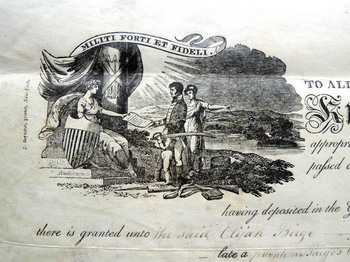
On February 21, 1815, six militia men (all of the Tennessee militia) were court-martialed and executed while under General Andrew Jackson’s command. When Jackson ran for President of the United States in 1828, the incident was used against him by those in favor of his opponent, John Quincy Adams.

This satirical print depicts editor-publisher John Binn, who published a number of handbills that accused Jackson of arbitrary executions, as well as other violent acts. The anger campaign somewhat back-fired and led to pro-Jackson handbills and cartoons, such as this one. Binn is seen here supporting a load of coffins on his back, along with the figures of Henry Clay on the left and the incumbent President John Quincy Adams on the right. Binns: “I must have an extra dose of Treasury-pap, or down go the Coffins Harry, for I feel faint already.” Clay: “Hold on Jonny Q—for I find that the people are too much for us, and I’m sinking with Jack and his Coffins!” Adams: “I’ll hang on to the Chair Harry, in spite of Coffin hand-bills Harris’s letter Panama mission or the wishes of the People.”
This led to a full-blown mud-slinging campaign on both sides. Adams was accused of misusing public funds (he bought a chessboard and a pool table). In addition to the murders, Jackson was accused of adultery (his wife’s divorce papers were not finalized before their marriage). In the end, Jackson’s popularity grew and he won the election. The final electoral vote results were: Jackson 178, Adams 83.

November 11, 2007

A Memorial to President James A. Garfield

James Meyer Jr. The Late Administration … Our National Prosperity. Education, Church & State. God Reigns and the Government at Washington Still Lives. A Memento of 1881. Dedicated to the Memory of Our Honored Dead President and His Faithful Cabinet. New York: E.G. Rideout & Co., 1881. Color lithograph. 41 x 58 cm.

The commercial designer James Meyer created a series of broadsides, such as this one, as memorials to President James A. Garfield who was assasinated in September 1881. A smaller scale print was also commissioned by E.G. Rideout & Company and included in an issue of Household Journal (also called Household Guest Magazine) that same year. This is possibly in response to the fear of a nation-wide panic over two presidents being killed in the short span of 16 years.

October 8, 2007

The Shaving Machine that Never Caught On

Unidentified British artist, Representation of the New Shaving Machine, Whereby a Number of Persons May be Done at the Same Time with Expedition Ease and Safety : Manufactured and Sold by D. Merry and Son, Birmingham. no date. Wood engraving. GA 2005.00992.

The references to the print are as follows:
A. A small barrel of soap suds;
B. Soap brush;
C. The razor;
D. The Master of the shop who directs the position of his customers faces. Here he is desiring the gentleman with the large nose to keep it more to the left, that is may be out of the way;
E. The Pinion wheel being turned round;
H. The machine is put in motion & brought to “E” and in passing along, the brush, followed by the razor, performs on the right cheek. The faces, the brush, & the razor, being then reversed, a contrary motion of the Wheel does the left cheek. And the faces being again turned to the front, the forebeard is done by the instrument at “I”, which finishes the shaving.
September 6, 2007

From Beef Bouillon to Chromolithography

The German chemist, Justus von Liebig (1803-1873), made major contributions to agricultural and organic chemistry, and is regarded as one of the greatest chemistry teachers of all time. In addition to his academic work, he invented a way of producing beef extract from carcasses, which could provide a cheap, nutritious alternative to real meat (we know this today as beef bouillon). In 1865, Liebig formed the Liebig Extract of Meat Company and, like many companies at the time, had a number of trade cards printed to advertise his business. More than 1,900 Liebig cards have been documented, containing pictures of animals, landscapes, or portraits of historical figures along with the company logo.

The graphic arts collection holds a large group of late 19th- and early 20th-century trade cards, among them one 1906 set of cards for Liebig’s company entitled Wie ein Liebig-bild entsteht. Each of the six cards depict one segment of the process of making chromolithographs, and the entire set is beautifully printed by chromolithography. Although I’m sure the Liebig extract of meat was very tasty, it is the views of chromolithographic process that make these cards of value to our collection. To see a wonderful exhibition on chromolithography, visit the Museum of Printing in Lyon, France, or their website: http://www.imprimerie.lyon.fr/imprimerie/sections/fr/expositions

Continue reading "From Beef Bouillon to Chromolithography" »