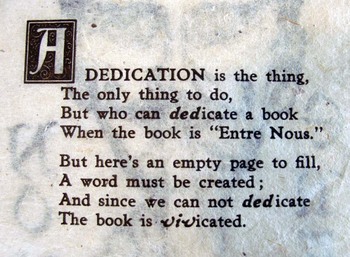
According to American Book Clubs by Adolf Growoll (Graphic Arts Z1008.A2 G8), the Cadmus Club was organized in the fall of 1895 at Galesburg, Illinois. There were no officers and its membership was restricted to twelve, in honor of the twelve months in the calendar year. The members included John Pearsons Gushing, John Huston Finley, Ben Bowles Hampton, George Appleton Lawrence, Philip Sidney Post, Jr., Lee Saunders Pratt, William Edward Simonds, Francis Hinckley Sisson, Willard S. Small, Willis E. Terry, Charles Burton Thwing, and Philip Greene Wright, all of Galesburg.
The purpose of the Club was “good fellowship among the members, the encouragement of good reading in the community, and the publication of literary products that possess a local interest.” Cadmus, the Father of Letters, became their patron saint. The Club held regular meetings, hosted lectures, and shared their own knowledge of all aspects of book-making and book history.
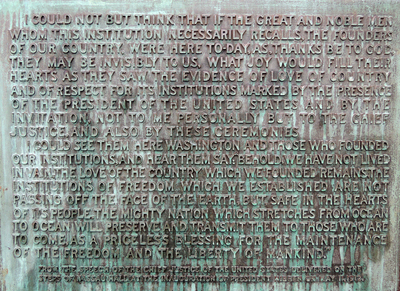
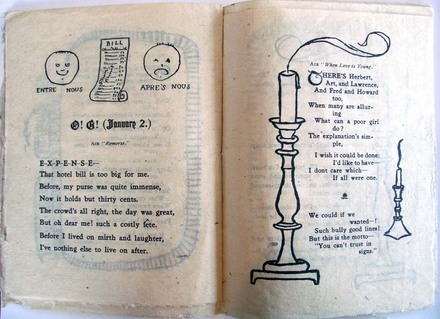
Early in 1897 the Club published Cadmus His Almanack, which was “a book by bookish men about books”. It was printed in an edition of 365 copies. Other publications by the Club include Epithalamia (1896); An Analysis of The Social Structure of a Western Town by Arthur W. Dunn (1906), and The Moral Sentiment of the People … An Address by Edgar A. Bancroft (1905) Firestone 1084.07.144.
Other men-only book clubs founded at this time include the Grolier Club in New York (1884), the Club of Odd Volumes in Boston (1886), the Rowfant Club in Cleveland (1892), the Philobiblon Club in Philadelphia (1893), and the Caxton Club of Chicago (1895). The Club of Odd Volumes and the Rowfant Club still restrict their membership to men only.
The Child’s Garden of Verses is one of Stevenson’s most popular and most often illustrated books, although Stevenson himself never approved an illustrated edition during his lifetime.
Joyce Lancaster Wilson designed the 9 full-page and 36 initial woodcuts for this 1978 edition, which was printed by her husband, Adrian Wilson, at The Press in Tuscany Alley in an edition of 500 copies. Stevenson’s text includes nine poems contained in the 1883 trial proof of Child’s Garden but excluded from subsequent published editions. The introduction is by Janet Adam Smith, editor of Stevenson’s Collected Poems.
The Wilsons’ other books include Four Kings of the Forest (1973); The Ark of Noah (1975); and The Swing (1981). Adrian and Joyce did not set out to make books. They founded a theater company in 1946, for which Adrian printed programs and posters. His interest led to a job printing with Jack Stauffacher at Greenwood Press, before opening his own studio The Press in Tuscany Alley, located at One Tuscany Alley in San Francisco, California. He researched the history of book design and in 1983, received a MacArthur Fellowship for this work. When Adrian passed away in 1988, Joyce managed the business until her own death in 1996.
Princeton’s copy is bound by the Colorado book artist Laura Wait, who studied traditional English binding with Richard Tullett at Croydon. From 1981 to 2003, Wait ran a bookbinding and conservation business, and now works on books of her own design. For more information on her work, see http://garageannexschool.com/index.php/gas/instructors/wait/in
Octavio Paz (1914-1998), Discos visuals (México: Ediciones Era, 1968). Edición de 1,000 ejemplares. Contents:, I. Juventud.—II. Pasaje.—III. Concorde.—IV. Aspa. Graphic Arts Collection (GAX), PQ7297.P285 D5
Octavio Paz (1914-1998) was an activist and a writer. During the 1960s, he served for six years as the Mexican ambassador in New Delhi before resigning in support of the student demonstrations at the 1968 Mexico City Olympics. His poem “The Shame of the Olympics” was translated by Mark Strand and published in the New York Review of Books.
That same year, Paz published the essay “Marcel Duchamp o el castillo de la pureza,” which was later translated by Donald Gardner and republished as “Marcel Duchamp, or the Castle of Purity.” His interest in concrete poetry and the role of chance in art led to experiments in graphic poetic devices. The visual artist Vicente Rojo helped Paz with the design of an edition of visual poetry discs, entitled Discos visuals.
These four overlapping cardboard circles, with openings top and bottom, can be turned in either direction revealing words and phrases written by Paz, creating poems by accidental combinations. Part scrabble and part Ouija board, these discs are now extremely rare.
Henry Van Lemmep traveled to Turkey as a missionary in 1840 and did not return to the United States for twenty years. After his retirement, he gathered all his drawings and had them printed by the lithographer Charles R. Parsons (1821-1910) and published by Anson D. F. Randolph (1820-1896) as The Oriental Album. “In terms of American color plate books, this is one of the only large projects from the 1860s, when the Civil War seems to have curtailed production of such lavish enterprises.”—William Reese
Parsons began as an apprentise to the artist George Endicott (1802-1848) at the age of twelve, learning first to draw and then to make lithographs. He became a partner at Endicott & Company, producing work for Currier & Ives, as well as Frank Leslie. At the age of forty-two, Parsons took over the art department at Harper’s on Franklin Square, where he hired the best young artists of that time. Later, Joseph Pennell wrote “the growth of real and vital American art started in the department of Mr. Parsons in Franklin Square.”
University of Rochester Memorial Art Gallery, Catalogue of an Exhibition of Portraitures of James McNeill Whistler ([Rochester, N.Y.] Priv. print., 1915). Graphic Arts: Reference Collection (GARF) ND237.W6 R6
The title page of this James McNeill Whistler (1834-1903) exhibition catalogue holds the collector’s mark, “From Whistleriana of Elmer Adler.” A further look reveals this is copy no. 1 of an edition of 130, printed on hand-made paper by the Craftsman press of Rochester, New York. Princeton’s volume is heavily extra-illustrated with mounted or tipped-in correspondence, prints, drawings, and photographs of the works in the exhibition.
The curator and major lender of the show was 34 year old Elmer Adler. In the early years of the 20th century, Adler was living in Rochester and well-known for his collecting interests. The local university art gallery tapped him several times to exhibit his holdings.
In 1915, Adler was asked to prepare an exhibition of portraits of the American artist J. M. Whistler, one part of his larger Whistleriana collection. What followed was a great deal of personal correspondence, research notes, and reproduction inquiries. When the show was complete and the catalogue printed, Adler gathered all the paperwork together and had it bound with the catalogue into one unique, extra-illustrated edition, now part of Princeton’s graphic arts collection.
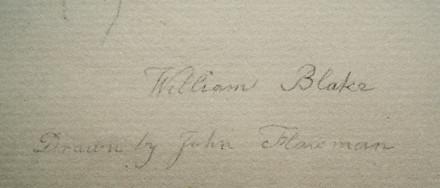
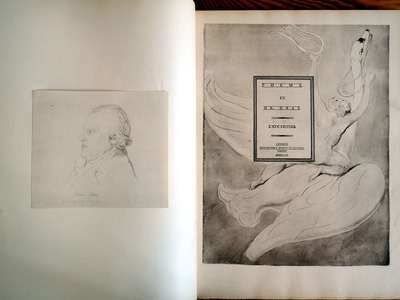
William Blake (1757-1827) had only one exhibition and received only one published review in his lifetime. We are celebrating the 200th anniversary of this 1809 show, held at 28 Broad Street (the same building where Blake was born) on the second floor above the family shop now run by his brother Robert. Six visitors paid 2s 6d to attended, including Robert Hunt, a reviewer from The Examiner, who wrote: “The poor man fancies himself a great master, having painted a few wretched pictures, blotted and blurred and very badly drawn … [Blake is] an unfortunate lunatic whose personal inoffensiveness secures him from confinement.”
For the show Blake wrote and published a Descriptive Catalogue, along with an index to the works in the exhibition. The title page reads (spelling is Blake’s) “In this Exhibition will be seen real Art, as it was left us by Raphael and Albert Durer, Michael Angelo and Julio Romano; stripped from the Ignorances of Rubens and Rembrandt, Titian and Correggio; By Wm Blake.” Happily, this ephemeral catalogue only known to most of us from notes in a history book, can now be seen in person at separate exhibitions in London and in Paris, or you can buy the reprint recently published by Tate Britain.
Blake’s purpose in mounting this poorly attended exhibition was to highlight his interpretation of Chaucer’s Canterbury Pilgrims, and prove the superiority of his work over the one exhibited in 1806 by publisher Robert Cromek and the artist Thomas Stothard. Blake had given Cromek the idea for a Chaucer print and was angry when a more commercial artist was chosen to accomplish it. Blake responded with both a tempera painting “Sir Jeffery Chaucer and the Nine and Twenty Pilgrims on their Journey to Canterbury” for the 1809 exhibition and in 1810, this engraving.
“Every age is a Canterbury Pilgrimage,” wrote Blake in his catalogue, “We all pass on, each sustaining one or other of these characters, nor can a child be born who is not one of these characters of Chaucer.”
British artist George Cruikshank is known for his caricatures, book illustrations, and oil paintings but he also designed sheet music. This song for voice and piano, based on the story of Hamlet is a good example (first and last pages shown here). The final verse goes:
So then he stabbed his liege,
The Princeton University Library holds several dozen pieces of sheet music illustrated by Cruikshank. Here are a few:
William Hone (1780-1842), Great Gobble Gobble Gobble, and Twit Twittle Twit, or Law, Versus Common Sense: being a twitting report of successive attacks on a tom tit, his stout defenses & final victory: a new song with original music ([London]: Published by William Hone, [ca.1817]) Graphic Arts Collection (GA) Cruik 1818.36
The Song refers to William Hone, and the design represents a farmyard with the different characters engaged in the trial as domestic birds, notably Lord Ellenborough as a turkey and William Hone as a tom-tit.
Jacob Beuler, Tea in the Arbour; a Comic Song written by J. Beuler, and sung with great applause by Mr. Fitzwilliam (London: B. Williams [1819?]) Graphic Arts Collection (GA) Oversize Cruik 1819.9q
Jonathan Blewitt (1782-1853), Wery Ridiculous! Or, Fickle Miss Nicholas; a new comic song, sung by Mr. Keeley, at the Theatre Royal, Covent Garden. The words by Mr. Beuler … (London: Keith, Prowse & Co. [18—]) Graphic Arts Collection (GA) Oversize Cruik 18—q
George Colman (1762-1836), Barney Buntline and Billy Bowling, or, The Advantages of Being at Sea (London: Printed and published by Clementi, Collard & Collard, between 1822 and 1830]) Graphic Arts Collection (GA) Oversize Cruik 18—.99f
Dolly and the Rat, or, The Brisket Family: a burlesque, tragic, comic, operatic parody on The maid and magpie, with songs, &c. &c. in two acts … : now performing with acclamations of applause at the Olympic Theatre (London: Printed and published by Duncombe … 1823) Graphic Arts Collection (GA) Cruik 1823.27
Mathews in America, or, The Theatrical Wanderer: a cargo of new characters, original songs, and concluding piece of the Wild goose chase, or, The inn at Baltimore (London: Printed by & for Hodgson & Co. … [1823]) Graphic Arts Collection (GA) Cruik 1823.7
Charles Dibdin (1745-1814), Songs, Naval and National, of the Late Charles Dibdin; with a memoir and addenda (London: John Murray, 1841) Graphic Arts Collection (GA) Cruik 1841.3
John J. Corell, Ye Occasional Idler. A family paper published by an association of gentlemen containing controversial and practical matter articles of intelligence and miscellany (Mt Washington, Mass.: Corell Printer, 1932). First issue August 1932. Graphic Arts (GAX) 2009- in process
Editorial
“Earnest appreciation of The Busy Idler, published here in August 1875 is our first thought and we are proud after fifty years to feel the same urge to unfurl again the banner of an “Idler”. We proclaim to the work-a-day world that our Township of Mt. Washington, the highest in the Commonwealth, still is noted for its salubrious substantiality flourishing as of yore with no debt, no paupers, no lawyers or dentists or doctors; no bank and, we really enjoy our occasional preacher.”
Also from the Corell Press, A Booke to Showe Certaine Goodlie Types for Printinge in Olde Style (Neu Amsterdam [i.e. New York]: Corell Press, 1900). “Ye Corell Press & ye Press of ye Classical School Associated Printers in ye olde style at Vniversity Place & Ninth Street in ye goodlie city of Neu Amsterdam.”—Colophon. Houghton Library, Harvard University
We have a wonderful conservation staff here at Firestone Library, dedicated to the care and preservation of our rare books and special collections. As you might imagine, these materials can present uncommon problems that need unique solutions. One of our conservation technicians Nicole Dobrowolski, working under the assistant rare books conservator Jody Beenk, designed and constructed this housing for Le Surréalisme en 1947, the catalogue for the Exposition Internationale du Surréalisme at Galerie Maeght in Paris. The book was conceived by André Breton (1896-1966) and Marcel Duchamp (1887-1968) and produced in an edition of 999 copies. It is illustrated with eighteen lithographs, five etchings, and two woodcuts by such artists as Joan Miró, Max Ernst, Hans Bellmer, and others.
The trouble with the book is its cover, featuring a foam rubber breast glued onto black velvet. The design was a collaboration between Duchamp and Enrico Donati (1909-2008), working together in New York, while the book was being printed in Paris. When asked about the project, Donati said he purchased 999 falsies from a warehouse in Brooklyn and then, the two artists painted each one by hand and assembled them on cardboard covers. They liked the idea that the readers would have to handle the breast in order to get at the text so added a sticker to the back of the volume: Prière de toucher (Please touch).
However, it was this handling, along with the instability of the foam rubber, which caused the book’s damage. Our conservators needed to design a housing that would allow researchers to view the cover without handling it while still having complete access to the volume’s text. The solution was this beautifully constructed, multi-compartment clamshell box designed to fit each individual part of the book, case, and cover.
In 1966, conceptual artist John Latham (1921-2006) had a part-time teaching job at St. Martin’s School of Art in London. One day, he went to the school library and borrowed a copy of Clement Greenberg’s Art and Culture. Latham invited his students to participate in one of his “event-based” art works by chewing pages of the book into a pulp, which was then dissolved, distilled, and the fermented liquid sealed in several glass vials. When Latham received an overdue notice from the library, he attempted to return a vial (housed in a leather case, just like the book) but the librarian rejected it as unreadable. Latham’s teaching contract was not renewed but the artwork, entitled “Chew and Spit: Art and Culture,” was purchased by the Museum of Modern Art in New York City.
http://www.moma.org/collection/object.php?object_id=81529
That same year, William Howard Adams met Latham, possibly through the Fluxus symposium at which Latham set fire to a tower of books outside the British Museum. Adams suggested Latham do something with Marshall McLuhan’s book The Mechanical Bride, and gave the artist a copy. Three years later, Latham returned the volume, altered and autographed. This “event-based” object was donated to the Princeton University Library’s graphic arts collection, where it can be seen today. Special thanks to Hannes Mandel for this discovery.
For more information on Latham, see John Albert Walker, John Latham: the Incidental Person (London: Middlesex University Press, 1995). Marquand library SA Oversize N6797.L37 W344 1995Q
http://www.tate.org.uk/britain/exhibitions/latham/default.shtm
International edible books festival, April 1 each year: http://www.books2eat.com/Books2eat/books2eat.html
“It is not unlikely that the day may arrive when the connoisseur of a future age shall turn over the pages of a book, and pause upon an aquatinta print, with the same solemn delight as those of our day are wont to do upon a woodcut of Albrecht Dürer, an etching of Hollar, or a production of any ancient engraver.”
At the time Samuel Prout (1783-1852) wrote these words, aquatint prints had taken over English book illustration, dominating it from 1790 to 1830. The leading publishers, such as Rudolph Ackermann, maintained stables of artists who turned-out watercolor drawings, which were converted to black and white aquatints by master printers, hand colored by cheaper technicians. Samuel Prout worked for Ackermann and others as a watercolorist, specializing in picturesque views for armchair travelers.
Prout’s real interest lay in the newer technique of lithography, being one of the first English artists to perfect the process. In 1817, when Ackermann wrote an article praising lithography in his Repository of the Arts, it was Prout who illustrated the text with an original lithographic print.
As the audience grew for Prout’s topographical views, so did his geographic range. Prout made frequent trips across the continent of Europe, producing multiple series of tinted lithographs with hand-colored highlights. Most prints celebrate towering Gothic cathedrals and other romantic architectural views rendered with astonishing detail. This is one such set with views from France, Switzerland, and Italy.
William Elliot Marshall, Lieutenant Colonel of Her Majesty’s Bengal Staff Corps, was an amateur ethnographer. He was introduced to the Todas people, who lived on the Nilgiri Hills in southern India, while on a furlough to Ooty. Although he did not speak their language, Marshall decided to study the small tribe in order to uncover physiognomic proof of their “primitive nature.”
His final report was published in two similar editions, one titled A Phrenologist amongst the Todas and the other Travels amongst the Todas or the Study of a Primitive Tribe in South India. Both are illustrated with 14 carbon prints from glass negatives. At least two of these plates are from the Simla photography firm Bourne & Shepherd (founded by British photographers Samuel Bourne 1834-1912 and Charles Shepherd) and printed by the Autotype Fine Art Company.
Bourne and Shepherd sold their business in 1870 and Bourne returned to England (although their stock of glass negatives remained in circulation for many years). The images of the Todas are clearly made from life and so, must have been taken a number of years before Marshall’s book was finally published in 1873.
For more information, see Kavita Philip, Civilizing Natures : Race, Resources, and Modernity in Colonial South India (New Brunswick, N.J.: Rutgers University Press, c2004). Firestone Library Q127.I4 P48 2004
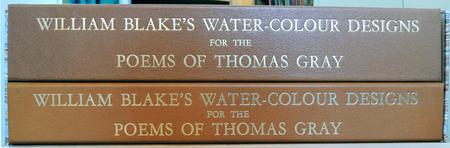
American born dentist Dr. James Leon Williams (1852-1932) moved to London in 1887. He spent summers in Stratford-on-Avon making photographs and printing the negatives as photogravures. In 1890, his first project matched these gravures with the poem “Elegy Written in a Country Churchyard” written by Thomas Gray (1716-1771). Boston publisher Joseph Knight brought it out in a small edition.
Two years later, Williams followed this with a massive folio entitled The Home and Haunts of Shakespeare published by Charles Scribner’s Sons in New York. Reproductions of 15 watercolors by 15 different American artists are completely overshadowed by Williams’ 45 pictorialist gravures. The New York Times published a review before the book was even finished, crediting Williams with reviving America’s interest in Shakespeare.
Henry Martin, class of 1948, worked as a cartoonist and illustrator for more than forty-five years, publishing in the New Yorker, Ladies’ Home Journal, Saturday Evening Post, and many other magazines. He also had a single-panel comic strip, “Good News/Bad News,” which was nationally syndicated.
Martin had his first drawing accepted at the New Yorker in April 1950 but it was another ten years before his first cartoon was accepted there. It is, in fact, these drawings or “spots,” for which Martin is best represented in the magazine. A search of the New Yorker’s cartoon database reveals 188 cartoons but our archive of Martin’s drawings shows he made over 1,000 spots. These are the tiny drawings that fill the spaces above and below the stories, articles, and columns of the magazine.
In March of 2005, New Yorker editor David Remnick changed the handling of these spots (Martin was by then retired). The earlier spots Martin drew had no running narrative of their own; no connection with politics or current events or each other. They were visual poems living gloriously apart from daily life. This changed with the magazine’s 80th anniversary issue. The spots, now created by a series of artists, have their own narrative or running theme throughout an individual issue. This week, for instance, they are all about garbage.
We include a few here in the old style.
And one cartoon for good measure.
For some other Princeton University related Henry Martin cartoons, see: http://tigernet.princeton.edu/
~ptoniana/cartoons.asp
For an extended commentary on the redesign of the New Yorker, see http://www.aiga.org/
content.cfm/redesigning-the-new-yorker
-part-one?pff=2
See also Love is a Pink Cake Graphic Arts GAX N7433.4.C67 A4 1969
Born in Rochester N.Y., Elmer Adler (1884-1962) reluctantly joined the family clothing business as advertising manager and designer. In his spare time, he collected books and taught himself the importance of great typography, paper, and binding. In 1920, the Rochester Memorial Art Gallery opened an exhibition entitled “The History of the Art of Printing,” curated by Adler primarily from his own collection (catalogue available full-text on google).
Less than two years later, Adler packed up his books and moved to New York City where he organized a printing company of his own, The Pynson Printers. As a long-time member of The Stowaways, a private club for men involved in graphic arts, he was already acquainted to many of the leading printers and publishers in New York. His friend Arthur Hays Sulzberger (1891-1968), son-in-law and heir to the publisher of The New York Times, invited Adler to move the business into the spacious new Times Annex at 229 West 43rd street. Adler’s rooms consisted of a printing shop with three presses, a library, an exhibition gallery (opened to the public in 1938), and offices elegant enough to hold afternoons teas for his colleagues. He was proud to say “in the eighteen years of its existence Pynson Printers charged more than any other shop in the country and never made a profit.”
These photographs of Adler’s rooms at 43rd Street were taken by Ralph Steiner (1899-1986). The year Adler moved to NYC, Steiner had graduated from Dartmouth and was finishing an extra year studying at the Clarence White School of Photography. Steiner got a job making photogravure plates at the Manhattan Photogravure Company, until he had enough commissions to work as a freelance advertising photographer.
It is no wonder Adler chose Steiner. Considered one of the best modern art photographers of the period, Steiner actively exhibited his work in the modern galleries and museums, including the infamous 1927 “Machine Age” exhibition at the Museum of Modern Art. Along with Louis Lozowick, Charles Sheeler, Charles Demuth, and other Precisionist, Steiner celebrated the technology of the modern world and brought fine art status to the art of the camera. Adler thought so much of Steiner’s work that he gave the artist an exhibition in the Pynson gallery in 1930.
Steiner began moving into film in the late 1920s, first with the avant-garde short H2O edited by Aaron Copeland (available through the media lab or online at http://video.aol.com/video-detail/ralph-steiner-h2o-1929/1808778335). This was followed by Redes/The Waves with Paul Strand; Pie in the Sky with Elia Kazan; and The Plow that Broke the Plains with Strand and Pare Lorentz. Two years later, Steiner and Willard Van Dyke founded American Documentary Films and collaborated on The City, shown to acclaim at the 1939 New York World’s Fair.
In 1940, Adler and Steiner both left New York; Adler for Princeton University and Steiner for Hollywood.
An aeronautical collection of more than 400 items that span the decades from the fire balloons of the seventeen-hundreds to the prop-driven planes of the nineteen thirties has been given to Princeton University.
The collection of prints, correspondence, photographs, and models was assembled by Harold Fowler McCormick during the early decades of this century. It was given to Princeton by Alexander Stillman of Chicago, a relative of the McCormick family.
Mr. McCormick, the son of Cyrus McCormick, the founder of the International Harvester Company, and a member of the Princeton Class of 1895, died in 1941.
The McCormick collection begins with a series of letters written by the 18th-century balloonist, Etienne Montgolfier, and ends with memorabilia of the collector’s own career in aviation.
Mr. McCormick’s interest in aviation stemmed form a meeting with the Wright brothers in France in the summer of 1908. He took his first flight two years later, and in 1911, helped organize the First International Aviation Meet, held at Grant Park, Ill.
In 1913, he became one of the earliest communters by air when he used a Curtiss hydroplane to travel between his home in Lake Forest, Ill, and Chicago. He named the craft Edith after his wife, the former Edith Rockefeller.
An article about the gift in the Princeton University Library Chronicle, 27, no. 3 (spring 1966): 143+ is available full text: http://libweb5.princeton.edu/visualmaterials/pulc/pulcv27n_3.pdf
More description of the entire collection can be found at http://www.princeton.edu/~ferguson/h-a-ann.html
For information on the McCormick-Romme ‘Umbrella’ airplane, see http://www.ctie.monash.edu.au/hargrave/vought.html
In 1924, Ralph Waldo Emerson Barton (1891-1931) was asked to serve as an advisory editor to Harold Ross for his new magazine The New Yorker, along with Marc Connelly, George Kaufman, Rea Irvin, Alice Duer Miller, Dorothy Parker, and Alexander Woollcott. These artists and writers were expected to contribute material to be printed anonymously, in exchange for stock, while retaining rights for reprints themselves. In one week alone, in the late 1924s, Barton completed eighty-five drawings. He was at the height of his career and one of the highest paid artists working in New York City. His drawings are, for many, synonymous with the 1920s.
Hundreds, if not thousands, of Barton’s drawings were published unsigned and few survive in their original format. Besides The New Yorker, he worked for Collier’s, The Delineator, Everybody’s magazine, Harper’s Bazaar, Hearst’s International, Judge, Leslie’s Weekly, Liberty, New York Herald Tribune, Photoplay, Puck, Satire, Shadowland, Vanity Fair, and many more. He illustrated many books, including Droll Stories by Honoré de Balzac, Gentlemen Prefer Blondes and But Gentlemen Marry Brunettes by Anita Loos, The Tattooed Countess by Carl Van Vechten, and his own God’s Country. He also made one film, at the urging of his friend Charlie Chaplin, entitled Camille: The Fate of a Coquette, starring Paul Robeson, Sinclair Lewis, George Jean Nathan, Theodore Dreiser, Sherwood Anderson, Alfred Knopf, Ethel Barrymore, Somerset Maugham, and many of his other friends.
The drawings in the Graphic Arts Division were published in Judge under the section “Judge’s Rotogravure section; The News of the Globe in Pictures by Ralph Barton”. They are not included in any published listing of Barton’s work. We can only assume they are from the 1920s.
When Barton shot himself in 1931, he left two notes. The first, titled “Obit,” was an explanation of his suicide, which he attributed to melancholia. Barton wrote, “No one thing is responsible for this and no one person—except myself. If the gossips insist on something more definite and thrilling as a reason, let them choose my pending appointment with the dentist or the fact that I happened to be painfully short of cash at the moment.” The second note was to his housekeeper, leaving her $35 and an apology that it was all he had left.
John Updike (1932-2009) selected only a few, favorite artists to write about in The New Yorker, later republished in Just Looking, and one was Ralph Barton. “Barton’s caricatures are not idignant, like Daumier’s, or frenzied, like Gerald Scarfe’s,” he wrote, “they are decoratively descriptive.” Then, Updike quoted Barton speaking of his own work, “It is not the caricaturist’s business to be penetrating; it is his job to put down the figure a man cuts before his fellows in his attempt to conceal the writhings of his soul.”
Later, in a foreword to Bruce Kellner’s biography on Barton, Updike wrote
“In the fury of his life and career Barton was careless of his work; most of his originals are lost, destroyed by him or by the engravers whose indifferent, coarsely screened reproductions are all we have left. …A lost Manhattan and a lost decade live again in the particulars of Barton’s hectic career. The life was less happy than it should have been, considering its achievement; the best of Barton’s art is like a perfect flower, wiry and fluent, blooming in the wilderness of his era’s commercial art.”
Bruce Kellner, The Last Dandy, Ralph Barton: American Artist, 1891-1931 (Columbia: University of Missouri Press, c1991) Firestone Library (F) NC139.B36 K45 1991
John Updike (1932-2009), Just Looking: Essays on Art (New York: Knopf; Distributed by Random House, 1989) Rare Books (Ex) N71 .U64 1989
This album holds a collection of wood engravings used in books published by the American Sunday School Union (ASSU) of Philadelphia. Judging from the dates which occasionally occur, the period covered is from the early 1820s to 1831. All the cuts have been carefully organized chronologically and numbered in pen. Over 70 are by George Gilbert, along with designs by Reuben S. Gilbert, Christian F. Gobrecht (1785-1844), Alexander Anderson (1775-1870), and John Warner Barber (1798-1885).
This is book one of two volumes. The second album, beginning with 1831, is held by the Library Company of Philadelphia. Special thanks go to their rare book curator Cornelia King for her research on these sample books.
The ASSU was founded in 1824 in Philadelphia, Pennsylvania to promote early literacy and spiritual development of children, teaching them to read through the use of booklets published by the Union. The ASSU continued its publication program until l960 and some time later changed its name to the American Missionary Fellowship, which is how we know them today. Although the publications were meant to be nondenominational, many of the images tell biblical stories with a conservative leaning. No. 608 shows Adam and Eve in the Garden of Eden with a note below: "Not to be used unless clothed."
This German printers’ manual describes an early 18th-century printing office. The shop, first owned by Michael Endter (fl. 1653-1662) and his family, was purchased by Johann Ernesti in 1717. As seen in the engraved frontispiece, Ernesti had two working presses. One is engraved with the dated 1440, for the beginning of printing, and the other 1730, to signify the printing of this issue of the manual. Nine men are working inside the shop setting the type, proofreading the copy, and printing the pages.
The manual begins with thirteen biographies and engraved portraits of early printers, including Laurens Janszoon Koster (ca. 1370-ca. 1440), Johannes Gutenberg (ca. 1398-1468), Johann Fust (ca. 1400-1466), Aldus Manutius (1449/1450-1515), Christophe Plantin (ca. 1520-1589), among others.
Over one hundred type specimens are introduced, including 47 Black Letter, 21 Roman, 14 Italic types, as well as Slavic, Greek, and Hebrew fonts. In addition, there are special calendar symbols, astrological signs, and engraved music fonts.
This two volume scrapbook contains 131 leaves of mounted drawings, pattern plates for the colorist, and uncolored proof impressions compiled by the Scottish naturalist William Jardine for his five volume Contributions to Ornithology. The project followed directly after his hugely popular 40 volume Naturalist Library published in 1843 (GAX 2007-0067N), which established his position in Victorian society and his reputation as an ornithologist.
Contributions was issued in parts from 1848 to 1852 and is considered the first British periodical devoted to ornithology. Jardine meant the series to be an annual updating of the latest ornithological information. It was a family project with Jardine as principal organizer, artist, and author. His daughter Catherine Strickland executed many of the plates and his other daughter Helen did some drawing. Other contributors included T.C. Eyton, John Gould, and Philip Sclater.
Andrea Pozzo (1642-1709), Rules and Examples of Perspective Proper for Painters and Architects, etc. in English and Latin: Continuing a Most Easy and Expeditious Method to Delineate in Perspective all Designs Relating to Architecture, After a New Manner Wholly Free from the Confusion of Occult Lines… (London: Printed by Benj. Motte: Sold by John Sturt …, 1707). Graphic Arts Collection (GAX) Oversize 2007-0007F
Andrea Pozzo was a remarkable Italian painter and architect of the Baroque period. Known for his frescoes using illusionist perspective, Pozzo’s most dramatic work can be found in Rome in the painting of the dome, apse, and ceiling of the Church of S. Ignazio (1685-1694). As this project was being completed, Pozzo wrote down instructions for his particular technique of perspective in a manual entitled Perspectiva pictorum et architectorum, published in 1693.
As one of the earliest manuals on perspective for artists and architects, the book went through many editions and translations, from the original Latin and Italian into French, German, English, and, Chinese. The text was noted for the clarity and the precision of its explanations of perspective, making it accessible to architects and artists alike. A cherished volume in any library, Pozzo’s book has been called “the most elaborate and expensive architectural book ever produced ….”
The first English edition came in 1707 under the title Rules and Examples of Perspective Proper…, translated by the architect John James (ca. 1672-1746) and published by Benjamin Motte Sr. (died 1710). This edition has over one hundred folio engravings along with 208 historiated initials John Sturt (1658-1730). 161 subscribers are listed on an engraved plate bound into the final book, including many prominent artists, architects, printers, businessmen, and politicians.
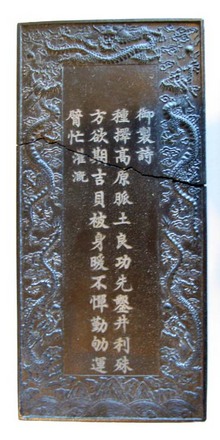
The 46th imperial ruler of Japan was Empress Kōken (孝謙天皇, Kōken Tennō) who ruled from 749-758. The eccentric queen suffered from depression and on the advice of her cousin, Fujiwara Nakamaro, finally abdicated the throne. Friends introduced her to a young, handsome Buddhist monk named Dōkyō and under his care, she made a miraculous recovery.
Kōken became devoted to this monk, brought him into the royal family as a Master of Healing, and (depending on which history you read) had an intimate relationship with him. Her cousin objected to the monk and led a rebellion. Nakamaro was killed and Kōken restored herself to the throne, this time under her father’s name, as Empress Shōtoku (称徳天皇 Shōtoku-tennō) in 764.
As a sort of penitence, she had one million dharani (Buddhist incantations or prayer charms) printed and one million tiny wood pagodas built in which to store the prayers. Completed around 770, these slips of paper—now held in collections around the world—represent some of the earliest printed texts. They are known as the Hyakumanto Dharani or one million pagoda prayers, and Princeton University library hold two.
The text consists of four Sanskrit prayers of the Mukujoko-kyo, entitled Kompon, Jishinin, Sorin and Rokudo from the Darani-kyo. Both the Scheide Library and the graphic arts division hold sections of the “short” Sōrin darani. (WHS E.1.2.1 and GAX 2009- in process).
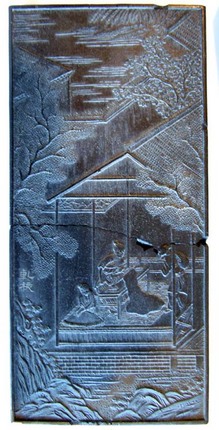
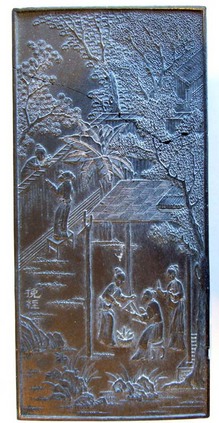
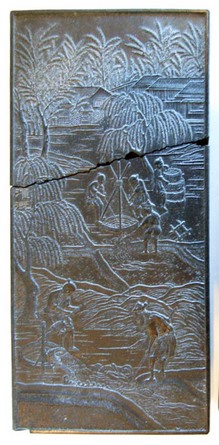
Royal printers created eight relief bronze printing plates with the prayers transliterated in Chinese characters. At least 125,000 slips of paper were printed from each plate in order to complete the run of 1,000,000 prayers. The pagodas were distributed to temples around Japan as thanksgiving for the suppression of the Rebellion of 764.
A detailed article by Mimi Hall Yiengpruksawan “One millionth of a Buddha: the Hyakumanto Dharani in the Scheide Library” from the Princeton University Library Chronicle 48 (1987): 224-38, can be read in full at: http://libweb5.princeton.edu/visualmaterials/pulc/pulcv48n_3.pdf
(*Note: this is a very large file)
Today, new models of hardware are obsolute in a matter of years. It wasn’t until five years after his death that the first edition of Vittorio Zonca’s book on new machines was printed and published by Pietro Bertelli. Fourteen years later Bertelli’s son Francesco published a second edition using the same 42 copperplate engravings.
Three plates are signed: FV (i.e. monogram Francesco Valesio, born ca. 1560); Ben W sc (i.e. Benjamin Wright); and AH (or AHI or AI; monogram). The source for Zonca’s designs is believed to be a manuscript by the Sienese painter Francesco di Giorgio Martini (1439-1501), which includes illustrations of various fifteenth-century machines.
A good article about such books: Alexander Keller, “Novo Teatro di Machine et Edificii,” Technology and Culture (1988), p. 285-87. Firestone Library (F) 9030.898.
Other volumes in Princeton libraries of the “Theater of Machines” genre:
Jacques Besson, Theatrum instrumentorum et machinarum Iacobi Bessoni Delphinatis, mathematici ingeniosissimi (Lugduni: Apud. Barth. Vincent. …, 1582). 60 engravings by Jacques Androuet du Cerceau (fl. 1549-1584) and others. Rare Books (Ex) Oversize 9008.175f
Gaspard Grollier de Servière (1677-1745), Recueil d’ouvrages curieux de mathematique et de mecanique, ou, Description du cabinet de Monsieur Grollier de Serviere (Lyon: Chez David Forey …, 1719). Engravings Étienne Joseph Daudet (1672-1730). Graphic Arts Collection (GA), 2007-3659N
Jacob Leupold (1674-1727), Theatrum machinarum… (Leipzig: Druckts Christoph Zunkel, 1724-1788). MICROFILM 03959
Agostino Ramelli (1531-ca. 1600), The Various and Ingenious Machines of Agostino Ramelli, translated from the Italian and French … by Martha Teach Gnudi (Baltimore: Johns Hopkins University Press, 1976). Rare Books (Ex) Oversize Oversize TJ144 .R313q
Johann Vogel (17th/18th century), Die moderne Baukunst (Hamburg: B. Schiller, 1708). Marquand Library (SAX): Oversize TH144 .W63 1708q
In 1866, the two candidates running for governor of Pennsylvania were Democrat Hiester Clymer (1827-1884), who ran on a white-supremacy platform, and Republican James White Geary (1819-1873), who supported Negro suffrage. This was a poster created by the Clymer campaign to discredit the Republicans.
Clymer spoke to a Philadelphia audience shortly before the election:
“Everywhere I beheld not only Democrats but Conservatives who had joined hands with us, and who had declared that the integrity of the American Union should be actually as well as in theory preserved. My fellow-citizens, the clouds of darkness are disappearing. Upon every hill-top and in every valley the watchfires of conservatism are burning brightly; and by the 9th of October I predict the glorious sun of victory will arise to shine upon the peace and happiness of our distracted country.”
The official voted was Geary: 307,274 and Clymer: 290,096. Geary served two terms as the governor of Pennsylvania from 1867 to 1873.
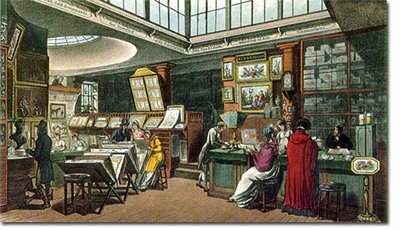
Around the end of the eighteenth century, the most successful London print shop was the Shakespeare Gallery, run by John Boydell. Their most famous project was a series of over one hundred extravagantly large engravings illustrating well-known scenes from Shakespeare’s plays. Boydell’s success led to many imitations, such as the Woodmason’s Shakespeare Gallery and the Irish Shakespeare Gallery. The most ambitious was the Poet’s Gallery, managed by Thomas Macklin.
Macklin hired the popular caricaturist Henry Bunbury to create a similar series of pen and ink and watercolor drawings to illustrate Shakespeare’s plays. Bunbury chose comic, often obscure scenes, emphasizing the outlandish and the ridiculous. His designs were engraved over five year by Francesco Bartolozzi (1727-1815), Peltro William Tomkins (1760-1840), Thomas Cheeseman (active 1780-1790), and Robert Mitchell Meadows (died 1812). The artists only finished twenty-two prints, which in the end was no real competition for Boydell.
See also Andrew White Tuer (1838-1900), Bartolozzi and his works: a biographical and descriptive account of the life and career of Francesco Bartolozzi, R.A. (illustrated): with some observations on the present demand for and value of his prints …: together with a list of upwards of 2,000 … of the great engraver’s works (London: Field & Tuer; New York: Scribner & Welford, [1882]) Graphic Arts Collection (GA) Oversize Rowlandson 953.2q
William Hogarth (1697-1764) created this print series “in the hopes of preventing in some degree that cruel treatment of poor Animals which makes the streets of London more disagreeable to the human mind, than any thing what ever….”
The first plate finds Tom Nero (center) as a young boy torchering a dog.
Text transcribed:
In the second plate, Nero is a young man working as a coach driver. He has been mistreating his horse, which now has a broken leg. All around them are examples of cruelty to animals on the public streets of London.
In Hogarth’s third plate, Nero has become a highway robber. He is being apprehended for killing Ann Gill, his pregnant lover.
In the final scene, Nero has been hanged and his body is being dissected in the Cutlerian theatre near Newgate prison. The public was invited to view these gruesome dissections and this scene reflects back on the first plate, where the young boys staged their own theater of gruesome operations.
Paul Colin created posters and stage designs for theaters throughout Paris in the 1920s. His favorite was the Théâtre des Champs-Élysées, where La Revue Nègre performed led by the dancer Josephine Baker (1906-1975). In 1927, Colin was inspired by the Revue to create a portfolio entitled Le Tumulte Noir or The Black Craze. He drew his designs directly onto lithographic stones, which were printed in black, brown, or gray inks and then, hand-colored by the master of pochoir, Jean Saudé. The images include many figures of contemporary French popular culture, such as Maurice Chevalier, Ida Rubinstein, the film actress Jane Marnac, the theatrical caricaturist Sem, and others.
For more information, see the introduction by Henry Louis Gates, Jr., and Karen C.C. Dalton in Josephine Baker and La revue nègre (1998). Marquand Library Oversize NE2349.5.C66 A4 1998q
Ariwara Narihira (825-880), 伊勢物語 (Ise monogatari or Tales of Ise) [S.l. : s.n., 慶長戊申 i.e. 1608?]. Second edition. Graphic Arts (GAX) 2008- in process.
“In 1593, in the wake of the Japanese invasion of Korea, a printing press with movable type was sent from Korea as a present for Emperor Go-Yōzei. …The printing press may have been offered to the emperor more as a curiosity than as a practical invention, but that same year he commanded that it be used to print an edition of the Confucian Kobun Kokyo (Classic of Filial Piety). Four years later, in 1597, a Japanese version of the Korean printing press was built with wooden instead of metal type, probably because of the difficulties of casting; and in 1599 this press was used to print the first part of the Nihon Shoki (Chronicles of Japan).
By this time printing was developing into the hobby of the rich … and many editions began to appear. These editions, associated with Emperors Go-Yōzei and Go-Mizunoo and with such figures as Toyotomi Hideyoshi and Tokugawa Ieyasu, were intended for presentation and not for sale. The finest printed books of the time were designed by the artist Hon’ami Kōetsu (1558-1637)… [and] the masterpiece of this press was the illustrated edition of Ise Monogatari (Tales of Ise) published in 1608.”
from Donald Keene, World Within Walls: Japanese Literature of the Pre-Modern Era, 1600-1867 (New York: Holt, Rinehart and Winston, c1976) East Asian Library (Gest): Western, PL726.35.K4
Complete digital book: http://digitalgallery.nypl.org/
Complete text, see: http://etext.lib.virginia.edu/japanese/
Midway in the journey of our life
I came to myself in a dark wood,
for the straight way was lost.
Ah, how hard it is to tell
the nature of that wood, savage, dense and harsh —
the very thought of it renews my fear!
above:
It is so bitter death is hardly more so.
But to set forth the good I found
I will recount the other things I saw.
How I came there I cannot really tell,
I was so full of sleep
when I forsook the one true way.
The Princeton Dante Project: http://etcweb.princeton.edu/dante/index.html
On Thursday, November 11, 1971, The Daily Princetonian ran a story about an exhibition of candy wrappers at the Firestone Library. “As a boy,” the story begins, “Ephraim di Kahble, an elusive member of the Class of 1939, had a tremendous sweet tooth.” The reporter goes on to recount how Kahble’s father had encouraged the young boy to write to candy companies and collect their wrappers. A sizable collection resulted, despite an incident during World War II in which Kahble was almost court-martialed for impersonating a candy inspector and stealing chocolate from European factories. This collection was ultimately donated to the graphic arts collection.
In fact, Kahble was a fictitious student, whose exploits turn up in a variety of printed stories and Princeton records. He was the invention of Frederick E. Fox, class of 1939, who did indeed write to candy companies as a Princeton freshman and gathered a collection of wrappers.
The letterhead on the stationary from the companies who responded to Fox is almost as intriguing as the candy wrappers themselves. Happily, many of these letters have been preserved along with company ephemera in GC149: Printed Ephemera, Candy
In 1904, the Grolier Club in New York City published a sumptuous, limited edition catalogue in honor of the centenary of George Washington’s death. The book features not only a complete listing of Washington portrait engravings but also 31 original mezzotint and photogravure prints.
Frank O. Briggs, of Trenton, N.J. purchased a copy, which eventually made it to the graphic arts division at Princeton University. Inside the front cover are a number of sheets of cream wove paper with the watermark of George Washington.
The Miliani Mill, Fabriano, Italy, created this watermark of Washington in recognition of the bicentennial celebration of his birth in 1932. Later, the Graphic Arts collection used it as a keepsake for their friends. The portrait is after a bust of Washington done by the sculptor Jean-Antoine Houdon, who visited Mount Vernon in 1785. Houdon’s profile is said to have been one of Washington’s favorites.
Man Ray painted his first letter “Y” in 1923 as an homage to his friend Yves Tanguy. Even earlier, he contemplated creating an alphabet of Rayographs (photograms) but gave up the idea as too lengthy.
He eventually realized his project in 1947 in two entirely different versions. Alphabet was published by the Copley Galleries, Beverly Hills in 1948 and Analphabet was presented to a California collector around the same time. This second series of letters was published by Timothy Baum for Nadada Edition in 1974.
In 1970, at the age of 80, Man Ray completed a French edition, entitled Alphabets pour Adultes, seen here. The artist wrote, “A letter always suggests a word, and a word always suggests a book. There are words that are for every day use and there are words reserved for the more special occasions, for poetry … To make a new alphabet of the discarded props of a conversation can lead only to fresh discoveries in language.”
The graphic arts division has a number of postcard collections, this one includes 2,393 postcards of Cuba. Most are collotypes and half-tone images, but a few have original photographs or prints. The collection now has a complete finding aid, thanks to the wonderful processing of Kate Carroll, class of 2009. Here’s a summary:
Box 1 Havana: homes, buildings, parks, plazas and surroundings.
Box 2 Havana: Views of the bay, harbors, main monuments, ships, fortresses, ramparts, aerial views and streets.
Box 3 Havana: Churches, monuments, cemetery, streets. Includes four famous postcards series, tourism ads, Bacardi and beer ads and patriotic propaganda related to the US and Cuba.
Box 4 Havana: Hotels, beaches, clubs, casinos, zoo, cabarets, restaurants, musicians, carnival, hippodrome, theatre, bull fights and cockfights.
Box 5 Life in Cuba and the country: Sugar cane industry, tobacco industry, homes, palms, rivers, transportation, soldiers, families, children, typical scenes, carriages, shops and street sellers.
Box 6 Cities from the interior: Pinar del Rio, Isla de Pinos, Matanzas, Cardenas, Varadero, Santa Clara, Cienfuegos, Camaguey, etc.
Box 7 Oriente: Santiago de Cuba, Guantanamo and other regions.
Box 8 Oversize.
Robert Burford (1791-1861), A Miscellaneous Collection of Panoramas and Others (London, 1821-32). 14 v. in 1. Graphic Arts division (GAX) in process
Panoramic displays, offering 360 degree views of exotic scenes, were enormously popular in the 1800s. Some were cleverly painted and lit to give the illusion of day turning into night. Some showed important historical events, such as battle scenes.
The panorama was invented about 1787 by the Scottish-Irish artist Robert Barker (1739-1806). From 1794 to 1863, his family ran an exhibition theater on Leicester Square, where the largest views were about 30 feet high by 90 feet across. Barker’s success led to many others such theaters throughout Europe and the United States.
Barker applied for a patent for his invention, which he called La nature à coup d’oeil, for “representing natural objects … designed so as to make observers, on whatever situation he may wish they should imagine themselves, feel as if really on the very spot.”
For more information, see the CUNY website: http://newman.baruch.cuny.edu/digital/2003/panorama/new_001.htm
Contents:
No.1, Guide to the model of the battle of Waterloo.
No.2, A descriptive account of a series of pictures, representing some of the most important battles fought by the French armies in Egypt, Italy, Germany and Spain between the years 1792 and 1812.
No.3, Description of the Egyptian tomb, discovered by G.Belzoni.
No.4, Description du mausolée du maréchal Comte de Saxe, érigé dans l’Église de St.-Thomas, à Strasbourg.
No.5, Description of a view of the city and lake of Geneva, and surrounding country.
No.6, Description of a view of the town of Sydney, New South Wales; the harbour of Port Jackson and surrounding country.
No.7, Description of a view of the city of Florence, and the surrounding country.
No.8, Descriptive catalogue of the gallery of Europe & America.
No.9, Descriptive catalogue of the gallery of Asia & Africa.
No.10, Descriptive catalogue of the cosmorama panoramic exhibition, 209, Regent Street.
No.11, Description of the island and city of Corfu
No.12, Catalogue of the exhibition, called Modern Mexico.
No.13, Description of a view of the city of Mexico, and surrounding country.
No.14, Description of a view of the city of Edinburgh, and surrounding country.
The cover and frontispiece to this magic book were designed by Abel Bowen (1790-1850), a Boston printer. As an engraver he was self-taught and worked both in copper and on wood. A scrap of autobiography written by Bowen can be found in William H. Whitmore’s “Abel Bowen” in The Collections of the Bostonian Society, Boston 1887.Graphic Arts division (GAX) Hamilton 463
Bowen’s long career began at the age of 15 and he claimed he was the first to attempt a commercial wood engraving business in Boston. Nathaniel Dearborn made the same claim but it seems clear from Mr. Whitmore’s monograph that Bowen is entitled to be ranked as the first Boston wood engraver. Princeton owns 113 books with illustrations by Bowen, held in the Sinclair Hamilton Collection of American Illustrated Books from 1670 to 1870.
Posted for Professor Arcadio Díaz-Quiñones, “Topics in Latin American Literature and Ideology: Islands and Literature …”
Alexandre Olivier Exquemelin, De Americaensche zee-roovers: behelsende een pertinente en waerachtige beschrijving van alle de voornaemste roveryen, en onmenschelijcke wreedheden, die de Engelse en Franse rovers, tegens de Spanjaerden in America, gepleeght hebben… First edition (Amsterdam: Jan ten Hoorn, boeckverkoper, over ‘t Oude Heeren Logement, 1678). Rare Books: Kane Collection (ExKa) Americana 1678 Exquemelin
Translated into Spanish in 1681, into English in 1684, and into French in 1686. The work went through numerous editions in its various versions and formed the foundation for many of the histories and romances of the buccaneers published during the seventeenth and eighteenth centuries. Digital copy: http://www.loc.gov/flash/pagebypage/buccaneers/index.html
Alexandre Olivier Exquemelin, Piratas de la America, y luz à la defensa de las costas de Indias Occidentales … / traducido de la lengua flamenca en española, por el Dor. Alonso de Buena-Maison, español, medico practico en la amplissima y magnifica ciudad de Amsterdam (Impresso en Colonia Agrippina [Cologne]: en casa de Lorenzo Struickman, 1681). Rare Books: Kane Collection (ExKa), Americana 1681 Exquemelin
Alexandre Olivier Exquemelin, Bucaniers of America, or, A true account of the most remarkable assaults committed of late years upon the coasts of the West-Indies, by bucaniers of Jamaica and Tortuga, both English and French. Wherein are contained more especially, the unparrallel’d exploits of Sir Henry Morgan, our English Jamaican hero, who sack’d Puerto Velo, burnt Panama, &c. Written originally in Dutch, by John Esquemeling, one of the bucaniers, who was present at those tragedies; and thence translated into Spanish, by Alonso de Bonne-Maison … Now faithfully rendered into English (London: Printed for W. Crooke, at the Green Dragon without Temple-bar, 1684-1685). “This copy consists of the first English edition & the second vol. of the second English edition, the latter containing matter not in the first.” Rare Books: Kane Collection (ExKa) Americana 1684b Exquemelin
Alexandre Olivier Exquemelin, The history of the bucaniers: being an impartial relation of all the battels, sieges, and other most eminent assaults committed for several years upon the coasts of the West-Indies by the pirates of Jamaica and Tortuga… (London: Printed for Tho. Malthus, 1684). Rare Books: Kane Collection (ExKa) Americana 1684 Exquemelin
Alexandre Olivier Exquemelin, Piratas de la América, y luz a la defensa de las costas de Indias Occidentales: en que se tratan las cosas notables de los viages, descripcion de las islas Española, Tortuga, Jamayca, de sus frutos y producciones, política de sus habitantes, guerras y encuentros entre Españoles y Franceses, origen de los piratas, y su modo de vivir, la toma é incendio de la ciudad de Panamá, invasion de varias plazas de la América por los robadores franceses, Lolonois y Morgan (Madrid: Ramón Ruiz, 1793). Rare Books: Kane Collection (ExKa) Americana 1793 Exquemelin
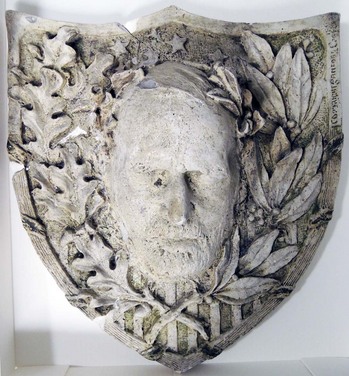
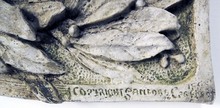
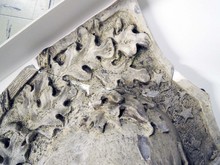
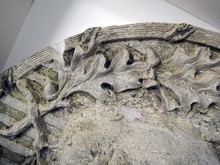
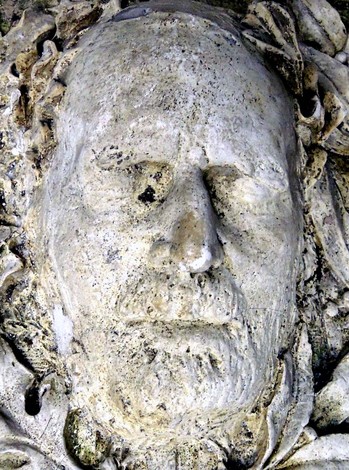
Laurence Hutton was the dramatic critic for the New York Evening Mail from 1872 to 1874 and literary editor of Harper’s Magazine from 1886 to 1898. In 1897, he received the degree of A.M. from Princeton and presented the University with “a collection of over sixty death masks of distinguished men.”
“Mr. Hutton has been at infinite pains to make this collection as complete as possible,” reported The New York Times, “It represents the researches [sic] and untiring labor of over thirty years.” Hutton traveled around the world to collect these plaster casts, looking in obscure curiosity shops and major museums, where many curators granted Hutton permission to have copies made from their masks.
A complete set of digital images of these masks can be found at:
http://libweb.princeton.edu/libraries
/firestone/rbsc/aids/C0770/
The collection began almost by accident while shopping in New York City. Hutton was interrupted by a ragged boy trying to sell a cast of a human face, unquestionably that of Benjamin Franklin. He purchased it for two shillings and offered another quarter if the boy showed him where he found it. In a couple of ash-barrels on Second Street were dozens of casts of Washington, Sheridan, Cromwell, and many others, which Hutton carted home.
Some years later, Hutton read an illustrated volume of lectures by the well-known phrenologist George Combe and was surprised to see reproductions of many of these same masks. Combe had come to the United States in 1838-39 and Hutton concluded that his collection had either been left behind or given to someone and then, years later, was discarded on the Lower East Side.
Hutton went to great lengths to gather historical documentation on his masks and wrote about the collection in articles, lectures, and a book entitled Portraits in Plaster. In his Talks in a Library he confirmed that, “with the exception of the cast of Shakespeare, the only cast in the collection which is not from nature is that of Elizabeth of England; and these two are preserved only because they are both supposed and believed to have been based upon masks from death.”
When Hutton died of pneumonia in 1904, his obituary in The New York Times, remarked once again on his death mask collection but did not mention whether provisions had been made to take a death mask of Hutton himself.
For a bibliography on Hutton and his collection, continue below.
In 1843, lithographer Napoleon Sarony (1821-1896) left the studio of Nathaniel Currier (1813-1888) to establish his own printing firm in New York City. From 1845 to 1857, he formed a partnership with Henry B. Major and together they found success printing and publishing fine art prints, maps, sheet music and much more. While the graphic arts collection does not hold the complete music sheets, we do have a collection of the lithographed covers to sheet music with Western American themes.
One is the Fort Harrison March, composed by Carl Heinrich Weber (1819-1892) and published by Balmer & Weber in St. Louis in 1848. The tinted lithograph with additional hand coloring depicts a scene from the 1812 battle of Fort Harrison. In preparation for an attach on Native Americans in Vigo County, Indiana, General William Henry Harrison ordered construction of a fort to protect the treaty line with Indian Territory. Later, when Indian forces attached Fort Harrison, Captain Zachary Taylor held them off until reinforcements arrived. History books list the battle of Fort Harrison as the first land victory of the United States during the War of 1812.
Also shown here is the lithographed cover for Death of Minnehaha composed by Charles Crozat Converse (1832-1918), with words from Henry Wadsworth Longfellow’s “New Poem, Hiawatha” and published by Oliver Ditson & Company in Boston around 1856. The hand colored lithograph is by John Henry Bufford (1810-1870).
Between 1846 and 1847, the United States was at war with Mexico. Artists of the extremely influential American Art Union (AAU) created a number of prints, paintings, and maps showing the events and characters involved in the war to satisfy an engaged public.
One of the most successful was the oil painting by Richard Caton Woodville (1825-1955) entitled War News from Mexico, which shows a dapper-looking man reading the news aloud to a small crowd on the porch of the American Hotel. Painted in 1848 while Woodville was an art student in Düsseldorf, the canvas was exhibited at the AAU’s gallery in 1849 and reproduced in the AAU Bulletin, which circulated to its nearly 19,000 members.
George Austen, the AAU treasurer, purchased the painting and commissioned Alfred Jones (1819-1900) to create two color engravings of the scene—a large folio and the other a small print—which were published by the AAU in 1851. Princeton owns copies of both prints.
Note: This work is by the American artist Woodville who died at the age of 30, not to be confused with the British artist of the same name (1856-1927) who created many war and genre scenes for the Illustrated London News.
Books written in shorthand began to appear as early as the sixteenth century. But it was the eighteenth-century invention of lithography that provided the ideal medium for their printing, along with books of music and those written in some non-Latin scripts. More than any other individual, it was Sir Isaac Pitman (1813-1897) who was responsible for the writing and distribution of these lithographic books.
Pitman was a great proponent of alternative writing systems. His plan for phonic writing or phonography has dominated the shorthand world since 1830s, while his design for simplified spelling, which he called phonotype, never caught on — unless you count twenty-first-century texting. If Pitman had his way, we would have dropped the k, q, and x long ago.
He was a zealot for these writing systems and published dozens of books and journals promoting them, including the Fonographic Korrespondent seen here. Over the years, the journal was also called the Phonographic Correspondent, Fonografic Corispondunt, Fonografic Corispondent and Riportur, Fonografic Corespondent and Reporter, and many other variations.
The text was written by hand on transfer paper, which could be pressed onto a lithographic stone surface alleviating the need to write the text backwards. Some transfers were taken from letterpress type, border elements, and signatures, giving the title pages the look of letterpress books, although they were always printed lithographically.
For more information on fonography, see Michael Twyman, Early Lithographed Books: a study of the design in the and production of improper books in age of the hand press (London: Farrand Press & Private Libraries Association, 1990). Graphic Arts Collection (GA), NE2295 .T99
The Elm Press, founded by Mark in 1986, is devoted to publishing fine press artists’ books. Most featured Mark’s delicate lithographs although she was an adventurous bookmaker who explored many printing techniques and technologies. She had a special affinity to the relationship between word and image, and knew how to complement a poem rather than just illustrate it.
She wrote, “I imagine the book as a continuous picture plane on which word, image, sequence and structure all reinforce each other. What interests me most is the relationship between word and image. I plan no hierarchy of them. An artist’s book is a unique form of visual disclosure. It must be slowly savored. It should be held in the hand and carefully considered. Only then are its contents fully revealed.”
For more information, see: http://www.theelmpress.com/index.html
Anything ends
In its beginning,
The circles turning
Slowly, so slowly,
Quern of the beat
Of the downrunning heart.
The sunlight fell like diamonds
But did not slacken
Remembrance’s forewarning
Of cold and dark to come,
The journey retaken
Without end,
Without end.
—from IV. “Ignis” in Journey to a Known Place (1961) Graphic Arts division GAX Z232.M54C37 1961. Gift of Daniel and Mary Jane Woodward.
From 1868 to 1871, four Tammany Hall Democrats ran the government of New York City: William Marcy Tweed, alias “Big Bill” or “Boss Tweed”; Peter Barr Sweeny, also called “Brains”; Richard B. Connolly, known as “Slippery Dick”; and A. Oakey Hall, referred to as “O.K. Haul”. It has been estimated that these men stole from $75,000,000 to $200,000,000 from the NYC treasury.
The German-American cartoonist Thomas Nast (1840-1902) referred to Tweed and Sweeny as Tweedledee and Sweedledum, as he waged a campaign to remove the corrupt officials from power through his caricatures in Harper’s Weekly and The New York Times.
Nast’s assault was so sharp and successful that Tweed presented a bill to the State Legislature as an official protest against “an artist encouraged to send forth in a paper that calls itself a “Journal of Civilization” pictures vulgar and blasphemous, for the purpose of arousing the prejudices of the community against a wrong which exists only in their imagination.” There is no doubt that Assembly Bill No. 169 of March 31, 1870, was directed at the “Nast-y artist of Harper’s Hell Weekly—a Journal of Devilization.”
When this did little to stop Nast, Tweed gave orders to his Board of Education to reject all Harper bids for schoolbooks and to throw out those already purchased. More than $50,000 of public property was destroyed and replaced by books from the New York Printing Company (controlled by Tammany Hall).
Harper’s continued publishing Nast’s political cartoons, although Nast moved his family to New Jersey after receiving death threats.
Tweed and his compatriots were finally removed from office in November 1871. One of several celebratory cartoons drawn by Nast depicts Tweed as Marius among the ruins of Carthage, seen above. While Tweed is defeated, the New York Treasury is left demolished and empty.
For more details, see Albert Bigelow Paine, Th. Nast: His Period and His Pictures (New York: Macmillan Company, 1904) Firestone NE 539.N18 P16
A man named Rigdum Funnidos is given credit for a number of the issues of the Comic Almanack, but who was he? Brewer’s Dictionary of Phrase and Fable lists Funnidos as “A quick, active, intrepid little fellow, … full of fun and merriment, … all over quaintness and humorous mimicry, ….” Sir Walter Scott gave the name to his publisher, John Ballantyne, after a character in Henry Cary’s, Chrononhotonthologos (Robert Taylor collection 19th-305).
George Cruikshank (1792-1878) also used the name rather than credit himself for the editing (compiling?) of Comic Almanack from 1935-48, when Horace Mayhew took over. Cruikshank served as the principle illustrator for most of the annual’s nineteen years, creating issues “adorned with a dozen of ‘Righte Merrie’ cuts, pertaining to the months, and an hieroglyphic.” Text authors included William Thackeray (1811-1863), Albert Smith, Gilbert Becket, (1811-1856) and others.
Thackeray wrote a commentary entitled “George Cruikshank,” for the Westminster Review, June 1840, which spoke about their project:
Twelve admirable plates, furnished yearly to that facetious little publication, the Comic Almanac [sic], have gained for it a sale, as we hear, of nearly twenty thousand copies. The idea of the work was novel; there was, in the first number especially, a great deal of comic power, and Cruikshank’s designs were so admirable that the Almanac at once became a vast favorite with the public, and has so remained ever since.
…In the earlier numbers of the Comic Almanac all the manners and customs of Londoners that would afford food for fun were noted down; and if during the last two years the mysterious personage who, under the title of “Rigdum Funnidos,” compiles this ephemeris, has been compelled to resort to romantic tales, we must suppose that he did so because the great metropolis was exhausted, and it was necessary to discover new worlds in the cloud-land of fancy.
…it is very difficult to find new terms of praise, as find them one must, when reviewing Mr. Cruikshank’s publications, and more difficult still (as the reader of this notice will no doubt have perceived for himself long since) to translate his design into words, and go to the printer’s box for a description of all that fun and humor which the artist can produce by a few skilful turns of his needle. …thank heaven, Cruikshank’s humor is so good and benevolent that any man must love it, and on this score we may speak as well as another.
More digital images of the Comic Almanack are at http://www.uflib.ufl.edu/ufdc/?g=all&b=UF00078634
If you want to enlarge one of these images, you can just click on the thumbnail and a larger image will appear. In the seventeenth century, for the first time, artists had a device, called the pantograph, to help them mechanically copy a design on an enlarged or reduced scale.
Christopher Scheiner, a German Jesuit, was responsible for designing and building the first pantograph in 1603. An illustration of the device can be seen in his 1630 book, Rosa ursina Sive Sol, along with other instruments he invented including a refracting telescope. The following year, Scheiner published a manual on the construction and use of the device, entitled Pantographice, seen here.
There are several types of pantographs, each consisting of parallel and intersecting rods. Scheiner’s frontispiece engraving depicts it being used both horizontal and vertical. To make your own pantograph, see http://users.hubwest.com/hubert/mrscience/pantograph.html
The American artist Arthur Burdett Frost produced illustrations for nearly 100 books from 1876 until his death in 1928. He worked alongside Howard Pyle and Frederic Remington for the leading publishers of the day, including Harper & Brothers and Scribner’s. While he made his living primarily as a commercial artist, Frost studied painting with Thomas Eakins and William Merritt Chase at the Pennsylvania Academy of the Fine Art and lived for awhile in Paris, hoping for success as a “serious painter” [his words]. Although he never gave up painting entirely, in 1914 Frost and his family returned to the United States and he resumed work as an illustrator.
In 1917, Frost wrote “… am going to take up caricaturing with a view of getting into the syndicate job. If it all goes at all it means better pay that I could get in any other way. Caricature is with me a separate thing from my life. I can draw absurd things that amuse others but do not affect me. I am wretchedly unhappy and always will be but I can make “comic” pictures just as I always did.”
One of the commissions he recieved that year was to illustrate a short story by the mystery writer Hugh Wiley. Wiley is best known today for his character James Lee Wong, who was the focus of a series of stories in Collier’s magazine and then, in movies as played by Boris Karloff. Wiley’s short story “On the Altar of Hunger,” illustrated by Frost, appeared in the August issue of Scribner’s Magazine, and later, unillustrated, in 50 Best American Short Stories 1915-1939 edited by Edward O’Brien (New York: Literary Guild of America [1939]) Firestone Library (F) 3588.684.2
Page 177 of Scribner’s shows the published version of Frost’s ink wash drawing, now in the collection of graphic arts. The choice of blue is interesting, since in the 20th century, magazine illustrators made corrections in blue, which could then be screened out of the published image. Here those elements are included as an added tone.
Thomas Rowlandson was one of several prolific artists who sold satirical designs to the London publisher Thomas Tegg (176-1846). Tegg's bookshop was well-placed at 111 Cheapside--known for its cheap reproductions of remaindered or out-of-copyright books. He often reissued the same plate over several years, each time hand colored by whatever colorist was on staff at the time. We often collect several issues of the same image, to compare the result of different coloring.
Rowlandson's print is one of many commenting on the underground distribution of gin in London after the Gin Act of 1751, which prohibited distillers from selling to unlicensed merchants and charged high fees to those with a license. This led to hundreds of illegal stills across the city. The alcohol was often flavored with turpentine . . . or anything else that was handy.
These operations closed in 1830, when the Duke of Wellington's administration passed the Sale of Beer Act, removing all taxes on beer and allowing retail sale of beer on payment of a two-guinea fee.
Although it may be difficult to tell from a thumbnail, this is a mammoth plate (23 x 17 inch) collodion on glass positive photograph of Grover Cleveland’s 1885 inauguration as the twenty-second president of the United States. The spectacular image represents the end of one era and the beginning of another for American photography.
Mammoth glass plates had been used with great success since the 1860s when Carleton Watkins and other members of the government expeditions carried them through the West. Commercial photographers in the East, such as Mathew Brady, also used mammoth plates to make celebrity portraits on a grand scale.
However, for most photographers, glass plates were heavy, difficult to handle, and easily broken. Even with the development of an emulsion-coating machine in 1879, there was a demand for better, cheaper materials to support the light-sensitive chemistry. In 1885, George Eastman introduced his Eastman American Film and in 1888, offered a camera that held a pre-coated roll of his flexible film. Now anyone who could afford to buy the camera could make photographs.
It is not surprising to find this seminal photograph at Princeton. When he retired from office, Cleveland chose Princeton, New Jersey, for his home and served for a time as a trustee of Princeton University. When he died in 1907, he was buried in the Princeton cemetery of the Nassau Presbyterian Church.
Cleveland’s papers are available in the Grover Cleveland collection, 1860-1907 (Manuscripts Collection MSS C0237). In addition, the books from his personal library are now part of Princeton’s rare books collections, including his copy of the 1885 Message from the President of the United States to the two Houses of Congress at the commencement of the first session of the forty-ninth Congress (Rare Books (Ex) CL 1090.24.9).
For more information on Cleveland’s connections with Princeton, see http://etcweb.princeton.edu/CampusWWW/Companion/cleveland_grover.html
Toulouse-Lautrec contributed two designs for covers to L’estampe originale, which offered an original lithograph to its subscribers three times each year between 1893 and 1895. This lithograph is the first. It shows dancer and singer Jane Avril studying a fresh impression at the Paris lithography studio of Édouard Ancourt. The master printmaker at the press is Père Cotelle
Although only around 100 copies of this print were made, it has become one of the iconic images of the 1890s. Indeed, Toulouse-Lautrec’s colorful lithographic posters are almost synonymous with the Belle Époque. Inspired by Japanese woodblock prints, note the flatness of the design, a strong diagonal, and the large areas of muted color.
This unrecorded first edition pattern book contains 17 fullpage and 96 vignette woodcuts on 34 leaves of plates. Latomus catered to an international clientele of women and girls, offering both favorite designs and the latest in needlework patterns. An elaborate opening woodcut cartouche with contemporary hand coloring was commissioned by Latomus specifically for this edition. The design features Virtues and Senses in the four corners: Labor, Diligence, Sight, Touch. In the central scene, six women can be seen weaving, measuring, and cutting fabric, while also attending to a wealthy customer and his page.
For more information on this and other of model books, see Arthur Lotz, Bibliographie der modelbücher (Leipzig: K. W. Hiersemann, 1933). Marquand Lib.NK8804 .L9
This miniature courtesy book was pulled recently for a researcher. First published in 1695 by Lady Mary Cressy, under the title The Whole Duty of a Woman; or, A Guide to the Female Sex, from the Age of Sixteen to Sixty, &c. For a new edition in 1753, the author was simply listed as “A Lady.” In fact, this author was William Kenrick (1725?-1779), English novelist, playwright, and founder of the book review digest The London Review. Kenrick was described by Paul Fussell in PMLA (June 1951) as “one of London’s most despised, drunken, and morally degenerate hack writers in the later eighteenth century.”
In this tiny volume, Kenrick assumes the persona of a fallen woman, now reformed, who wants to persuade other women to live a life of virtue. Chapters include Curiosity, Reflection, Vanity, Knowledge, Reputation, Applause, Censure, Insinuation, Affectation, Modesty, Chastity, Complacence, Acquaintance, Friendship, Elegance, Frugality, Employment, Virginity, Marriage, Education, Authority, Widowhood, and Religion.
While courtesy books are, in general, books of etiquette for young women, they often went further by offering a philosophy of life, a code of principles, and ethical behavior by which to live. Kenrick was certainly having a good laugh as this volume was reprinted in over 20 editions.
Winslow Homer (1836-1910) was twenty-six before he seriously took up painting and nearly forty before he depended on it for a living. How did he pay the rent before this? His early career was as an illustrator, designing more than 160 illustrations for books and literary journals.
Homer apprenticed with the Boston lithographer, John Henry Bufford, until his twenty-first birthday. For the next two years, working independently, he designed at least forty-two small drawings for thirteen different books, all juveniles. One of these was the Eventful History of Three Little Mice. Homer created seventeen illustrations for the book, which was released in April 1858, priced at 12 ½ cents as printed or double that if the illustrations were hand-colored.This project was something of a rip-off of the Remarkable History of Five Little Pigs, engraved by the Dalziel Brothers.
Homer’s frontispiece shows the climax of the story, the cutting of the mice’s tails—talk about giving away the ending. He did not draw the cover, which may explain the difference in the title.
This is how the production was often handled: For each drawing, a blank wood block was sent to Homer’s studio. The block usually consisted of a number of closely fitted pieces of boxwood bolted together. Homer drew directly on the block’s whitened surface and returned it to the publisher (later he was allowed to submit a drawing on paper). The master wood engraver cut the lines that ran across the joints. Then, the blocks were separated and assistants would engrave the different parts of the design. The blocks were then reassembled and electrotyped, to create a metal plate for printing.
If you are interested in Homer’s career as a book illustrator, take a look at: David Tatham, Winslow Homer and the Illustrated Book (Syracuse, N.Y.: Syracuse University Press, 1992) Graphic Arts NC975.5.H65 T38 1992
This posting is in honor of Stephen Rea’s brilliant performance at the Public Theater in Kicking a Dead Horse. http://www.publictheater.org/
component/option,com_shows/
task,view/Itemid,141/id,917
Rare Books and Special Collections holds a large collection of Irish theater plays, playbills, posters, and manuscripts given by Leonard L. Milberg in honor of the Irish poet and Princeton professor Paul Muldoon.
Shown here is a poster from an early production by Stephen Rea’s Field Day Theatre Company, The Cure at Troy written by Seamus Heaney and directed by Stephen Rea. His company also originated the production of Translations by Brian Friel. Field Day now publishes books. https://marketplace.nd.edu/
fielddaybooks/index.cfm
For more information on the Irish Theater Collection, see the website http://www.princeton.edu/milberg.
Here is a finding aid to the posters: http://libweb.princeton.edu/libraries/
firestone/rbsc/aids/tc145.html
Coming in 2011, a new collection of Irish novels.
First American Woodcut, ca. 1670
At the age of twenty-two, John Foster had completed his education at Harvard and was teaching English grammar in Dorchester, Massachusetts. When his friend and minister, the influential Richard Mather, passed away, members of the congregation planned a publication in his honor. Foster offered to design and print a woodcut portrait of Mather for a frontispiece to The Life and Death of That Reverend Man of God, Mr. Richard Mather. Only six copies of the print are known. It is considered the first woodcut printed in the United States.
First American metamorphosis book, ca.1775
Graphic Arts holds three different editions of this ealy American juvenile. This one contains eight woodcuts by James Poupard. The prints are arranged into sections with four of the plates cut through the center so that the top and bottom can be raised. The lion turns into a griffin, the girl into a mermaid, etc. According to Sinclair Hamilton’s Early American Book Illustrators and Wood Engravers, some later 19th-century editions carry the title Metamorphosis; or, a Transformation of Pictures with Poetical Explanations for the Amusement of Young Persons.
In the 1820s, a group of men from Philadelphia, prevented by an obscure ordinance from enjoying their favorite pastime in their own city, began playing an early version of baseball in Camden, New Jersey. By the 1830s, other teams had formed along the East Coast, and rules to the game were published in Robin Carver’s Book of Sports (1834). Carver’s book included this wood engraving depicting a baseball game played on Boston Common. The same block was used to illustrate several publications over the next few years, including the first and second editions of The Boy’s Book of Sports (1835 and 1838).
Aisōpou tou Phrygos ho bios kai hoi mythoi: auxēthentes te kai pro sapēkribōmenoi pros antigraphon palaiota ton to ek tēs basilikēs bibliothēkēs = Æsopi Phrygis vita & fabulæ : plures & emendatiores, ex vetustissimo codice bibliothecæ Regiæ (Lutetiæ [Paris]: Ex officina Rob. Stephani typographi Regii, M. D. XLVI. [1546]). Greek title and Greek subtitle in Greek characters; text in Greek. Graphic Arts Collection (GAX) 2004-3189N
Robert Dodsley (1703-1764), Select Fables of Esop and Other Fabulists …(Birmingham [Eng.]: printed by John Baskerville, for R. and J. Dodsley, 1761). Graphic Arts Collection (GAX) Baskerville 1761b
Fables of Aesop and Others, translated into English with instructive applications, and a print before each fable by Samuel Croxall (Philadelphia: S. Probasco, 1831). engravings by James Poupard. Graphic Arts Collection (GAX) 2003-0490N
Selections from Aesop’s Fables, versified by Clara Doty Bates; accompanied by the standard translations from the original Greek; illustrated by E.H. Garrett … [et al.] (Boston: D. Lothrop, c1884). Graphic Arts Collection (GAX) 2003-0369N
The Subtyl Historyes and Fables of Esope, Translated out of Frensshe in to Englysshe by William Caxton at Westmynstre in the yere of oure Lorde. mcccc.lxxxiij ([San Francisco]: The Grabhorn Press at San Francisco, 1930) “Two hundred copies… Initialed and decorations by Valenti Angelo …” Graphic Arts Collection (GAX) 2004-3609N
12 Fables of Aesop (New York: Museum of Modern Art, c1954) “Linoleum blocks by Antonio Frasconi to illustrate Twelve fables of Aesop newly narrated by Glenway Wescott, Adapted from a limited edition designed by Joseph Blumenthal.” Graphic Arts Collection (GAX) Z232.B654 A37 1954
The Potawatomie Indian Tribe occupied various lands in Illinois, Indiana, Michigan, and Wisconsin as they were pushed further and further west by U.S. government treaties. As hunters and farmers, one of the many things they were known for was their medicinal herb gardens. This is a nineteenth-century Potawatamie herbarium, or medicine stick, identifying the plant specimens from one area or territory. Note the hand-coloring.
Western Americana collection WC086
This untitled and undated pastel by the American modernist Arthur Dove found its way into the graphic arts collection without even a mention in the department's annual "new and notable" commentary. It has never been published and was not included in the artist's catalogue raisonné.
The pastel has been attributed on the verso to the 1930s, which is fitting. In 1920s, Dove lived with Helen Torr in a houseboat on Huntington Harbor, off Long Island, and he often included abstracted landscapes of the water and shore in his work. Dove also included elements of collage in his work of this period, none of which are present in this pastel.
At the end of the 1920s, Dove wrote to his dealer Alfred Stieglitz, "Am more interested now than ever in doing things than doing something about things. The pure paintings seem to stand out from those related too closely to what the eye sees there. To choose between here and there--I should say here." Dove to Stieglitz, October 1929, Beinecke Library.
In 1933, Dove moved to rural Geneva, New York, and produced a number of formal color studies based on the wildlife of the area, emphasizing shapes and lines in an effort to move closer to an organic abstraction. When he returned to Long Island in 1938, Dove's work changed once again; his color pallet became bolder and his abstractions more geometric. It is from somewhere within the early 1930s period that I believe Princeton's pastel was created.
The Inconstant Moon: Poems to the Moon by Mark Jarman … [et al.]; with a Homeric hymn translated by Apostolos N. Athanassakis; lithographs by Enid Mark. (Philadelphia: ELM Press, 2007) Limited edition of 45 signed copies, 8 poets’ copies numbered I-VIII, and 10 artist’s proofs. (GAX) Oversize 2007-0662Q
James Nasmyth (1808-1890) and James Carpenter (1840-1899), The Moon, Considered as a Planet, a World, and a Satellite. 2d edition. (London: J. Murray, 1874). Illustrated with woodburytypes and wood engravings. Graphic Arts Collection (GAX) Oversize 2003-0202Q
Nasmyth photographed his own hand to demonstrate the similarity between the shrinking of the molten surface of the moon and the wrinkling of his own skin.
In 1954, Princeton received a gift from the painter Georgia O’Keeffe (1887-1986). This donation included issues of 291, a monthly magazine published out of The Little Galleries of the Photo Succession, run by her husband Alfred Stieglitz. Today, the graphic arts division holds issues no. 2-7/8 (although no.1, 9-12 are currently missing, things have a way of turning up).
291 was edited by Alfred Stieglitz (1864-1946), Marius de Zayas (1880-1961), Paul Haviland (1880-1950), Agnes Ernst Meyer (1887-1970), and to a lesser extent Francis Picabia (1879-1953), and Katherine N. Rhoades (1885-1986). Many of the prints include hand-coloring and issue no. 7/8 has a photogravure by Stieglitz.
The inspiration for 291 came in 1914, when De Zayas was in Paris searching for art to exhibit in the New York gallery. In one of his letters back to Stieglitz, he mentions the visual poetry of Guillaume Apollinaire (1880-1918) “[who] is doing in poetry what Picasso is doing in painting. He uses actual forms made up with letters. All these show a tendency towards the fusion of the so-called arts.” When De Zayas returned, he convinced Stieglitz of the need for a new magazine devoted to visual poetry and satire. Together with Haviland and Meyer they began 291.
Only about 100 copies of the regular and deluxe (heavy paper) editions were sold to subscribers. The magazine never found an audience in New York and the publication only survived for one year before closing. Stieglitz sold the entire back stock to a ragpicker for $5.80.
William Morris (1834-1896) wrote, “Have nothing in your houses which you do not know to be useful or believe to be beautiful.” [Hopes and Fears for Art, Rare Books (EX) 3867.4.345] One of the objects Morris would not have objected to was his own Works of Geoffrey Chaucer, also known as the Kelmscott Chaucer after the press where it was printed.
In 1891, Morris set up three presses in his home, where he could design and print fine press editions. Over 50 books were completed. The Kelmscott Chaucer was one of the last and certainly one of the most successful.
The book was the product of many talented men besides Morris. The text was edited by Frederick Startridge Ellis (1830-1901), ornamented with 87 pictures designed by Edward Burne-Jones (1833-1898), and engraved on wood by William Harcourt Hooper (1834-1912). It is interesting to noted that Burne-Jones’s drawings were photographed and the photographic images printed onto the woodblocks to ensure the fidelity of the engraving. The full-page woodcut title, fourteen large borders, eighteen borders or frames for the pictures, and twenty-six large initial words, along with the ornamental initial letters large and small were designed by Morris. For more on this, see The Life of William Morris by J. W. Mackail, v. 2, p. 326, Graphic Arts collection (GAX) PR5083.M25.
425 copies of the book were completed by a total of 11 master printers. Thanks to Morris’s expert salesmanship and personal magnetism, the entire edition was sold out before the books were finished on May 8 and issued on June 26, 1896.
Princeton University library owns four copies of the Kelmscott Chaucer. One is bound in full white pigskin and signed by T. J. Cobden-Sanderson (1840-1922) at Doves Bindery in 1903. For more about Morris and his circle, the William Morris Society has a new blog at http://morrissociety.blogspot.com/
Around 1740, painter and printermaker Thomas Worlidge settled in the Covent Garden section of London. He found success painting portrait miniatures and later, as an etcher working “after the manner of Rembrandt”. This refers to his drypoint technique of drawing with a sharp needle directly into the surface of the copper plate. It also alludes to Worlidge’s admiration for Rembrandt the man, such as in this frontispiece self-portrait, which is a clear imitation of a Rembrandt self-portrait.
When Worlidge died in 1766, he was in the middle of a massive project etching a series of 182 drypoint portraits. Princeton owns several variant editions of the collection. The following is a description of the project taken from the Dictionary of National Biography, vol. 21:
The series was published in parts, some of which seem to have been issued as early as 1754 but Worlidge died before the work was completed. It was finished by his pupils William Grimaldi and George Powle, and was published by his widow in 1768 at the price of eighteen guineas a copy. In its original shape the volume bore the title, A select Collection of Drawings from curious antique Gems … printed by Dryden Leach for M. Worlidge … and M. Wicksteed, Seal-engraver at Bath.
The frontispiece, dated in 1764, shows Worlidge drawing the Pomfret bust of Cicero; behind on an easel is a portrait of his second wife, Mary. No letterpress was included originally in the volume, but between 1768 and 1780 a few copies were issued with letterpress. After 1780 a new edition in quarto, deceptively bearing the original date of 1768, appeared with letterpress in two volumes at five guineas each. The title-page omits mention of M. Wicksteed’s name, but is otherwise a replica of the first.
Carl Otto Kretzschmar von Kienbusch (1884-1976, Princeton class of 1906) was a successful businessman and friend to the Princeton University Library. In particular, Kienbusch donated an extensive collection of books, manuscripts, and other works relating to angling. In among the reels and tied flies are some amazing paintings and drawings, including Arthur Fitzwilliam Tait’s American Speckled Brook Trout, seen above.
When Tait immigrated to America in 1850, he was already a practicing lithographer and illustrator. His was also an enthusiastic amateur naturalist. In his spare time, Tait hiked the Adirondack Mountains; camping, hunting, and painting in a summer studio he built.
Tait produced thousands of paintings, most often romantic depictions of sportsmen and outdoor life. It was his still life of a brook trout that first caught the attention of Currier & Ives, who commissioned the elaborate “American Speckled Brook Trout” for a commercial print. Tait became one of their favorite free-lance artists, producing over forty-two designs for print reproduction. These prints sold for anywhere from 5 cents to $3.00, depending on the size and coloring. Tait wisely sold only the rights to the design and kept the oil paintings for himself, to be sold separately.
Around the same time as this painting, Tait designed the frontispiece for Charles Whitehead’s “Wild Sports in the South,” which was engraved on wood by N. Orr & Company.
blank verso of leaf 40 and leaf 38 “s” Hell
Princeton’s historical leaf collection holds three leaves from an edition of the Biblia pauperum, one of the best-known of the fifteenth-century blockbooks. According to Nigel Palmer’s article in the current Journal of the Printing Historical Society (no. 11, 2008, Firestone Z119 .P95613), the Biblia pauperum was “an ensemble of texts and images which narrated the history of man’s redemption from the Annunciation through to the Last Judgement and the coronation of the blessed soul in heaven” represented in 40 plates. During the 1460s, the 40 woodblocks for this volume were recut three times, along with seven intermediate issues in which just some of the blocks were replaced.
Mr. Palmer examined the sheets in Princeton’s collection and wrote that he believed they belong to the edition X, “almost certainly printed in Germany”. Of the known copies of this edition, Palmer identified one in Blackburn, England, originally from Gotha, which lacks these numbers and might be a match for our leaves.
The three leaves shown here are anopisthographic (printed on one side). Two of the sheets have been pasted together to form recto and verso of one sheet. Because there are so few Biblia pauperum surviving in their original structures, it is difficult to be certain about their construction but several editions were sewn into single-quire volumes in chancery folio (approximately 310-20 x 440-50 mm., only slightly larger than Princeton’s sheets).
Blockbooks were made from about 1450 to the 1470s, and Palmer cautions us to regard them as intertwined with all experimentation in printing technology of the period, included single-leaf woodcuts, single-leaf metalcuts, single-leaf engravings, books and single leaves with text printed with moveable type, and books with typographic text and woodcut illustrations.
For a complete reading of the iconography in each plate (in English), see Avril Henry’s Biblia Pauperum Marquand Library Oversize Z241.B6B52 1986Q
Rabanus Maurus (784?-856), the Archbishop of Mainz, was one of the greatest writers of the Carolingian age. Rabanus compiled an early encyclopaedia, wrote commentaries on the Bible, and devised a complicated system of coded poetry, shown here.
Princeton’s Magnencij Rabani Mauri De Laudib[us] sancte Crucis opus begins with an introduction by Jakob Wimpheling (dated 1501) and includes 30 full-page poems printed in red and black, followed by a transcript in ordinary type for the sake of clarity and a Declaratio explaining the whole ingenious arrangement. The encrypted poems are composed in a grid of 36 lines each containing 36 letters. Rabanus sometimes incorporated a figure within the grid, creating both a figurative and a literal picture poem.
Saint Odilo of Cluny, an 11th-century devotee of Rabanus’s poetry wrote “no work more precious to see, more pleasing to read, sweeter to remember, or more laborious to write can or could ever be found.” Gustav Mahler was also a fan and composed his 8th symphony around one of Rabanus’s poems.
Other images of these poems can be found at http://www.almaleh.com/
raban-e.htm.
Soon after Thomas Maitland Cleland left school, at the age of 16, he taught himself to set type, bought a small Gally Universal, and began making books in his basement. In 1900, he moved to Boston and published under the imprint Cornhill Press, named after the street where he lived. D. B. Updike of Merrymount Press was an early mentor, who provided commissions and endless criticism, leaving Cleland chronically unsatisfied with anything less than perfection.
Cleland went on to work as art designer for McClure’s Magazine, the Locomobile Company of America, the Westvaco Corporation, the Cadillac Motor Car Company, and Fortune Magazine, although he wrote “I am not, and never have been, particularly interested in advertising and have done much of my work for it only because it was, or seemed to be, necessary in order to make a living.”
In the 1930s, he made a series of calendar illustrations for the Harris, Seybold, Potter Company of Cleveland Ohio, which manufactured high-quality sheet-fed offset lithographic printing presses. The company tried to convince the printing world that sheet fed-offset presses could produce quality 4-color process work and Cleland’s prints were meant to provide the proof. “God Bless America,” seen below, is one of these prints.
In between commercial work, Cleland illustrated fine press editions, often using a series of stencils. Writing to Merle Armitage about his process, Cleland explained “It is made entirely with stencils which I cut myself by hand in thin metal (thirteen of them in all) and which I then printed successively by brushing through them with pure water colours. … so far as I know, no one has attempted before to make a complete picture with them as a medium, and I hope no one will try it again. It was an insane amount of work for such a trifling result, and took about four months work to make a hundred of them—fifty for the special edition of Adler’s book of my work, and fifty for sale.” (GAX Oversize NE539.C57 A3 1929q)
One of his most complex projects was Jonathan Wild, seen above, printed under Cleland’s supervision by the Marchbanks Press and published by the Limited Editions Club. In a letter to editor George Macy in 1942, Cleland wrote, “I am anxious to have this large line drawing photographed for the plate so … I should have proofs of the plate on which I can paint in the color for each stencil … so that they will have only the actual coloring of the edition to do after the book is off the press.” The coloring was accomplished by Charlize Brakely, who charged $10 per thousand pages. The book has 30 pages with color in an edition of 1,500, so that means a total of 45,000 pages to color.
Sadly, Robert Rauschenberg died on Monday night at the age of 82. One of many obituaries for this great artist can be read at http://www.nytimes.com/2008/
05/14/arts/design/14rauschenberg.html?partner=rssnyt&emc=rss
The Graphic Arts division is fortunate to hold a set of publisher’s proofs for Rauschenberg’s print edition of XXXIV Drawings for Dante’s Inferno, published in 1964 by Harry Abrams. This collotype portfolio reproduces the 34 drawings in the collection of the Museum of Modern Art in New York. A great source of information about the Dante project and many of Rauschenberg’s other works of art is Mary Lynn Kotz’s Rauschenberg, Art and Life, revised 2004 Marquand Library SA ND237.R187 K679 2004.
There are works of art, films, books, and other materials in the storage rooms of museums and libraries across the country for which the copyright owner cannot be found. Any use of these materials could mean statutory damages of up to $150,000 per work and so, these orphans go unused. Please write to your congressmen and congresswomen to encourage them to pass the Orphan Works Act of 2008. For more information, see http://www.publicknowledge.org/alertfax/1549
Here is a copy of the letter I sent to help you with your own:
I am writing to ask you to support H.R. 5889, *The Orphan Works Act of 2008*. The bill addresses a problem under copyright law that stops copyrighted works from being used when their owners cannot be found. These works are called “orphans” and there are millions of them that go unused today because filmmakers, libraries, archives, museums, and publishers are afraid of being sued. Penalties for using an “orphan work” without permission can be as high as $150,000 if the original copyright owner appears.
H.R. 5889 allows for orphan works to be used, so long as the user does a “qualifying search” for the owner. In the off chance the original owner surfaces after the search, he is compensated for the use. The bill goes out of its way to prevent “bad faith” users from gaming the system, but is balanced enough to not make it burdensome for the honest users.
The bill includes a “Notice of Use Archive,” a limit on how an orphan can be used, and an extra fee just because a work was registered. These sections would add costs and put more burdens on users that would limit their use of orphan works. I would urge you to take out those sections of H.R. 5889.
Lastly, H.R. 5889 authorizes services that would let owners upload their photos or other visual works to online databases so that the owners could be found later if someone else wanted to use the work. These services are a good idea, but the bill should be changed to guarantee the public free access to search them, including through Internet search engines. Please support this small but important change to the bill.
I urge you to make the above changes to H.R. 5889, and support its passage.
The Graphic Arts collection holds a wide selection of optical toys and instruments, from a portable camera obscura to 20th-century Magic Mirror Movies. One of the favorite viewing devices in the Victorian era was affectionately known as the Peep Egg.
Unlike moving image viewers, such as the phenakistoscope or the zoetrope, this personal viewer allows one person to view one still image through a monocular lens. More complex peep shows or boite d’optique were equipped with many openings and/or moving parts to simulate daytime and nighttime. These viewing eggs were often made as souvenirs for a special event, festival, or exposition.
The peep egg is made of alabaster, so that light passes through the body of the device and no other source of illumination is required. The body is fitted with twin alabaster handles rotating a spindle so that two or three prints can be mounted inside the body of the egg. Each person turns the handle at his/her own speed to see each of the images. Princeton’s egg is from London and offers a hand-colored engraving of Greenwich Hospital, another of the Thames river at the entrance to the Tunnel, and a third panel in-between with a small bouquet of dried foliage and crystals.
One of many good websites showing optical devices is: http://users.telenet.be/thomasweynants/pre-cinema.index.html
Thomas Rowlandson (1757-1827) was one of the greatest of the British caricaturists. Critic Robert Hughes wrote “William Hogarth invented the panorama of social class as a subject in English painting. Rowlandson, who was eight when Hogarth died, continued the tradition, with an equal gusto but greater humor. The dark side of Hogarth, his capacity for moral rage, is largely missing in Rowlandson, and his interest in art theory is entirely absent.”
Theodore Lane (1800-1828) on the other hand, was a lesser known British caricaturist who worked around the same period as Rowlandson. A savant, who had his debut at the age of 16 with an exhibition of paintings at the Royal Academy, Lane is only known today for his humorous work, such as his caricatures of George IV.
The graphic arts collection holds a scrolling panorama made up of 12 unsigned, hand-colored etchings, with a narrative in verse, attributed to Rowlandson and titled Mister O’Squat. This year, a search for more information about this item uncovered an unbound series of 12 panoramic colored prints that were sold in a 1906 book sale under the title Mister O’Squat and the Widow Shanks. This title corresponds to a listing in OCLC for a series of prints with verse attributed to Lane and titled The Misadventures of a Pair of Newlyweds who Leave the Country for the Superior Pleasures and Society of London, also called Mister O’Squat and Widow Shanks. Published in 1818, this is also a panorama in 12 sections, each 13 x 73 cm. the same as Princeton’s.
Were these prints just reconfigured to be viewed as a continuous scene through the window of a small box (sometimes called a myriopticon)? Did Rowlandson know of Lane’s prints and reproduce them for the publisher William Sams? Is the 1818 series misattributed to Lane and really the work of Rowlandson? These are still unanswered questions that deserve further research before an answer is given.
In the early years of the 20th century, the publishing house known as Tolmer et Cie or Maison Tolmer was located at 15, quai Bourbon in Paris. The editor in chief was Alfred Tolmer, who took over after his father, and who’s son, Claude, was also with the firm. These three generations of Tolmers produced literally hundreds of beautiful volumes with exceptional design, often illustrated with original pochoir or lithographic prints. See Papillons in a previous blog post.
In 1930, Alfred Tolmer began to write his definitive treatise on graphic design, entitled Mise en Page: the Theory and Practice of Layout, which continues to be consulted today, if only for the inspirational layout of this book alone. The volume deals with photography, typography, and illustration, using unusual techniques of collage, pochoir, and coated papers. He published a French language edition himself and an English language edition with The Studio magazine, which was printed in London and includes the French text at the back.
The coming of the seventeenth-century brought a proliferation of drawing manuals, beginning with Henry Peacham (1576?-1643?), The Art of Dravving vvith the Pen and Limning in Water Colours (London: Printed by Richard Braddock, 1606) [available online as an electronic text]. These books were written for an aristocratic audience of men and women who had the time to train their eyes and improve their mind.
The manuals provided instruction with an emphasis on art as an intellectual endeavor. Drawing is always the essential practice, with the arts of printing and painting coming later. Linear or contour models of the body parts are offered for copying, teaching the popular practice of limning.
The Excellency of the Pen and Pencil was published anonymously, printed by Thomas Ratcliff and Thomas Daniel, and sold by them at the Chyrurgeons Arms and at the Golden Lyon. The text is based in part on the writings of Albrecht Dürer and Hans Holbein. The title page introduces it as “A Work very useful for all Gentlemen, and other Ingenious Spirits, either Artificers or others.” A second edition was published in 1688 with the significant edition of a section on the mezzotint, a process that came into use just after the first edition had been released.
Other seventeenth-century drawing manuals available at Princeton include: Sir William Sanderson (1586?-1676), Graphice. The Use of the Pen and Pensil. Or, The Most Excellent Art of Painting (London: Printed for R. Crofts, 1658). Marquand Library (SA) NE910.G7 F17 1658
John Evelyn (1620-1706), Sculptura, or, The History, and Art of Chalcography and Engraving in Copper (London: Printed by J.C., 1662) Graphic Arts Collection (GAX), NE1760 .E94
William Salmon (1644-1713), Polygraphice: or the Arts of Drawing, Engraving, Etching, Limning, Painting, Washing, Varnishing, Gilding, Colouring, Dying, Beautifying and Perfuming (London: Printed by A. Clark, for John Crumpe, 1675). 3rd ed. Marquand Library (SAX): Rare Books, NE910.G7 S45 1675x
On August 5, 1915 Edith Cavell, head of the Training School for Nurses in occupied Brussels, was arrested for assisting Belgian, British, and French soldiers to escape from the country. Two months later, she was shot by the German authorities. As news of her execution spread, with no fewer than 41 stories in The New York Times alone from October 16-30, her case became somewhat of a cause célèbre.
The American artist George Bellows included this incident in a series of 12 lithographs he produced depicting atrocities committed by the German armies in Belgium. The Graphic Arts collection is fortunate to own 7 of the 12 prints from this series, including The Murder of Edith Cavell. In 1959 the Princeton University Art Museum found and acquired Bellow’s finished, full-size drawing (53.5 x 68.5 cm.) for this print. Interestingly, only after completing the drawing and print did Bellows paint the same scene in oil. The painting now belongs to the Springfield Art Museum in Springfield, Massachusetts.
For a comparison of the work in three mediums, see the entry by Robert A. Koch “George Bellows’ Murder of Edith Cavell” in Record of the Art Museum, Princeton University 18, no.2 (1959): 46-62.
For more about the Cavell case, see Correspondence with the United States Ambassador Respecting the Execution of Miss Cavell at Brussels (London, Darling, 1915). Rare Books (Ex) 2004-1558N
One of the highlights of Cincinnati’s thirteenth annual Industrial Exposition in 1886 was the trompe l’oeil painting by the American artist William Harnett called The Old Violin. Publisher Frank Tuchfarber, who specialized in art reproductions, bought the painting both for his love of music and his interest in selling a commercial reproduction of the painting.
The resulting chromolithograph was printed in seventeen colors, each from a separate stone. The thickness of the inks, along with the varnish, gives the impression (if not the exact look) of an oil painting. Two versions exist; one published in Cincinnati and one in Covington, Kentucky under the Donaldson Art Sign Company (also known as Donaldson Lithographing Company). Although neither was issued with a printed date, Princeton’s copy is a printer’s proof and so probably from around 1887. The sheet is not trimmed to the image but retains its margins, with their registration crosses, color keys and ink bleeds.
The popularity of this print and the question of the artistic achievement in making the chromolithographic reproduction led to a court battle over the copyright for the print. To read more about this, see http://www.law.uconn.edu/homes/swilf/ip/cases/bleistein.htm
This portrait of Albert Einstein was completed by Antonio Frasconi in 1952, three years before Einstein’s death, as a commission for the Princeton Print Club. The Print Club was organized in 1940 as an undergraduate activity with the stated aim of furthering student interest in the field of the Graphic Arts. Dues were $5 and in the first year the Club numbered 180 members. The Club’s founder Kneeland McNulty, class of 1943, went on to become a print curator at the Philadelphia Museum of Art.
The members decided on three main activities:
To build up a lending collection of examples of contemporary American Graphic Art and to offer them each term, framed and free of charge, to undergraduates for the decoration of their rooms.
To hold exhibitions, invite authoritative lecturers, and provide demonstrations by artists of the various techniques of print making. An extra-curricular seminar, conducted by Elmer Adler was held on the history and identification of the Graphic Art techniques. These seminars were open to all students regardless of Club membership.
To invite to Princeton each year an outstanding American artist in the Graphic Arts to make sketches of the Princeton campus for the annual Club Dividend Print. A signed proof of this print was presented to each member. Prints were completed by T.W. Nason (1941), Louis Rosenberg (1942), Charles Locke (1943), Louis Novak (1944), Harry Shokler (1945), Samuel Chamberlain (1946), George Jo Mess (1947), John Meniham (1948), Leonard Pytlak (1950), Hans Mueller (1950), Herbert Waters (1951), and Antonio Frasconi (1952).
“THE FIRST DUTY of the mistress after breakfast is to give her orders for the day, and she naturally begins with the cook.
ON ENTERING THE KITCHEN, invariably say, “Good morning, cook” (a courtesy much appreciated below stairs), go into the larder—do not give a mere glance, careless or nervous, as the case may be, but examine every article there; never let anything that displeases your neat eye pass: it is much easier to correct as you go along, than to overburden a maid with directions or reprimands. Do not allow any shy fear of strangers, as new servants of course are, to interfere with the careful discharge of your duties as a wife and mistress of the household. Look in the bread-pan and see that there is no waste. After all joints a good basin of dripping ought to be in the larder.
IN ORDERING DINNER it is best to write down what you intend having; for instance, one o’clock dinner, “Cold beef, potatoes, greens, apple pudding;” six (seven or eight) o’clock dinner, “Julienne soup, fish, roast fowl, gravy, bread sauce, boiled bacon, browned potatoes, spinach, plum tart, custard pudding. Another good result from writing down the dinner; it keeps both mistress and cook up to the mark in seeing that every proper accompaniment to a dish is served with it.”
The first edition of Mrs. Beeton’s book was published when she was only twenty-five. Unfortunately, she died before for turning thirty. To read more about her eventful life, see Kathryn Hughes, The Short Life and Long Times of Mrs. Beeton (New York: Knopf, 2006). Firestone Library TX140.B4 H84 2006
S.M.S. ([New York]: Letter Edged in Black Press, 1968). Gift of Barbara Kamen Movius in 1992. Graphic Arts Collection (GAX) Oversize 2006-0017E
Volume No. 1
A: Black dress by James Byars; B: Chicago project by Walter de Maria; C: Two propositions in black by La Monte Young and Marian Zazeela; D: Photograph - hottentot apron by Sol Mednick; E: Luggage labels by Nancy Reitkopf; F: LERP SMS Title Page; G: My country ‘tis of thee, West Germany 1968 (4 views) by Kasper König; H: A postal card - for mother by Richard Hamilton; I: Project for a bridge by Su Braden; J: Store front by Christo; K: Pharmaceuticals by Julien Levy
Volume No. 2
A: A proposed comic section for the New York Times by Bernard Pfriem; B: A 2-year old girl choked to death today on an Easter egg by Ray Johnson; C: Three color separation by Alain Jacquet; D: Cynocephalus & co. by Nicolas Calas; E: The mirror of genoveva by Meret Oppenheim; F: Thesis (1960) by Lee Lozano; G: Legal tender by Bruce Conner; H: Album by Clovis Trouille; I: Title page; J: Ten collages by Marcia Herscovitz; extra item located between H & I. Farewell to Faust by George Reavey.
Volume No. 3
A: O de tes London by Dick Higgins; B: Mona Lisa’s father by Man Ray; C: Bush in hand by Roland Penrose; D: Four Titled Abstracts by Joseph Kosuth; E: Poems by Aftograf; F: Two Drawings by Ronnie Landfield; G: Clouds by William Bryant; H: Signal Flag Poems by Hannah Wiener; I: Correspondence by H.C. Westerman; J: Poppy nogoods all night flight (the first ascent) by Terry Riley.
Volume No. 4
A: 100 year old calendar by On Kawara; B: Concept: Bergtold by Paul Bergtold; C: Asylum manuscripts by Princess Winifred; D: Phenakistiscope by Hollis Frampton; E: Burned bow-tie by Lil Picard; F: Folded hat by Roy Lichtenstein; G: 6 prison poems by Rotella; H: Parking meter sticker by Robert Watts; I: Diary: how to improve the world (you will only make matters worse) continued 1968 by John Cage; J: Tortured color by Arman Fernandez; K: Title page
Volume No. 5
A: Cut corners by Robert Rohm; B: Candy by Mel Ramos; C: Footsteps by Bruce Nauman; D: Against the grain by William Schwedler; E: Splendid person by Wall Batterton; F: Turf, stake and string by Larry Wiener; G: The inner pages by Angus MacLise; H: Twenty-four still lifes by Edward Fitzgerald; I: Bux Americana by Neil Jenny; J: The magellanic clouds by Diane Wakoski; K: Mend piece for John by Yoko Ono; L: Reflections on Picasso’s gift to the people of Chicago by The Barber’s Shop.
Volume No. 6 and Suppl.
A: Ten xerox sheets by Toby Mussman; B: Friends by Betty Dodson; C: Twenty down by Adrian Nutbeam; D: Adora by Jean Reavey; E: Unattended lunches by Claes Oldenburg; F: Junior historical theatre playroom kit by Mischa Petrow; G: Astrophysics by Bernar Venet; H: Neon construction by Ronaldo Ferri; I: Self portrait by Ed Bereal; J: Chocolate bar by Diter Rot; K: Johns in art galleries by Paul Steiner; L: Chinese fortune game by John Giorno; extra item. Massage sticker by Pierre Fournier — Cover by Richard Artschwager.
Pictured here is a lithograph by the French artist Honoré Daumier created for the journal Paris comique or Comic Paris. The caption reads, “Malheur au Pêcheur à la ligne qui se trouve sur celle d’un bateau à vapeur!” Or in English, “Woe to the angler who finds himself in the wave of a steamer!”
For this work, Daumier received 40 francs, approximately equal to a month’s salary for an unskilled worker at the time. This was Daumier’s standard payment from the publishing house of Aubert and Aubert’s son-in-law Charles Philipon. Daumier had been working for these men since 1830, most notably supplying lithographs for their weekly La Caricature. His politically charged images so enraged the government of King Louis-Philippe that censorship laws were enacted in 1835 and as of 1836, Daumier stopped making political cartoons and moved exclusively to social satire. La Caricature ceased publication, but other journals soon took its place. Note that Paris comique states on its title page that it does not contain political texts.
Various copies of one issue of Paris comique might contain different prints, as Maison Aubert had a stockpile and simply used whatever was convenient to finish the run. This used to make researching and viewing all of Daumier’s work difficult, as researchers often had to go to several libraries. Today, the broad scope of Daumier’s work can be researched on a free database written by Dieter and Lilian Noack, which records and images all of his 4,000 lithographs and 1,000 wood engravings. A search for lithographs about fishing results in 51 prints, with complete information and images, including the one shown here. Take a look: http://www.daumier-register.org/werklist.php?lingua=en&search=intro
In 1957, Princeton received a wonderful donation of photography books from David H. McAlpin, class of 1920. These included many reference books and serials from the Camera Club of New York’s library (sold in 1955); in particular a set of Wilson’s Photographic Magazine.
When Dr. Edward L. Wilson (1838-1903) began the publication The Philadelphia Photographer in 1864, it was the only photographic magazine in the United States. In 1885, the magazine’s name was changed to Wilson’s Photographic Magazine and its central offices removed to New York City. As Wilson’s Photographic, the magazine was published semimonthly from 1889 to 1892. Issues published on the first Saturday of the month included an original albumen print and those published on the third Saturday held a photogravure, photo-engraving, or photolithograph. Beginning January 1893, the magazine became a monthly and each issue included at least one original print.
The following is a brief section of Wilson’s obituary printed in The American Amateur Photographer:
“[Wilson’s] first service was to secure a modification of the copyright law of 1831 so as to include photographs. In 1865 he organized and led the opposition of the fraternity to the so- called Bromide Patent. This fight continued over several years and eventually resulted in the upsetting of the patent, by which decision photographers were freed from a grievous tax. The stamp law was modified in 1866 and completely removed in 1868. In this year Mr. Wilson was foremost among those who organized the National Photographic Association, of which the present Photographer’s Association of America is the successor. In 1873 the National Association held at Buffalo, N. Y. what was probably the most successful photographic gathering ever held in America. A special number of The Philadelphia Photographer, comprising some 224 pages, reported this convention in detail, being published within two weeks after the close of the Convention—a remarkable journalistic feat at that time.”
The Pilgrim Society was incorporated in 1820 “for the purpose of procuring, in the town of Plymouth, a suitable lot or plat of ground for the erection of a monument to perpetuate the memories … of their ancestors, who first settled in that ancient town” Four years later, the Society established Pilgrim Hall in Plymouth, which is today the oldest continuously-operated museum in the United States. http://www.pilgrimhall.org/plgrmhll.htm
The monument the Society originally planned took much longer to fund and to build. The 81 foot tall granite structure was not dedicated until August 1889, but clearly the plans were drawn much earlier because it appears in the central vignette of this 1864 engraved membership certificate for the Pilgrim Society. The monument’s central figure is the female personification of Faith and surrounding her are the symbols of Morality, Education, Law, and Liberty.
The copy of the Society’s membership certificate owned by Princeton is for John Warren, presumably a descendent of Richard Warren (ca. 1580-1628), one of the passengers aboard the Mayflower and a signer of the Mayflower compact. A partial genealogy of the Warren family can be found at http://www.geocities.com/Heartland/Plains/4803/warrenb.htm
Although most paper is now made by machine, for hundreds of years it was made by hand, one sheet at a time. Western papermakers would tear up old clothes and rags, and soak them in water until they dissolved into a thick soup of fibers. A small amount of the liquid was scooped into a wire screen mould where the fibers were allowed to settle down onto the screen and the excess water was drained off. Each sheet was then dried between blankets of felt.
The screen was originally made with brass wires strung across the length of the mould (laid lines), secured at several crossing wires (chain lines). These wires left an impression in the paper that can be seen when holding the sheet up to the light. We call this laid paper.
In the 1750s, James Whatman (1702-1759), owner of the largest papermill in England, developed a paper mould with brass wires that were woven together. The new design produced paper with a smoother surface, particularly good for drawings and watercolors. The first book published with wove paper was John Baskerville’s 1757 Virgil.
Laid paper mould [left]; wove mould [right]
Laid paper [left]; wove paper [right]
These paper moulds are from the collection of graphic arts. The papers are samples found in:
Dard Hunter (1883-1966). Old papermaking (Chillicothe, Ohio: Mountain House Press, 1923), which includes 6 samples of paper manufactured from the 15th to the 20th century. Graphic Arts GAX, Oversize TS1090 .H8q
To see the original 1757 Virgil on wove paper, see Publii Virgilii Maronis Bucolica, Georgica et Aeneis (Birminghamiae: Typis Johannis Baskerville, 1757) Rare Books: Junius Morgan Collection (VRG) Oversize 2945.1757.2q
Le chef-d’oeuvre inconnu is a short story by Honoré de Balzac, which was originally called “Maître Frenhofer” or “Master Frenhofer” when it was published in 1831. The character of Frenhofer is a painter who has been working on the same painting for ten years. Over that time, he develops a complex relationship with his model who is also his mistress. The story ends sadly, with the artist burning his canvas before he dies.
In 1927, the French art dealer and publisher Ambroise Vollard commissioned Picasso to illustrate a deluxe edition of Balzac’s text, intended for fine art print collectors. Picasso connected with the story on a very deep level, to the point that he moved his studio to the street where the hero of the story had lived. On the centenary of the story, the Picasso/Balzac edition was released.
Along with this masterpiece in 20th-century book design, the collection of graphic arts holds a woodblock designed by Picasso for Le chef-d’oeuvre inconnu that was never included in the published edition.
In the early eighteenth century, a Scottish goldsmith named William Ged (1690-1749) experimented with a new printing technique in which a whole page of type is cast as a single metal plate. Not having his own shop, Ged borrowed a page of set type so that he could make a mold of it and then, cast the mold in lead. His invention become known as stereotyping and allowed a printer to return individual pieces of type to the composing room for reuse, while the metal plates could be stored and printed on demand. Corrections could easily be made by cutting out the imperfect part and soldering the necessary new type into place.
Around the same time, William Caslon was establishing the first successful type foundry in London. Caslon was afraid Ged’s invention would diminish his type business, so he made a public bet with Ged that he could set and print pages faster than Ged could reproduce them. Ged won the bet, but Caslon did not give up and secretly sabotaged Ged’s business (accounts differ on this), sending him into bankruptcy. In the end, Ged only stereotyped the pages for one complete book. Ironically, the text concerns an ancient Roman conspiracy written by Sallust.