Recently in Notable holdings Category

Hokusai's Ama

| 1 Comment

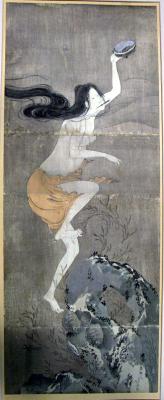
The print on the left has no signature or title within the design as is common with Japanese woodblock prints. It has been attributed to Katsushika Hokusai (1760-1849), whose career spanned sixty years, producing more than 30,000 prints. He was not only a master of Ukiyo-e (pictures of the floating world), but actively studied Chinese and Western techniques, in the last years of the Edo period.

The image is of an Ama, or fisher-woman who specialized in diving for abalone (awabi). I have not been able to find this work in any of the several dozens of volumes on Hokusai in Marquand Art library, nor was it included in the Smithsonian’s extensive retrospective of the artist’s prints and books. Their website is a wonderful source of biographical and stylistic information: http://www.asia.si.edu/exhibitions/online/hokusai/launch.htm. If anyone has information we would be interested in hearing from you.

Hokusai, a child prodigy, is best-known for a series of views of Mount Fuji, including 46 unique scenes at different times of day and seasons of the year. Both Hokusai’s Ama and selections of the Mt. Fuji series will be on view in our gallery next year when we exhibit the Gillett Griffin collection of Japanese prints on deposit in the Graphic Arts division, Rare Books and Special Collections, Princeton University.

The Temple of the Muses

| 1 Comment

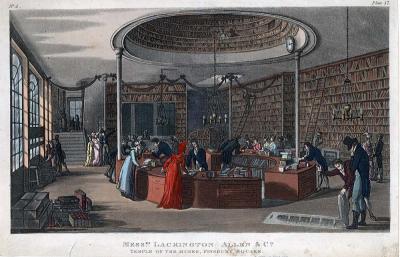
William Wallis (fl.1816-1855) after Thomas Hosmer Shepherd (1793-1864), Temple of the Muses, Finsbury Square. London: Jones & Co., 1828. Etching and aquatint with added hand-coloring.

As a boy, James Lackington (1746-1815) worked as a meat pieman. As an adult, he became one of the most successful booksellers in all of London. If you were looking for literature in the late 18th-century, you would have made your way to No. 32 Finsbury Place South in the southeast corner of Finsbury Square. At that corner, you would check to see if the flag on the huge circular dome of the Temple of the Muses was flying. That way, you knew if Lackington was in residence inside his remarkable bookshop. Books were sold for cash, at prices listed in Lackington’s annual printed catalogues, such as A Catalogue of Books, for the Year 1803, Containing Eight Hundred Thousand Volumes in all Languages and Classes of Learning, the Whole of which are Marked at Low Prices, for Ready Money, and are Warrented Complete. (Rare Books, Ex 2005-0187N). After Lackington’s death, his son continued the business until the shop burned down in 1841.

A sketch of Lackington’s bookshop was originally created by Thomas Shepherd as an illustration to James Elmes, Metropolitan Improvements; or London in the Nineteenth Century: Displayed in a Series of Engravings… by Mr. Thos. H. Shepherd (London: Jones and Co., 1828). (Rare Books (Ex) 1465.323.11). Shepherd’s original is now in the collection of the Guildhall Library. William Wallis reproduced that scene in an etching, which can be found in several formats, with and without color. The print was published in The Repository of Arts, Literature, Commerce, Manufactures, Fashions and Politics. London: R. Ackermann, 1809-1815 (Graphic Arts Collection 2006-3077N)

Illustrated with Original Photographs

| 1 Comment

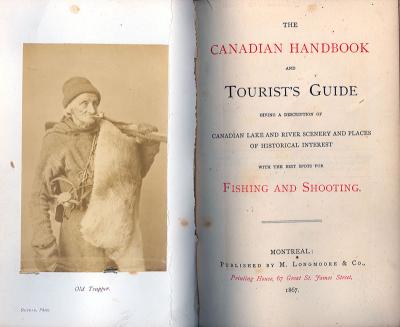
During the nineteenth century, when photography was still a new art form, book publishers would cut and paste individual, original photographs into their books as illustrations. It was an expensive, time-consuming process and so, you might think it was only very limited-edition publications that were illustrated in this way. This is not the case. One reason we know this is is by looking at the Princeton University Library, where there are hundreds of examples of books—novels, textbooks, government documents—that include original, now historic, photographs.

H. Beaumont Small (1832-1919). The Canadian Handbook and Tourist’s Guide; Giving a Description of Canadian Lake and River Scenery and Places of Historical Interest with the Best Spots for Fishing and Shooting. Montreal, M. Longmoore & Co., 1867. Frontispiece by William Notman (1826-1891). Graphic Arts Collection (GAX) 2004-1110N

We are now adding a special subject heading to books with original photographs in them to make them searchable in the main online catalogue. If you would like to try this search, go to http://catalog.princeton.edu and type: Photographs, Original—Illustrations in books into the search box. If you find books with photographs that has not yet been noted, please sent me the information and we will add the heading.

If you would like to browse a list of the titles we have been able to locate so far, continue with this posting below:

All the World Going to See the Great Exhibition of 1851

| No Comments

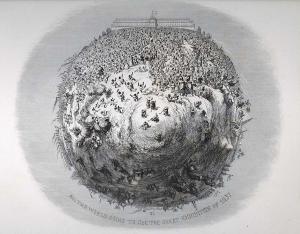
George Cruikshank, 1792-1878. All the World Going to See the Great Exhibition of 1851. Etching, 1851. Signed at the center of globe.

This image first appeared in Henry Mayhew’s 1851 or The Adventures of Mr. and Mrs. Sandboys and Family, Who Came Up to London to ‘Enjoy Themselves,’ and to See the Great Exhibition (London: David Bogue, [1851]). The work includes ten etchings by George Cruikshank and a woodcut title page reproducing the design on the wrappers of the parts. Cruikshank is making fun of the approximately 25,000 people who attended the exhibition, which was conceived to demonstrate Britain’s status as an industrial power.

According to Cruikshank’s catalogue raisonne by Albert Cohn, Mayhew’s text was originally issued in eight parts in green wrappers, February-September 1851, and on completion in light blue stamped cloth, with a gilt design upon the spin. In the early issues there is an error in the pagination at p. 63, where in subsequent issues a leaf of advertisements is inserted to make good the omission on the numbering of the pages. The set was sold in parts for ten pounds and in blue cloth for four pounds.

College Comforts, A Freshman Taking Possession of his Rooms

| No Comments

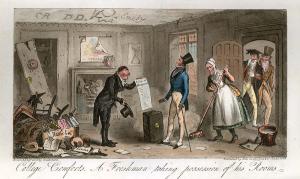
[Isaac] Robert Cruikshank, “College Comforts, A Freshman Taking Possession of his Rooms,” in Charles Molloy Westmacott, The English Spy: an Original Work, Characteristic, Satirical, and Humorour. Comprising Scenes and Sketches in Every Rank of Society, Being Portraits of the Illustrious, Eminent, Eccentric, and Notorious. Drawn from the Life by Bernard Blackmantle … London: Sherwood, Jones, and Company, 1825-26.

This beautiful hand-colored etching is found opposite the lines: “Men are my subject, and not fictions vain;// Oxford my chaunt, and satire is my strain,” which precede Westmacott’s chapter entitled The Freshman, in part 4 of The English Spy. Note the “list of necessaries” being given to the young man as he enters his room.

For about 3 shillings in 1826, you could purchase the new installment of Bernard Blackmantle’s story (a pseudonym for Westmacott). This book has been described as “perhaps the most daring book every published”, since many of the characters were drawn from life, and were, at the time of publication, undoubtedly easy to recognize.

These 2 volumes are in the 24 original wrappers, each wrapper having on the front cover, a reproduction of the uncolored plate, “The Five Pincipal Orders of Society.” The set contains 72 colored plates, including 67 by Robert Cruikshank, 2 by Thomas Rowlandson, and one each by Wageman and Brightly; along with 36 woodcut illustrations. It can be seen in the graphic arts division, rare books and special collection: GA Cruik R 1825.3

The Print Shop of F. Delpech

| 6 Comments

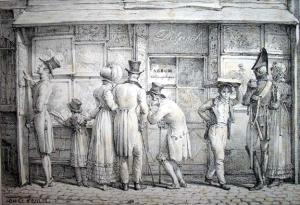
Carle Vernet (1758-1836). Delpech’s Lithographic Print Shop, ca. 1818. Lithograph. Graphic Arts division.

At the beginning of the 19th-century, François-Séraphin Delpech (1778-1825) ran the most popular lithographic print shop in Paris. Delpech not only made beautiful lithographic prints from his own designs, but printed lithographs after designs by other artists, and sold these prints in his shop. Vernet’s print shows the front of Delpech’s shop, with potential buyers looking over the new work, while a young man exits the shop carrying a lithographic stone on his head.

Lithography was a relatively new art form, invented by Alois Senefelder (1771-1834) in Germany around 1798. In 1811, Senefelder published The Invention of Lithography, which was soon translated into English, French, and Italian, and the popularity of the technique soared. Senefelder’s book can be found in rare books and special collection, (GARF) NE 2420.S53.

Tom Phillips' Work at Princeton

| No Comments

Artist, composer, and scholar, Tom Phillips is currently in residence at the Institute for Advanced Study as a Director’s Visitor. His focus this fall is the production of Heart of Darkness, an opera-in-progress, music by Tarik O’Regan and libretto by Tom Phillips, based on the novella by Joseph Conrad. The opera will receive a semi-staged workshop performance on Friday, November 9 at 8:00 p.m. in Wolfensohn Hall. When a limited version was presented last year, The New York Times wrote “… a dense, dreamlike chamber opera heavily tinged with exoticism, like ‘Death in Venice’ on steroids.” More information can be found at: http://www.ias.edu/newsroom/announcements/view/1193068784.html

Heart of Darkness is only the latest work from this multi-talented artist and Princeton is fortunate to hold many of Phillips’ other projects, books, and videos in its library collections. In particular, the 1985 trade edition of his Dante’s Inferno: The First Part of the Divine Comedy of Dante Alighieri. Phillips began illustrating and translating the Inferno in the late seventies, and published in a deluxe, limited edition in 1983. Demand was such that a trade edition was issue by Thames and Hudson two years later. Available in Rare Books and Special Collections, Graphic Arts division, GA Oversize PQ4315 .P45 1985q.

Dante’s Inferno represents the first and most famous part of the Divine Comedy (1308-21) and tells the story of the three realms of the dead. It is full of the gruesome punishments meted out to the unfortunate souls sent to Hell—as observed by Dante as he travels through the circles of Hell with his guide, the Roman poet Virgil. It is one of the few undisputed masterpieces of European literature and Phillips’ reinterpretation is one of the most remarkable artist’s books of the twentieth century.

Several years later, Phillips’ translation became the basis for A TV Dante (1989), a mini-series for the BBC, co-directed by Tom Phillips and Peter Greenaway. The series includes eight episode or the first eight cantos, up to the entrance to the city of Dis. The cast includes John Gielgud as Virgil, Bob Peck as Dante, Joanne Whalley as Beatrice. Historical commentary is provided by Ian Armstrong, David Attenborough, Jim Bolton, Nicholas Campion, and others. Available at the Language Resource Center (VIDL): Video Coll. East Pyne, VCASS 631.

The Hell Hole

| No Comments

John Sloan (1871-1951). Hell Hole, 1917. Etching and aquatint, edition of 100. [Morse 186, second state (of 2)]. Printed by Peter Platt.

Exactly ninety years ago, John Sloan, Marcel Duchamp, and four others climbed to the top of Washington Square Arch and proclaimed it the “free and independent republic of Washington Square.” That same year Sloan immortalized the Golden Swan saloon, better known as the Hell Hole or the Bucket of Blood, in an etching; shown here. Not only was the artist a frequent visitor to the saloon, but his studio was directly across the street and his 11th floor window looked down on the life-size, gilded swan that hung over the front door.

The artist described the scene in his diary, “The back room of Wallace’s … was a gathering place for artists, writers, and bohemians of Greenwich Village. The character in the upper right hand corner of the plate is Eugene O’Neill.”

The Wallace he refers to was Thomas Wallace, the proprietor of the bar and a former prizefighter. The figure in the back right is playwright Eugene O’Neill, who, as Sloan documents, was a regular to the Golden Swan. O’Neill also memorializes the bar by using it as the setting for his play The Iceman Cometh.

Today, the southeast corner of the intersection Fourth Street and Sixth Avenue has been transformed into a small park, known affectionately as the Golden Swan Park.

The Shaving Machine that Never Caught On

| 1 Comment

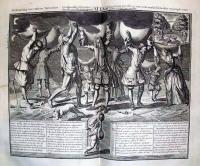
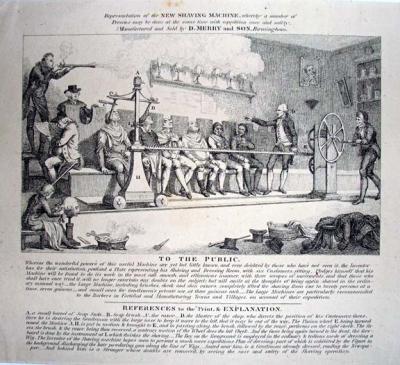
Unidentified British artist, Representation of the New Shaving Machine, Whereby a Number of Persons May be Done at the Same Time with Expedition Ease and Safety : Manufactured and Sold by D. Merry and Son, Birmingham. no date. Wood engraving. GA 2005.00992.

The references to the print are as follows:
A. A small barrel of soap suds;
B. Soap brush;
C. The razor;
D. The Master of the shop who directs the position of his customers faces. Here he is desiring the gentleman with the large nose to keep it more to the left, that is may be out of the way;
E. The Pinion wheel being turned round;
H. The machine is put in motion & brought to “E” and in passing along, the brush, followed by the razor, performs on the right cheek. The faces, the brush, & the razor, being then reversed, a contrary motion of the Wheel does the left cheek. And the faces being again turned to the front, the forebeard is done by the instrument at “I”, which finishes the shaving.

Tachtigjarige Oorlog (The Eighty Years' War)

| No Comments

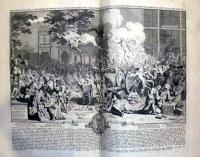
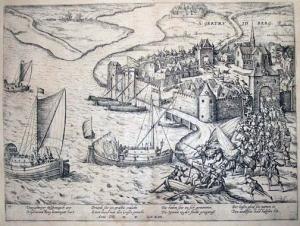
Franz Hogenberg (1540?-1590?). Geertruidenberg durch die Geusen entsetzt, 28 August 1573. Engraving. On deposit from Bruce Willsie, class of 1986.

Franz Hogenberg was a painter, printmaker, and publisher during the late renaissance. By the time he settled in Cologne in the 1570s, he had already begun a chronicle of the Dutch Revolt, also known as the Eighty Years’ War, through a massive series of engravings. The events depicted in these prints pre-date the protestant revolt, beginning with scenes from the 1530s and continue well into the 1600s. Although Hogenberg died some time around 1590, his son Abraham took over the work and completed the project.

Father and son published their Geschichtsblätter (history papers) in various forms during their lifetime but happily, the entire work was reissued in a 1983 facsimile edition by Fritz Hellwig. [GARF Oversize D231 .H64 1983f] The series includes battle scenes on land and sea, portraits of the major figures, maps, ransacking of churches, hangings, elections, elegant parades, and brutal slaughters. When seen in chronological order, the prints take the viewer on an almost week-by-week journey through 16th- and 17th-century Dutch history.

Princeton University library is fortunate to have a large set of these engravings currently on deposit in the graphic arts collection. The set of 157 prints begins with the title plate of the Geschichtsblätter and ends with a scene in 1610. To search the prints, use the Visuals database at: http://libweb5.princeton.edu/RareBooks/database.asp

From Beef Bouillon to Chromolithography

| No Comments

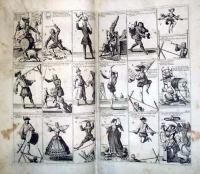
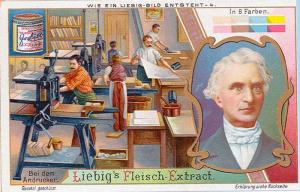
The German chemist, Justus von Liebig (1803-1873), made major contributions to agricultural and organic chemistry, and is regarded as one of the greatest chemistry teachers of all time. In addition to his academic work, he invented a way of producing beef extract from carcasses, which could provide a cheap, nutritious alternative to real meat (we know this today as beef bouillon). In 1865, Liebig formed the Liebig Extract of Meat Company and, like many companies at the time, had a number of trade cards printed to advertise his business. More than 1,900 Liebig cards have been documented, containing pictures of animals, landscapes, or portraits of historical figures along with the company logo.

The graphic arts collection holds a large group of late 19th- and early 20th-century trade cards, among them one 1906 set of cards for Liebig’s company entitled Wie ein Liebig-bild entsteht. Each of the six cards depict one segment of the process of making chromolithographs, and the entire set is beautifully printed by chromolithography. Although I’m sure the Liebig extract of meat was very tasty, it is the views of chromolithographic process that make these cards of value to our collection. To see a wonderful exhibition on chromolithography, visit the Museum of Printing in Lyon, France, or their website: http://www.imprimerie.lyon.fr/imprimerie/sections/fr/expositions

Centenary for Ringling Brothers and Barnum and Bailey Circus

| No Comments

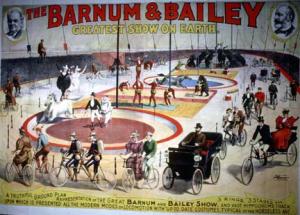
100 years ago the seven Ringling Brothers paid $400,000 to buy out their chief competitor, the Barnum and Bailey Circus. The savvy Ringling boys knew how much the public loved each of the individual shows and so, for twelve years they maintained the separate organizations and ran two separate circus companies. It was only during WWI, when money was tight that the two companies physically merged to form a single “Greatest Show on Earth.”

The William Seymour Theatre Collection, which is housed chiefly in the Harvey S. Firestone Memorial Library, encompasses over one hundred collections relating to the performing arts, including theater, dance, film, circus, and other popular forms of entertainment. One of the most colorful of the collections is TC093: Circus Posters. To view the complete collection, see: http://libweb5.princeton.edu/visual_materials/Circus/TC093.html

One of the Great Botanicals

| 1 Comment

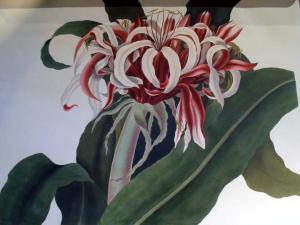
Priscilla Susan Bury. A Selection of Hexandrian Plants: Belonging to the Natural Orders Amaryllidæ and Liliacæ from Drawings by Mrs. Edward Bury, Liverpool. London: R. Havell, 1831-1834. Elephant portfolio, bound in dark green three-quarter goatskin with green moiré silk sides.

The other day I was looking for books by the botanical artist Priscilla Susan Bury (1799-1872) in our library catalogue. I now understand that one must first search under her husband Edward, where you will find a listing for Bury, Edward, Mrs. This will be Priscilla.

Born Priscilla Falkner, in Rainhill, Lancashire, Mrs. Bury had no academic training in either Art or Botany. She grew up drawing plants raised in the greenhouses of her family home east of Liverpool. In 1829, she proposed to a few friends that she publish these drawings in a book called simply Drawings of Lilies. The drawings were to be lithographed and the book to be sold for 5 guineas.

Amazingly, two years later the first of ten fascicles was indeed published, but with a new title and a new printing process. Now called A Selection of Hexandrian Plants, the job of reproducing Bury’s drawings was taken over by Robert Havell, Jr. (1793-1878). He used the same aquatinting process he was concurrently using to complete John James Audobon’s Birds of America. Like Audobon’s project, Havell reproduced Bury’s drawings on large plates (64 x 48 cm.) printed in vibrant colors and then, later finished by hand in watercolor. Havell was also the book’s publisher and Audubon was listed among its subscribers. It is unclear whether Bury subscribed to Audubon’s book.

1 2 3 4 5 6 7 8 9 10 11 12 13 14 >>

Recent Comments

  • S. Scudder: Mary Stilwell is my ggg-grandmother ... thank you for posting read more
  • V.E.G.: James Franklin, Benjamin Franklin's half-brother is a direct descendant of read more
  • Bob Fleck: Nice comments and well worth it. read more
  • N. Sutherland: Do you have any further biographical material on this Thomas read more
  • john W: Have the complete collection of EA Seguy papillons including front read more
  • Vermathio: algarabia, charabia et Picabia. Le premier désigne la langue read more
  • Matt SCOVILL: I have the complete "bookplates in Japan" box. I am read more
  • Daniel Joseph Bobroff: April 30, 2013 To Princeton University: This is a Plaintiff read more
  • Ana Paula: Nice! I wish I could be there to enjoy it! read more
  • Nora Lin: What a shame! Those rooms were inspirational, not only on read more