Main

Prints & Drawings Archives

June 17, 2009

Les metamorphoses du jour

The French artist Jean-Ignace-Isidore Gérard went by the name Grandville, which was the stage name his grandparents used. In the early nineteenth-century, Grandville created several hand-colored lithographic books to satirize the bourgeois middle class of Parisian society in the Romantic period. His best, and today the rarest, is Les metamorphoses du jour published in 1829.

The characters of the book have a human body and an animal face, exposing people for the beasts they really are. The preface comments that the artist was thereby able to encompass “both the living picture of social manners and the satire of institutions and prejudices. Truth can circulate with impunity under the very eyes of the men it attacks.”

J.J. Grandville (1803-1847), Les metamorphoses du jour (Paris: Chez Bulla…et chez Martinet, 1829). 73 lithographic plates drawn by Grandville, printed by Langlumé. Graphic Arts (GAX) 2009- in process

The first edition was a huge success and quickly went out-of-print. A new edition was prepared in 1854, this time using wood-engraved reproductions of Grandville’s original lithographs. It is unfortunate that most people only know the series through these poor copies.

Princeton’s Les metamorphoses is a complete set of hand-colored lithographs with the extra two plates issued in 1830 in Belgium and then censored. In addition, the book is extra-illustrated with four lithographs in the style of the series: La chasse et la Pêche (1830), La revanche ou le Français du Missouri (1829), Casse nationale sur les terres royales (1830), and Chasse aux ordonnances (1830?).

Princeton also holds a number of books illustrated by Grandville including Jonathan Swift (1667-1745), Voyages de Gulliver dans des contrées lointaines (Paris: H. Fournier ainé: Furne et Cie, 1838). Graphic Arts (GAX) 2005-2172N; along with an original preparatory drawing for Gulliver by Grandville in the Cotsen Collection, (CTSN) Framed Artwork 3976

June 2, 2009

Les Artistes

In 1838, Paul Gavarni (Sulpice Guillaume Chevalier) began a sixteen-part series of caricatures entitled The Artists (Les artistes) for the journal La charivari. Here are a few examples:

No. 1
Paul Gavarni (1804-1866), Ma sainte te ressemble n’est pas (sic) Nini? -Pus souvent que j’ai un air chose comme ça!, 1838. Hand-colored lithograph. Graphic Arts GA French prints
No. 9
Paul Gavarni (1804-1866), O bon! M’ame Jean! v’lá qui tire vot’ clos! …Un peu qui tire l’clos de M’ame Jean, 1838. Hand-colored lithograph. Graphic Arts GA French prints

No. 13

Paul Gavarni (1804-1866), S’Pierre mon ami, vous êtes capot!, 1838. Hand-colored lithograph. Graphic Arts GA French prints

No. 16

Paul Gavarni (1804-1866), L’atelier du lithographe, 1840. Hand-colored lithograph. Graphic Arts GA French prints


For more information, see:
Marie Joseph François Mahérault (1795-1879), L’œuvre de Gavarni: catalogue raisonné des estampes (Dijon: L’Échelle de Jacob, c2002). Marquand Library (SA), NE650.G2 M3 2002

May 31, 2009

The Wheel of Fortune

Thomas Cook (1744-1818) after the original print by William Hogarth (1697-1764), An Emblematic Print on the South Sea, 1 August 1800. Engraving. Published London: G.G. & J. Robinson. This is the bottom plate on a sheet that originally included Rehearsal of the Oratorio of Judith and The Laughing Audience. Graphic Arts GA 2005.01324

William Hogarth created this scene in 1721 as a satire of the South Sea investment frauds in 1720. A monument to the destruction that was caused is shown on the right, with wolves fighting at the top. The central Wheel of Fortune is labeled “Who’l Ride” and is crowned with a goat. At the left, a devil is auctioning off pieces of Fortune’s body as religious leaders gamble below. The naked figure of Honesty, at the bottom center, is being tortured by Self-interest. At the right, Honor is whipped by Villainy and Trade lies dead below.

The text at the bottom reads:

See here the causes why in London
So many men are made and undone
That arts and honest trading drop,
To swarm about the Devil’s Shop (A),
Who cuts out (B) Fortune’s golden haunches,
Trading their souls with lots and chances,
Sharing ‘em from Blue Garters down
To all Blue Aprons in the town.
Here all Religions flock together,
Like tame and wild fowl of a feather,
Leaving their strife Religious battle,
Kneel down to play at pitch and hustle(C) :
Thus when the Shepherds are at play
Their flocks must surely go astray
The woeful cause that in these times
(E) Honour and Honesty (D) are crimes
That publickly are punish’d by
(G) Self-Interest and (F) Vilany
So much for mony’s magic power,
Guess at the rest, you find out more.
Price One Shilling

May 29, 2009

Little Devils

Isaac Cruikshank (1764-1811), after a drawing by George Moutard Woodward (1760-1809), John Bull Troubled with the Blue Devils, 1799. Hand-colored etching. London: S.W. Fores, 1799. Graphic Arts division (GAX) R1800.02E

Shortshanks (Robert Seymour 1798-1836), Morning, no date. Hand-colored etching. “Etched by shortshanks in imitation of George Cruikshank” Graphic Arts (GAX) R2800.02E
George Cruikshank (1792-1878) after a drawing by Captain Frederick Marryat (1792-1848), The Cholic. Hand-colored etching. Originally published London: G. Humphrey, 1819; second state published London: McLean, Aug. 1, 1835. Graphic Arts division GC022 Cruikshank

James Gillray (1757-1815), Le Diable-Boiteux,-or- The Devil upon Two Sticks, Conveying John Bull to the Land of Promise, 1806. Hand-colored etching. Published London: Hannah Humphrey, 1806. Graphic Arts (GC Gillray Collection)

May 20, 2009

Lovis Corinth

Lovis Corinth (1858-1925), Self-portrait, no date. Drypoint. GC018 German print collection.

Lovis Corinth (1858-1925), Self-portrait, 1909. Drypoint. GC018 German print collection

In the last years of the nineteenth-century, discontented artists in Germany and Austria chose to leave the formal, academic salons to form a “free association for mounting art exhibitions.” The Munich Secession formed in 1892, the Vienna Secession in 1897 and the Berlin Secession in 1898.

German artist Franz Heinrich Louis Corinth (1858-1925), later called Lovis Corinth, founded the Munich Secession. It’s interesting to note this influential artist hadn’t yet sold a single painting—his first sale was in 1895. Corinth then moved to Berlin, where he joined the 65 dissident artists of that Secession, eventually serving as their president from 1915 to 1925.

By that time, however, the power of the organization was lessening. There was a new generation of young artists who objected to what had become the establishment. They left Corinth’s Secession and formed their organization, they called The New Secession.
Corinth created over 900 prints, including 60 self-portraits. The Graphic Arts collection is fortunate to own these two drypoints.

May 12, 2009

Never a Day Without a Line

Crispijn [van] de Passe (1594-1670), La prima-[quinta] parte della luce del dipingere et disegnare, … (Ghedruckt t’ Amsterdam: Ende men vintse te koop by Ian Iantsz. … als mede by den Autheur selve … , 1643-1644). Five parts bound as one. Graphic Arts (GAX) 2009- in process

The frontispiece for Crispijn de Passe’s five volume manual for painters depicts Minerva as the patroness of the arts.

She is holding a torch to symbolize the light mentioned in the title of this volume. In her lap is an open book with the artist’s motto: Nulla dies sine linea (Never a day without a line). Behind her are eight Utrecht painters: Abraham Bloemaert, Gerard van Honthorst, two unidentified, Jan van Bronckhorst, Roelandt Saverij, Joachim Wtewael, and Paulus Moreelse. Apprentices sit at Minerva’s feet drawing.
The manual was meant for a wide audience and so, the text is printed in Italian, Dutch, French, and German. Part one is devoted to proportions; part two to drawing from the male nude; part three drawing from the female nude; part four to figure studies by famous contemporary master including Guercino, Jan Cousin, Abraham Bloemaert, and Roelandt Saverij; and part five focuses on the study of mammals, birds, fish, and insects.

There are only four other copies of this book in the United States. One is at the National Gallery of Art in Washington D.C., one at the Getty Research Institute, and two at the Museum of Fine Arts, Boston. Each copy is slightly different in the plates included, their sequence, and the altering of dates. The title pages of part 1-2 in Princeton’s copy have imprint: t’Amsterdam : By Crispijn de Pas, M.D.C.XLIV (altered with pen to M.D.C.LXIV), while the National Gallery of Art’s copy is altered similarly for parts 2-3. Princeton’s copy also has plate dates altered to reflect the addition of a number of prints.

Each of the five parts has its own title page, hence the combined title: La prima-[quinta] parte della luce del dipingere et disegnare, used for the single bound volume. The polyglot book is also known as Van ‘t Licht der teken en schilderkonst and Luce del dipingere et disegnare.

Most of the 225 plates in these volumes were engraved by Crispijn the Younger himself, although the years following the publication of this opus were troublesome for the artist. He had more and more trouble keeping up with demand for his work and in 1645, the artist was admitted to an asylum to be “cured of his insanity of mind.” Although he returned to work, this manual remains his most ambitious project.

The book is dedicated to the city of Utrecht, where his father Crispijn de Passe the elder, had moved for religious reasons. The entire family, father and four children, worked together as artists and print publishers. When the family estate was settled near the end of the 18th century, their work totaled more than 14,000 prints and around 50 print books or illustrated volumes. Princeton is fortunate to now hold 5 rare volumes with prints by Crispijn the younger, and 6 illustrated by Crispijn the elder.


The honour is immortal that remains
Of virtuous artists whose name shall never wither.
Just so with De Passe, the praise the Muses sing
In the vale of Pegasus, of all the wondrous marvels
That he disclosed with his needle,
By etching on the plate, of which Belgica boasts.
So skillfully done, stippled and boldly cut,
As can still be seen up to this very day.
The proof demonstrates the work’s deed to the master’s honour,
Aye, the hand may perish, but the spirit never dies.

May 10, 2009

She's pretty but how is her handwriting?


Kitao Masanobu (1761-1816), The courtesan Chōzan seated at a Chinese writing table copying poems from a book while Hinazuru stands talking to her, (also called Chōzan and Hinazuru), 1784. Double ōban tate-e color bookplate from 吉原傾城新美人合自筆鏡; Yoshiwara Keisei Shin Bijin Awase Jihitsu Kagami (A Comparison of New Beauties with Samples of their Calligraphy). Graphic Arts collection, GA2009- in process.

This is one in a series of woodblock prints offering the Japanese public a look at the leading prostitutes of the Yoshiwara (pleasure district). Along the top of each sheet is a waka (thirty-one-syllable) poem written in the women’s own hand to show her abilities in calligraphy. Handwriting was only one of the many attributes expected from a high-class courtesan at that time.

The artist Kitao Masanobu was only twenty-two when he produced what would become his most famous work, Seirō meikun jihitsu-shū (Collection of calligraphy by celebrated Yoshiwara courtesans). The seven double ōban woodblock prints each depict two bijin or beauties along with their kamuro (eight to twelve year old attendants learning the business).

According to Cecilia Seigle’s book Yoshiwara (Firestone HN730.T65 S45 1993), Masanobu practically lived in the pleasure district during the 1780s and may have drawn these images from life. The following year, the artist teamed up with publisher Tsutaya Jūsaburō to reformat the series into a book, newly titled Shin Bijin Awase Jihitsu Kagami.

In this sheet, Hinazuru is on the right, showing her New Year kimonos. Chōzan is seated on the left at a writing desk. She has a calligraphy primer, a copy of the book Eiga monogatari (Tales of Glory), and strips of paper waiting for her to write New Years poems.

May 6, 2009

Vauxhall Gardens

Thomas Rowlandson (1756-1827), Vauxhall, 1732. Engraving with handcoloring. Published London: Richard Powell. Inscribed in border l.l.: Drawn & Engraved by Th. Rowlandson. Gift of Dickson Q. Brown, Class of 1895. Graphic Arts, British caricature
In 1784, British artist Thomas Rowlandson submitted two watercolors to the Royal Academy member’s exhibition: The Serpentine River and Vauxhall. They were recognized by the critics and at 28 years-old, Rowlandson emerged as an artist of note. The later work was engraved by Robert Pollard for wide distribution the following year. One of the finest aquatintists of the period, Francis Jukes (1745-1812), was hired to recreate the look of the watercolor and the print was published by John Raphael Smith (1752-1812), one of the leading printmakers of the day, who published prints after Gainsborough, Reynolds, and Romney.

In Vauxhall, figures are caricatured but identifiable, including Mrs. Weichsel singing from the front balcony and Mr. Barthelemon leading the orchestra. Below is a supper party with James Boswell, Dr. Samuel Johnson, Mrs. Thrale, and Oliver Goldsmith. Boswell did frequent Vauxhall and said “I am a great friend to pubic amusements; for they keep people from vice. You would now have been with a wench had you not been here.” Playwright and columnist Captain Topham is looking through a spyglass at the Duchess of Devonshire and her sister, Lady Duncannon. Further to the right, the Prince of Wales flirts with his former mistress Perdita Robinson, who remains on the arm of her husband.

Vauxhall Gardens originated in 1661, was renovated in 1732 and remained a popular venue well into the 19th century. As described in Boswell’s Life of Johnson, “There being a mixture of curious shew, gay exhibition, musick, vocal and instrumental, not too refined for the general ear; for all which only a shilling is paid; and, though last, not least, good eating and drinking for those who choose to purchase that regale.”

Rowlandson liked to go there in the evening to watch and draw. He created at least two watercolors and several prints featuring the Garden. However, there is no recorded impression of this image “drawn and engraved by Rowlandson” as the Princeton print claims. The inscribed border of our print gives the publisher as Richard Powell, with no date, and names many of the celebrities in the scene, but there is no listing of such a print in Grego’s catalogue raisonné. Most likely it is one of many illegal reprintings of Rowlandson’s popular prints.

Joseph Grego (1843-1908), Rowlandson the Caricaturist (London: Chatto and Windus, 1880) Graphic Arts Collection (GA) Oversize Rowlandson 703.3q

James Boswell (1740-1795), The Life of Samuel Johnson (Printed by Henry Baldwin, for Charles Dilly …, 1791) Rare Books (Ex) 3804.3.59

April 16, 2009

Four prints to decorate your room

Paul Allier, Les quatre saisons (Paris: Galerie Lutétia, [192-?]). Pochoir plates. Copy 918 of 1000. Gift of Charles Rahn Fry. Graphic Arts Collection (GAX) Oversize 2004-0389Q


April 12, 2009

Hans Sebald Beham

Hans Sebald Beham, Der Genius mit dem Alphabet (The Genius with the Alphabet), 1542. Engraving. Bartsch 229. Pauli 233. Graphic Arts, German prints
The German artist Hans Sebald Beham (1500-1550), who often went by Sebald Beham or HSB, grew up in Nuremberg during a time of political unease. The Nuremberg council actively sought out prints that might be considered propaganda or printmakers who might be religious agitators. Sebald, his brother Barthel (1502-1540), and their colleague George Pencz (1500-1550) were nicknamed the “Godless Painters” when they were brought to trial for atheism, specifically a disbelief in transubstantiation. All three were expelled from Nuremberg, only to return after about ten months.

Sebald was chiefly recognized for his small engravings in the style of Albrecht Dürer (1471-1528), the undisputed superstar of the era, but this similarity also brought him trouble. When Hieronymus Andreae (ca.1500-1556) hired Sebald in 1527 to illustrated a Lutheran prayer book and several other projects, the two were accused of plagiarizing Dürer and Sebald was once again forced out of Nuremberg.

Biblia: insignium historiarum simulachris… (Paris, printed by François Gryphius, 1542). Graphic Arts (GAX) Z232.G8751 B52

Settling in Frankfurt, Sebald produced nearly 2,000 prints during his career. The same year he engraved the putti above, he was also one of several artists responsible for the woodcuts used in the first Paris Bible to contain illustrations in the Renaissance style, as recognized by bibliographer Ruth Mortimer. She writes, “The first three Old Testament cuts are based on Holbein blocks common to the Dance of Death and Icones sets; the remainder of the Old Testament illustration derives chiefly from a series by Hans Sebald Beham.” (French 16th century books GA Z881 .H346)

For more, see Gustav Pauli (1866-1938), Hans Sebald Beham: ein kritisches Verzeichnis seiner Kupferstiche, Radierungen und Holzschnitte (Strassburg: J.H.E. Heitz, 1901). Marquand Library (SA) ND588.B4 P2

April 8, 2009

Newyorks Hamn och Redd

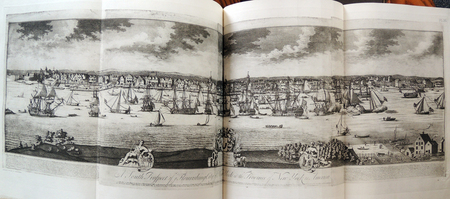
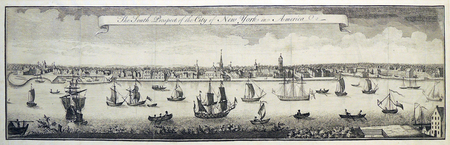
Axel Klinkowström (1775-1837), engraved by Carl Fredrik Akrell (1779-1868), Newyorks Hamn och Redd, från Brooklyn på Longisland (published in Klinkowstöm’s Atlas, Stockholm, 1824). Gift of Leonard L. Milberg, class of 1953. Graphic Arts


Axel Klinkowström (1775-1837), engraved by Carl Fredrik Akrell (1779-1868), Brodway gatan och Rådhuset i New York (published in Klinkowstöm’s Atlas, Stockholm, 1824). Gift of Leonard L. Milberg, class of 1953. Graphic Arts

Swedish Baron Axel Leonhard Klinkowström (or Klinckowström) became an ensign at the age of 17 and rose to Lieutenant-Colonel. It was in detached service from the naval fleet that he visited the United States from 1818 to 1820. The purpose of his trip was to investigate the American steamboat and study its possibilities for use by the Swedish navy.

During these two years in America, Klinkowström wrote 25 illustrated letters home to Admiral Claes Cronstedt and the Swedish public, which were published in 1924 under the title Bref om de Förenta Staterna (EX Oversize 1053.527.1824E, 2 v.+ atlas) and translated into English in 1957 as Baron Klinkowström’s America, 1818-1820 (Recap 1053.527)

Here are a few excerpts:

The harbor is full of small sailing vessels, yachts, and schooners which come from all America’s ports to this mid-point of all movement. Usually these ships are well-painted and are built in a light and handsome style. The steamboats which come and go like stagecoaches add great activity to this picture. Behind the city itself the great Hudson River empties into the harbor, which is large and reaches as far as New Jersey. This grand panorama is bounded by the New Jersey coast and the highlands on the other side of the Hudson.
…I want to advise any travelers who plan to stay in this country for a while not to live in expensive hotels. Everywhere, and especially here in New York, there are boarding houses where one can lodge comfortably and enjoy adequate board at varying rates. The advantage of these boarding houses over hotels is that one lives in closed company which is pleasant, for the guest are people with some education and with whom one can become acquainted. Breakfast is served at nine o’clock, after which each one goes to his duties. Dinner is served at four or five and then the guests gather in the living room before a glowing fire where the evening is spent in card playing, games, or merriment.
…According to what I have found, people here show more respect for the laws than they do in Europe, and do not require such strong measures to govern and maintain authority. Although the American people are compounded from different nations, although different tongues are spoken and different religious sects exist, less grave crimes are committed…than in Europe. Contrast this with conditions in Southern Europe, where, despite watchful police and strong armies and severe punishment, it is still not always possible to protect the peaceful citizen…

April 5, 2009

The Academicians of the Royal Academy

Richard Earlom (1742-1822), The Academicians of the Royal Academy or The Royal Academy of Art after the painting by Johann Zoffany (1733-1810), published 1773. Mezzotint. GA 2005.01515

Mezzotint engraver Richard Earlom (1742-1822), executed a series of prints after drawings and paintings by well-known artists such as Claude Lorraine, Jan van Huysum, Guido Reni, Joshua Reynolds, and others. This mezzotint reproduces an oil painting attributed to Johann Zoffany, depicting 36 members or academicians (RAs) of the Royal Academy of Arts, London. The group is seen in the Life Room at the Old Somerset House, where members gathered for life drawings sessions. Each of the figures can be identified, and a complete list of names can be found on the National Portrait Gallery’s website: http://www.npg.org.uk

Full membership to the academy is limited to painters, printmakers, sculptors, or architects actively working in Great Britain. Both Earlom and Zoffany were elected to this celebrated group. In the beginning, both men and women were accepted into membership: Angelica Kauffman (1741-1807) and Mary Moser (1744-1819) were among the founding members. However, these two women were not allowed to serve on the governing council of the Academy, or to take part in committee work, as other members were required to do. The two women were also not allowed to attend life classes, where models were drawn in the nude. So it is fitting that these two women are only seen in this image as portraits on the wall.

Things quickly got worse for female artists. The organization discouraged other women from joining and after Kauffman and Moser died, no other female artist was accepted to full membership until 1922. The only exception came in the late-nineteenth century, when a few women were allowed to hold a life class inside the Academy but no men were allowed in the room.

To see other work by Earlom, see Liber veritatis (1777-1819). Marquand Library SAX Oversize ND553.G3 A31f

April 1, 2009

Mirror of Brave Military Guards in Kamakura

Utagawa Kunisada (歌川国貞, Toyokuni III, 1786-1865), Kamakura Buei Yoshi Kagami (Mirror of Brave Military Guards in Kamakura), ca. 1844. Color woodblock print triptych. Graphic Arts division GA2009- in process

Minamoto no Noriyori (1156-1193) sixth son of Minamoto no Yoshitomo

These three Japanese men were half-brothers during the late Heian and early Kamakura period. They were also successful generals whose achievements made them celebrated figures in the battles of the Genpei War. From 1180-1185, they fought against the Taira warriors, leading tens of thousands of soldiers over mountains and across seas. The brothers won magnificent battles and accomplished remarkable feats to successfully retake the city of Kyoto and ultimately defeat their enemies in the climactic Battle of Dan no Ura in April 1185.

However, suspicion and envy led to violent arguments between the brothers and in 1189, Yoritomo ordered that Yoshitsune be put to death. Noriyori was asked to lead the expedition to kill their brother and when he refused, Yoritomo had him sent into exile and later executed. To save face, Yoshitsune committed suicide.

Minamoto no Yoritomo (1147-1199) third son of Minamoto no Yoshitomo
Minamoto no Yoshitsune (1159-1189) ninth son of Minamoto no Yoshitomo

The story of Yoshitsune has been retold in many books and songs, as well as a movie by Akira Kurosawa entitled Tora no O wo Fumu Otokotachi (They Who Step on a Tiger's Tail), based on the kabuki play Kanjincho.

For more information, see Elizabeth Oyler, Swords, Oaths, and Prophetic Visions: Authoring Warrior Rule in Medieval Japan (Honolulu: University of Hawaii Press, 2006). East Asian Library (Gest): Western PL747.33.W3 O95 2006

March 28, 2009

John Baptist Jackson

John Baptist Jackson (1701-1780?), Titiani Vecelli, Pauli Galiarii, Jacobi Robusti, et Jacobi de Ponte opera (Venetiis: J. B. Pasquali, 1745). 24 leaves of plates Graphic Arts Collection (GA) GC171

In 1731, the British printmaker John Baptist Jackson arrived in Venice and found work with printmaker Count Antonio Maria Zanetti. Jackson impressed his employer with images printed from multiple blocks, dramatically reproducing paintings and sculpture in a two-dimensional format. He went on to have success designing and cutting woodcuts for book illustration for various Venetian publishers. This came to an end when Jackson learned that some of his designs had been stolen and the blocks printed under another name.


The Crucifixion after Tintoretto (1518-1594)

Fortunately, he met the wealth British banker and bibliophile Joseph Smith (ca. 1674-1770) who offered Jackson several commissions for reproductive prints of works in Smith’s art collection. The last, completed in 1739, was a multi-block or chiaroscuro reproduction of Rembrandt’s Descent from the Cross (the painting now in the National Gallery of Art, London). The success of this print led his friends Charles Frederick and Smart Lethieullier to propose a larger series of chiaroscuro prints reproducing the great paintings of the Venetian masters.

The Virgin in the Clouds and Six Saints after Titian (ca. 1488-1576)

The project took 4 ½ years, during which time Jackson proofed nearly 100 blocks to produce 24 plates after 17 paintings by such artists as Titian, Tintoretto, Veronese, Leandro da Ponte Bassano, Jacopo Bassano, and Francesco da Ponte Bassano. This was not the first or only such project Jackson attempted but it was the only one to be successfully completed and published in a large edition.

Jackson’s book brought the Renaissance process of chiaroscuro printing back into favor and in 1754, he published a technical manual entitled, An Essay on the Invention of Engraving and Printing in Chiaro Oscuro. In it, Jackson comments “… there is a masterly and free Drawing [in chiaroscuro], a boldness of Engraving and Relief, which pleases a true Taste more than all the little Exactness found in the Engravings in Copper plates..”

Princeton’s copy of Jackson’s book has been disbound and digitized. The prints can be seen in their entirely at http://diglib.princeton.edu/xquery?_xq=getCollection&_xsl=collection&_pid=jacksonprints

Presentation of the Virgin in the Temple after Titian (ca. 1488-1576)

For more information, see: John Baptist Jackson (1701-1780): chiaroscuri dalla Collezione Remondini del Museo biblioteca archivio di Bassano del Grappa (Vicenza: La Serenissima, 1996) Marquand Library (SA) NE642.J13 M37 1996

March 23, 2009

Anthony Morris Family Tree


Anthony Morris Family Tree, compiled by Anthony Saunders Morris, lithographed by L. Haugg, 1861. Graphic Arts division (GA) 2009- in process

Anthony Saunders Morris (1803-1885) must have had great interest in the history of his family because in the 1860s, he began compiling a complete Morris family tree. When he succeeded in documenting nine generations of male decedents, he hired lithographer Louis Haugg (1856-1894), one of Philadelphia’s leading printmakers, to draw the family tree in its entirety.

The result is this massive sixteen-plate panorama of an actual tree (approximately six by five feet), which holds all the names of the Morris family. Note that the men are the branches that continue the lineage and the women the foliage, only good for decoration.

Printed by F. Bourquin and Company on Chestnut Street, it is unclear how large an edition Morris commissioned. No other copy of this print is currently recorded.

March 20, 2009

Sketches in France, Switzerland, and Italy


Samuel Prout (1783-1852), Sketches in France, Switzerland, and Italy (London: Hodgson & Graves, [1839]). 26 tinted lithographs, GAX copy imperfect. Graphic Arts Collection (GAX) Oversize Rm 2-15-G, cabinet 33.

“It is not unlikely that the day may arrive when the connoisseur of a future age shall turn over the pages of a book, and pause upon an aquatinta print, with the same solemn delight as those of our day are wont to do upon a woodcut of Albrecht Dürer, an etching of Hollar, or a production of any ancient engraver.”

At the time Samuel Prout (1783-1852) wrote these words, aquatint prints had taken over English book illustration, dominating it from 1790 to 1830. The leading publishers, such as Rudolph Ackermann, maintained stables of artists who turned-out watercolor drawings, which were converted to black and white aquatints by master printers, hand colored by cheaper technicians. Samuel Prout worked for Ackermann and others as a watercolorist, specializing in picturesque views for armchair travelers.

Prout’s real interest lay in the newer technique of lithography, being one of the first English artists to perfect the process. In 1817, when Ackermann wrote an article praising lithography in his Repository of the Arts, it was Prout who illustrated the text with an original lithographic print.

As the audience grew for Prout’s topographical views, so did his geographic range. Prout made frequent trips across the continent of Europe, producing multiple series of tinted lithographs with hand-colored highlights. Most prints celebrate towering Gothic cathedrals and other romantic architectural views rendered with astonishing detail. This is one such set with views from France, Switzerland, and Italy.

March 18, 2009

Meryon's San Francisco

Charles Meryon (1821-1868), View of San Francisco, 1856. Etching and drypoint. Graphic Arts GA 2005.00259
By the vigor, the delicacy and the certainty of his drawings, Meryon recalls what is best in the work of the early etchers. We have rarely seen represented with more poetry the solemnity peculiar to a great capital. -Charles Baudelaire 1859

Baudelaire was reacting to “Eaux-fortes sur Paris,” a series of 22 etchings documenting Paris before it was transformed into a modern city by Baron Georges-Eugene Haussmann. Completed by the French printmaker Charles Meryon (1821-1868) between 1850 and 1854, the prints were rejected by the Salons of the time.

Meryon must have been grateful to receive a commission in the spring of 1856 from François Louis Alfred Pioche (1818-1872), a banker, investor and art collector, who traveled between his native Paris and his adopted home of San Francisco. Poiche asked Meryon to create a panoramic landscape of San Francisco, although the artist had never been there. For inspiration, he was given a five-daguerreotype panorama of the city (now in the Art Institute of Chicago), from which five large paper photographs were made for his use.

While much of the landscape was copied directly from the photographs, Meryon added a cartouche to the center foreground with allegorical figures of Abundance and Labor, as well as portrait medallions of Pioche and his partner Jules B. Bayerque. Meryon pulled the first proofs in September and finished some time that winter. Princeton’s copy is a rich, clean impression from the fourth of four states, measuring 185 x 950 mm.

Not long after finishing this panorama, the artist checked into the asylum in Charenton. Although he returned to Paris and his work several times, Meryon’s final years were spent in Charenton, where he died of self-starvation in 1868.

March 10, 2009

William Penn, Extra Illustrated


Samuel M. Janney (1801-1880), The Life of William Penn. 2nd ed. (Philadelphia: Lippincott, Grambo & Co., 1853). 208 engravings. Graphic Arts GAX 2009- in process

This single-volume biography originally published in 1852, has been extra illustrated with 208 additional engravings bound into a three-volume set. The prints include portraits of William Penn (1644-1718), his colleagues and contemporaries, and the landmarks from his life story.

The earliest print in this set is a portrait of Penn at age twenty-two, posed in armor for his father, an admiral in the Royal Navy. Penn never joined the military but instead joined the Religious Society of Friends, later known as the Quakers. He petitioned Charles II, King of England, and received a grant of land in America, north of Maryland. Penn suggested naming his territory Sylvania but the King wanted to honor Penn and so we call this area Pennsylvania.

March 3, 2009

Henry Martin's Spots

Henry Martin, class of 1948, worked as a cartoonist and illustrator for more than forty-five years, publishing in the New Yorker, Ladies’ Home Journal, Saturday Evening Post, and many other magazines. He also had a single-panel comic strip, “Good News/Bad News,” which was nationally syndicated.

Martin had his first drawing accepted at the New Yorker in April 1950 but it was another ten years before his first cartoon was accepted there. It is, in fact, these drawings or “spots,” for which Martin is best represented in the magazine. A search of the New Yorker’s cartoon database reveals 188 cartoons but our archive of Martin’s drawings shows he made over 1,000 spots. These are the tiny drawings that fill the spaces above and below the stories, articles, and columns of the magazine.

In March of 2005, New Yorker editor David Remnick changed the handling of these spots (Martin was by then retired). The earlier spots Martin drew had no running narrative of their own; no connection with politics or current events or each other. They were visual poems living gloriously apart from daily life. This changed with the magazine’s 80th anniversary issue. The spots, now created by a series of artists, have their own narrative or running theme throughout an individual issue. This week, for instance, they are all about garbage.

We include a few here in the old style.

And one cartoon for good measure.

For some other Princeton University related Henry Martin cartoons, see: http://tigernet.princeton.edu/
~ptoniana/cartoons.asp

For an extended commentary on the redesign of the New Yorker, see http://www.aiga.org/
content.cfm/redesigning-the-new-yorker
-part-one?pff=2

Continue reading "Henry Martin's Spots" »

February 24, 2009

Clément Pierre Marillier

Graphic Arts holds a number of works by the French artist Clément Pierre Marillier (1740-1808) including this print:

La medecine. Esculape eloigne la mort, ca. 1780. Designed by Clément Pierre Marillier (1740-1808), engraved by Le Roy. Graphic Arts GA2009.00108. Gift of William H. Helfand.

And this book:

Claude Joseph Dorat (1734-1780), Fables nouvelles (Paris: Chez Delalain, 1773-1775). 99 vignettes and 99 culs-de-lampe after designs by C.P. Marillier, engraved by E. De Ghendt, Masquelier, Nee, Delaunay, Baquoy, Le Roy, Lebeau, and others. Graphic Arts (GAX) 2004-3296N.

In his twenties, Marillier left Dijon to study painting in Paris but failed to find success. He turned instead to graphic design, working on books, magazines, maps, and other projects where his complex images of imaginative scenes found great appreciation. From 1769 to 1789, Marillier designed prints for at least twenty books:

Louis-Sébastien Mercier, 1740-1814, Jenneval, ou Le Barnevelt françois, drame en cinq actes, en prose, 1769.
Louis Sébastien Mercier, 1740-1814, Olinde et Sophronie, drame héroîque en cinq actes et en prose, 1771.
Jacques Cazotte, 1719-1792, Le diable amoureux: nouvelle espagnole, 1772.
Claude Joseph Dorat, 1734-1780, Fables; ou, Allégories philosophiques, 1772.
Claude Joseph Dorat, 1734-1780, Fables nouvelles, 1773.
Arnaud Berquin, 1747-1791, Idylles, 1774.
Guillaume-Thomas-François Raynal, 1713-1796, Histoire philosophique et politique des établissemens & du commerce des Européens dans les deu, 1775.
Adrien Richer, 1720-1798, Théatre du monde, où, par des exemples tirés des auteurs anciens & modernes, les vertus & les, 1775.
Arnaud Berquin, 1747-1791, Romances, 1777.
Grécourt, 1683-1743, Œuvres choisies de Grécourt, 1777.
Charles de Secondat Baron de Montesquieu, 1689-1755, Oeuvres de Monsieur de Montesquieu, 1777.
Ovid, Les oeuvres galantes et amoureuses d’Ovide … , 1777.
Giovanni Boccaccio, 1313-1375, Nimfale fiesolano: nel quale si contiene l’innamoramento di Affrico e Mensola: poemetto in ott, 1778.
Pliny, the Elder, Caii Plinii Secundi Historiae naturalis libris XXXVII, 1779.
Alexander Pope, 1688-1744, Oeuvres complettes d’Alexandre Pope, 1779.
Claude Joseph Dorat, 1734-1780, Mélanges de poésies fugitives et de prose sans conséquence; suivis de Volsidor et Zulménie, 1780.
Cabinet des fees, ou, Collection choisie des contes des fees et autres contes merveilleux, 1785.
Louis Elisabeth, comte de Tressan, 1705-1783, Oeuvres choisies du comte de Tressan, 1787.
Sainte Bible, contenant l’Ancien et le Nouveau testament, 1789.

February 19, 2009

Historic Monkeys in Cartoons

Artists have often made fun of politicians, royalty, and others by depicting them as monkeys. Here are a few examples.

Cham (1819-1879), Le docteur Véron remomcant à la plume pour se livrer à la peinture satyrique, 1851. Lithograph. GA2009.00083. Gift of William H. Helfand.

George Cruikshank (1792-1878), The Royal Menagerie, on the Road to Ruin Spain, March 12, 1823. Etching with hand-coloring. GA Cruikshank Cohn 1924. Gift of Richard W. Meirs, class of 1888.

Frederick Burr Opper (1857-1937), Untitled, no date. Pen and ink on board. GA2007.00153.

Thomas Nast (1840-1902), Our Modern Canute at Long Branch, October 11, 1873. Wood engraving. GA2008.01719
George Cruikshank (1792-1878), The Genius of France, Expounding Her Laws to the Sublime People, April 4, 1815. Etching with hand-coloring. GA Cruikshank Cohn 1152. Gift of Richard W. Meirs, class of 1888

Thomas Nast (1840-1902), No, No More Chestnuts for Me, January 6, 1877. Wood engraving. GA2008.01562.


Lawson Wood (born 1878), A Good Egg Stays on the Job, no date. Published by “OSS” [United States Office of Strategic Services?]. Photomechanical poster. GA World War Posters.

Lawson Wood (born 1878), Keep Mum Chum. Only a Monkey Spills the Dope, no date. Published by “OSS” [United States Office of Strategic Services?]. Photomechanical poster. GA World War Posters.
Bernard Gillan (1856-1896), Untitled [U.S. Senator Thomas Platt as monkey], 1885. Pen and ink on board. GA2007.00106.

February 13, 2009

Ogden N. Hood, Class of 1852

Ogden N. Rood (1831-1902), 13 untitled drawings, ca.1880. Graphic Arts (GAX) 2009- in process

Columbia University chemistry professor Ogden Nicholas Rood, Princeton class of 1852, had a passion for the science of color. He published a number of influential books, including Modern Chromatics, with Applications to Art and Industry (Annex A P94.852.051.05) and Students’ Text-Book of Color (ND1259.R67).

Hood made a number of trips to Europe to do research and to paint. Graphic Arts recently acquired thirteen drawing after bas reliefs made by Hood while in Florence. Writing in The American Journal of Science (1903), Arthur Wright commented, “It may be added that Professor Rood’s work upon [Modern Chromatics] was greatly facilitated by his own experience as an artist. As early as his residence in Munich [ca. 1854-58] he had practiced painting in oil, and attached a high degree of proficiency. He had a great skill in drawing, and became expert in painting in water-colors, some of his pictures having been shown at the exhibitions of the Academy of Design in New York.”

Princeton also owns a small collection of letters written by Rood from New York and Germany, 1843-1902. Manuscripts Division CO602

February 6, 2009

Printmaker's abbreviations

Geographus der Erdbeschreiker, ca. 1721. Engraving with hand coloring. Augsburg: Martin Engelbrecht. Gift of Nally-Wright. GC018

This German engraving is being moved in our database from "created by" Martin Engelbrecht (1684-1756) to "printed by" Engelbrecht. It is a good example of printer's abbreviations and useful they are in identifying the print.

In the lower left hand corner of the print is: "C. Priv. S.C. Maj." which is the privilege statement: "Cum Privilegio Sacrae Caesareae Majestatis" or with the privilege of the Holy Imperial Majesty or Holy Roman Empire. This privilege is not only the authorization to publish, but the imperial printing privilege gave copyright protection to the publisher for a time.

On the right, Englebrecht's name is printed with "excud. A.V." or excudit Augusta Vindelicorum; that is, published in Augsburg, Germany. Engelbrecht was both an artist and the owner of a large print publishing house in Augsburg, and many prints are wrongly attributed to him for this reason. Although no artist is identified on the print, it could have been engraved by Johann Georg Ringlin, who worked closely with the Engelbrecht firm.

Some other useful abbreviations seen on prints include:

A.P.: Artist's proof
B.A.T., Bon á tirer: Proof print approved by artist and ready to be handled over to the master printer
Cael., caelavit: Engraved by
Cum privilegio: Privilege to publish from some authority
Del., delt., delin., delineavit: Drawn by
Disig., designavit: Designed by
Divulg., divulgavit: Published by
Eng., engd.: Engraved by
Exc., excud., excudit: Printed by or published by
F., fac., fec., fect., fecit, faciebat: Made by
H.C., Hors Commerce: Not for commercial sale
Imp., Impressit: Printed by
Inc,. incidit, incidebat: Incised or engraved by
Inv., invenit, inventor: Designed by or originally drawn by
Lith., litho., lithog.: Lithographed by
Pins., pinxit: Painted by
Scrip., scripsit: Text engraved by
Sc., sculp., sculpt., sculpsit: Image engraved by

February 1, 2009

McCormick Balloon Print Collection

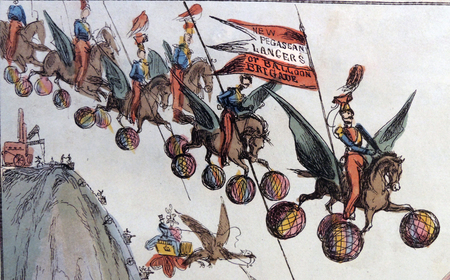
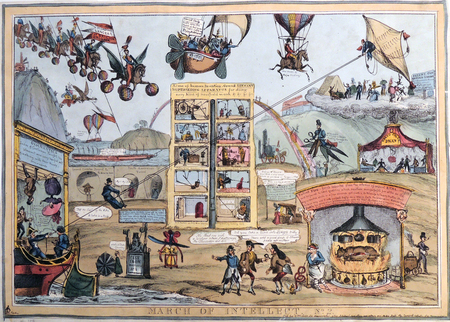
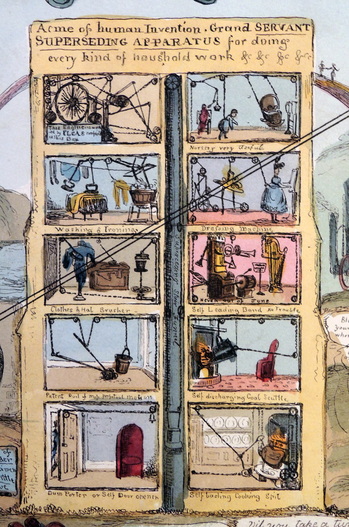
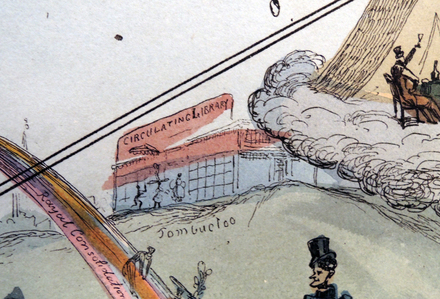
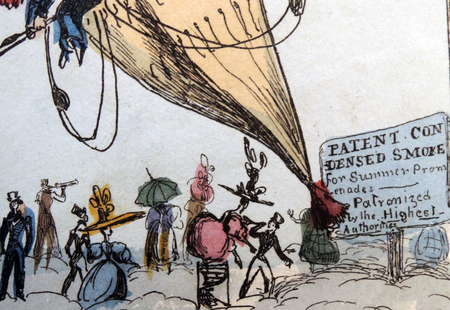
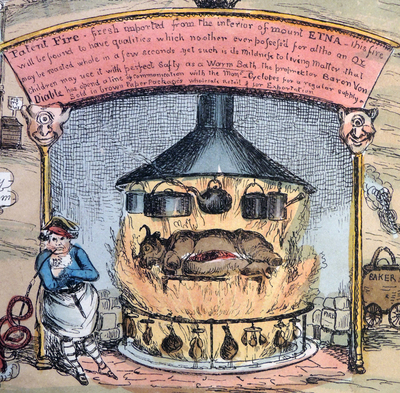
Paul Pry (pseudonym for William Heath 1795-1840), March of Intellect, 1828. Etching with hand coloring. GC014 box 7

James Gillray (1757-1815), The National Parachute or John Bull Conducted to Plenty & Emancipation, 1802. Etching with hand coloring. GC014 box 7

Artist unknown, The Montgolfier, A First Rate of the French Aerial Navy, 1783. Etching with hand coloring. GC014 box 7

On January 3, 1966, The New York Times reported:

An aeronautical collection of more than 400 items that span the decades from the fire balloons of the seventeen-hundreds to the prop-driven planes of the nineteen thirties has been given to Princeton University.

The collection of prints, correspondence, photographs, and models was assembled by Harold Fowler McCormick during the early decades of this century. It was given to Princeton by Alexander Stillman of Chicago, a relative of the McCormick family.

Mr. McCormick, the son of Cyrus McCormick, the founder of the International Harvester Company, and a member of the Princeton Class of 1895, died in 1941.

The McCormick collection begins with a series of letters written by the 18th-century balloonist, Etienne Montgolfier, and ends with memorabilia of the collector’s own career in aviation.

Mr. McCormick’s interest in aviation stemmed form a meeting with the Wright brothers in France in the summer of 1908. He took his first flight two years later, and in 1911, helped organize the First International Aviation Meet, held at Grant Park, Ill.

In 1913, he became one of the earliest communters by air when he used a Curtiss hydroplane to travel between his home in Lake Forest, Ill, and Chicago. He named the craft Edith after his wife, the former Edith Rockefeller.

N. Louis, Le voyage aerien: grande valse triomphale, (Philadelphia: A. Fiot, 1844-1849?) printed music. GC014 box 7

An article about the gift in the Princeton University Library Chronicle, 27, no. 3 (spring 1966): 143+ is available full text: http://libweb5.princeton.edu/visualmaterials/pulc/pulcv27n_3.pdf

More description of the entire collection can be found at http://www.princeton.edu/~ferguson/h-a-ann.html

For information on the McCormick-Romme ‘Umbrella’ airplane, see http://www.ctie.monash.edu.au/hargrave/vought.html

January 29, 2009

Ralph Barton

Figure 1


Figure 2

In 1924, Ralph Waldo Emerson Barton (1891-1931) was asked to serve as an advisory editor to Harold Ross for his new magazine The New Yorker, along with Marc Connelly, George Kaufman, Rea Irvin, Alice Duer Miller, Dorothy Parker, and Alexander Woollcott. These artists and writers were expected to contribute material to be printed anonymously, in exchange for stock, while retaining rights for reprints themselves. In one week alone, in the late 1924s, Barton completed eighty-five drawings. He was at the height of his career and one of the highest paid artists working in New York City. His drawings are, for many, synonymous with the 1920s.

Hundreds, if not thousands, of Barton’s drawings were published unsigned and few survive in their original format. Besides The New Yorker, he worked for Collier’s, The Delineator, Everybody’s magazine, Harper’s Bazaar, Hearst’s International, Judge, Leslie’s Weekly, Liberty, New York Herald Tribune, Photoplay, Puck, Satire, Shadowland, Vanity Fair, and many more. He illustrated many books, including Droll Stories by Honoré de Balzac, Gentlemen Prefer Blondes and But Gentlemen Marry Brunettes by Anita Loos, The Tattooed Countess by Carl Van Vechten, and his own God’s Country. He also made one film, at the urging of his friend Charlie Chaplin, entitled Camille: The Fate of a Coquette, starring Paul Robeson, Sinclair Lewis, George Jean Nathan, Theodore Dreiser, Sherwood Anderson, Alfred Knopf, Ethel Barrymore, Somerset Maugham, and many of his other friends.

The drawings in the Graphic Arts Division were published in Judge under the section “Judge’s Rotogravure section; The News of the Globe in Pictures by Ralph Barton”. They are not included in any published listing of Barton’s work. We can only assume they are from the 1920s.

When Barton shot himself in 1931, he left two notes. The first, titled “Obit,” was an explanation of his suicide, which he attributed to melancholia. Barton wrote, “No one thing is responsible for this and no one person—except myself. If the gossips insist on something more definite and thrilling as a reason, let them choose my pending appointment with the dentist or the fact that I happened to be painfully short of cash at the moment.” The second note was to his housekeeper, leaving her $35 and an apology that it was all he had left.

John Updike (1932-2009) selected only a few, favorite artists to write about in The New Yorker, later republished in Just Looking, and one was Ralph Barton. “Barton’s caricatures are not idignant, like Daumier’s, or frenzied, like Gerald Scarfe’s,” he wrote, “they are decoratively descriptive.” Then, Updike quoted Barton speaking of his own work, “It is not the caricaturist’s business to be penetrating; it is his job to put down the figure a man cuts before his fellows in his attempt to conceal the writhings of his soul.”

Later, in a foreword to Bruce Kellner’s biography on Barton, Updike wrote

“In the fury of his life and career Barton was careless of his work; most of his originals are lost, destroyed by him or by the engravers whose indifferent, coarsely screened reproductions are all we have left. …A lost Manhattan and a lost decade live again in the particulars of Barton’s hectic career. The life was less happy than it should have been, considering its achievement; the best of Barton’s art is like a perfect flower, wiry and fluent, blooming in the wilderness of his era’s commercial art.”

Bruce Kellner, The Last Dandy, Ralph Barton: American Artist, 1891-1931 (Columbia: University of Missouri Press, c1991) Firestone Library (F) NC139.B36 K45 1991

John Updike (1932-2009), Just Looking: Essays on Art (New York: Knopf; Distributed by Random House, 1989) Rare Books (Ex) N71 .U64 1989

Figure 3


Figure 4


Fig. 1: Ralph Barton (1891-1931), The News of the Globe in Pictures (Judge, no date). Pen and ink, wash on paper. Frame 1—4,000 miles of 20-inch reinforced rubber tubing. Frame 2—Mss Carrie Wardrobe. Frame 3—Training polo ponies at Meadowbrook. Frame 4—Silent Cal. Frame 5—Mis Gloria Swanson. Frame 6—Device to let rooms on courts at seaside hotels. Graphic Arts division GA 2006.02584

Fig. 2: Ralph Barton (1891-1931), The News of the Globe in Pictures (Judge, July 12, 192?). Pen and ink, wash on paper. Frame 1—Water sprites at a limpid woodland pool. Frame 2—William Jennings Bryan. Frame 3—A modern Jean Bart. Frame 4—Senatorial entries. Frame 5—Staunch champion of the principles of democracy. Frame 6—Playtime for Americans in Europe. Graphic Arts division GA 2006.01928

Fig. 3: Ralph Barton (1891-1931), The News of the Globe in Pictures (Judge, May 31, 192?). Pen and ink, wash on paper. Frame 1—College prexy in hot water; Dr. Nicholas Murray Butler, of Columbia University being pressed by reporters to back up his recent allegation that several congressmen habitually appear on the floor of the House sober enough to stand alone. Frame 2—The blessings of liberty at the White House; Though denied the ecstasy of shaking their President by the hand, a new ruling at the executive mansion still permits 1,450,000 citizens daily to feast their eyes on him as he works at his desk. Frame 3—Crazy Ik, village idiot of Pt. Barrow, Alaska; said to be the only American citizen who still believes that the Income Tax will be reduced. Frame 4—Borrowing an idea from Hollywood; William Gibbs McAdoo carries a small orchestra as a part of his touring equipment to aid him in working himself up to the proper emotional pitch to make his campaign speeches more effective. Frame 5—Joseph Hergesheimer, Carl Van Vechten, and James Branch Cabell; The only American authors who have never acted in amateur theatricals, honor the bust of Joseph Conrad, the only British author who has never lectured in America. Frame 6—The latest in feminism; New York’s police commissioner, Richard Enright (left) welcomes “Copperette” Sarah Jones (right) head of the Liverpool policewomen who has gone her London sister-officer one better in smart turn-outs by raising a mustache. Graphic Arts division GA 2006.01927

Fig. 4: Ralph Barton (1891-1931), Camera Shots by Ralph Barton (Judge, April 12, 192?). Pen and ink, wash on paper. Frame 1—Reincarnation of Sappho? Sadie Snipt, whose dance recitals have startled Omaha, claims the Greek poetess is re-born in her. Frame 2—America’s premiere showman again turns to Europe for talent; Morris Gest signs the Prince of Wales for eight matinees of his great equestrian act at Madison Square Garden. Frame 3—A gift for the president; Calvin Coolidge receives a mother-of-pearl colander full of brass cole-slaw from an admirer. Frame 4—In training for the White House; Wm.G. McAddo, in Apring Training Camp, learning to throw out the first ball of the season. Frame 5—Playtime at the Capital; Senators and Representatives enjoy a few letters from constituents demanding Income Tax reduction. Frame 6—Notable gathering of leading American reformers; Photographed at a banquet given last month to celebrate Anthony Comstock. Graphic Arts division GA 2009.00076

Continue reading "Ralph Barton" »

January 28, 2009

American Sunday School Union

Unpublished album containing 1000 wood engravings. Graphic Arts Collection (GAX) Oversize Hamilton 1674q

This album holds a collection of wood engravings used in books published by the American Sunday School Union (ASSU) of Philadelphia. Judging from the dates which occasionally occur, the period covered is from the early 1820s to 1831. All the cuts have been carefully organized chronologically and numbered in pen. Over 70 are by George Gilbert, along with designs by Reuben S. Gilbert, Christian F. Gobrecht (1785-1844), Alexander Anderson (1775-1870), and John Warner Barber (1798-1885).

This is book one of two volumes. The second album, beginning with 1831, is held by the Library Company of Philadelphia. Special thanks go to their rare book curator Cornelia King for her research on these sample books.

The ASSU was founded in 1824 in Philadelphia, Pennsylvania to promote early literacy and spiritual development of children, teaching them to read through the use of booklets published by the Union. The ASSU continued its publication program until l960 and some time later changed its name to the American Missionary Fellowship, which is how we know them today. Although the publications were meant to be nondenominational, many of the images tell biblical stories with a conservative leaning. No. 608 shows Adam and Eve in the Garden of Eden with a note below: "Not to be used unless clothed."

January 18, 2009

Jonathan Belcher "Destroy the plate & burn all the impressions"

John Faber (died 1756) after a painting by Richard Phillips (1681-1741), His Excellency Jonathan Belcher, Esqr. 1734. Mezzotint. Gift of Samuel S. Dennis and Charles W. McAlpin, Class of 1888. Graphic Arts division GC 018

This is a mezzotint engraving of Jonathan Belcher (1682-1757) made while he was Royal Governor of Massachusetts Bay and New Hampshire prior to becoming Governor of New Jersey and a strong supporter of the newly founded College of New Jersey (later known as Princeton University). Gov. Belcher gave the college 474 books from his private collection, making our library the sixth largest in the colonies.

“Concerning the Phillips portrait and the engraving of it, Belcher wrote from Boston on August 7, 1734, to his son, Jonathon Belcher, Jr., who was then in London: ‘I see you had rec’d my picture from Mr Caswall. I think it is not much like, tho’ a good piece of paint, done by Mr Phillips of Great Queen Street out of Lincoln’s Inn Fields. I am surprised & much displeas’d at what your uncle writes me of Mr Newman & your having my picture done on a copperplate. How cou’d you presume to do such a thing without my special leave and order? You shou’d be wise and consider the consequences of things before you put ‘em in execution. Such a foolish affair will pull down much envy, and give occasion to your father’s enemies to squirt & squib & what not. It is therefore my order, if this comes to hand timely that you destroy the plate & burn all the impressions taken from it.”

Princeton University Library Chronicle 14, no.4 (Summer 1953): 172.

January 16, 2009

Contributions to Ornithology

Sir William Jardine (1800-1874), Drawings for Contributions to Ornithology, no date. Index to plates inserted. Graphic Arts division GC025

This two volume scrapbook contains 131 leaves of mounted drawings, pattern plates for the colorist, and uncolored proof impressions compiled by the Scottish naturalist William Jardine for his five volume Contributions to Ornithology. The project followed directly after his hugely popular 40 volume Naturalist Library published in 1843 (GAX 2007-0067N), which established his position in Victorian society and his reputation as an ornithologist.

Contributions was issued in parts from 1848 to 1852 and is considered the first British periodical devoted to ornithology. Jardine meant the series to be an annual updating of the latest ornithological information. It was a family project with Jardine as principal organizer, artist, and author. His daughter Catherine Strickland executed many of the plates and his other daughter Helen did some drawing. Other contributors included T.C. Eyton, John Gould, and Philip Sclater.

For more information, see Christine Elisabeth Jackson and Peter Davis, Sir William Jardine: a Life in Natural History (London: Leicester University Press, 2001) Annex B, Fine Hall, QH31.J37 J23 2001

January 15, 2009

Photoxylography and Timothy Cole

Timothy Cole (1852-1931), Abraham Lincoln, 1928. Wood engraving. Graphic Arts division GC030.


Timothy Cole (1852-1931), Untitled portrait of white-haired man, 1917. Wood engraving. Graphic Arts division GC030.

Timothy Cole (not to be confused with the painter Thomas Cole) was a “new school” reproductive wood engraver who made a career of reproducing famous works of art for Scribner’s Monthly. His technique, developed in the 1870s, involved painting a wood block with light-sensitive chemistry, then placing a photographic negative on the block, and developing out the image in a few minutes of sunlight. This allowed him to carve the block without redrawing the image and to create an ink print that had all the subtly of the continuous tone photograph. The technique is sometimes called “photoxylography.”

“Now the engraving is nothing, absolutely nothing,” wrote Cole. “It is the reproduction of the original alone that concerns me … [The engraver] must not speak his own words, nor do his own works, nor think his own thoughts, but must be the organ through which the mind of the artist speaks.”

“Old school” engravers deplored the “new school” kids. William James Linton wrote many articles against reproduction without interpretation, including “Art in Engraving on Wood,” Atlantic Monthly June 1879, criticizing Timothy Cole in particular. As often happens, the younger generation won out and most wood cutting from then on was done with the assistance of photography.

Timothy Cole (1852-1931) after a painting by John Singer Sargent (1856-1925), John D. Rockefeller, Sr., 1921. Wood engraving. Graphic Arts division GC030.

Timothy Cole (1852-1931) after a painting by Albert Gustaf Aristide Edelfelt (1854-1905), Louis Pasteur in His Laboratory, Paris, 1925. Wood engraving. Graphic Arts division GC030.

Continue reading "Photoxylography and Timothy Cole" »

January 9, 2009

Paul Landacre

Jake Zeitlin (1902-198) moved to Los Angeles in 1925 and in only two years, was operating one of the most popular bookstores in the city. Nicknamed At the Sign of the Grasshopper because of the symbol on the front, the shop became a local hangout for writers and artists, who browsed the shelves and enjoyed works of visual art in the shop’s small gallery.

One of the local artists Zeitlin introduced to the neighborhood was Paul Landacre (1893-1963) whose first one-man show was held at the bookstore in 1930 and received a favorable reviewed by Arthur Millier in Prints magazine. The Zeitlin’s and the Landacre’s became good friends and Paul’s wife Margaret even worked as a secretary for the bookshop.

When Zeitlin established his own publishing imprint, Primavera Press, Landacre was asked to illustrate many of the books. The first in 1933 was Marguerite Wilbur’s translation of Alexandre Dumas’ gold rush novel A Gil Blas in California. Pictured at the left is a recently acquired sheet of proofs for chapter headings in this book.

1933 was a busy year for Landacre, who submitted designs for the proposed Limited Editions publication of W.H. Hudson’s Green Mansions. Although some proof pages were printed by Grant Dahlstrom, the design was not selected and these chapter headings (top and bottom) were never published. Note, as Jake Wien below reminds us, that Landacre went on to illustrate three future editions for the Club.

For a bibliography of Primavera Press, see A Garland for Jake Zeitlin, on the occasion of his 65th birthday & the anniversary of his 40th year in the book trade (Los Angeles: Grant Dahlstrom & Saul Marks, 1967) Firestone Library (F) 0334.993.37

January 3, 2009

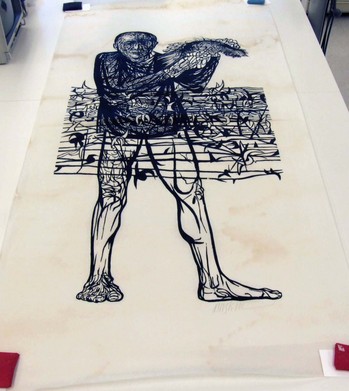
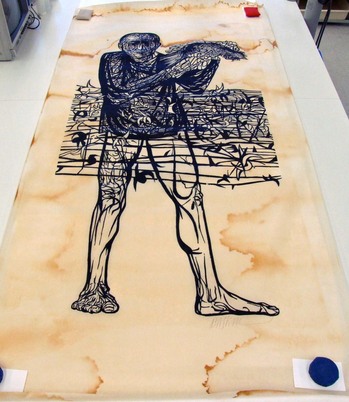
Horrifying Stories from Chile

Guillermo Frommer (born 1953), Relatos espeluznantes [Horrifying Stories] (Santiago, Chile: [printed at the Taller Artes Visuales], 2006). 63 cm. The first volume of the series was published in 2003. This is number two. It is unclear whether there will be others. Graphic Arts Collection (GAX) Oversize 2008-0025E

The Chilean artist Guillermo Frommer had an international education in printmaking. Both his parents were artists and he made his first prints under their direction in Chile. In the 1970s, he studied at the University of Ottawa, Canada, and then, received a degree from the Ontario College of Art in Toronto. His interest in lithography led to a residency at the Tamarind Institute in Albuquerque, New Mexico. Although Tamarind is known primarily for its stone printing, Frommer also worked with xylography, engraving, and silkscreen.

When he returned to Chile in 1987, Frommer joined the Visual Arts Workshop (Taller Artes Visuales or TAV), a printing collective founded in 1974 by artists exempted from the Faculty of Arts at the University of Chile. Today, Frommer is a professor of printing in Santiago and continues to create his own work through the TAV.

December 23, 2008

Scenes from Shakespeare

Henry William Bunbury (1750-1811), Twenty-Two Plates Illustrative of Various Interesting Scenes in the Plays of Shakspeare (London: Published originally by the late T. Macklin, sold by J. Nichols & son, [1792-1796]). Graphic Arts Collection (GA) Oversize Rowlandson 1792.2e

Around the end of the eighteenth century, the most successful London print shop was the Shakespeare Gallery, run by John Boydell. Their most famous project was a series of over one hundred extravagantly large engravings illustrating well-known scenes from Shakespeare’s plays. Boydell’s success led to many imitations, such as the Woodmason’s Shakespeare Gallery and the Irish Shakespeare Gallery. The most ambitious was the Poet’s Gallery, managed by Thomas Macklin.

Macklin hired the popular caricaturist Henry Bunbury to create a similar series of pen and ink and watercolor drawings to illustrate Shakespeare’s plays. Bunbury chose comic, often obscure scenes, emphasizing the outlandish and the ridiculous. His designs were engraved over five year by Francesco Bartolozzi (1727-1815), Peltro William Tomkins (1760-1840), Thomas Cheeseman (active 1780-1790), and Robert Mitchell Meadows (died 1812). The artists only finished twenty-two prints, which in the end was no real competition for Boydell.

See also Andrew White Tuer (1838-1900), Bartolozzi and his works: a biographical and descriptive account of the life and career of Francesco Bartolozzi, R.A. (illustrated): with some observations on the present demand for and value of his prints …: together with a list of upwards of 2,000 … of the great engraver’s works (London: Field & Tuer; New York: Scribner & Welford, [1882]) Graphic Arts Collection (GA) Oversize Rowlandson 953.2q

December 21, 2008

The Four Stages of Cruelty

William Hogarth, First Stage of Cruelty, 1 February 1751. Etching and engraving. Graphic Arts GA113


William Hogarth, Second Stage of Cruelty, 1 February 1751. Etching and engraving. Graphic Arts GA113


William Hogarth, Cruelty in Perfection, 1 February 1751. Etching and engraving. Graphic Arts GA113


William Hogarth, The Reward of Cruelty, 1 February 1751. Etching and engraving. Graphic Arts GA113


William Hogarth (1697-1764) created this print series “in the hopes of preventing in some degree that cruel treatment of poor Animals which makes the streets of London more disagreeable to the human mind, than any thing what ever….”
The first plate finds Tom Nero (center) as a young boy torchering a dog.

Text transcribed:

While various Scenes of sportive Woe
The Infant Race employ.
And tortur’d Victims bleeding shew
The Tyrant in the boy

Behold a Youth of gentler Heart
To spare the Creature’s pain
O take, he cries — take all my Tart.
But Tears and Tart are vain.

Learn from this fair Example — You
Whom savage Sports delight
How Cruelty disgusts the view
While Pity charms the sight.


In the second plate, Nero is a young man working as a coach driver. He has been mistreating his horse, which now has a broken leg. All around them are examples of cruelty to animals on the public streets of London.

The generous Steed in hoary Age
Subdu’d by Labour lies,
And mourns a cruel Master’s rage,
While Nature Strength denies.

The tender lamb o’er drove and faint
Amidst expiring Throws
Bleats forth its innocent complaint
And dies beneath the Blows.

Inhuman Wretch! Say whence proceeds
This coward Cruelty?
What Int’rest springs from barb’rous deeds?
What Joy from Misery?


In Hogarth’s third plate, Nero has become a highway robber. He is being apprehended for killing Ann Gill, his pregnant lover.

To lawless love when once betray’d,
soon crime to crime succeeds:
At length beguil’d to theft,
the maid By her beguiler bleeds.

Yet learn, Seducing Man.’nor Night.
with all its sable Cloud.
Can screen the guilty deed from sight;
Foul Murder cries aloud.

The gaping Wounds, and blood stain’d steel.
Now shock his trembling Soul:
But Oh! what Pangs his Breast must feel.
When Death his knell shall toll.

In the final scene, Nero has been hanged and his body is being dissected in the Cutlerian theatre near Newgate prison. The public was invited to view these gruesome dissections and this scene reflects back on the first plate, where the young boys staged their own theater of gruesome operations.

Behold the Villain’s dire disgrace!
Not Death itself can end.
He finds no peaceful Burial-place;
His breathless Corse, no friend.

Torn from the Root, that nicked Tongue,
Which daily snore and curst!
Those Eyeballs, from their Sockets nrung,
That glori’d with lawless lust!

His Heart, expos’d to prying Eyes,
To Pity has no Claim:
But, dreadful! from his Bones shall rise,
His Monument of shame.

December 20, 2008

Hindu Gods


Hindu Gods ([India?: s.n., ca. 1850]). This volume consists exclusively of 78 hand-colored drawings of Hindu gods. Graphic Arts Collection (GAX) ND2047 .H562 1850. Gift of Hibben (Class of 1924) and Mrs. Ziesing.

December 14, 2008

Théâtre des Champs-Élysées and La Revue Nègre

Paul Colin (1892-1985), Le tumulte noir (Paris: Editions d’Art Succès, [1927]). Graphic Arts Collection (GAX) Oversize 2003-0018E

Paul Colin created posters and stage designs for theaters throughout Paris in the 1920s. His favorite was the Théâtre des Champs-Élysées, where La Revue Nègre performed led by the dancer Josephine Baker (1906-1975). In 1927, Colin was inspired by the Revue to create a portfolio entitled Le Tumulte Noir or The Black Craze. He drew his designs directly onto lithographic stones, which were printed in black, brown, or gray inks and then, hand-colored by the master of pochoir, Jean Saudé. The images include many figures of contemporary French popular culture, such as Maurice Chevalier, Ida Rubinstein, the film actress Jane Marnac, the theatrical caricaturist Sem, and others.

For more information, see the introduction by Henry Louis Gates, Jr., and Karen C.C. Dalton in Josephine Baker and La revue nègre (1998). Marquand Library Oversize NE2349.5.C66 A4 1998q

December 12, 2008

Tea Tax Tempest

Carl Gottlieb Guttenberg (1743-1790), The Tea Tax Tempest, or the Anglo-American Revolution, 1778. Engraving. GC077, Graphic Arts 2-14-G.
Reproduction from Amelia Rauser, “Death or Liberty: British Political Prints and the Struggle for Symbols in the American Revolution,” Oxford Art Journal, 21, No. 2 (1998), 155.
Reproduction from British Museum: A Tea-Tax-Tempest or Old Time with His Magick-Lantern (London: William Humphrey, 1783).

In this 41 x 49 cm. engraving, the winged figure of Father Time is seen balancing a magic lantern on a globe of the world. The image being projected has at its center a steaming tea pot (the American Revolution), cooking on a fire fanned by a cock (symbolizing France), with British soldiers on one side and American soldiers on the other. Time is explaining the scene to four viewers, who represent America, Africa, Europe, and Asia.

Guttenberg was not the original artist of this scene but only adapted it from a 1774 print by John Dixon, shown at the left. Dixon’s print, entitled The Oracle, was suppose to portray a hopeful view of Great Britain at a time when not only America but Scotland and Ireland were threatening revolt. Guttenberg literally reverses the image and replaces the pastoral scene with one of impending war.

Not to be undone by the German artist, an unidentified British caricaturist redrew the print once more in 1783 and put words into Father Time’s mouth:

There you see the little Hot Spit Fire Tea pot that has done all the Mischief - There you see the Old British Lion basking before the American Bon Fire whilst the French Cock is blowing up a storm about his Ears to Destroy him and his young Welpes - There you See Miss America grasping at the Cap of Liberty - There you see The British Forces be yok’d and be cramp’d flying before the Congress Men - There you see the thirteen Stripes and Rattle-Snake exalted - There you see the Stamp’d Paper help to make the Pot Boil -There you See &c &c &c.

Some copies of Guttenberg’s print include the title engraved in English, French, and German. Princeton’s impression has only the English.

November 29, 2008

Combat Paper Portfolio

You Are Not My Enemy. Combat Paper Portfolio 4 (Vermont: People’s Republic of Paper, 2008). Copy 8 of 8. Graphic Arts (GAX) 2008- in process

After six years in the army…[Drew] Cameron moved to Vermont and took a $10 papermaking course at a community college. Something clicked. He began practicing the trade out of the Green Door Studio artists’ collective in Burlington. One night back in 2007, Cameron took his old fatigues out of the closet. “I hadn’t put that thing on my body since Iraq,” he says. “I was thinking about it systematically at first. Where do I cut? Well, I’ll start with my left arm. Then I started feeling this overwhelming feeling of empowerment and emotional expression. I started ripping and pulling at my uniform until I was down to my skivvies.” From those scraps he created the first sheet of Combat Paper. http://www.veteransforcommonsense.org/articleid/11262

Combat Paper is a publication of the People’s Republic of Paper, a collaboration betwen Iraqi veterans, activists, and artists. This project is conceived & coordinated by Drew Matott, former director of Green Door Studio in Burlington, Vermont, and Drew Cameron, current director of Green Door Studio and an Iraq War Veteran.

Through papermaking workshops veterans use their uniforms worn in combat to create cathartic works of art. The uniforms are cut up, literally beaten to a pulp, and formed into sheets of paper. Veterans use the transformative process of papermaking to reclaim their uniform as art and begin to embrace their experiences as a soldier in war.

For more information on the Combat Paper Project, see: http://www.combatpaper.org/about.html

One of several videos of the project can be seen at: http://www.youtube.com/watch?v=wUtXYCihavw

November 26, 2008

New Year's Gifts for the People

J.J. Grandville (1803-1847), Etrennes au Peuple (New Year’s Gifts for the People). Lithograph on China paper. Published in La Caricature, no 113, planche 235, January 3, 1833.

The French caricaturist Jean Ignace Isidore Gérard, working under the pseudonym of J.J. Grandville, created a number of plates for French magazines including Le Silhouette, L’Artiste, Le Charivari, and La Caricature. This satirical scene denounces the repressive actions of the French government under Louis-Philippe, which sought to limit freedom of the press and personal expression. The image presents a man being stabbed in the back and pelted with a rain of iconic objects, including pears (representing Louis-Philippe), crutches (Talleyrand, who was then ambassador in London), a parsley pot (Jean-Charles Persil who attacked the newspapers as a prosecutor under Louis-Philippe), guns, chains, keys, bolts, cross, medals, cords, scissors, hats, bell and shoes, each representing members of the government.

This print is part of a recent donation generously given by Dr. William Helfand, president of the Grolier Club and a consultant to the National Library of Medicine, the Philadelphia Museum of Art and other institutions in areas relating to art and medicine. Dr. Helfand has written five books including Quack, Quack, Quack: the Sellers of Nostrums in Prints, Posters, Ephemera & Books… (GA Oversize 2005-0625Q), and The Picture of Health (Marquand Library N8223 .H44 1991) He has also published a number of articles on prints, caricatures, posters and ephemera relating to pharmacy and medicine. This posting shows only a few of the wonderful eighteenth- and nineteenth-century prints coming to Princeton thanks to Dr. Helfand.

Paul Gavarni (1804-1866), Enfant Terrible, 1833. Lithograph.

Honoré Daumier (1808-1879), Le Malade imaginaire (Hypocondriac), 1833. Lithograph.


After the painting by Thomas Wyck (ca.1616-1677), The Alchemist in his Laboratory. Engraving, ca. 1700.

Engraved by Jean-Jacques de Boissieu (1736-1810) after a drawing by Karl Du Jardin, Les Grands Charlatans, or Charlatan with guitar player and crowd. Engraving (drawing 1657), printed 1772.

November 18, 2008

The Penographic

…the writer is enabled to use it for 10 or 12 hours with the same ease as with a pencil…!

Patent Penographic or Writing Instrument [broadside] (London: W. Robson & Co., ca.1819). Graphic Arts division GAX 2008- in process

Scheffer’s Penographic, patented in 1819, was one of the first workable fountain pens. Its secret was a flexible tube made of a goose quill and pig’s bladder. Pressure was exerted on a lever and a knob to propel ink into the nib when desired.

November 13, 2008

The End of the Stock-Market World

Last December 2007, I posted an entry on Het Groote Tafereel der Dwaasheid or The Great Mirror of Folly. Each edition has a slightly different group of prints: Harvard’s copy has 71, Princeton’s 73, and each includes several not in the other volume.

This page, originally engraved by Monogrammist C L, later altered by an anonymous 18th-century Dutch engraver after Pieter Quast (1606-1647) and entitled De Actiewerld op Haar Ende (The End of the Stock-Market World), is included in Harvard’s copy but not Princeton’s. However, we recently acquired an impression to help complete our collection of the prints for in this anonymous 1720 project.

The central figure in this caricature is the philosopher Diogenes (ca. 412-323 BCE). Considered the founder of Cynicism, he eschewed worldly pleasures, wore coarse clothing, and pursued practical good. He is often shown carrying a lantern, searching for an honest person, but in this print his lantern has been given away (presumably having given up finding an honest man). He has lost everything in the stock-market bubble of 1720 from investing in the South Seas Company. As the text beneath the image concludes,

How easily can such a flier be upset by a South Sea blast or a Quinquempoix* bubble! So whoever gives his name and honor for the money, and adores it like an idol, deserves to be scorned in this fashion.

*Quinquempoix was the name of the street where the Parisian money market was located.

This print was first engraved around 1670 by the Monogrammist C L to satirize the tulip mania in the Netherlands. The plate was then altered to satirize the stock-market speculation of 1720.


November 10, 2008

Verdun from the Meuse

James Alphege Brewer (fl.1909-1938), Verdun from the Meuse, 1916. Etching with watercolor, signed and titled in pencil. GA 2008.01068

The biography of J. Alphege Brewer has yet to be written and details are sketchy. He was the son of the artist H. W. Brewer and his brother H. C. Brewer also painted. Alphege was born around 1882 in Great Britain but moved to Paris, where he lived most of his professional career. He was especially successful drawing architectural views of the great cathedrals of France.

This view of the medieval city of Verdun, in the Lorraine region of northeast France, is typical of Brewer’s work. The river Meuse in the foreground places the viewer on a low horizon, giving the Cathédrale Notre-Dame de Verdun a dramatic central focus.

We are grateful to Robert Milevski, our Preservation Librarian, for bringing this work to the attention of the Graphic Arts division.

November 7, 2008

George Washington 1732-1799

Charles Henry Hart (1847-1918), Catalogue of the Engraved Portraits of Washington (New York: The Grolier Club, 1904). “One of an edition of four hundred and twenty-five copies printed on American hand-made paper …” Graphic Arts division GAX 2008- in process

In 1904, the Grolier Club in New York City published a sumptuous, limited edition catalogue in honor of the centenary of George Washington’s death. The book features not only a complete listing of Washington portrait engravings but also 31 original mezzotint and photogravure prints.

Frank O. Briggs, of Trenton, N.J. purchased a copy, which eventually made it to the graphic arts division at Princeton University. Inside the front cover are a number of sheets of cream wove paper with the watermark of George Washington.

“Photogravure after mezzotint engraved by Valentine Green.”
“Engraved in mezzotint by S. Arlent Edwards from an original in oil, which was probably executed in 1798 or 1799.”

The Miliani Mill, Fabriano, Italy, created this watermark of Washington in recognition of the bicentennial celebration of his birth in 1932. Later, the Graphic Arts collection used it as a keepsake for their friends. The portrait is after a bust of Washington done by the sculptor Jean-Antoine Houdon, who visited Mount Vernon in 1785. Houdon’s profile is said to have been one of Washington’s favorites.

“Photogravure after line engraving
attributed to John Norman.”

November 1, 2008

Cuban postcards

Artists Unidentified. Postcards of Cuba, no dates but approximately 1900-1920. Graphic Arts division, GC141 Postcards Collection

The graphic arts division has a number of postcard collections, this one includes 2,393 postcards of Cuba. Most are collotypes and half-tone images, but a few have original photographs or prints. The collection now has a complete finding aid, thanks to the wonderful processing of Kate Carroll, class of 2009. Here’s a summary:

Box 1 Havana: homes, buildings, parks, plazas and surroundings.

Box 2 Havana: Views of the bay, harbors, main monuments, ships, fortresses, ramparts, aerial views and streets.

Box 3 Havana: Churches, monuments, cemetery, streets. Includes four famous postcards series, tourism ads, Bacardi and beer ads and patriotic propaganda related to the US and Cuba.

Box 4 Havana: Hotels, beaches, clubs, casinos, zoo, cabarets, restaurants, musicians, carnival, hippodrome, theatre, bull fights and cockfights.

Box 5 Life in Cuba and the country: Sugar cane industry, tobacco industry, homes, palms, rivers, transportation, soldiers, families, children, typical scenes, carriages, shops and street sellers.

Box 6 Cities from the interior: Pinar del Rio, Isla de Pinos, Matanzas, Cardenas, Varadero, Santa Clara, Cienfuegos, Camaguey, etc.

Box 7 Oriente: Santiago de Cuba, Guantanamo and other regions.

Box 8 Oversize.

October 30, 2008

Paul Sandby

Paul Sandby, Album of 18th-century Scottish etchings. Graphic Arts division (GAX) GA2008- in process


Called the father of English watercolor, Paul Sandby (1731-1809) was a founding member of the Royal Academy of Arts, London. This album stems from Sandby’s early Scottish period, when he was a draughtsman with the military survey of the highlands. It holds 75 etchings on 27 sheets, assembled and printed by the artist, with dates ranging from 1747 to 1758. The etchings are primarily landscapes, with occassional Scottish street characters intermixed. One holds the comment “etched on the spot P. Sandby 1750.”

The album, with late 18th century half calf and blue/greenish marbled paper covered boards, has no title page. The only identification is a book label reading “Fasque,” which is a Scottish country house in Kincardineshire, built in 1809. The estate was purchased in 1829 by Sir John Gladstone, father of William Gladstone.

October 28, 2008

The Pic-Nic Orchestra

Edward Francis Burney (1760-1848) after James Gillray (1757-1815), The Pic-Nic Orchestra, ca.1802. Pen and ink drawing, watercolor. Transferred to graphic arts division (GAX) 2008- in process

The Pic-Nic Society was an exclusive London club, under the leadership of Lady Albina Buckinghamshire (seen here at the piano). They performed fashionable amusements for private aristocratic audiences, which were mercilessly attacked by the newspaper critics and journalists. The British caricaturist James Gillray printed at least three satires of the group, including the design seen here. The sheet owned by Princeton is attributed to Edward Francis Burney, completed after the Gilray hand-colored print was published by Hannah Humphrey on 23 April 1802 from her St. James’s Street print shop.

Also taking part in the performance is Colonel Henry Francis Greville, playing a fiddle. Note the paper hanging from his coat pocket. In the final print, words were added: “Pic Nic Concert—Imitations—Nightingale by Lord C.—Tom Tit Lord ME—Jack daw Gent G.—Screech Owl Lady B—Poll Parrot…” Perhaps the words were too small for Burney to duplicate with the brush.

On the left is Lord Mount (Richard) Edgcumbe playing a cello and behind him is Lord George James Cholmondeley on the flute. Seated on the pianist’s left is Lady Salisbury (Mary Amelia) playing the French horn with one hand. To the extreme right, opposite Greville, is an unidentified lady’s arm holding a trumpet.

Bibliography

Thomas Wright (1810-1877), Historical and descriptive account of the caricatures of James Gillray: comprising a political and humorous history of the latter part of the reign of George the Third (London: Henry G. Bohn, 1851.) Rare Books (Ex) NE642.G42 W9

Draper Hill, Mr. Gillray the caricaturist, a biography (Greenwich, Conn., Phaidon Publishers, [1965]) Firestone Library (F) NE642.G42 H5

James Gillray (1756-1815), The works of James Gillray, the caricaturist: with the story of his life and times (London: Chatto and Windus, [1873]) Graphic Arts Collection (GA) Rowlandson 989.2

October 27, 2008

Panoramas

Robert Burford (1791-1861), A Miscellaneous Collection of Panoramas and Others (London, 1821-32). 14 v. in 1. Graphic Arts division (GAX) in process

Panoramic displays, offering 360 degree views of exotic scenes, were enormously popular in the 1800s. Some were cleverly painted and lit to give the illusion of day turning into night. Some showed important historical events, such as battle scenes.

The panorama was invented about 1787 by the Scottish-Irish artist Robert Barker (1739-1806). From 1794 to 1863, his family ran an exhibition theater on Leicester Square, where the largest views were about 30 feet high by 90 feet across. Barker’s success led to many others such theaters throughout Europe and the United States.

Barker applied for a patent for his invention, which he called La nature à coup d’oeil, for “representing natural objects … designed so as to make observers, on whatever situation he may wish they should imagine themselves, feel as if really on the very spot.”

For more information, see the CUNY website: http://newman.baruch.cuny.edu/digital/2003/panorama/new_001.htm

Contents:
No.1, Guide to the model of the battle of Waterloo.
No.2, A descriptive account of a series of pictures, representing some of the most important battles fought by the French armies in Egypt, Italy, Germany and Spain between the years 1792 and 1812.
No.3, Description of the Egyptian tomb, discovered by G.Belzoni.
No.4, Description du mausolée du maréchal Comte de Saxe, érigé dans l’Église de St.-Thomas, à Strasbourg.
No.5, Description of a view of the city and lake of Geneva, and surrounding country.
No.6, Description of a view of the town of Sydney, New South Wales; the harbour of Port Jackson and surrounding country.
No.7, Description of a view of the city of Florence, and the surrounding country.
No.8, Descriptive catalogue of the gallery of Europe & America.
No.9, Descriptive catalogue of the gallery of Asia & Africa.
No.10, Descriptive catalogue of the cosmorama panoramic exhibition, 209, Regent Street.
No.11, Description of the island and city of Corfu
No.12, Catalogue of the exhibition, called Modern Mexico.
No.13, Description of a view of the city of Mexico, and surrounding country.
No.14, Description of a view of the city of Edinburgh, and surrounding country.

October 15, 2008

Thomas Bewick

At the close of the 18th century, printmaking was revolutionized by the English wood engraver Thomas Bewick (1753-1828), and the German lithographer Aloys Senefelder (1771-1834). The processes developed by these men brought innovation in fine art printing and in commercial book illustration.


Copperplate engraving

copperplate engraving

Wood engraving

Bewick is remembered for his wood engraved masterworks A General History of Quadrupeds (1790), and History of British Birds Vol. I (1797), Vol. II (1804). However, his firm printed work in all media, including engraved wood, glass, silver, and traditional copperplate engraving.


Wood engraving


Wood engraving

Copperplate engraving

When Bewick died in 1828, his son Robert took over the business and published two further editions of the Birds in 1832 and 1847, and a large wood engraved Waiting for Death in 1832. After the death of the rest of the family, Julia Boyd compiled the volume seen here, documenting both copperplate and wood engravings in Bewick Gleanings: Being Impressions from Copperplates and Wood Blocks Engraved in the Bewick Workshop… (Newcastle-upon-Tyne: Andrew Reid, 1886). Graphic Arts: Reference Collection (GARF) Oversize NE1212.B5 xB6q

October 12, 2008

Mexican News

Alfred Jones (1819-1900) after a painting by Richard Caton Woodville (1825-1855), Mexican News. Published by the American Art Union, 1851. Hand colored engraving. Gift of Leonard L. Milberg, Class of 1953. Graphic Arts division GA2008- in process

Between 1846 and 1847, the United States was at war with Mexico. Artists of the extremely influential American Art Union (AAU) created a number of prints, paintings, and maps showing the events and characters involved in the war to satisfy an engaged public.

One of the most successful was the oil painting by Richard Caton Woodville (1825-1955) entitled War News from Mexico, which shows a dapper-looking man reading the news aloud to a small crowd on the porch of the American Hotel. Painted in 1848 while Woodville was an art student in Düsseldorf, the canvas was exhibited at the AAU’s gallery in 1849 and reproduced in the AAU Bulletin, which circulated to its nearly 19,000 members.

George Austen, the AAU treasurer, purchased the painting and commissioned Alfred Jones (1819-1900) to create two color engravings of the scene—a large folio and the other a small print—which were published by the AAU in 1851. Princeton owns copies of both prints.

Note: This work is by the American artist Woodville who died at the age of 30, not to be confused with the British artist of the same name (1856-1927) who created many war and genre scenes for the Illustrated London News.

October 7, 2008

The Stonemasons Guild of Strasbourg

Johannes Striedbeck (1707-1772), Certificate from the Stonemasons Guild of Strasbourg. Engraving. 1771. Graphic Arts division GA 2008.00111

This view of Strasbourg, France, set within an elaborate border, includes the arms of the Upper and Lower Alsace. There was once a large wax seal at the bottom center, no longer attached. The inscription reads:

Wir Geschwohrne Ober- und andere Meister des Ehrs. Handwercks derer Steinmetzen, Steinhauser und Maurer in der Stadt Strassburg bescheinen hiermit, das gegenwartiger Gesell Nahmens Johann Samuel Imhoft … .

A guild is an organization of men and women in a particular occupation. Guilds were first formed in the Middle Ages and craftspeople would have been unable to work without being a member of the guild. Members were bound by a code of quality and price, but could also obtain assistance from the guild, such as funeral costs. Guilds oversaw a craftsman’s progress from apprentice to master, maintained the quality and ownership of the craft. A stonemason’s “lodge” was located at the job site and was the place where masons gathered, received instruction, and stored their tools.

Until the capture of the city by France in 1681, the headquarters of the German stonemasons was in Strasbourg (even as late as 1760 the Strasbourg lodge still claimed tribute from the lodges of Germany).

October 5, 2008

Manhattan 3

Lyonel Feininger (1871-1956), Manhattan 3, stone 2, 1955 (L19). Lithograph. Graphic Arts division GAX 2008- in process

The American artist Lyonel Feininger made a name for himself in the early years of the twentieth century working in Germany alongside members of the Fauves and later the Blaue Reiter. In 1919, he joined Walter Gropius (1883-1969) serving as the first master of the Bauhaus printmaking workshop in Weimar.

Late in the 1930s, Feininger resettled in New York City and his imagery reflected his interest in the growth of that urban center. In 1940, he began a series of abstract oil paintings entitled Manhattan. Master lithographer George C. Miller (1894-1965) collaborated with Feininger to transfer the images to stone for a second series of Manhattan cityscapes on paper. The final view seen here, Manhattan 3, stone 2 was completed by the two men a year before Feininger’s death. This print is one of only eight early impressions left unsigned.

October 4, 2008

The Sword is Drawn!

Kenyon Cox (1856-1919), “The Sword is Drawn, the Navy Upholds It!”, published by the H.C. Miner Lithograph Company, New York, 1917. Graphic Arts division GC156 World War Posters Collection.

In 1914, when war broke out in Europe, the American painter Kenyon Cox joined the American Artists’ Committee of One Hundred, founded to help French artists and their families. Three years later, when the United States entered the war, Cox assisted President Wilson in the design of propaganda to help unify the country.

His most important work was a recruiting poster for the U.S. Navy, seen above. The finished painting was reproduced in an enormous lithograph, 42 x 26 inches. When a copy of the finished poster was sent to him by the Navy Publicity Bureau, he wrote, “It’s very well reproduced, on the whole, by lithography. They’ve weakened and prettified the head a little, but it was either that or caricaturing it into a plug-ugly, and perhaps it’s best as it is.”

September 28, 2008

Tweedledee and Sweedledum

Thomas Nast (1840-1902), “What are you laughing at? To the victor belong the spoils,” Published by Harper’s Weekly, 25 November 1871. Wood engraving. Graphic Arts division GAX Nast Collection

From 1868 to 1871, four Tammany Hall Democrats ran the government of New York City: William Marcy Tweed, alias “Big Bill” or “Boss Tweed”; Peter Barr Sweeny, also called “Brains”; Richard B. Connolly, known as “Slippery Dick”; and A. Oakey Hall, referred to as “O.K. Haul”. It has been estimated that these men stole from $75,000,000 to $200,000,000 from the NYC treasury.

The German-American cartoonist Thomas Nast (1840-1902) referred to Tweed and Sweeny as Tweedledee and Sweedledum, as he waged a campaign to remove the corrupt officials from power through his caricatures in Harper’s Weekly and The New York Times.

Nast’s assault was so sharp and successful that Tweed presented a bill to the State Legislature as an official protest against “an artist encouraged to send forth in a paper that calls itself a “Journal of Civilization” pictures vulgar and blasphemous, for the purpose of arousing the prejudices of the community against a wrong which exists only in their imagination.” There is no doubt that Assembly Bill No. 169 of March 31, 1870, was directed at the “Nast-y artist of Harper’s Hell Weekly—a Journal of Devilization.”

When this did little to stop Nast, Tweed gave orders to his Board of Education to reject all Harper bids for schoolbooks and to throw out those already purchased. More than $50,000 of public property was destroyed and replaced by books from the New York Printing Company (controlled by Tammany Hall).

Harper’s continued publishing Nast’s political cartoons, although Nast moved his family to New Jersey after receiving death threats.

Tweed and his compatriots were finally removed from office in November 1871. One of several celebratory cartoons drawn by Nast depicts Tweed as Marius among the ruins of Carthage, seen above. While Tweed is defeated, the New York Treasury is left demolished and empty.

For more details, see Albert Bigelow Paine, Th. Nast: His Period and His Pictures (New York: Macmillan Company, 1904) Firestone NE 539.N18 P16

September 20, 2008

A Murder Mystery Illustrated by A.B. Frost

A.B. Frost (1851-1928), illustration for “On the Altar of Hunger” by Hugh Wiley (Scribner’s Magazine, August 1917, p. 177). Ink wash with gouche highlights. Graphic Arts division GAX 2008-

The American artist Arthur Burdett Frost produced illustrations for nearly 100 books from 1876 until his death in 1928. He worked alongside Howard Pyle and Frederic Remington for the leading publishers of the day, including Harper & Brothers and Scribner’s. While he made his living primarily as a commercial artist, Frost studied painting with Thomas Eakins and William Merritt Chase at the Pennsylvania Academy of the Fine Art and lived for awhile in Paris, hoping for success as a “serious painter” [his words]. Although he never gave up painting entirely, in 1914 Frost and his family returned to the United States and he resumed work as an illustrator.

In 1917, Frost wrote “… am going to take up caricaturing with a view of getting into the syndicate job. If it all goes at all it means better pay that I could get in any other way. Caricature is with me a separate thing from my life. I can draw absurd things that amuse others but do not affect me. I am wretchedly unhappy and always will be but I can make “comic” pictures just as I always did.”

One of the commissions he recieved that year was to illustrate a short story by the mystery writer Hugh Wiley. Wiley is best known today for his character James Lee Wong, who was the focus of a series of stories in Collier’s magazine and then, in movies as played by Boris Karloff. Wiley’s short story “On the Altar of Hunger,” illustrated by Frost, appeared in the August issue of Scribner’s Magazine, and later, unillustrated, in 50 Best American Short Stories 1915-1939 edited by Edward O’Brien (New York: Literary Guild of America [1939]) Firestone Library (F) 3588.684.2

Page 177 of Scribner’s shows the published version of Frost’s ink wash drawing, now in the collection of graphic arts. The choice of blue is interesting, since in the 20th century, magazine illustrators made corrections in blue, which could then be screened out of the published image. Here those elements are included as an added tone.

September 17, 2008

Ticket to Pasquin: A Dramatick Satire On The Times

The Author’s Benefit Pasquin, etching, 1736 or after. Formerly attributed to William Hogarth; currently attributed to Joseph Sympson. Graphic Arts division GA 2008- in process

This print appears to be an admission ticket for a benefit performance of Henry Fielding’s Pasquin, first performed in April 1736. It depicts a stage scene with seven performers, a dog and a cat, and in the background, two tightrope walkers accompanied by an ape; framed with a satyr on either side.

Originally attributed to William Hogarth (a friend and colleague of Fielding), the etching is a forgery. It was later attributed to Joseph Sympson, although that attribution is also questioned by some historians. In particular, Ronald Paulson wrote two different explanations for this print in Hogarth’s Graphic Works, if you look at both the 1965 and 1989 editions (Marquand Library (SA) ND497.H7 A35 and ND497.H7 A35 1989q).

Henry Fielding (1707-1754) was a British writer, playwright and journalist. His satirical comedy Pasquin; A Dramatick Satire On The Times Being The Rehearsal Of Two Plays: Viz., A Comedy Called The Election, And A Tragedy Called The Life And Death Of Common Sense, opened at London’s Haymarket Theatre.

A year earlier, Fielding had taken over management of the Little Theatre in the Haymarket and formed a company he called “Great Mogul’s Company of English Comedians.” That winter, he launched Pasquin to enormous success. His play was a brutal satire of the contemporary British government under Sir Robert Walpole, who retaliated with the Theatrical Licensing Act of 1737 and effectively ended Fielding’s brief West End career.

It may have been this political drama that built a market for the forged Fielding ticket.

September 6, 2008

Rowlandson's Distillers

Thomas Rowlandson (1756-1827), Distillers Looking into Their Own Business (London: Thos. Tegg, 111 Cheapside. October 10, 1811). Etching. Inscribed in plate: Price one shilling coloured. Tegg no. 100. c.1 Gift of Dickson Q. Brown, Class of 1895. c.2 Gift of Bruce Willsie, Class of 1986. GA 2006.00684

Thomas Rowlandson was one of several prolific artists who sold satirical designs to the London publisher Thomas Tegg (176-1846). Tegg's bookshop was well-placed at 111 Cheapside--known for its cheap reproductions of remaindered or out-of-copyright books. He often reissued the same plate over several years, each time hand colored by whatever colorist was on staff at the time. We often collect several issues of the same image, to compare the result of different coloring.

Rowlandson's print is one of many commenting on the underground distribution of gin in London after the Gin Act of 1751, which prohibited distillers from selling to unlicensed merchants and charged high fees to those with a license. This led to hundreds of illegal stills across the city. The alcohol was often flavored with turpentine . . . or anything else that was handy.

These operations closed in 1830, when the Duke of Wellington's administration passed the Sale of Beer Act, removing all taxes on beer and allowing retail sale of beer on payment of a two-guinea fee.

August 30, 2008

Toulouse-Lautrec

Henri de Toulouse-Lautrec (1864-1901), Cover of the portfolio L’estampe originale, no. 1 1893. Lithograph. Graphic Arts division, French prints G9

Toulouse-Lautrec contributed two designs for covers to L’estampe originale, which offered an original lithograph to its subscribers three times each year between 1893 and 1895. This lithograph is the first. It shows dancer and singer Jane Avril studying a fresh impression at the Paris lithography studio of Édouard Ancourt. The master printmaker at the press is Père Cotelle

Although only around 100 copies of this print were made, it has become one of the iconic images of the 1890s. Indeed, Toulouse-Lautrec’s colorful lithographic posters are almost synonymous with the Belle Époque. Inspired by Japanese woodblock prints, note the flatness of the design, a strong diagonal, and the large areas of muted color.

August 29, 2008

Cartoons

Al Capp (1909-1979), Fust is thar anyone else yo’druther come home to?, 1976. Screen print. Graphic arts division GA 2008.00735

The cartoon character Li’l Abner was created in the 1930s by Alfred G. Caplin (1909-1979), better known by his pseudonym Al Capp. At that time, Capp was the youngest syndicated cartoonist in America and Abner was the most popular of all American cartoon characters. The strip ran from 1934 to 1977, when Capp stopped drawing it.

Graphic arts holds a number of cartoons, both contemporary and historical. Several years ago, our good friend and a splendid cartoonist Henry Martin, class of 1948, mounted a website of selections from the collection, which can still be viewed at: http://libweb5.princeton.edu/Visual_Materials/gallery/index.html

August 17, 2008

Les costumes grotesques

Nicolas de Larmessin II (ca. 1638-1694), Habit d’Imprimeur en Lettres (The Printer’s Costume), ca. 1680. Engraving. Graphic Arts GA 2007.04409.

This copper plate engraving is from Les costumes grotesques et les metiers or the Fancy Trade Costumes series. In the series, over 70 artisans are dressed in the materials of their occupation, in this case the tools of a printer.

Nicolas de Larmessin II is one member of a family of printmakers and booksellers, many with the same name, leading to much confusion in attributing their work. The family had their own publishing house in Paris, where they designed and printed books, prints, calendars, and other popular works on paper.

To see more of Larmessin’s work, look at: Les avgvstes representations de tovs les roys de France depvis Pharamond ivsqv’a Lovys XIIII: dit Le Grand, a present regnant, 1679: auec vn abrège historique sous chacun, contenant leurs naissances, inclinations et actions plus remarquables pendant leurs regnes (Paris: Bertrand, 1679). Engraved portraits of the Kings of France. Graphic Arts Collection (GAX) Oversize 2008-0170Q

August 15, 2008

A Drawing for Blake to Engrave, But Who Made It?

Portrait of Johann Lavater, ca.1787. Attributed to Johann Lavater after a drawing by Johan Lips. Graphite. Graphic Arts division GA2008- in process .

The Swiss minister Johann Caspar Lavater (1741-1801) was convinced that the science of physiognomy made it possible to know about a person’s interior self from their exterior body. This included both the physical skull itself and the visual representation of it. He published his beliefs in three major editions, Physiognomische fragmente (1775-78) RBSC Oversize 6453.568.15q, Essai sur la Physiognomonie (1781-1803), and Essays on Physiognomy (1788-99) GAX Oversize 2007-0002Q. These volumes are lavishly illustrated with profile portraits, silhouettes and linear profile outlines.

Johan Heinrich Lips (1758-1817) was the principal engraver of the plates, working from his own drawings and after drawings by Georg Friedrich Schmoll. Lavater’s close friend Henry Fuseli (1741-1825) added a few illustrations and brought in the young William Blake (1757-1827) to complete a few additional plates.

Joan K. Stemmier, writing in The Art Bulletin (March 1993), asserts that Lavater planned a lavish folio edition of his Physiognomonie and prepared several drawings on folio sheets for this project. Ultimately, trouble between Lavater, Fuseli, and the publisher, Joseph Johnson, brought a halt to the project.

This was around 1787, at the point when Blake was called in to engrave, among other things, a large portrait of Lavater. The question is, who made the drawing that he used for the image? There is a chalk drawing by Lips in the Kunstsammlungen at Weimar that resembles this engraving, but not exactly.

Reproduction of William Blake’s engraved portrait of Lavater.

The graphic arts division at Princeton University holds a second large profile drawing of Lavater. This is believed to be the source for Blake’s engraving. According to Stemmier, Lips drawing was engraved by Adam Ludwig Wirsing in 1787 and sent to Lavater but the author was not satisfied with the sharp angles and lack of overall harmony in composition. Working from either the drawing or the engraving, Lavater made his own drawing with the harsh lines altered and jowl softened. It is this drawing that was sent to Blake to engrave, which is now owned by Princeton.

When the folio edition fell through, Johnson published Blake’s engraving as a single print in several editions from 1787 through 1800. Now it was Blake’s turn to be dissatisfied. “I find on all hand great objections to my doing any thing but the meer drudgery of business …” he wrote to his patron Thomas Butts and vowed to give up reproductive engraving for projects on which he could have complete artistic control.

July 28, 2008

A Paper Museum

Wenceslaus Hollar (1607-1677), Muscarum scarabeorum, uermiumque uarie figure & formae / omnes primo ad uiuum coloribus depictæ & ex collectione Arundelian a Wenceslao Hollar aqua forti æri insculptæ, Antuerpiæ, anno, 1646. [Antwerp, Belgium: s.n., 1646]. Gift of Elmer Adler. Graphic Arts Collection (GAX) 2004-3713N

Named Václav but called Wenceslaus when living in London, Hollar was a Czech printmaker who published his first book etchings in 1635. He traveled with the renowned art collector Thomas Howard, the Earl of Arundel, who finally settle in London.

Hollar assignment was to etch copies of each individual item in Arundel’s collection, in an attempt to create a visual inventory or a paper museum. He never finished, although Muscarum scarabeorum … includes some of Arundel’s massive collection.

Thomas Sprat (1635-1713), The History of the Royal-Society of London, for the Improving of Natural Knowledge (London: Printed by T. R. for J. Martyn … and J. Allestry … printers to the Royal Society, 1667). Frontispiece etched by Wenceslaus Hollar (1607-1677) after design by John Evelyn (1620-1706). Gift of Elmer Adler, signed by Albert Einstein. Graphic Arts Collection (GAX) 2004-3215N

When Lord Arundel left England in 1642, and Hollar passed into the service of the Duke of York, working alongside other royalist artists, such as Inigo Jones. Over his lifetime, Hollar created nearly 3,000 etchings. He was one of the most skilled printmakers of his time, despite being almost blind in one eye.

The following anecdote is difficult to prove but fun to repeat. Holland struggled all his life to make a living, charging four pence an hour for his work (measuring his time with a sandglass). As he was dying, his last recorded words were a request to the bailiffs that they would not carry away the bed until he was entirely dead.

Wenceslaus Hollar (1607-1677), Le triomphe de la Mort / gravé d’apres les desseins de Holbein par W. Hollar ([London: s.n., 1790]) The 32 plates are interleaved with the text Explication des sujets de triomphe de la Mort de Jean Holbein. Graphic Arts Collection (GAX) 2006-2648N

To see more of Hollar’s work, see http://link.library.utoronto.ca/hollar/

July 22, 2008

Shopping at the Bazaar


George Cruikshank (1792-1878), A Bazaar [London]: J. Johston [sic] Cheapside. Published, June 1st, 1816. Etching with hand coloring. Graphic Arts division GAX 2008- in process

This is one of George Cruikshank’s earliest etchings. In it we find John Bull (who always personified the English public), along with his family, enjoying a day at the Soho Bazaar. Around them, a mob of fairly rakish buyers are working their way through the stalls.

According to our rare book friends at Marlborough, the Bazaar was established by John Trotter in 1815 to enable the widows and daughters of Army officers to dispose of their handiwork. Counter space was rented at 3d. per foot per day, with open counters arranged on both sides of aisles or passages, and on two separate floors of the building. This market was the first of its kind and extended from the north-west corner of Soho Square to Oxford Street.

The items sold at these stalls were almost exclusively something for the dress or personal decoration of ladies and children; such as millinery, lace, gloves, or jewelry. At the height of the season, the long line of carriages alongside the building testified to the number of wealthy visitors who enjoyed browsing through the merchandise.

Some of the rules of the establishment were very stringent. A plain, modest style of dress was required for the young, female workers and a matron was always on duty to check on this.

July 12, 2008

Eternally I labour on

The Graphic Arts collection includes original work by the British artist William Blake (1757-1827). Among these is an over-painted monotype entitled “Eternally I labour on” for his Urizen project. This Blake came to Princeton in a small bound volume (4to) with a letter written by A. Edward Newton: “This is a hand colored plate by William Blake, not an original drawing, from Urizen. I bought it from Gabriel Wells when we were in London together in the summer of 1921. And I paid a pretty stiff price for it, too. Edward Newton, May 1922.”

When the painted print was exhibited at the Philadelphia Museum of Art in 1939, the catalog noted, “Los striving to lift the Stony Roof, the 10th plate of Urizen. Painted with strong opaque pigments, printed by Blake’s monotype process. The background, showing clearly the reticulation of the mill-board, is especially brilliant, being executed in a wonderful variety of bright colors. Surrounded by framing lines, and inscribed below by Blake, ‘Eternally I labour on’.”

How this image fits into the published and unpublished copies of Urizen has been a subject of much research. Here are a few comments.

“Although considered a monotype because of Blake’s unique color-printing techniques, the image of “Eternally I labour on” originally belongs to one of Blake’s Illuminated Books printed around the 1790’s entitled The Book of Urizen - also known as The First Book of Urizen. Blake created seven copies … only two of which contain all twenty-eight plates. The Princeton Collection’s … image also belongs to Blake’s Small Book of Designs copy B, a compilation of 23 impressions of images without text from Blake’s other books commissioned by Ozias Humphry. Therefore, when Blake first began experimenting with this image, his intention was not to create a print for individual sale.” Elizabeth R. Lemoine, class of 2009

“Many thanks for the image of Urizen plate 9 from Small Book of Designs, copy B. Actually, copy B of both the Large Book and Small Book is a bibliographical invention, because most of the impressions are second pulls, impressions pulled from the plate while the ink was still wet. However, your impression does not have a corresponding impression in copy A (there are one or two others like that in copy B). All the B impressions have the three or four frame lines, and the impressions are, as you say, monotypes. He could get a good second impression from the plate without replenishing colors between pulls, but the second impression was usually lighter and required more finishing in pen and ink and watercolors. Even a second impression from the plate, though, is still technically a monotype because the impressions are not exactly repeatable.” an email from Blake expert Joseph Viscomi

For more information see, The William Blake Archive, Editors Morris Eaves, Robert N. Essick, and Joseph Viscomi http://www.blakearchive.org

Joseph Viscomi, Blake and the Idea of the Book, Firestone NE642.B5 V57 1993

Thanks to Mrs. Gerard B. Lambert of Princeton, RBSC also holds several Blake poems in manuscript, including:

I asked a thief to steal me a peach.
He turned up his eyes.
I ask’d a lithe lady to lie her down.
Holy & meek she cries.

As soon as I went an angel came:
He wink’d at the thief
And smil’d at the dame,
And without one word spoke
Had a peach from the tree,
And ‘twixt earnest & joke
Enjoy’d the Lady.

July 6, 2008

Robert Nanteuil

Nanteuil, Robert (1623-1678), Francois-Antoine Dulieu de Chenevoux, Maitre des Comptes, 1667. Engraving. Gift of John Douglas Gordon, Class of 1905. GA 2005.00673


Nanteuil, Robert (1623-1678), Marie-Jeanne-Baptiste de Savoie-Nemours, Duchesse de Savoie, 1678. Engraving. Gift of John Douglas Gordon, Class of 1905. GA 2005.00584

In 1966, collector and Francophile John Douglas Gordon, class of 1905, donated a collection of 134 seventeenth-century engravings by Robert Nanteuil to the Graphic Arts collection in memory of his wife, Janet Munday Gordon. Nanteuil was Royal Engraver to Louis XIV and the outstanding portraitist of his age. Thanks to Mr. Gordon, Princeton holds impressions from approximately one half of the plates completed by Nanteuil.

We recently digitized this entire collection and all of Graphic Arts’ Nanteuil engravings can be viewed at http://diglib.princeton.edu/
xquery?xq=getCollection&xsl=collection&_pid=gc016
To see his complete works, you might consult: Charles Petitjean, Catalogue de l’œuvre gravé de Robert Nanteuil (Paris: L. Delteil et M. Le Garrec, 1925) Graphic Arts Collection (GA) Oversize 2005-0487Q.

July 3, 2008

Vagabondiana


John Thomas Smith (1766-1833), Vagabondiana; or, Anecdotes of Mendicant Wanderers through the Streets of London; with Portraits of the Most Remarkable, Drawn from the Life (London: Published for the proprietor; and sold by J. and A. Arch [etc.] 1817) Graphic Arts Collection (GA) Oversize Rowlandson 929.3q

In the early years of the nineteenth-century, John Thomas Smith was the Keeper of Prints and Drawings at the British Museum as well as a professional illustrator. He lived on Chandos Street near Covent Garden, a rather seedy part of London, where he liked to sketch portraits of his neighbors.

Smith’s 1833 obituary printed in The Gentleman’s Magazine noted “Mr. Smith had much pleasure in tracing out and examining the peculiar manners and costumes of the inhabitants and visitors of this district of the metropolis. The procuring of information from various sources occupied many years of his life; and he meditated the publication of this interesting mass in two volumes, which we regret he never completed… but in 1817 he published a work on which he had been some time employed, entitled Vagabondiana”. For more information, read Smith’s autobiography: A Book for a Rainy Day (London: Richard Bentley, 1845). Firestone Library (F) 1459.863.1845

June 27, 2008

First Things First

First American Woodcut, ca. 1670

John Foster (1648-1681), Portrait of Richard Mather. Woodcut, first issued ca. 1670. Given in memory of Frank Jewett Mather Jr. by his wife, his son, Frank Jewett Mather III, and his daughter, Mrs. Louis A. Turner. Graphic Arts division, GA 2006.00728

At the age of twenty-two, John Foster had completed his education at Harvard and was teaching English grammar in Dorchester, Massachusetts. When his friend and minister, the influential Richard Mather, passed away, members of the congregation planned a publication in his honor. Foster offered to design and print a woodcut portrait of Mather for a frontispiece to The Life and Death of That Reverend Man of God, Mr. Richard Mather. Only six copies of the print are known. It is considered the first woodcut printed in the United States.


First American metamorphosis book, ca.1775

[Metamorphosis] ([Philadelphia, ca.1775])

Graphic Arts holds three different editions of this ealy American juvenile. This one contains eight woodcuts by James Poupard. The prints are arranged into sections with four of the plates cut through the center so that the top and bottom can be raised. The lion turns into a griffin, the girl into a mermaid, etc. According to Sinclair Hamilton’s Early American Book Illustrators and Wood Engravers, some later 19th-century editions carry the title Metamorphosis; or, a Transformation of Pictures with Poetical Explanations for the Amusement of Young Persons.


First American picture of a baseball game, 1838

The Boy’s Book of Sports: or, Exercises and Pastimes of Youth. New Haven: S. Babcock, 1838. Wood engraving by Alexander Anderson (1775-1870). Graphic Arts Collection. Gift of Sinclair Hamilton, Class of 1906.

In the 1820s, a group of men from Philadelphia, prevented by an obscure ordinance from enjoying their favorite pastime in their own city, began playing an early version of baseball in Camden, New Jersey. By the 1830s, other teams had formed along the East Coast, and rules to the game were published in Robin Carver’s Book of Sports (1834). Carver’s book included this wood engraving depicting a baseball game played on Boston Common. The same block was used to illustrate several publications over the next few years, including the first and second editions of The Boy’s Book of Sports (1835 and 1838).

June 22, 2008

"the reality of sensation alone remains" -Arthur Dove

Arthur Dove (1880-1946), Untitled, ca. 1930s. Pastel on paper. GA 2006.02661

This untitled and undated pastel by the American modernist Arthur Dove found its way into the graphic arts collection without even a mention in the department's annual "new and notable" commentary. It has never been published and was not included in the artist's catalogue raisonné.

The pastel has been attributed on the verso to the 1930s, which is fitting. In 1920s, Dove lived with Helen Torr in a houseboat on Huntington Harbor, off Long Island, and he often included abstracted landscapes of the water and shore in his work. Dove also included elements of collage in his work of this period, none of which are present in this pastel.

At the end of the 1920s, Dove wrote to his dealer Alfred Stieglitz, "Am more interested now than ever in doing things than doing something about things. The pure paintings seem to stand out from those related too closely to what the eye sees there. To choose between here and there--I should say here." Dove to Stieglitz, October 1929, Beinecke Library.

In 1933, Dove moved to rural Geneva, New York, and produced a number of formal color studies based on the wildlife of the area, emphasizing shapes and lines in an effort to move closer to an organic abstraction. When he returned to Long Island in 1938, Dove's work changed once again; his color pallet became bolder and his abstractions more geometric. It is from somewhere within the early 1930s period that I believe Princeton's pastel was created.

June 16, 2008

Twenty Volumes of "Phiz"

David Croal Thomson (1855-1930), Life and Labours of Hablôt Knight Browne “Phiz” (London: Chapman and Hall, 1884). 1 vol. in 20, extra-illustrated with 1250 plates. Graphic Arts (GAX) 2008- in process

Newly acquired by the graphic arts division is this unique twenty-volume extra-illustrated copy of Life and Labours of Hablôt Knight Browne. Browne was the 19th-century illustrator best known for his steel-plate etchings and wood engravings for ten books by Charles Dickens.

Dickens was already a popular author when his illustrator Robert Seymour committed suicide. The practically unknown Browne was selected to complete The Pickwick Papers and went on to collaborate with Dickens until 1859. Browne took the nickname “Phiz” to complement Dickens’ penname “Boz.”

As it was originally published in 1884, Thomson’s single volume biography contained an engraved portrait and 130 illustrations (GA Rowlandson 946). Princeton’s unique copy has been vastly expanded to 20 volumes, extra-illustrated with the insertion of more than 1250 plates, including 11 watercolours, 81 pencil and ink drawings (a few with a touch of colour or double-sided), and 11 autograph manuscript items signed by Browne.

Among the manuscripts are a group of charming illustrated letters to Frederick William Cosens, an avid collector of Dickens. Cosens commissioned Browne to furnish him with watercolor drawings of every image he had created for a Dickens novels (more than 400 in all). It has been speculated that this 20 volume set is the work or commission of Cosens, although the provenance is not certain.

These volumes present to researchers not only a wonderful collection of art by one of the great illustrators of the 19th century, but also a number of variant states of the final plates. The sketches and letters provide documentary information about Browne that cannot be obtained elsewhere.

June 1, 2008

After the Manner of Rembrandt

Thomas Worlidge (1700-1766), A Select Collection of Drawings from Curious Antique Gems: Most of Them in the Possession of the Nobility and Gentry of this Kingdom: Etched after the Manner of Rembrandt (London: Printed by Dryden Leach, for M. Worlidge … , [between 1768 and 1780]. Graphic Arts Collection (GAX) 2005-2376N

Around 1740, painter and printermaker Thomas Worlidge settled in the Covent Garden section of London. He found success painting portrait miniatures and later, as an etcher working “after the manner of Rembrandt”. This refers to his drypoint technique of drawing with a sharp needle directly into the surface of the copper plate. It also alludes to Worlidge’s admiration for Rembrandt the man, such as in this frontispiece self-portrait, which is a clear imitation of a Rembrandt self-portrait.

When Worlidge died in 1766, he was in the middle of a massive project etching a series of 182 drypoint portraits. Princeton owns several variant editions of the collection. The following is a description of the project taken from the Dictionary of National Biography, vol. 21:

The series was published in parts, some of which seem to have been issued as early as 1754 but Worlidge died before the work was completed. It was finished by his pupils William Grimaldi and George Powle, and was published by his widow in 1768 at the price of eighteen guineas a copy. In its original shape the volume bore the title, A select Collection of Drawings from curious antique Gems … printed by Dryden Leach for M. Worlidge … and M. Wicksteed, Seal-engraver at Bath.
The frontispiece, dated in 1764, shows Worlidge drawing the Pomfret bust of Cicero; behind on an easel is a portrait of his second wife, Mary. No letterpress was included originally in the volume, but between 1768 and 1780 a few copies were issued with letterpress. After 1780 a new edition in quarto, deceptively bearing the original date of 1768, appeared with letterpress in two volumes at five guineas each. The title-page omits mention of M. Wicksteed’s name, but is otherwise a replica of the first.

May 29, 2008

Pantomime Actor Joseph Grimaldi

Attributed to William Heath (1795-1840), Mr. Grimaldi and Mr. Norman in the Epping Hunt, from the Popular Pantomime of the Red Dwarf (1812). Engraving with hand-coloring. Graphic Arts Division, British Caricatures

This print depicts the British actor Joseph Grimaldi (1778-1837) in one of his many popular pantomimes. Grimaldi, who always played the clown in these physical comedies, worked as a professional actor from the age of three. Unfortunately, his body was worn out by the age of forty-five and he was forced into retirement. One of his best-loved songs begins

A little old woman, her living she got
by selling codlins, hot, hot, hot.
And this little old woman, who codlins sold,
tho’ her codlins were not, she felt herself cold.
So to keep herself warm she thought it no sin
to fetch for herself a quartern of gin.


Joseph Grimaldi, (1779-1837), Memoirs of Joseph Grimaldi, edited by “Boz” [Charles Dickens (1812-1870)]; with illustrations by George Cruikshank (London: R. Bentley, 1838). Graphic Arts Collection (GA) Cruik 1838.5


After retirement Grimaldi worked on his memoirs, which eventually filled two volumes. When the actor died in 1837, Charles Dickens was asked to edit the massive work and he succeeded by rewriting a good deal of the text. Dickens comments in the introductory chapter: “The present editor … accepted a proposal from the publisher to edit the book, and has edited it to the best of his ability, altering its form throughout, and making such other alterations as he conceived would improve the narration of the facts without any departure from the facts themselves.”

Princeton is also fortunate to also hold a songbook owned and signed by Grimaldi, seen below.

Thomas Tegg (1776-1845), Tegg’s prime song book, bang up to the mark! :the fourth collection (London: T. Tegg, [1814?]). Frontispiece and title vignette by Thomas Rowlandson. Rare Books (Ex) PR1188 .T43 1814.

Continue reading "Pantomime Actor Joseph Grimaldi" »

May 27, 2008

Anopisthographic Biblia Pauperum

leaf 39 “t” Beatitude and leaf 40 “v” Coronation


blank verso of leaf 40 and leaf 38 “s” Hell


Three leaves from a Biblia pauperum, Schreiber edition X (38-40, .s, t, v.), late 1460s. Hand-colored woodblock prints. Sheet size 27 x 41 cm. GC110 Book Leaves Collection.

Princeton’s historical leaf collection holds three leaves from an edition of the Biblia pauperum, one of the best-known of the fifteenth-century blockbooks. According to Nigel Palmer’s article in the current Journal of the Printing Historical Society (no. 11, 2008, Firestone Z119 .P95613), the Biblia pauperum was “an ensemble of texts and images which narrated the history of man’s redemption from the Annunciation through to the Last Judgement and the coronation of the blessed soul in heaven” represented in 40 plates. During the 1460s, the 40 woodblocks for this volume were recut three times, along with seven intermediate issues in which just some of the blocks were replaced.

Mr. Palmer examined the sheets in Princeton’s collection and wrote that he believed they belong to the edition X, “almost certainly printed in Germany”. Of the known copies of this edition, Palmer identified one in Blackburn, England, originally from Gotha, which lacks these numbers and might be a match for our leaves.

The three leaves shown here are anopisthographic (printed on one side). Two of the sheets have been pasted together to form recto and verso of one sheet. Because there are so few Biblia pauperum surviving in their original structures, it is difficult to be certain about their construction but several editions were sewn into single-quire volumes in chancery folio (approximately 310-20 x 440-50 mm., only slightly larger than Princeton’s sheets).

Blockbooks were made from about 1450 to the 1470s, and Palmer cautions us to regard them as intertwined with all experimentation in printing technology of the period, included single-leaf woodcuts, single-leaf metalcuts, single-leaf engravings, books and single leaves with text printed with moveable type, and books with typographic text and woodcut illustrations.

For a complete reading of the iconography in each plate (in English), see Avril Henry’s Biblia Pauperum Marquand Library Oversize Z241.B6B52 1986Q

May 16, 2008

The History of the Life of the Late T. M. Cleland

Henry Fielding (1707-1754), The History of the Life of the Late Mr. Jonathan Wild the Great. Illustrations by T.M. Cleland (1880-1964) and an introduction by Louis Kronenberger (New York: Limited Editions Club, 1943). Gift of Elmer Adler. Graphic Arts collection (GAX) PR3454.J663 1943


Soon after Thomas Maitland Cleland left school, at the age of 16, he taught himself to set type, bought a small Gally Universal, and began making books in his basement. In 1900, he moved to Boston and published under the imprint Cornhill Press, named after the street where he lived. D. B. Updike of Merrymount Press was an early mentor, who provided commissions and endless criticism, leaving Cleland chronically unsatisfied with anything less than perfection.

Cleland went on to work as art designer for McClure’s Magazine, the Locomobile Company of America, the Westvaco Corporation, the Cadillac Motor Car Company, and Fortune Magazine, although he wrote “I am not, and never have been, particularly interested in advertising and have done much of my work for it only because it was, or seemed to be, necessary in order to make a living.”

In the 1930s, he made a series of calendar illustrations for the Harris, Seybold, Potter Company of Cleveland Ohio, which manufactured high-quality sheet-fed offset lithographic printing presses. The company tried to convince the printing world that sheet fed-offset presses could produce quality 4-color process work and Cleland’s prints were meant to provide the proof. “God Bless America,” seen below, is one of these prints.

In between commercial work, Cleland illustrated fine press editions, often using a series of stencils. Writing to Merle Armitage about his process, Cleland explained “It is made entirely with stencils which I cut myself by hand in thin metal (thirteen of them in all) and which I then printed successively by brushing through them with pure water colours. … so far as I know, no one has attempted before to make a complete picture with them as a medium, and I hope no one will try it again. It was an insane amount of work for such a trifling result, and took about four months work to make a hundred of them—fifty for the special edition of Adler’s book of my work, and fifty for sale.” (GAX Oversize NE539.C57 A3 1929q)

One of his most complex projects was Jonathan Wild, seen above, printed under Cleland’s supervision by the Marchbanks Press and published by the Limited Editions Club. In a letter to editor George Macy in 1942, Cleland wrote, “I am anxious to have this large line drawing photographed for the plate so … I should have proofs of the plate on which I can paint in the color for each stencil … so that they will have only the actual coloring of the edition to do after the book is off the press.” The coloring was accomplished by Charlize Brakely, who charged $10 per thousand pages. The book has 30 pages with color in an edition of 1,500, so that means a total of 45,000 pages to color.

May 14, 2008

Robert Rauschenberg 1925-2008

Robert Rauschenberg (1925-2008), Rauschenberg. XXXIV Drawings for Dante’s Inferno (New York: H. N. Abrams, 1964). Limited to 300 sets signed by the artist. Princeton set also signed by Harry Abrams. Graphic Arts Collection GA 2006.00181-00213

Sadly, Robert Rauschenberg died on Monday night at the age of 82. One of many obituaries for this great artist can be read at http://www.nytimes.com/2008/
05/14/arts/design/14rauschenberg.html?partner=rssnyt&emc=rss

The Graphic Arts division is fortunate to hold a set of publisher’s proofs for Rauschenberg’s print edition of XXXIV Drawings for Dante’s Inferno, published in 1964 by Harry Abrams. This collotype portfolio reproduces the 34 drawings in the collection of the Museum of Modern Art in New York. A great source of information about the Dante project and many of Rauschenberg’s other works of art is Mary Lynn Kotz’s Rauschenberg, Art and Life, revised 2004 Marquand Library SA ND237.R187 K679 2004.

May 8, 2008

Mister O'Squat by Rowlandson or Lane?

Attributed to Thomas Rowlandson (1757-1827), [Mister O’Squat: A Panorama] (London: Published by William Sams, Booksellers to his Royal Highness the Duke of York opposite the Palace, St. James Street, 1822). Box embossed: E.P. Sutton & Company; Sangorski & Sutcliff. GA 2005.01039

Thomas Rowlandson (1757-1827) was one of the greatest of the British caricaturists. Critic Robert Hughes wrote “William Hogarth invented the panorama of social class as a subject in English painting. Rowlandson, who was eight when Hogarth died, continued the tradition, with an equal gusto but greater humor. The dark side of Hogarth, his capacity for moral rage, is largely missing in Rowlandson, and his interest in art theory is entirely absent.”

Theodore Lane (1800-1828) on the other hand, was a lesser known British caricaturist who worked around the same period as Rowlandson. A savant, who had his debut at the age of 16 with an exhibition of paintings at the Royal Academy, Lane is only known today for his humorous work, such as his caricatures of George IV.

The graphic arts collection holds a scrolling panorama made up of 12 unsigned, hand-colored etchings, with a narrative in verse, attributed to Rowlandson and titled Mister O’Squat. This year, a search for more information about this item uncovered an unbound series of 12 panoramic colored prints that were sold in a 1906 book sale under the title Mister O’Squat and the Widow Shanks. This title corresponds to a listing in OCLC for a series of prints with verse attributed to Lane and titled The Misadventures of a Pair of Newlyweds who Leave the Country for the Superior Pleasures and Society of London, also called Mister O’Squat and Widow Shanks. Published in 1818, this is also a panorama in 12 sections, each 13 x 73 cm. the same as Princeton’s.

Were these prints just reconfigured to be viewed as a continuous scene through the window of a small box (sometimes called a myriopticon)? Did Rowlandson know of Lane’s prints and reproduce them for the publisher William Sams? Is the 1818 series misattributed to Lane and really the work of Rowlandson? These are still unanswered questions that deserve further research before an answer is given.

April 26, 2008

Matisse and Joyce

“Cyclops” by Henri Matisse, 1935. Soft-ground etching.
James Joyce (1882-1941), Ulysses (New York: Limited Editions Club, 1935). 6 etchings and 20 photomechanical reproductions by Henri Matisse (1869-1954) Copy no. 700 of 1500, signed by Henri Matisse and James Joyce. Graphic Arts Collection (GAX) Oversize PR6019.O9 U4 1935q

Ever since George Macy, founder and editor of the Limited Editions Club, published an English language edition of Ulysses in 1935, pairing James Joyce’s text with prints by Henri Matisse, there has been a controversy as to whether Matisse ignored Joyce by submitting images based on Homer’s Odyssey. There is no question that the six original soft-ground etchings— “Calypso,” “Aeolus,” “Cyclops,” “Nausicaa,” “Circe,” and “Ithaca”—have a relationship to Homer. The question is whether this was a conscious choice, sanctioned by Joyce, to relate the story and structure of the one book to the other.

In James A. Knapp’s article “Joyce and Matisse Bound” http://muse.jhu.edu/journals/elh/v067/67.4hnapp.html the question is answered yes, with documentation offered from letters between Macy and the artists, and comments from their colleagues, such as Alfred Barr who wrote “Matisse remarked that he had observed how Joyce’s Ulysses was divided into episodes based on Homer’s Odyssey … Macy accepted the suggestion and Matisse went to work.” (Matisse: His Art and His Public, 1951).

Either way, the work of two masters comes together in a powerful way. Macy designed the sequence, including reproductions of the drawings Matisse also sent, which led up to the final etchings. These are bound on top of the final prints in an overlapping fashion that echoes the overlapping stories of the text. Princeton’s copy is one of the 250 (out of the total edition of 1500) signed by Joyce, which originally sold for $15.

April 21, 2008

The Murder of Edith Cavell

George Bellows (1882-1925), The Murder of Edith Cavell, 1918. Black chalk and black crayon over charcoal on cream wove paper. Courtesy of Princeton University Art Museum. Museum purchase, Laura P. Hall Memorial Fund

George Bellows (1882-1925), The Murder of Edith Cavell, 1918. Lithograph. Graphic Arts division. GA 2008- in process


On August 5, 1915 Edith Cavell, head of the Training School for Nurses in occupied Brussels, was arrested for assisting Belgian, British, and French soldiers to escape from the country. Two months later, she was shot by the German authorities. As news of her execution spread, with no fewer than 41 stories in The New York Times alone from October 16-30, her case became somewhat of a cause célèbre.

The American artist George Bellows included this incident in a series of 12 lithographs he produced depicting atrocities committed by the German armies in Belgium. The Graphic Arts collection is fortunate to own 7 of the 12 prints from this series, including The Murder of Edith Cavell. In 1959 the Princeton University Art Museum found and acquired Bellow’s finished, full-size drawing (53.5 x 68.5 cm.) for this print. Interestingly, only after completing the drawing and print did Bellows paint the same scene in oil. The painting now belongs to the Springfield Art Museum in Springfield, Massachusetts.

For a comparison of the work in three mediums, see the entry by Robert A. Koch “George Bellows’ Murder of Edith Cavell” in Record of the Art Museum, Princeton University 18, no.2 (1959): 46-62.

For more about the Cavell case, see Correspondence with the United States Ambassador Respecting the Execution of Miss Cavell at Brussels (London, Darling, 1915). Rare Books (Ex) 2004-1558N

April 20, 2008

Come and Join Us Brothers

Come and Join Us Brothers, ca. 1863. Published by the Supervisory Committee for Recruiting Colored Regiments. Lithograph printed by P. S. Duval & Son. Graphic Arts division GA2008- in process.

Early in the Civil War, the Northern or Federal Army was desperate for more men. In his preliminary emancipation proclamation in the fall of 1862, President Lincoln announced that the federal government would enroll African American soldiers as of 1863. By the end of the Civil War there were 166 black units of infantry, cavalry and artillery totaling 185,000 men.

This lithographed poster is one of the best-known of the recruiting posters used to persuade African Americans to join the Northern Army. There are two versions; each has the same image but with different captions. The one held by the Princeton Library has the caption: Come and Join Us Brothers, while the other reads United States Soldiers at Camp “William Penn” Philadelphia. Camp William Penn was just north of Philadelphia and the largest facility for the organization and training of African American soldiers. Special thanks to Phil Lapsansky, Curator of Afro-Americana, at the Library Company of Philadelphia for the note that the original photo from which these posters were made appeared in the Civil War Times in July of 1973 but has since vanished.

For more information about the original photograph and a recent controversy surrounding it, see http://people.virginia.edu/~jh3v/retouchinghistory/essay.html

April 17, 2008

Trompe l'oeil prints

The Old Violin. Chromolithograph printed by Frank Tuchfarber (fl. 1870-1890) after the painting by William Michael Harnett (1848-1892). Published by Donaldson Art and Sign Company, Kentucky, 1887. Graphic Arts division GA2008- in process

One of the highlights of Cincinnati’s thirteenth annual Industrial Exposition in 1886 was the trompe l’oeil painting by the American artist William Harnett called The Old Violin. Publisher Frank Tuchfarber, who specialized in art reproductions, bought the painting both for his love of music and his interest in selling a commercial reproduction of the painting.

The resulting chromolithograph was printed in seventeen colors, each from a separate stone. The thickness of the inks, along with the varnish, gives the impression (if not the exact look) of an oil painting. Two versions exist; one published in Cincinnati and one in Covington, Kentucky under the Donaldson Art Sign Company (also known as Donaldson Lithographing Company). Although neither was issued with a printed date, Princeton’s copy is a printer’s proof and so probably from around 1887. The sheet is not trimmed to the image but retains its margins, with their registration crosses, color keys and ink bleeds.

The popularity of this print and the question of the artistic achievement in making the chromolithographic reproduction led to a court battle over the copyright for the print. To read more about this, see http://www.law.uconn.edu/homes/swilf/ip/cases/bleistein.htm

April 15, 2008

Princeton Print Club

Antonio Frasconi, Albert Einstein, 1952. Woodcut and woodblock. GA2007.01286

This portrait of Albert Einstein was completed by Antonio Frasconi in 1952, three years before Einstein’s death, as a commission for the Princeton Print Club. The Print Club was organized in 1940 as an undergraduate activity with the stated aim of furthering student interest in the field of the Graphic Arts. Dues were $5 and in the first year the Club numbered 180 members. The Club’s founder Kneeland McNulty, class of 1943, went on to become a print curator at the Philadelphia Museum of Art.

The members decided on three main activities:

To build up a lending collection of examples of contemporary American Graphic Art and to offer them each term, framed and free of charge, to undergraduates for the decoration of their rooms.

To hold exhibitions, invite authoritative lecturers, and provide demonstrations by artists of the various techniques of print making. An extra-curricular seminar, conducted by Elmer Adler was held on the history and identification of the Graphic Art techniques. These seminars were open to all students regardless of Club membership.

To invite to Princeton each year an outstanding American artist in the Graphic Arts to make sketches of the Princeton campus for the annual Club Dividend Print. A signed proof of this print was presented to each member. Prints were completed by T.W. Nason (1941), Louis Rosenberg (1942), Charles Locke (1943), Louis Novak (1944), Harry Shokler (1945), Samuel Chamberlain (1946), George Jo Mess (1947), John Meniham (1948), Leonard Pytlak (1950), Hans Mueller (1950), Herbert Waters (1951), and Antonio Frasconi (1952).

April 11, 2008

Soft-cutting

Abraham Bosse (1602-1676), Tractaet in Wat Manieren men of Root Koper Snijden oste Etzen Zal… (Amsterdam: Jacob van Meurs, 1662). Graphic Arts, GA2008. in process

In 1645, Abraham Bosse, an instructor at the Académie royale in Paris, published an engraving manual specifically focused on the technique called taille-douce or soft cutting, which is the cutting of straight lines on soft copper plates. Sixteen wonderfully detailed illustrations show the individual steps of cutting and printing a plate, including the use of a new, rolling press. As the manual continues, Bosse also introduces etching, the more modern printing technique using of baths of acid to cut the lines in the copper.

The book proved quite popular, revised many times and translated into several languages. With each new edition, there are additions and corrections as the practice of etching itself was changing. To collect each variation is to document the progression of technical printing information both practical and historical.

Princeton is fortunate to have not only the first French edition and the first German translation, but has now acquired the rare first Dutch translation. The Dutch edition has, in particular, a section on recipes for the composition of hard varnishes that can be used as an etching ground. Both summer and winter recipes are included, taking into account the changes in humidity that effects the artist’s materials. To compare earlier editions, see:

Abraham Bosse (1602-1676), Traicté des manieres de graver en taille dovce svr l’airin (Paris: Chez ledit Bosse, 1645) Marquand Library (SAX): Rare Books NE1760 .B67
Abraham Bosse (1602-1676), Kunstbüchlein: handelt von der Radier- und Etzkunst (Nürnberg: In Verlegung Paulus Fürsten…, 1652) Rare Books (Ex), NE1760 .B7315 1652s

April 8, 2008

Mirth Verses Misery

John Britton (1771-1857), The Pleasures of Human Life (London: Printed for Longman, Hurst, Rees, and Orme …, 1807). Graphic Arts Collection (GA) Rowlandson 1807.3

In 1806, Reverend James Beresford (1764-1840) published a series of humorous dialogues entitled, The Miseries of Human Life (Graphic Arts, Rowlandson 1806.3). The book proved so popular that three editions sold out in a matter of weeks.

Several imitations appeared the following year, including Robert Heron’s Comforts of Human Life (Graphic Arts, Rowlandson 1807.4) but the most successful by far was The Pleasures of Human Life published under the name of Hilaris Benevolus and Company, Fellows of the “London Literary Society of Lusorists.” In fact, the book was written by John Britton, a young man whose only other books to date were historical and topographical essays on England.

Britton followed Beresford’s use of dialogues and his use of hand-colored etchings by Thomas Rowlandson (1756-1827), commissioning five prints only loosely connected to the text. The frontispiece literally turns Beresford’s book topsy-turvy, complimented by an illustrated title page, drawn by another popular artist of the time, R. William Satchwell (1732-1811) and engraved by William Bond.

Britton wrote that members of the Society of Lusorists, including Benevolus, Simon Specific, David Demurrer, and others, held meetings to “examine, canvass, and discuss the most noted and popular acts, deeds, and things done, performed, and committed in the British metropolis.” The pleasures are separated between male, female, and neuter, “interspersed with various anecdotes, and expounded by numerous annotations.”

Britton went on to become an celebrated advocate of historic preservation and in 1845, a Britton Club was formed in his honor.

April 5, 2008

Daumier's Comic Paris


Paris comique: revue amusante des caractères, moeurs, modes, folies, ridicules, excentricités, niaiseries, bètises, sottises, voleries et infamies parisiennes (Comic Paris. Amusing review of the Characters, Manners, Modes, Madnesses, Ridiculous, Eccentricities, Sillinesses, Silly things, Stupidities, Flailings and infamies Parisian. Nonpolitical text.) Paris: Chez Aubert, [1840?]. Texts written by Charles Philipon, 1800-1862; Louis Huart, 1813-1865; Henri Michelant, 1811-1890; Illustrations by Frédéric Bouchot, b. 1798; Cham, 1819-1879; Honoré Daumier, 1808-1879; Paul Gavarni, 1804-1866; J.J. Grandville, 1803-1847. Graphic Arts Collection (GAX) Oversize 2006-0467Q

Pictured here is a lithograph by the French artist Honoré Daumier created for the journal Paris comique or Comic Paris. The caption reads, “Malheur au Pêcheur à la ligne qui se trouve sur celle d’un bateau à vapeur!” Or in English, “Woe to the angler who finds himself in the wave of a steamer!”

For this work, Daumier received 40 francs, approximately equal to a month’s salary for an unskilled worker at the time. This was Daumier’s standard payment from the publishing house of Aubert and Aubert’s son-in-law Charles Philipon. Daumier had been working for these men since 1830, most notably supplying lithographs for their weekly La Caricature. His politically charged images so enraged the government of King Louis-Philippe that censorship laws were enacted in 1835 and as of 1836, Daumier stopped making political cartoons and moved exclusively to social satire. La Caricature ceased publication, but other journals soon took its place. Note that Paris comique states on its title page that it does not contain political texts.

Various copies of one issue of Paris comique might contain different prints, as Maison Aubert had a stockpile and simply used whatever was convenient to finish the run. This used to make researching and viewing all of Daumier’s work difficult, as researchers often had to go to several libraries. Today, the broad scope of Daumier’s work can be researched on a free database written by Dieter and Lilian Noack, which records and images all of his 4,000 lithographs and 1,000 wood engravings. A search for lithographs about fishing results in 51 prints, with complete information and images, including the one shown here. Take a look: http://www.daumier-register.org/werklist.php?lingua=en&search=intro

April 2, 2008

Edward Gordon Craig's first publications

Edward Gordon Craig (1872-1966), Gordon Craig’s Book of Penny Toys (Hackbridge, Surrey: Published at the Sign of the Rose; London : Sold by Lamley, 1899). 43 prints.Graphic Arts Collection (GAX) Oversize NE1326.5.T68 C73 1899q


The British actor, director and artist Edward Gordon Craig (1872-1966) was the son of actress Ellen Terry and designer Edwin Godwin. He began his professional career as an actor with Henry Irving’s company at his Lyceum Theatre in London. Craig played Hamlet in 1894 and again in 1896, but gave up acting soon after. His interest in art and design became more important to him and ultimately, occupied all his time and energies.

It was in Uxbridge around 1893 that Craig met the artists James Ferrier Pryde and William Nicholson, from whom he learned to make prints and in particular, fell in love with the woodcut. In 1898, Craig started a magazine, The Page, which he edited, illustrated, and published as an outlet for his own work. In less than two years, he had completed nearly 200 woodblocks and published Gordon Craig’s Book of Penny Toys.

Craig printed 500 copies of Penny Toys and began to hand color them but before long, tired of this work. His solution was to burn 250 copies to reduce the edition size. Craig continued coloring the books and is said to have finished approximately 100 of the remaining 250 before he turned the rest of the coloring over to Jess Dorynne.

Craig moved to Germany in 1904, where he wrote and published On the Art of the Theatre. A few years later, Constantin Stanislavski invited him to direct Hamlet with the Moscow Arts Theatre. Craig also designed the sets, using a series of neutral, movable screens. He later presented a set to William Butler Yeats for use at the Abbey Theatre in Dublin, Ireland.

The Page (Carshalton, Eng.: E.G. Craig, 1898-1901) Graphic Arts Collection (GAX) NE1000 .P333

March 30, 2008

Certificate of Membership in the Pilgrim Society

Pilgrim Society certificate. Engraved by J. Andrews at the firm of Rawdon, Wright, Hatch & Edison after a design by Hammatt Billings (1818-1874). Published J. Andrew, Massachusetts, 1856. Inscribed: “This certifies that John Warner, Esq. is a member of the Pilgrim Society, instituted at Plymouth, Mass., A.D. 1820 in grateful remembrance of the first settlers of New England who landed at that place December 21st 1620. Plymouth, June 1, 1864. Elliott Russell Secy. Richd Warren Prest.” Graphic Arts collection, GA2008. -in process

The Pilgrim Society was incorporated in 1820 “for the purpose of procuring, in the town of Plymouth, a suitable lot or plat of ground for the erection of a monument to perpetuate the memories … of their ancestors, who first settled in that ancient town” Four years later, the Society established Pilgrim Hall in Plymouth, which is today the oldest continuously-operated museum in the United States. http://www.pilgrimhall.org/plgrmhll.htm

The monument the Society originally planned took much longer to fund and to build. The 81 foot tall granite structure was not dedicated until August 1889, but clearly the plans were drawn much earlier because it appears in the central vignette of this 1864 engraved membership certificate for the Pilgrim Society. The monument’s central figure is the female personification of Faith and surrounding her are the symbols of Morality, Education, Law, and Liberty.

The copy of the Society’s membership certificate owned by Princeton is for John Warren, presumably a descendent of Richard Warren (ca. 1580-1628), one of the passengers aboard the Mayflower and a signer of the Mayflower compact. A partial genealogy of the Warren family can be found at http://www.geocities.com/Heartland/Plains/4803/warrenb.htm

March 18, 2008

Printed Paintings and Engraved Drawings

Le Couronnement
(The Crowning)

Antoine Gautier de Montdorge (1701-1768), L’art d’imprimer les tableaux (Paris: Le Mercier, 1756). Graphic Arts Collection (GAX) 2004-3391N. Gift of Elmer Adler.

In 1725, the German artist Jakob Christoffel Le Blon (1667-1741) published Scheme of Colours in Coloritto, outlining his discovery of a multi-color intaglio printing technique, which he used to print reproductions of chalk and pastel drawings. For the first time, full-color prints could be created from just three colors: blue, yellow, red (and later black) printed in that order, one on top of the other. Many eighteenth-century French printmakers learned and practiced this technique, which became known as chalk manner engraving. Variations were developed to also reproduce gouache and watercolor paintings.

Philibert-Louis Debucourt (1755-1832) was particularly able at wash manner printing and a good example of his work is “Le Couronnement” or “The Crowning” [at the left] from Héro et Léandre, translated by Le Chevalier de Quérelles (Paris: Pierre Didot l’ainé, 1801). Graphic Arts Collection (GAX) Oversize PQ2384.Q45 H4 1801q. This particular print required six different plates with six different inks: blue, green, yellow, red, brown, and black, in that order.

In the nineteenth century, these time-consuming and expensive printing techniques were replaced with stencil and hand coloring, which was usually done by low-paid female workers.

Princeton owns a later publication by Antoine Gautier de Montdorge with Le Blon’s text in English and French, along with a complete explanation of the technique. For additional information on chalk manner printing, see the exhibition catalogue: Margaret Morgan Grasselli, Colorful Impressions: the Printmaking Revolution in Eighteenth-Century France ([Washington, D.C.]: National Gallery of Art, 2003). Graphic Arts Collection (GA) Oversize 2005-0445Q

For more on color, see the new rare books acquisition announced at http://blogs.princeton.edu/rarebooks/2008/04/
recentlyacquiredwiener_farbe.html

March 11, 2008

Rowlandson Revives Gillray's English Beauties

James Gillray (1757-1815). A Sale of English Beauties in the East Indies. Published by William Holland, 16 May 1786. Etching and aquatint with added watercolor. 43 x 55 cm. GA Rowlandson

The English artist James Gillray was a leading force in the Golden Age of British caricature, completing at least 1,000 prints between 1779 and 1811. As a young student in London’s Royal Academy, at the same time as William Blake, Gillray supported himself by engraving for hire and published a number of prints under fictitious names.

The caricature shown here comes from early in his professional career. The scene reverses the roles of slave and slave owner, with English women being marketed to East Indian men. The ship has barely unloaded its cargo, when the auction begins. There is a warehouse on the right “for unsaleable goods from Europe, to be returned by the next ship,” where unwanted women are already exiting. The auctioneer stands at a podium made of bales of “britches” of British Manufacture, much the same as the women. At his feet are boxes of books of sexual content marked “for the amusement of Military gentlemen.” Barrels of “Leakes Pills” line the bottom of the print, a contemporary remedy for venereal disease.

Thomas Rowlandson (1756-1827) after James Gillray (1757-1815). A Sale of English Beauties in the East Indies. Published by Thomas Tegg, [1810]. Etching with hand coloring. 24 x 34 cm. GA Rowlandson

Thomas Wright, editor. The Works of James Gillray, the Caricaturist. London: Chatto and Windus, 1873. GA Rowlandson 989.2

A Sale of English Beauties was a very popular image but in the early nineteenth century Gillray was hospitalized and stopped printing. Publisher Thomas Tegg commissioned another caricaturist, Thomas Rowlandson, to copy the plate for a new edition. Smaller in size and less complex in design, Rowlandson went out of his way to make the satirical text in the image readable and finished the print in bright, bold colors that grabbed the attention of pedestrians passing Tegg’s printshop. Finally, the new publisher and date were inscribed at the bottom right, without any credit to Gillray.

March 6, 2008

Portraits of Artists

Harry Sternberg (1904-2001), Picasso, 1944. Serigraph. Sheet size: 55.7 x 36.4 cm. GA2008- in process
Auguste Rodin (1840-1917), Balzac. Published by Musée Rodin 1981. Bronze bust. GA 2006.01576

The artist Harry Sternberg (1904-2001) was an influential instructor at the Art Students League in New York from 1933 to 1966 and helped a generation of artists find their voice in color and line. While his own work is best-known for its social realism, Sternberg also produced a series of bright and sometimes humorous portraits of his favorite artists, such as the serigraph of Pablo Picasso (1881-1973) shown here.

The graphic arts collection includes over 800 portraits of visual artists from around the world, as well as portraits of over 800 authors, 100 actors, and 300 politicians. These include prints, drawings, photographs, paintings, and sculptures. To find the face of your favorite artist, go to the Visuals database: http://libweb5.princeton.edu/
RareBooks/database.asp


Weber & Fields as Mike and Meyer: a photo comedy complete. Published by Marcus Loew, no date. Lithographic poster. GA 2006.00018

March 5, 2008

Voting Rights Amendment

Thomas Kelly after James C. Beard, The Fifteenth Amendment. Celebrated May 19th 1870. New York, 1870. Lithograph with added watercolor. GA2008-in process

This print was designed to celebrate the passage of the Fifteenth Amendment to the U.S. Constitution that guaranteed African American men the right to vote. Its central vignette records a parade held in Baltimore, Maryland, on May 19, 1870, and peripheral vignettes feature portraits of Schuyler Colfax, Martin Delany, Frederick Douglass, Ulysses S. Grant, and Hiram Revels. Also included are generic scenes of African Americans participating in various political and cultural activities.

Section one of the amendment reads:The right of citizens of the United States to vote shall not be denied or abridged by the United States or by any State on account of race, color, or previous condition of servitude.

Opposition to the amendment took many forms including intimidation and physical violence. Literacy tests were authorize, along with poll taxes, grandfather clauses excluding all whose ancestors had not voted in the 1860s, and other obscure regulations, all enacted to disenfranchise African Americans.

February 22, 2008

Russian Graphic Arts During the Revolution 1917-1922

Aleksei Alekseevich Sidorov (1891-1978), Russkaia grafika za gody revoliutsii, 1917-1922 (Moskva: “Dom pechati”, 1923). in process GAX 2008-

February 16, 2008

Pre-revolutionary panoramas

William Burgis, The South Prospect of the City of New York, in North America. Engraving, depicting 1717-1745; issued August 1761 by London Magazine. GA2008.00187

George Heap. The East Prospect of the City of Philadelphia, in the Province of Pennsylvania. Engraving, issued October 1761 by London Magazine. GA2008.00188

Four large colonial prospects, or prospectus views, were engraved at various times during the pre-revolutionary era in the United States. The view of New York was first, then Boston, Charleston, and finally Philadelphia. Each includes a bustling river view with the major architectural landmarks depicted in considerable detail. Although they look similar, they have different artists, printers, and publishers, and do not constitute a set.

South Prospect of New York was designed by William Burgis, engraved in London by John Harris, and issued in 1717. The final print measured over six feet in length, printed from four separate copper plates. The harbor is seen from Brooklyn Heights and might better be called a southeast prospect. The occassion depicted is thought to be a celebration of King George’s birthday.

Burgis’s print was reissued in 1746 by London printseller Thomas Bakewell, with an updating of the skyline. In 1761, the Bakewell reissue was once again revised and re-engraved in a reduced format for the Auguat 1761 issue of London Magazine. This is the print we hold at Princeton, seen above.

In October of that same year, London Magazine printed a prospect of Philadelphia. The original was designed by George Heap in 1754 in the style of William Burgis, but Heap fell ill and died before it was completed. The surveyor for the project, Nicholas Scull, had the engraving finished in London by Gerard Vandergucht. This view measured over seven feet, out-doing Burgis by a foot. A smaller version was completed by Vandergucht in 1755, which included a small section of the Jersey shore in the foreground.

A number of variations of the Scull and Heap view exist, usually based on the second second state. Princeton’s copy, published by London Magazine, was a gift of Alfred E. Kay, class of 1912.

February 12, 2008

Anamorphic Self-Portrait by Chuck Close

Chuck Close. Self-Portrait (anamorphic), 2007. Publisher: Two Palms. Edition: 4/20. Engraving with embossment on black Twinrocker handmade paper, mounted on wooden box/platform, with polished stainless steel cylinder. 24 x 24 x 12 inches. Printer: Douglas Volle. Acrylic printing plate: David Lasry. GA 2008.

For more than 600 years, artists have been experimenting with spatial illusion to the great delight of the viewing public. A wonderful timeline of experimentation in perspective theory and spatial illusion has been mounted by the Getty at: http://www.getty.edu
/art/exhibitions/geometry/timeline.html
.

One optical technique is the anamorphic or distorted image, meant to be understood only when viewed at an acute angle or through a reflective cylinder. Some well-known examples of anamorphosis in art are the drawings in Leonardo da Vinci’s notebooks or the skull in the foreground of Hans Holbein the Younger’s painting The Ambassadors (1533, National Gallery, London). More recent examples can be seen painted on the stairs leading up to the Philadelphia Museum of Art or the stairs leading out of Pennsylvania Station in New York City.

Last fall, American artist Chuck Close created his first two anamorphic portraits at Two Palms studio in New York, http://www.twopalms.us/, utilizing a complex system of laser engraving and embossing. His Self-Portrait (Anamorphic), now in the collection of graphic arts, is a perfect example of the artist’s belief that “how an artist chooses to do something is often as important as what the artist chooses to do.” The image begins, like all his work, with a straight photographic portrait. His friend Phillip Glass once commented that for Close, the photograph “is simply the carrier for the idea; the occasion for the work to take place.”

Close divided the photograph into sections and painted each section abstractly and yet, when viewed at a distance the image reads as a realistic portrait. Then, a set of these portraits was distorted into a circular pattern, which was engraved by laser onto an acrylic plate. Once inked, the plate was pressed into hand-made paper using an overhead hydraulic press that can exert up to 750 tons of vertical pressure evenly on the paper and plate. The final image can only be seen realistically through a polished cylinder placed in the center of the design.

The graphic arts division at Princeton holds a wonderful collection of optical devices together with a collection of the optical prints and photographs to be used with each device. A small selection is currently on view on the second floor of Rare Books and Special Collections, Firestone Library.

January 27, 2008

La Orquesta


GAX Oversize 2007-0582Q

La Orquesta: Periódico Omniscio, de Buen Humor y con Cariaturas, often referred to as the Mexican Punch, was a satirical journal published out of Mexico City between 1861 and 1877. Graphic Arts holds 106 consecutive issues, each consisting of four pages of text and a full-page lithographic caricature.

Most of these caricatures were drawn by painter and social satirist Constantino Escalante (1836-1868), who was also one of the journal’s editors. Orquesta’s constant criticism of the Mexican government led to Escalante being arrested and jailed on more than one occasion.

For more information on Escalante, see Salvador Pruneda, La caricatura como arma política; caricaturas anónimas y de los artistas: J. G. Z., Constantino Escalante [et al.] (México, 1958). Firestone Library, NC1320 .P944

January 10, 2008

Taking the Stump

Taking the Stump or Stephen in Search of His Mother (New York: Currier & Ives, 1860). Lithograph. Graphic Arts division GA2007.04097

This political cartoon sets Democrat Stephen A. Douglas against Republican Abraham Lincoln during the presidential campaign of 1860. From left to right, the figures represent John Bell of Tennessee (Constitutional Union party candidate); John A. Wise (influential Democratic governor of Virginia); Douglas; James Buchanan (Democratic incumbent president); John C. Breckenridge (Buchanan’s vice-president and Democratic candidate); and Lincoln.

An interpretation of the scene comes from Americana dealer William Reese:
The cartoon is a play on the word “stump,” serving as a colloquial expression for both campaigning and a wooden leg. In “taking the stump” to campaign, Douglas is handicapped by a pegleg; in a dialogue balloon he explains his condition to Bell and Wise by stating that he “fell over a big lump of Breckenridge, and have been very lame ever since.” In turn, Breckenridge has his right foot and lower leg wrapped in bandages, and Buchanan presents him with a pegleg, telling his Vice President, “Here, Breck, as Dug [Douglas] has taken the stump, you must stump it too.” Breckenridge, perhaps alluding to his poor showing at the Democratic Party’s May convention, replies, “I suppose I must, but I know it will be of no use, for I feel that I haven’t got a leg to stand on.” Lincoln, leaning against a symbolic split-rail fence and the only figure depicted in casual dress, declares to the others, “Go it yet cripples! Wooden legs are cheap, but a stumping won’t save you.”

More information: Bernard Reilly, American Political Prints 1766-1876 (1991) GA Oversize E183.3.R45 1991Q and Currier & Ives: a Catalogue Raisonne (1983) GA Oversize NE 2312.C8 A4 1983Q.

December 23, 2007

Hokusai's Ama

The print on the left has no signature or title within the design as is common with Japanese woodblock prints. It has been attributed to Katsushika Hokusai (1760-1849), whose career spanned sixty years, producing more than 30,000 prints. He was not only a master of Ukiyo-e (pictures of the floating world), but actively studied Chinese and Western techniques, in the last years of the Edo period.

The image is of an Ama, or fisher-woman who specialized in diving for abalone (awabi). I have not been able to find this work in any of the several dozens of volumes on Hokusai in Marquand Art library, nor was it included in the Smithsonian’s extensive retrospective of the artist’s prints and books. Their website is a wonderful source of biographical and stylistic information: http://www.asia.si.edu/exhibitions/online/hokusai/launch.htm. If anyone has information we would be interested in hearing from you.

Hokusai, a child prodigy, is best-known for a series of views of Mount Fuji, including 46 unique scenes at different times of day and seasons of the year. Both Hokusai’s Ama and selections of the Mt. Fuji series will be on view in our gallery next year when we exhibit the Gillett Griffin collection of Japanese prints on deposit in the Graphic Arts division, Rare Books and Special Collections, Princeton University.

December 18, 2007

The Temple of the Muses

William Wallis (fl.1816-1855) after Thomas Hosmer Shepherd (1793-1864), Temple of the Muses, Finsbury Square. London: Jones & Co., 1828. Etching and aquatint with added hand-coloring.

As a boy, James Lackington (1746-1815) worked as a meat pieman. As an adult, he became one of the most successful booksellers in all of London. If you were looking for literature in the late 18th-century, you would have made your way to No. 32 Finsbury Place South in the southeast corner of Finsbury Square. At that corner, you would check to see if the flag on the huge circular dome of the Temple of the Muses was flying. That way, you knew if Lackington was in residence inside his remarkable bookshop. Books were sold for cash, at prices listed in Lackington’s annual printed catalogues, such as A Catalogue of Books, for the Year 1803, Containing Eight Hundred Thousand Volumes in all Languages and Classes of Learning, the Whole of which are Marked at Low Prices, for Ready Money, and are Warrented Complete. (Rare Books, Ex 2005-0187N). After Lackington’s death, his son continued the business until the shop burned down in 1841.

A sketch of Lackington’s bookshop was originally created by Thomas Shepherd as an illustration to James Elmes, Metropolitan Improvements; or London in the Nineteenth Century: Displayed in a Series of Engravings… by Mr. Thos. H. Shepherd (London: Jones and Co., 1828). (Rare Books (Ex) 1465.323.11). Shepherd’s original is now in the collection of the Guildhall Library. William Wallis reproduced that scene in an etching, which can be found in several formats, with and without color. The print was published in The Repository of Arts, Literature, Commerce, Manufactures, Fashions and Politics. London: R. Ackermann, 1809-1815 (Graphic Arts Collection 2006-3077N)

December 7, 2007

Upcoming exhibition: Notre Livre: À toute épreuve. A Collaboration between Joan Miró and Paul Éluard

Paul Éluard (1895-1952). À toute
épreuve. Gravures sur bois de
Joan Miró
. Première édition
illustrée. Geneva: Gérald Cramer,
[1958]. 79 woodcuts by Joan Miró,
printed in Paris at Atelier
Lacourière; text printed by Marthe Fequet and Pierre Baudier. Image copyright Artists Rights Society (ARS)
The Princeton University Library is pleased to announce the acquisition of one of the most beautiful books created in the twentieth-century, À toute épreuve, with text by the French poet Paul Éluard and 79 original woodcuts by the Catalan artist Joan Miró.
The entire volume can be seen in the upcoming exhibition entitled, Notre Livre: À toute épreuve. A Collaboration between Joan Miró and Paul Éluard, in the Milberg Gallery for the Graphic Arts, Firestone Library, from February 22 to June 29, 2008.

To create this book, Miró cut over 233 woodblocks working over the better part of eleven years. He used planks of wood collaged with plastic, wire, old engravings and bark paper to achieve images that practically dance across the page. "I am completely absorbed by the damn book," wrote Miró to his publisher, Gerald Cramer, "I hope to create something sensational. . . ." The final volume has a brilliance of invention and a vitality of form and color, rarely found inside the cover of a book.

The exhibition opening will be celebrated on Sunday, March 9, 2008, with Elza Adamowicz, Professor of French and Visual Culture, School of Modern Languages, Queen Mary, University of London, presenting the talk "The Surrealist Artist's Book: Beyond the Page" in the Betts Auditorium, School of Architecture, at 3:00. A reception will follow at 4:00, in the Leonard L. Milberg Gallery for the Graphic Arts on the second floor of Firestone Library.

In the gallery, we will offer English language translations of the poetry, some by the Irish writer Samuel Beckett, who was a great admirer of Eluard's work. Here is a sample:

L'univers-Solitude
2
Villages de la lassitude
Où les filles ont les bras nus
Comme des jets d'eau
La jeunesse grandi