Recently in Prints, Drawings, Paintings Category

New Year's Gifts for the People

| 1 Comment

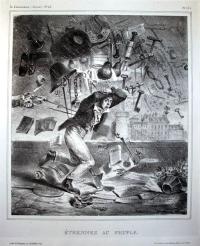
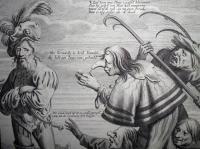
J.J. Grandville (1803-1847), Etrennes au Peuple (New Year’s Gifts for the People). Lithograph on China paper. Published in La Caricature, no 113, planche 235, January 3, 1833.

The French caricaturist Jean Ignace Isidore Gérard, working under the pseudonym of J.J. Grandville, created a number of plates for French magazines including Le Silhouette, L’Artiste, Le Charivari, and La Caricature. This satirical scene denounces the repressive actions of the French government under Louis-Philippe, which sought to limit freedom of the press and personal expression. The image presents a man being stabbed in the back and pelted with a rain of iconic objects, including pears (representing Louis-Philippe), crutches (Talleyrand, who was then ambassador in London), a parsley pot (Jean-Charles Persil who attacked the newspapers as a prosecutor under Louis-Philippe), guns, chains, keys, bolts, cross, medals, cords, scissors, hats, bell and shoes, each representing members of the government.

This print is part of a recent donation generously given by Dr. William Helfand, president of the Grolier Club and a consultant to the National Library of Medicine, the Philadelphia Museum of Art and other institutions in areas relating to art and medicine. Dr. Helfand has written five books including Quack, Quack, Quack: the Sellers of Nostrums in Prints, Posters, Ephemera & Books… (GA Oversize 2005-0625Q), and The Picture of Health (Marquand Library N8223 .H44 1991) He has also published a number of articles on prints, caricatures, posters and ephemera relating to pharmacy and medicine. This posting shows only a few of the wonderful eighteenth- and nineteenth-century prints coming to Princeton thanks to Dr. Helfand.

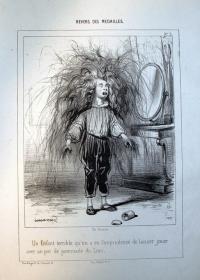
Paul Gavarni (1804-1866), Enfant Terrible, 1833. Lithograph.

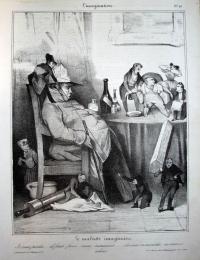
Honoré Daumier (1808-1879), Le Malade imaginaire (Hypocondriac), 1833. Lithograph.


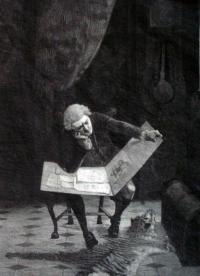
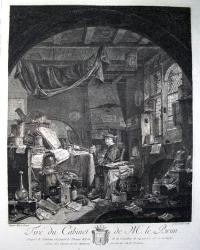
After the painting by Thomas Wyck (ca.1616-1677), The Alchemist in his Laboratory. Engraving, ca. 1700.

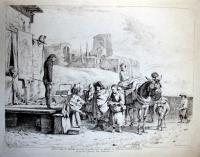
Engraved by Jean-Jacques de Boissieu (1736-1810) after a drawing by Karl Du Jardin, Les Grands Charlatans, or Charlatan with guitar player and crowd. Engraving (drawing 1657), printed 1772.

The Penographic

| No Comments

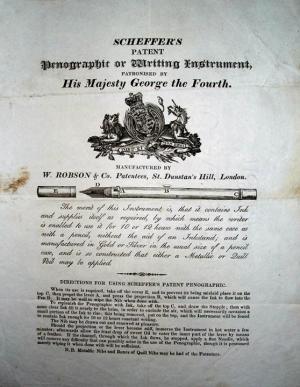
…the writer is enabled to use it for 10 or 12 hours with the same ease as with a pencil…!

Patent Penographic or Writing Instrument [broadside] (London: W. Robson & Co., ca.1819). Graphic Arts division GAX 2008- in process

Scheffer’s Penographic, patented in 1819, was one of the first workable fountain pens. Its secret was a flexible tube made of a goose quill and pig’s bladder. Pressure was exerted on a lever and a knob to propel ink into the nib when desired.

The End of the Stock-Market World

| No Comments

Last December 2007, I posted an entry on Het Groote Tafereel der Dwaasheid or The Great Mirror of Folly. Each edition has a slightly different group of prints: Harvard’s copy has 71, Princeton’s 73, and each includes several not in the other volume.

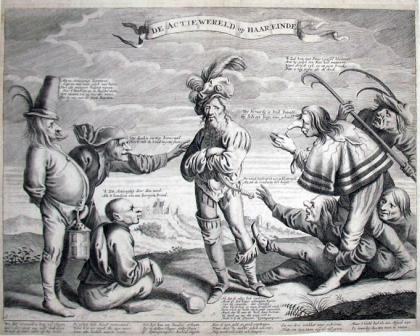
This page, originally engraved by Monogrammist C L, later altered by an anonymous 18th-century Dutch engraver after Pieter Quast (1606-1647) and entitled De Actiewerld op Haar Ende (The End of the Stock-Market World), is included in Harvard’s copy but not Princeton’s. However, we recently acquired an impression to help complete our collection of the prints for in this anonymous 1720 project.

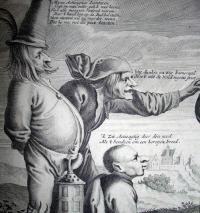
The central figure in this caricature is the philosopher Diogenes (ca. 412-323 BCE). Considered the founder of Cynicism, he eschewed worldly pleasures, wore coarse clothing, and pursued practical good. He is often shown carrying a lantern, searching for an honest person, but in this print his lantern has been given away (presumably having given up finding an honest man). He has lost everything in the stock-market bubble of 1720 from investing in the South Seas Company. As the text beneath the image concludes,

How easily can such a flier be upset by a South Sea blast or a Quinquempoix* bubble! So whoever gives his name and honor for the money, and adores it like an idol, deserves to be scorned in this fashion.

*Quinquempoix was the name of the street where the Parisian money market was located.

This print was first engraved around 1670 by the Monogrammist C L to satirize the tulip mania in the Netherlands. The plate was then altered to satirize the stock-market speculation of 1720.


Verdun from the Meuse

| 2 Comments

James Alphege Brewer (fl.1909-1938), Verdun from the Meuse, 1916. Etching with watercolor, signed and titled in pencil. GA 2008.01068

The biography of J. Alphege Brewer has yet to be written and details are sketchy. He was the son of the artist H. W. Brewer and his brother H. C. Brewer also painted. Alphege was born around 1882 in Great Britain but moved to Paris, where he lived most of his professional career. He was especially successful drawing architectural views of the great cathedrals of France.

This view of the medieval city of Verdun, in the Lorraine region of northeast France, is typical of Brewer’s work. The river Meuse in the foreground places the viewer on a low horizon, giving the Cathédrale Notre-Dame de Verdun a dramatic central focus.

We are grateful to Robert Milevski, our Preservation Librarian, for bringing this work to the attention of the Graphic Arts division.

George Washington 1732-1799

| No Comments
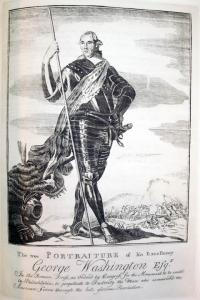
Charles Henry Hart (1847-1918), Catalogue of the Engraved Portraits of Washington (New York: The Grolier Club, 1904). “One of an edition of four hundred and twenty-five copies printed on American hand-made paper …” Graphic Arts division GAX 2008- in process

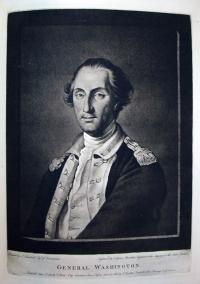
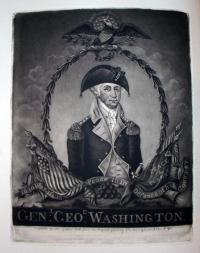
In 1904, the Grolier Club in New York City published a sumptuous, limited edition catalogue in honor of the centenary of George Washington’s death. The book features not only a complete listing of Washington portrait engravings but also 31 original mezzotint and photogravure prints.

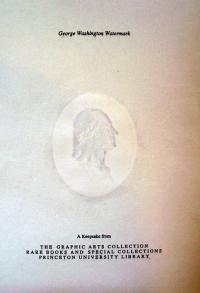
Frank O. Briggs, of Trenton, N.J. purchased a copy, which eventually made it to the graphic arts division at Princeton University. Inside the front cover are a number of sheets of cream wove paper with the watermark of George Washington.

“Photogravure after mezzotint engraved by Valentine Green.”
“Engraved in mezzotint by S. Arlent Edwards from an original in oil, which was probably executed in 1798 or 1799.”

The Miliani Mill, Fabriano, Italy, created this watermark of Washington in recognition of the bicentennial celebration of his birth in 1932. Later, the Graphic Arts collection used it as a keepsake for their friends. The portrait is after a bust of Washington done by the sculptor Jean-Antoine Houdon, who visited Mount Vernon in 1785. Houdon’s profile is said to have been one of Washington’s favorites.

“Photogravure after line engraving
attributed to John Norman.”

Cuban postcards

| No Comments
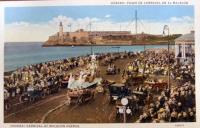
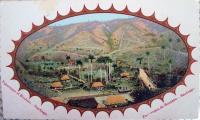
Artists Unidentified. Postcards of Cuba, no dates but approximately 1900-1920. Graphic Arts division, GC141 Postcards Collection

The graphic arts division has a number of postcard collections, this one includes 2,393 postcards of Cuba. Most are collotypes and half-tone images, but a few have original photographs or prints. The collection now has a complete finding aid, thanks to the wonderful processing of Kate Carroll, class of 2009. Here’s a summary:

Box 1 Havana: homes, buildings, parks, plazas and surroundings.

Box 2 Havana: Views of the bay, harbors, main monuments, ships, fortresses, ramparts, aerial views and streets.

Box 3 Havana: Churches, monuments, cemetery, streets. Includes four famous postcards series, tourism ads, Bacardi and beer ads and patriotic propaganda related to the US and Cuba.

Box 4 Havana: Hotels, beaches, clubs, casinos, zoo, cabarets, restaurants, musicians, carnival, hippodrome, theatre, bull fights and cockfights.

Box 5 Life in Cuba and the country: Sugar cane industry, tobacco industry, homes, palms, rivers, transportation, soldiers, families, children, typical scenes, carriages, shops and street sellers.

Box 6 Cities from the interior: Pinar del Rio, Isla de Pinos, Matanzas, Cardenas, Varadero, Santa Clara, Cienfuegos, Camaguey, etc.

Box 7 Oriente: Santiago de Cuba, Guantanamo and other regions.

Box 8 Oversize.

Paul Sandby

| No Comments
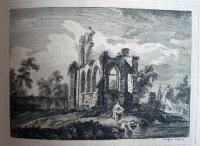
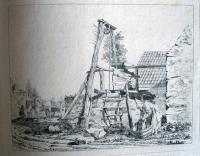
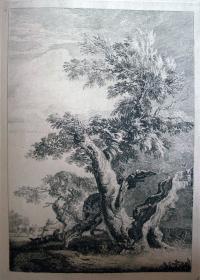
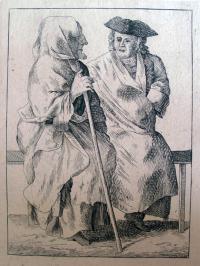
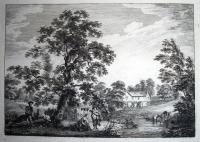
Paul Sandby, Album of 18th-century Scottish etchings. Graphic Arts division (GAX) GA2008- in process


Called the father of English watercolor, Paul Sandby (1731-1809) was a founding member of the Royal Academy of Arts, London. This album stems from Sandby’s early Scottish period, when he was a draughtsman with the military survey of the highlands. It holds 75 etchings on 27 sheets, assembled and printed by the artist, with dates ranging from 1747 to 1758. The etchings are primarily landscapes, with occassional Scottish street characters intermixed. One holds the comment “etched on the spot P. Sandby 1750.”

The album, with late 18th century half calf and blue/greenish marbled paper covered boards, has no title page. The only identification is a book label reading “Fasque,” which is a Scottish country house in Kincardineshire, built in 1809. The estate was purchased in 1829 by Sir John Gladstone, father of William Gladstone.

The Pic-Nic Orchestra

| No Comments

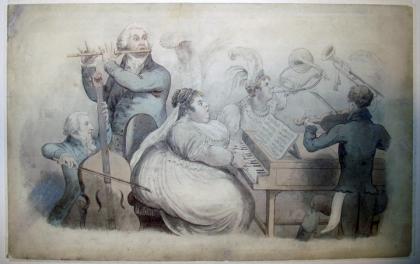
Edward Francis Burney (1760-1848) after James Gillray (1757-1815), The Pic-Nic Orchestra, ca.1802. Pen and ink drawing, watercolor. Transferred to graphic arts division (GAX) 2008- in process

The Pic-Nic Society was an exclusive London club, under the leadership of Lady Albina Buckinghamshire (seen here at the piano). They performed fashionable amusements for private aristocratic audiences, which were mercilessly attacked by the newspaper critics and journalists. The British caricaturist James Gillray printed at least three satires of the group, including the design seen here. The sheet owned by Princeton is attributed to Edward Francis Burney, completed after the Gilray hand-colored print was published by Hannah Humphrey on 23 April 1802 from her St. James’s Street print shop.

Also taking part in the performance is Colonel Henry Francis Greville, playing a fiddle. Note the paper hanging from his coat pocket. In the final print, words were added: “Pic Nic Concert—Imitations—Nightingale by Lord C.—Tom Tit Lord ME—Jack daw Gent G.—Screech Owl Lady B—Poll Parrot…” Perhaps the words were too small for Burney to duplicate with the brush.

On the left is Lord Mount (Richard) Edgcumbe playing a cello and behind him is Lord George James Cholmondeley on the flute. Seated on the pianist’s left is Lady Salisbury (Mary Amelia) playing the French horn with one hand. To the extreme right, opposite Greville, is an unidentified lady’s arm holding a trumpet.

Bibliography

Thomas Wright (1810-1877), Historical and descriptive account of the caricatures of James Gillray: comprising a political and humorous history of the latter part of the reign of George the Third (London: Henry G. Bohn, 1851.) Rare Books (Ex) NE642.G42 W9

Draper Hill, Mr. Gillray the caricaturist, a biography (Greenwich, Conn., Phaidon Publishers, [1965]) Firestone Library (F) NE642.G42 H5

James Gillray (1756-1815), The works of James Gillray, the caricaturist: with the story of his life and times (London: Chatto and Windus, [1873]) Graphic Arts Collection (GA) Rowlandson 989.2

Panoramas

| No Comments

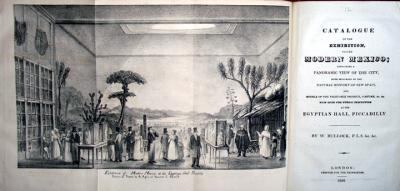
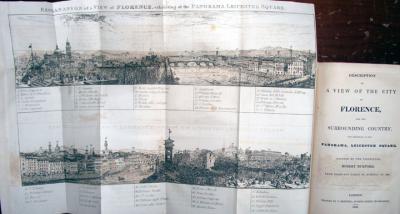
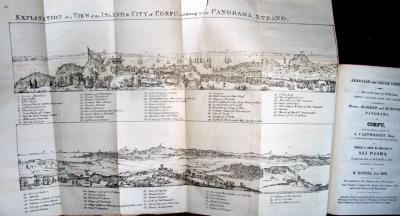
Robert Burford (1791-1861), A Miscellaneous Collection of Panoramas and Others (London, 1821-32). 14 v. in 1. Graphic Arts division (GAX) in process

Panoramic displays, offering 360 degree views of exotic scenes, were enormously popular in the 1800s. Some were cleverly painted and lit to give the illusion of day turning into night. Some showed important historical events, such as battle scenes.

The panorama was invented about 1787 by the Scottish-Irish artist Robert Barker (1739-1806). From 1794 to 1863, his family ran an exhibition theater on Leicester Square, where the largest views were about 30 feet high by 90 feet across. Barker’s success led to many others such theaters throughout Europe and the United States.

Barker applied for a patent for his invention, which he called La nature à coup d’oeil, for “representing natural objects … designed so as to make observers, on whatever situation he may wish they should imagine themselves, feel as if really on the very spot.”

For more information, see the CUNY website: http://newman.baruch.cuny.edu/digital/2003/panorama/new_001.htm

Contents:
No.1, Guide to the model of the battle of Waterloo.
No.2, A descriptive account of a series of pictures, representing some of the most important battles fought by the French armies in Egypt, Italy, Germany and Spain between the years 1792 and 1812.
No.3, Description of the Egyptian tomb, discovered by G.Belzoni.
No.4, Description du mausolée du maréchal Comte de Saxe, érigé dans l’Église de St.-Thomas, à Strasbourg.
No.5, Description of a view of the city and lake of Geneva, and surrounding country.
No.6, Description of a view of the town of Sydney, New South Wales; the harbour of Port Jackson and surrounding country.
No.7, Description of a view of the city of Florence, and the surrounding country.
No.8, Descriptive catalogue of the gallery of Europe & America.
No.9, Descriptive catalogue of the gallery of Asia & Africa.
No.10, Descriptive catalogue of the cosmorama panoramic exhibition, 209, Regent Street.
No.11, Description of the island and city of Corfu
No.12, Catalogue of the exhibition, called Modern Mexico.
No.13, Description of a view of the city of Mexico, and surrounding country.
No.14, Description of a view of the city of Edinburgh, and surrounding country.

Thomas Bewick

| No Comments

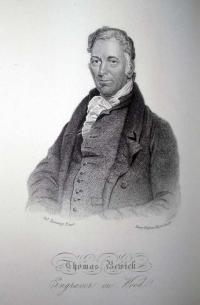
At the close of the 18th century, printmaking was revolutionized by the English wood engraver Thomas Bewick (1753-1828), and the German lithographer Aloys Senefelder (1771-1834). The processes developed by these men brought innovation in fine art printing and in commercial book illustration.


Copperplate engraving

copperplate engraving

Wood engraving

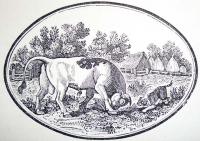
Bewick is remembered for his wood engraved masterworks A General History of Quadrupeds (1790), and History of British Birds Vol. I (1797), Vol. II (1804). However, his firm printed work in all media, including engraved wood, glass, silver, and traditional copperplate engraving.


Wood engraving


Wood engraving

Copperplate engraving

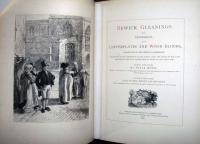
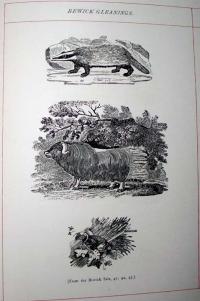
When Bewick died in 1828, his son Robert took over the business and published two further editions of the Birds in 1832 and 1847, and a large wood engraved Waiting for Death in 1832. After the death of the rest of the family, Julia Boyd compiled the volume seen here, documenting both copperplate and wood engravings in Bewick Gleanings: Being Impressions from Copperplates and Wood Blocks Engraved in the Bewick Workshop… (Newcastle-upon-Tyne: Andrew Reid, 1886). Graphic Arts: Reference Collection (GARF) Oversize NE1212.B5 xB6q

Mexican News

| No Comments
Alfred Jones (1819-1900) after a painting by Richard Caton Woodville (1825-1855), Mexican News. Published by the American Art Union, 1851. Hand colored engraving. Gift of Leonard L. Milberg, Class of 1953. Graphic Arts division GA2008- in process

Between 1846 and 1847, the United States was at war with Mexico. Artists of the extremely influential American Art Union (AAU) created a number of prints, paintings, and maps showing the events and characters involved in the war to satisfy an engaged public.

One of the most successful was the oil painting by Richard Caton Woodville (1825-1955) entitled War News from Mexico, which shows a dapper-looking man reading the news aloud to a small crowd on the porch of the American Hotel. Painted in 1848 while Woodville was an art student in Düsseldorf, the canvas was exhibited at the AAU’s gallery in 1849 and reproduced in the AAU Bulletin, which circulated to its nearly 19,000 members.

George Austen, the AAU treasurer, purchased the painting and commissioned Alfred Jones (1819-1900) to create two color engravings of the scene—a large folio and the other a small print—which were published by the AAU in 1851. Princeton owns copies of both prints.

Note: This work is by the American artist Woodville who died at the age of 30, not to be confused with the British artist of the same name (1856-1927) who created many war and genre scenes for the Illustrated London News.

The Stonemasons Guild of Strasbourg

| No Comments
Johannes Striedbeck (1707-1772), Certificate from the Stonemasons Guild of Strasbourg. Engraving. 1771. Graphic Arts division GA 2008.00111

This view of Strasbourg, France, set within an elaborate border, includes the arms of the Upper and Lower Alsace. There was once a large wax seal at the bottom center, no longer attached. The inscription reads:

Wir Geschwohrne Ober- und andere Meister des Ehrs. Handwercks derer Steinmetzen, Steinhauser und Maurer in der Stadt Strassburg bescheinen hiermit, das gegenwartiger Gesell Nahmens Johann Samuel Imhoft … .

A guild is an organization of men and women in a particular occupation. Guilds were first formed in the Middle Ages and craftspeople would have been unable to work without being a member of the guild. Members were bound by a code of quality and price, but could also obtain assistance from the guild, such as funeral costs. Guilds oversaw a craftsman’s progress from apprentice to master, maintained the quality and ownership of the craft. A stonemason’s “lodge” was located at the job site and was the place where masons gathered, received instruction, and stored their tools.

Until the capture of the city by France in 1681, the headquarters of the German stonemasons was in Strasbourg (even as late as 1760 the Strasbourg lodge still claimed tribute from the lodges of Germany).

Manhattan 3

| No Comments
Lyonel Feininger (1871-1956), Manhattan 3, stone 2, 1955 (L19). Lithograph. Graphic Arts division GAX 2008- in process

The American artist Lyonel Feininger made a name for himself in the early years of the twentieth century working in Germany alongside members of the Fauves and later the Blaue Reiter. In 1919, he joined Walter Gropius (1883-1969) serving as the first master of the Bauhaus printmaking workshop in Weimar.
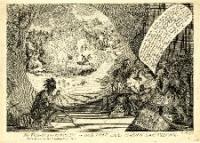
Late in the 1930s, Feininger resettled in New York City and his imagery reflected his interest in the growth of that urban center. In 1940, he began a series of abstract oil paintings entitled Manhattan. Master lithographer George C. Miller (1894-1965) collaborated with Feininger to transfer the images to stone for a second series of Manhattan cityscapes on paper. The final view seen here, Manhattan 3, stone 2 was completed by the two men a year before Feininger’s death. This print is one of only eight early impressions left unsigned.
The Sword is Drawn!

| No Comments

Kenyon Cox (1856-1919), “The Sword is Drawn, the Navy Upholds It!”, published by the H.C. Miner Lithograph Company, New York, 1917. Graphic Arts division GC156 World War Posters Collection.

In 1914, when war broke out in Europe, the American painter Kenyon Cox joined the American Artists’ Committee of One Hundred, founded to help French artists and their families. Three years later, when the United States entered the war, Cox assisted President Wilson in the design of propaganda to help unify the country.

His most important work was a recruiting poster for the U.S. Navy, seen above. The finished painting was reproduced in an enormous lithograph, 42 x 26 inches. When a copy of the finished poster was sent to him by the Navy Publicity Bureau, he wrote, “It’s very well reproduced, on the whole, by lithography. They’ve weakened and prettified the head a little, but it was either that or caricaturing it into a plug-ugly, and perhaps it’s best as it is.”

Tweedledee and Sweedledum

| No Comments
Thomas Nast (1840-1902), “What are you laughing at? To the victor belong the spoils,” Published by Harper’s Weekly, 25 November 1871. Wood engraving. Graphic Arts division GAX Nast Collection

From 1868 to 1871, four Tammany Hall Democrats ran the government of New York City: William Marcy Tweed, alias “Big Bill” or “Boss Tweed”; Peter Barr Sweeny, also called “Brains”; Richard B. Connolly, known as “Slippery Dick”; and A. Oakey Hall, referred to as “O.K. Haul”. It has been estimated that these men stole from $75,000,000 to $200,000,000 from the NYC treasury.

The German-American cartoonist Thomas Nast (1840-1902) referred to Tweed and Sweeny as Tweedledee and Sweedledum, as he waged a campaign to remove the corrupt officials from power through his caricatures in Harper’s Weekly and The New York Times.

Nast’s assault was so sharp and successful that Tweed presented a bill to the State Legislature as an official protest against “an artist encouraged to send forth in a paper that calls itself a “Journal of Civilization” pictures vulgar and blasphemous, for the purpose of arousing the prejudices of the community against a wrong which exists only in their imagination.” There is no doubt that Assembly Bill No. 169 of March 31, 1870, was directed at the “Nast-y artist of Harper’s Hell Weekly—a Journal of Devilization.”

When this did little to stop Nast, Tweed gave orders to his Board of Education to reject all Harper bids for schoolbooks and to throw out those already purchased. More than $50,000 of public property was destroyed and replaced by books from the New York Printing Company (controlled by Tammany Hall).

Harper’s continued publishing Nast’s political cartoons, although Nast moved his family to New Jersey after receiving death threats.

Tweed and his compatriots were finally removed from office in November 1871. One of several celebratory cartoons drawn by Nast depicts Tweed as Marius among the ruins of Carthage, seen above. While Tweed is defeated, the New York Treasury is left demolished and empty.

For more details, see Albert Bigelow Paine, Th. Nast: His Period and His Pictures (New York: Macmillan Company, 1904) Firestone NE 539.N18 P16

A Murder Mystery Illustrated by A.B. Frost

| No Comments
A.B. Frost (1851-1928), illustration for “On the Altar of Hunger” by Hugh Wiley (Scribner’s Magazine, August 1917, p. 177). Ink wash with gouche highlights. Graphic Arts division GAX 2008-

The American artist Arthur Burdett Frost produced illustrations for nearly 100 books from 1876 until his death in 1928. He worked alongside Howard Pyle and Frederic Remington for the leading publishers of the day, including Harper & Brothers and Scribner’s. While he made his living primarily as a commercial artist, Frost studied painting with Thomas Eakins and William Merritt Chase at the Pennsylvania Academy of the Fine Art and lived for awhile in Paris, hoping for success as a “serious painter” [his words]. Although he never gave up painting entirely, in 1914 Frost and his family returned to the United States and he resumed work as an illustrator.

In 1917, Frost wrote “… am going to take up caricaturing with a view of getting into the syndicate job. If it all goes at all it means better pay that I could get in any other way. Caricature is with me a separate thing from my life. I can draw absurd things that amuse others but do not affect me. I am wretchedly unhappy and always will be but I can make “comic” pictures just as I always did.”

One of the commissions he recieved that year was to illustrate a short story by the mystery writer Hugh Wiley. Wiley is best known today for his character James Lee Wong, who was the focus of a series of stories in Collier’s magazine and then, in movies as played by Boris Karloff. Wiley’s short story “On the Altar of Hunger,” illustrated by Frost, appeared in the August issue of Scribner’s Magazine, and later, unillustrated, in 50 Best American Short Stories 1915-1939 edited by Edward O’Brien (New York: Literary Guild of America [1939]) Firestone Library (F) 3588.684.2

Page 177 of Scribner’s shows the published version of Frost’s ink wash drawing, now in the collection of graphic arts. The choice of blue is interesting, since in the 20th century, magazine illustrators made corrections in blue, which could then be screened out of the published image. Here those elements are included as an added tone.

Ticket to Pasquin: A Dramatick Satire On The Times

| No Comments

The Author’s Benefit Pasquin, etching, 1736 or after. Formerly attributed to William Hogarth; currently attributed to Joseph Sympson. Graphic Arts division GA 2008- in process

This print appears to be an admission ticket for a benefit performance of Henry Fielding’s Pasquin, first performed in April 1736. It depicts a stage scene with seven performers, a dog and a cat, and in the background, two tightrope walkers accompanied by an ape; framed with a satyr on either side.

Originally attributed to William Hogarth (a friend and colleague of Fielding), the etching is a forgery. It was later attributed to Joseph Sympson, although that attribution is also questioned by some historians. In particular, Ronald Paulson wrote two different explanations for this print in Hogarth’s Graphic Works, if you look at both the 1965 and 1989 editions (Marquand Library (SA) ND497.H7 A35 and ND497.H7 A35 1989q).

Henry Fielding (1707-1754) was a British writer, playwright and journalist. His satirical comedy Pasquin; A Dramatick Satire On The Times Being The Rehearsal Of Two Plays: Viz., A Comedy Called The Election, And A Tragedy Called The Life And Death Of Common Sense, opened at London’s Haymarket Theatre.

A year earlier, Fielding had taken over management of the Little Theatre in the Haymarket and formed a company he called “Great Mogul’s Company of English Comedians.” That winter, he launched Pasquin to enormous success. His play was a brutal satire of the contemporary British government under Sir Robert Walpole, who retaliated with the Theatrical Licensing Act of 1737 and effectively ended Fielding’s brief West End career.

It may have been this political drama that built a market for the forged Fielding ticket.

Rowlandson's Distillers

Thomas Rowlandson (1756-1827), Distillers Looking into Their Own Business (London: Thos. Tegg, 111 Cheapside. October 10, 1811). Etching. Inscribed in plate: Price one shilling coloured. Tegg no. 100. c.1 Gift of Dickson Q. Brown, Class of 1895. c.2 Gift of Bruce Willsie, Class of 1986. GA 2006.00684

Thomas Rowlandson was one of several prolific artists who sold satirical designs to the London publisher Thomas Tegg (176-1846). Tegg's bookshop was well-placed at 111 Cheapside--known for its cheap reproductions of remaindered or out-of-copyright books. He often reissued the same plate over several years, each time hand colored by whatever colorist was on staff at the time. We often collect several issues of the same image, to compare the result of different coloring.

Rowlandson's print is one of many commenting on the underground distribution of gin in London after the Gin Act of 1751, which prohibited distillers from selling to unlicensed merchants and charged high fees to those with a license. This led to hundreds of illegal stills across the city. The alcohol was often flavored with turpentine . . . or anything else that was handy.

These operations closed in 1830, when the Duke of Wellington's administration passed the Sale of Beer Act, removing all taxes on beer and allowing retail sale of beer on payment of a two-guinea fee.

Toulouse-Lautrec

| No Comments
Henri de Toulouse-Lautrec (1864-1901), Cover of the portfolio L’estampe originale, no. 1 1893. Lithograph. Graphic Arts division, French prints G9

Toulouse-Lautrec contributed two designs for covers to L’estampe originale, which offered an original lithograph to its subscribers three times each year between 1893 and 1895. This lithograph is the first. It shows dancer and singer Jane Avril studying a fresh impression at the Paris lithography studio of Édouard Ancourt. The master printmaker at the press is Père Cotelle

Although only around 100 copies of this print were made, it has become one of the iconic images of the 1890s. Indeed, Toulouse-Lautrec’s colorful lithographic posters are almost synonymous with the Belle Époque. Inspired by Japanese woodblock prints, note the flatness of the design, a strong diagonal, and the large areas of muted color.

Cartoons

| No Comments
Al Capp (1909-1979), Fust is thar anyone else yo’druther come home to?, 1976. Screen print. Graphic arts division GA 2008.00735

The cartoon character Li’l Abner was created in the 1930s by Alfred G. Caplin (1909-1979), better known by his pseudonym Al Capp. At that time, Capp was the youngest syndicated cartoonist in America and Abner was the most popular of all American cartoon characters. The strip ran from 1934 to 1977, when Capp stopped drawing it.

Graphic arts holds a number of cartoons, both contemporary and historical. Several years ago, our good friend and a splendid cartoonist Henry Martin, class of 1948, mounted a website of selections from the collection, which can still be viewed at: http://libweb5.princeton.edu/Visual_Materials/gallery/index.html

1 2 3 4 5 6 7 8 9 10 11 12 13 14 15 16 17 18 19

Recent Comments

  • Isabel Ribeiro: Thank you for your reply. I would indeed love to read more
  • Isabel Ribeiro: Gorgeous! Is there any way to access the rest of read more
  • S. Scudder: Mary Stilwell is my ggg-grandmother ... thank you for posting read more
  • V.E.G.: James Franklin, Benjamin Franklin's half-brother is a direct descendant of read more
  • Bob Fleck: Nice comments and well worth it. read more
  • N. Sutherland: Do you have any further biographical material on this Thomas read more
  • john W: Have the complete collection of EA Seguy papillons including front read more
  • Vermathio: algarabia, charabia et Picabia. Le premier désigne la langue read more
  • Matt SCOVILL: I have the complete "bookplates in Japan" box. I am read more
  • Daniel Joseph Bobroff: April 30, 2013 To Princeton University: This is a Plaintiff read more