Recently in Prints, Drawings, Paintings Category

Cartoons

| No Comments
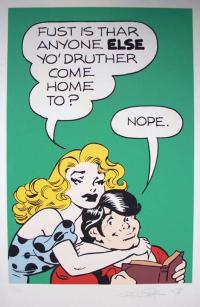
Al Capp (1909-1979), Fust is thar anyone else yo’druther come home to?, 1976. Screen print. Graphic arts division GA 2008.00735

The cartoon character Li’l Abner was created in the 1930s by Alfred G. Caplin (1909-1979), better known by his pseudonym Al Capp. At that time, Capp was the youngest syndicated cartoonist in America and Abner was the most popular of all American cartoon characters. The strip ran from 1934 to 1977, when Capp stopped drawing it.

Graphic arts holds a number of cartoons, both contemporary and historical. Several years ago, our good friend and a splendid cartoonist Henry Martin, class of 1948, mounted a website of selections from the collection, which can still be viewed at: http://libweb5.princeton.edu/Visual_Materials/gallery/index.html

Les costumes grotesques

| 5 Comments

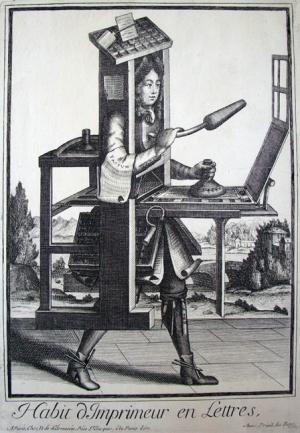
Nicolas de Larmessin II (ca. 1638-1694), Habit d’Imprimeur en Lettres (The Printer’s Costume), ca. 1680. Engraving. Graphic Arts GA 2007.04409.

This copper plate engraving is from Les costumes grotesques et les metiers or the Fancy Trade Costumes series. In the series, over 70 artisans are dressed in the materials of their occupation, in this case the tools of a printer.

Nicolas de Larmessin II is one member of a family of printmakers and booksellers, many with the same name, leading to much confusion in attributing their work. The family had their own publishing house in Paris, where they designed and printed books, prints, calendars, and other popular works on paper.

To see more of Larmessin’s work, look at: Les avgvstes representations de tovs les roys de France depvis Pharamond ivsqv’a Lovys XIIII: dit Le Grand, a present regnant, 1679: auec vn abrège historique sous chacun, contenant leurs naissances, inclinations et actions plus remarquables pendant leurs regnes (Paris: Bertrand, 1679). Engraved portraits of the Kings of France. Graphic Arts Collection (GAX) Oversize 2008-0170Q

A Drawing for Blake to Engrave, But Who Made It?

| No Comments
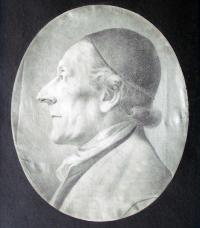
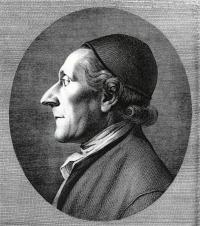
Portrait of Johann Lavater, ca.1787. Attributed to Johann Lavater after a drawing by Johan Lips. Graphite. Graphic Arts division GA2008- in process .

The Swiss minister Johann Caspar Lavater (1741-1801) was convinced that the science of physiognomy made it possible to know about a person’s interior self from their exterior body. This included both the physical skull itself and the visual representation of it. He published his beliefs in three major editions, Physiognomische fragmente (1775-78) RBSC Oversize 6453.568.15q, Essai sur la Physiognomonie (1781-1803), and Essays on Physiognomy (1788-99) GAX Oversize 2007-0002Q. These volumes are lavishly illustrated with profile portraits, silhouettes and linear profile outlines.

Johan Heinrich Lips (1758-1817) was the principal engraver of the plates, working from his own drawings and after drawings by Georg Friedrich Schmoll. Lavater’s close friend Henry Fuseli (1741-1825) added a few illustrations and brought in the young William Blake (1757-1827) to complete a few additional plates.

Joan K. Stemmier, writing in The Art Bulletin (March 1993), asserts that Lavater planned a lavish folio edition of his Physiognomonie and prepared several drawings on folio sheets for this project. Ultimately, trouble between Lavater, Fuseli, and the publisher, Joseph Johnson, brought a halt to the project.

This was around 1787, at the point when Blake was called in to engrave, among other things, a large portrait of Lavater. The question is, who made the drawing that he used for the image? There is a chalk drawing by Lips in the Kunstsammlungen at Weimar that resembles this engraving, but not exactly.

Reproduction of William Blake’s engraved portrait of Lavater.

The graphic arts division at Princeton University holds a second large profile drawing of Lavater. This is believed to be the source for Blake’s engraving. According to Stemmier, Lips drawing was engraved by Adam Ludwig Wirsing in 1787 and sent to Lavater but the author was not satisfied with the sharp angles and lack of overall harmony in composition. Working from either the drawing or the engraving, Lavater made his own drawing with the harsh lines altered and jowl softened. It is this drawing that was sent to Blake to engrave, which is now owned by Princeton.

When the folio edition fell through, Johnson published Blake’s engraving as a single print in several editions from 1787 through 1800. Now it was Blake’s turn to be dissatisfied. “I find on all hand great objections to my doing any thing but the meer drudgery of business …” he wrote to his patron Thomas Butts and vowed to give up reproductive engraving for projects on which he could have complete artistic control.

A Paper Museum

| No Comments

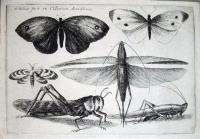
Wenceslaus Hollar (1607-1677), Muscarum scarabeorum, uermiumque uarie figure & formae / omnes primo ad uiuum coloribus depictæ & ex collectione Arundelian a Wenceslao Hollar aqua forti æri insculptæ, Antuerpiæ, anno, 1646. [Antwerp, Belgium: s.n., 1646]. Gift of Elmer Adler. Graphic Arts Collection (GAX) 2004-3713N

Named Václav but called Wenceslaus when living in London, Hollar was a Czech printmaker who published his first book etchings in 1635. He traveled with the renowned art collector Thomas Howard, the Earl of Arundel, who finally settle in London.

Hollar assignment was to etch copies of each individual item in Arundel’s collection, in an attempt to create a visual inventory or a paper museum. He never finished, although Muscarum scarabeorum … includes some of Arundel’s massive collection.

Thomas Sprat (1635-1713), The History of the Royal-Society of London, for the Improving of Natural Knowledge (London: Printed by T. R. for J. Martyn … and J. Allestry … printers to the Royal Society, 1667). Frontispiece etched by Wenceslaus Hollar (1607-1677) after design by John Evelyn (1620-1706). Gift of Elmer Adler, signed by Albert Einstein. Graphic Arts Collection (GAX) 2004-3215N

When Lord Arundel left England in 1642, and Hollar passed into the service of the Duke of York, working alongside other royalist artists, such as Inigo Jones. Over his lifetime, Hollar created nearly 3,000 etchings. He was one of the most skilled printmakers of his time, despite being almost blind in one eye.

The following anecdote is difficult to prove but fun to repeat. Holland struggled all his life to make a living, charging four pence an hour for his work (measuring his time with a sandglass). As he was dying, his last recorded words were a request to the bailiffs that they would not carry away the bed until he was entirely dead.

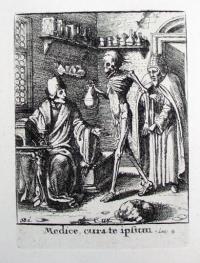
Wenceslaus Hollar (1607-1677), Le triomphe de la Mort / gravé d’apres les desseins de Holbein par W. Hollar ([London: s.n., 1790]) The 32 plates are interleaved with the text Explication des sujets de triomphe de la Mort de Jean Holbein. Graphic Arts Collection (GAX) 2006-2648N

To see more of Hollar’s work, see http://link.library.utoronto.ca/hollar/

Shopping at the Bazaar

| No Comments

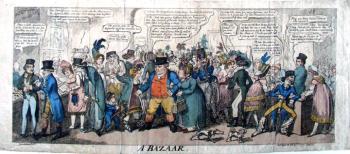
George Cruikshank (1792-1878), A Bazaar [London]: J. Johston [sic] Cheapside. Published, June 1st, 1816. Etching with hand coloring. Graphic Arts division GAX 2008- in process

This is one of George Cruikshank’s earliest etchings. In it we find John Bull (who always personified the English public), along with his family, enjoying a day at the Soho Bazaar. Around them, a mob of fairly rakish buyers are working their way through the stalls.

According to our rare book friends at Marlborough, the Bazaar was established by John Trotter in 1815 to enable the widows and daughters of Army officers to dispose of their handiwork. Counter space was rented at 3d. per foot per day, with open counters arranged on both sides of aisles or passages, and on two separate floors of the building. This market was the first of its kind and extended from the north-west corner of Soho Square to Oxford Street.

The items sold at these stalls were almost exclusively something for the dress or personal decoration of ladies and children; such as millinery, lace, gloves, or jewelry. At the height of the season, the long line of carriages alongside the building testified to the number of wealthy visitors who enjoyed browsing through the merchandise.

Some of the rules of the establishment were very stringent. A plain, modest style of dress was required for the young, female workers and a matron was always on duty to check on this.

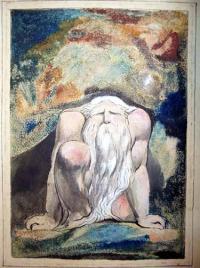
Eternally I labour on

| No Comments

The Graphic Arts collection includes original work by the British artist William Blake (1757-1827). Among these is an over-painted monotype entitled “Eternally I labour on” for his Urizen project. This Blake came to Princeton in a small bound volume (4to) with a letter written by A. Edward Newton: “This is a hand colored plate by William Blake, not an original drawing, from Urizen. I bought it from Gabriel Wells when we were in London together in the summer of 1921. And I paid a pretty stiff price for it, too. Edward Newton, May 1922.”

When the painted print was exhibited at the Philadelphia Museum of Art in 1939, the catalog noted, “Los striving to lift the Stony Roof, the 10th plate of Urizen. Painted with strong opaque pigments, printed by Blake’s monotype process. The background, showing clearly the reticulation of the mill-board, is especially brilliant, being executed in a wonderful variety of bright colors. Surrounded by framing lines, and inscribed below by Blake, ‘Eternally I labour on’.”

How this image fits into the published and unpublished copies of Urizen has been a subject of much research. Here are a few comments.

“Although considered a monotype because of Blake’s unique color-printing techniques, the image of “Eternally I labour on” originally belongs to one of Blake’s Illuminated Books printed around the 1790’s entitled The Book of Urizen - also known as The First Book of Urizen. Blake created seven copies … only two of which contain all twenty-eight plates. The Princeton Collection’s … image also belongs to Blake’s Small Book of Designs copy B, a compilation of 23 impressions of images without text from Blake’s other books commissioned by Ozias Humphry. Therefore, when Blake first began experimenting with this image, his intention was not to create a print for individual sale.” Elizabeth R. Lemoine, class of 2009

“Many thanks for the image of Urizen plate 9 from Small Book of Designs, copy B. Actually, copy B of both the Large Book and Small Book is a bibliographical invention, because most of the impressions are second pulls, impressions pulled from the plate while the ink was still wet. However, your impression does not have a corresponding impression in copy A (there are one or two others like that in copy B). All the B impressions have the three or four frame lines, and the impressions are, as you say, monotypes. He could get a good second impression from the plate without replenishing colors between pulls, but the second impression was usually lighter and required more finishing in pen and ink and watercolors. Even a second impression from the plate, though, is still technically a monotype because the impressions are not exactly repeatable.” an email from Blake expert Joseph Viscomi

For more information see, The William Blake Archive, Editors Morris Eaves, Robert N. Essick, and Joseph Viscomi http://www.blakearchive.org

Joseph Viscomi, Blake and the Idea of the Book, Firestone NE642.B5 V57 1993

Thanks to Mrs. Gerard B. Lambert of Princeton, RBSC also holds several Blake poems in manuscript, including:

I asked a thief to steal me a peach.
He turned up his eyes.
I ask’d a lithe lady to lie her down.
Holy & meek she cries.

As soon as I went an angel came:
He wink’d at the thief
And smil’d at the dame,
And without one word spoke
Had a peach from the tree,
And ‘twixt earnest & joke
Enjoy’d the Lady.
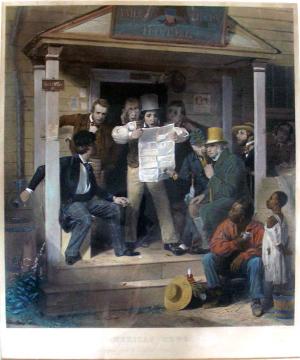
Robert Nanteuil

| No Comments
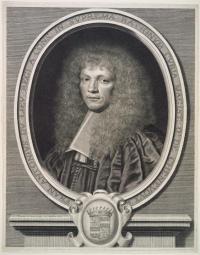
Nanteuil, Robert (1623-1678), Francois-Antoine Dulieu de Chenevoux, Maitre des Comptes, 1667. Engraving. Gift of John Douglas Gordon, Class of 1905. GA 2005.00673


Nanteuil, Robert (1623-1678), Marie-Jeanne-Baptiste de Savoie-Nemours, Duchesse de Savoie, 1678. Engraving. Gift of John Douglas Gordon, Class of 1905. GA 2005.00584

In 1966, collector and Francophile John Douglas Gordon, class of 1905, donated a collection of 134 seventeenth-century engravings by Robert Nanteuil to the Graphic Arts collection in memory of his wife, Janet Munday Gordon. Nanteuil was Royal Engraver to Louis XIV and the outstanding portraitist of his age. Thanks to Mr. Gordon, Princeton holds impressions from approximately one half of the plates completed by Nanteuil.

We recently digitized this entire collection and all of Graphic Arts’ Nanteuil engravings can be viewed at http://diglib.princeton.edu/
xquery?xq=getCollection&xsl=collection&_pid=gc016
To see his complete works, you might consult: Charles Petitjean, Catalogue de l’œuvre gravé de Robert Nanteuil (Paris: L. Delteil et M. Le Garrec, 1925) Graphic Arts Collection (GA) Oversize 2005-0487Q.

Vagabondiana

| No Comments


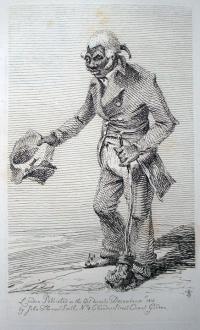
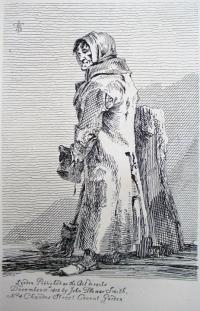
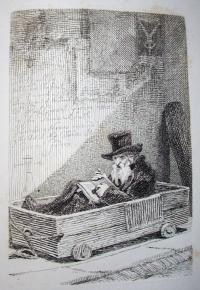
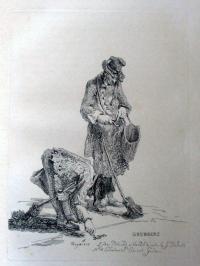
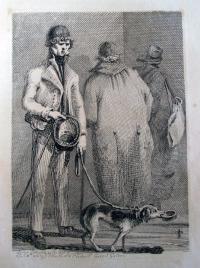
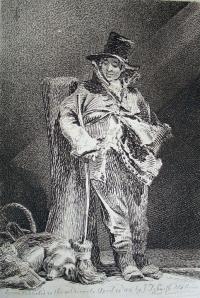
John Thomas Smith (1766-1833), Vagabondiana; or, Anecdotes of Mendicant Wanderers through the Streets of London; with Portraits of the Most Remarkable, Drawn from the Life (London: Published for the proprietor; and sold by J. and A. Arch [etc.] 1817) Graphic Arts Collection (GA) Oversize Rowlandson 929.3q

In the early years of the nineteenth-century, John Thomas Smith was the Keeper of Prints and Drawings at the British Museum as well as a professional illustrator. He lived on Chandos Street near Covent Garden, a rather seedy part of London, where he liked to sketch portraits of his neighbors.

Smith’s 1833 obituary printed in The Gentleman’s Magazine noted “Mr. Smith had much pleasure in tracing out and examining the peculiar manners and costumes of the inhabitants and visitors of this district of the metropolis. The procuring of information from various sources occupied many years of his life; and he meditated the publication of this interesting mass in two volumes, which we regret he never completed… but in 1817 he published a work on which he had been some time employed, entitled Vagabondiana”. For more information, read Smith’s autobiography: A Book for a Rainy Day (London: Richard Bentley, 1845). Firestone Library (F) 1459.863.1845

First Things First

| No Comments

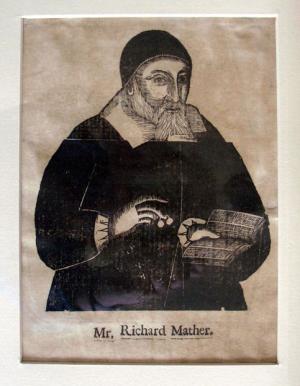
First American Woodcut, ca. 1670

John Foster (1648-1681), Portrait of Richard Mather. Woodcut, first issued ca. 1670. Given in memory of Frank Jewett Mather Jr. by his wife, his son, Frank Jewett Mather III, and his daughter, Mrs. Louis A. Turner. Graphic Arts division, GA 2006.00728

At the age of twenty-two, John Foster had completed his education at Harvard and was teaching English grammar in Dorchester, Massachusetts. When his friend and minister, the influential Richard Mather, passed away, members of the congregation planned a publication in his honor. Foster offered to design and print a woodcut portrait of Mather for a frontispiece to The Life and Death of That Reverend Man of God, Mr. Richard Mather. Only six copies of the print are known. It is considered the first woodcut printed in the United States.


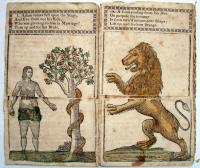
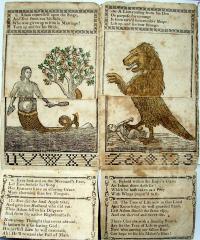
First American metamorphosis book, ca.1775

[Metamorphosis] ([Philadelphia, ca.1775])

Graphic Arts holds three different editions of this ealy American juvenile. This one contains eight woodcuts by James Poupard. The prints are arranged into sections with four of the plates cut through the center so that the top and bottom can be raised. The lion turns into a griffin, the girl into a mermaid, etc. According to Sinclair Hamilton’s Early American Book Illustrators and Wood Engravers, some later 19th-century editions carry the title Metamorphosis; or, a Transformation of Pictures with Poetical Explanations for the Amusement of Young Persons.


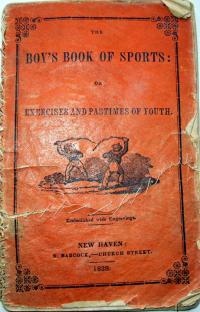
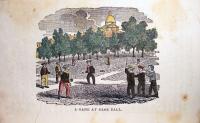
First American picture of a baseball game, 1838

The Boy’s Book of Sports: or, Exercises and Pastimes of Youth. New Haven: S. Babcock, 1838. Wood engraving by Alexander Anderson (1775-1870). Graphic Arts Collection. Gift of Sinclair Hamilton, Class of 1906.

In the 1820s, a group of men from Philadelphia, prevented by an obscure ordinance from enjoying their favorite pastime in their own city, began playing an early version of baseball in Camden, New Jersey. By the 1830s, other teams had formed along the East Coast, and rules to the game were published in Robin Carver’s Book of Sports (1834). Carver’s book included this wood engraving depicting a baseball game played on Boston Common. The same block was used to illustrate several publications over the next few years, including the first and second editions of The Boy’s Book of Sports (1835 and 1838).
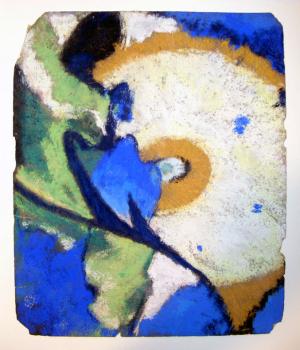
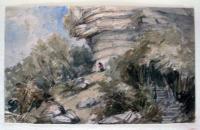
"the reality of sensation alone remains" -Arthur Dove

Arthur Dove (1880-1946), Untitled, ca. 1930s. Pastel on paper. GA 2006.02661

This untitled and undated pastel by the American modernist Arthur Dove found its way into the graphic arts collection without even a mention in the department's annual "new and notable" commentary. It has never been published and was not included in the artist's catalogue raisonné.

The pastel has been attributed on the verso to the 1930s, which is fitting. In 1920s, Dove lived with Helen Torr in a houseboat on Huntington Harbor, off Long Island, and he often included abstracted landscapes of the water and shore in his work. Dove also included elements of collage in his work of this period, none of which are present in this pastel.

At the end of the 1920s, Dove wrote to his dealer Alfred Stieglitz, "Am more interested now than ever in doing things than doing something about things. The pure paintings seem to stand out from those related too closely to what the eye sees there. To choose between here and there--I should say here." Dove to Stieglitz, October 1929, Beinecke Library.

In 1933, Dove moved to rural Geneva, New York, and produced a number of formal color studies based on the wildlife of the area, emphasizing shapes and lines in an effort to move closer to an organic abstraction. When he returned to Long Island in 1938, Dove's work changed once again; his color pallet became bolder and his abstractions more geometric. It is from somewhere within the early 1930s period that I believe Princeton's pastel was created.

Twenty Volumes of "Phiz"

| No Comments

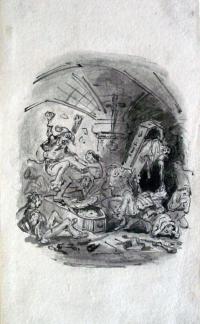
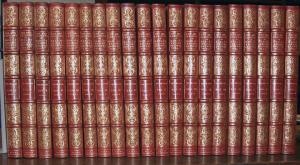
David Croal Thomson (1855-1930), Life and Labours of Hablôt Knight Browne “Phiz” (London: Chapman and Hall, 1884). 1 vol. in 20, extra-illustrated with 1250 plates. Graphic Arts (GAX) 2008- in process

Newly acquired by the graphic arts division is this unique twenty-volume extra-illustrated copy of Life and Labours of Hablôt Knight Browne. Browne was the 19th-century illustrator best known for his steel-plate etchings and wood engravings for ten books by Charles Dickens.

Dickens was already a popular author when his illustrator Robert Seymour committed suicide. The practically unknown Browne was selected to complete The Pickwick Papers and went on to collaborate with Dickens until 1859. Browne took the nickname “Phiz” to complement Dickens’ penname “Boz.”

As it was originally published in 1884, Thomson’s single volume biography contained an engraved portrait and 130 illustrations (GA Rowlandson 946). Princeton’s unique copy has been vastly expanded to 20 volumes, extra-illustrated with the insertion of more than 1250 plates, including 11 watercolours, 81 pencil and ink drawings (a few with a touch of colour or double-sided), and 11 autograph manuscript items signed by Browne.

Among the manuscripts are a group of charming illustrated letters to Frederick William Cosens, an avid collector of Dickens. Cosens commissioned Browne to furnish him with watercolor drawings of every image he had created for a Dickens novels (more than 400 in all). It has been speculated that this 20 volume set is the work or commission of Cosens, although the provenance is not certain.

These volumes present to researchers not only a wonderful collection of art by one of the great illustrators of the 19th century, but also a number of variant states of the final plates. The sketches and letters provide documentary information about Browne that cannot be obtained elsewhere.

After the Manner of Rembrandt

| No Comments

Thomas Worlidge (1700-1766), A Select Collection of Drawings from Curious Antique Gems: Most of Them in the Possession of the Nobility and Gentry of this Kingdom: Etched after the Manner of Rembrandt (London: Printed by Dryden Leach, for M. Worlidge … , [between 1768 and 1780]. Graphic Arts Collection (GAX) 2005-2376N

Around 1740, painter and printermaker Thomas Worlidge settled in the Covent Garden section of London. He found success painting portrait miniatures and later, as an etcher working “after the manner of Rembrandt”. This refers to his drypoint technique of drawing with a sharp needle directly into the surface of the copper plate. It also alludes to Worlidge’s admiration for Rembrandt the man, such as in this frontispiece self-portrait, which is a clear imitation of a Rembrandt self-portrait.

When Worlidge died in 1766, he was in the middle of a massive project etching a series of 182 drypoint portraits. Princeton owns several variant editions of the collection. The following is a description of the project taken from the Dictionary of National Biography, vol. 21:

The series was published in parts, some of which seem to have been issued as early as 1754 but Worlidge died before the work was completed. It was finished by his pupils William Grimaldi and George Powle, and was published by his widow in 1768 at the price of eighteen guineas a copy. In its original shape the volume bore the title, A select Collection of Drawings from curious antique Gems … printed by Dryden Leach for M. Worlidge … and M. Wicksteed, Seal-engraver at Bath.
The frontispiece, dated in 1764, shows Worlidge drawing the Pomfret bust of Cicero; behind on an easel is a portrait of his second wife, Mary. No letterpress was included originally in the volume, but between 1768 and 1780 a few copies were issued with letterpress. After 1780 a new edition in quarto, deceptively bearing the original date of 1768, appeared with letterpress in two volumes at five guineas each. The title-page omits mention of M. Wicksteed’s name, but is otherwise a replica of the first.

Pantomime Actor Joseph Grimaldi

| No Comments

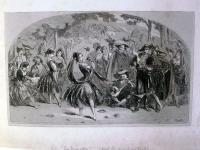
Attributed to William Heath (1795-1840), Mr. Grimaldi and Mr. Norman in the Epping Hunt, from the Popular Pantomime of the Red Dwarf (1812). Engraving with hand-coloring. Graphic Arts Division, British Caricatures

This print depicts the British actor Joseph Grimaldi (1778-1837) in one of his many popular pantomimes. Grimaldi, who always played the clown in these physical comedies, worked as a professional actor from the age of three. Unfortunately, his body was worn out by the age of forty-five and he was forced into retirement. One of his best-loved songs begins

A little old woman, her living she got
by selling codlins, hot, hot, hot.
And this little old woman, who codlins sold,
tho’ her codlins were not, she felt herself cold.
So to keep herself warm she thought it no sin
to fetch for herself a quartern of gin.


Joseph Grimaldi, (1779-1837), Memoirs of Joseph Grimaldi, edited by “Boz” [Charles Dickens (1812-1870)]; with illustrations by George Cruikshank (London: R. Bentley, 1838). Graphic Arts Collection (GA) Cruik 1838.5

After retirement Grimaldi worked on his memoirs, which eventually filled two volumes. When the actor died in 1837, Charles Dickens was asked to edit the massive work and he succeeded by rewriting a good deal of the text. Dickens comments in the introductory chapter: “The present editor … accepted a proposal from the publisher to edit the book, and has edited it to the best of his ability, altering its form throughout, and making such other alterations as he conceived would improve the narration of the facts without any departure from the facts themselves.”

Princeton is also fortunate to also hold a songbook owned and signed by Grimaldi, seen below.

Thomas Tegg (1776-1845), Tegg’s prime song book, bang up to the mark! :the fourth collection (London: T. Tegg, [1814?]). Frontispiece and title vignette by Thomas Rowlandson. Rare Books (Ex) PR1188 .T43 1814.

Anopisthographic Biblia Pauperum

| No Comments

leaf 39 “t” Beatitude and leaf 40 “v” Coronation

blank verso of leaf 40 and leaf 38 “s” Hell


Three leaves from a Biblia pauperum, Schreiber edition X (38-40, .s, t, v.), late 1460s. Hand-colored woodblock prints. Sheet size 27 x 41 cm. GC110 Book Leaves Collection.

Princeton’s historical leaf collection holds three leaves from an edition of the Biblia pauperum, one of the best-known of the fifteenth-century blockbooks. According to Nigel Palmer’s article in the current Journal of the Printing Historical Society (no. 11, 2008, Firestone Z119 .P95613), the Biblia pauperum was “an ensemble of texts and images which narrated the history of man’s redemption from the Annunciation through to the Last Judgement and the coronation of the blessed soul in heaven” represented in 40 plates. During the 1460s, the 40 woodblocks for this volume were recut three times, along with seven intermediate issues in which just some of the blocks were replaced.

Mr. Palmer examined the sheets in Princeton’s collection and wrote that he believed they belong to the edition X, “almost certainly printed in Germany”. Of the known copies of this edition, Palmer identified one in Blackburn, England, originally from Gotha, which lacks these numbers and might be a match for our leaves.

The three leaves shown here are anopisthographic (printed on one side). Two of the sheets have been pasted together to form recto and verso of one sheet. Because there are so few Biblia pauperum surviving in their original structures, it is difficult to be certain about their construction but several editions were sewn into single-quire volumes in chancery folio (approximately 310-20 x 440-50 mm., only slightly larger than Princeton’s sheets).

Blockbooks were made from about 1450 to the 1470s, and Palmer cautions us to regard them as intertwined with all experimentation in printing technology of the period, included single-leaf woodcuts, single-leaf metalcuts, single-leaf engravings, books and single leaves with text printed with moveable type, and books with typographic text and woodcut illustrations.

For a complete reading of the iconography in each plate (in English), see Avril Henry’s Biblia Pauperum Marquand Library Oversize Z241.B6B52 1986Q

The History of the Life of the Late T. M. Cleland

| 16 Comments

Henry Fielding (1707-1754), The History of the Life of the Late Mr. Jonathan Wild the Great. Illustrations by T.M. Cleland (1880-1964) and an introduction by Louis Kronenberger (New York: Limited Editions Club, 1943). Gift of Elmer Adler. Graphic Arts collection (GAX) PR3454.J663 1943


Soon after Thomas Maitland Cleland left school, at the age of 16, he taught himself to set type, bought a small Gally Universal, and began making books in his basement. In 1900, he moved to Boston and published under the imprint Cornhill Press, named after the street where he lived. D. B. Updike of Merrymount Press was an early mentor, who provided commissions and endless criticism, leaving Cleland chronically unsatisfied with anything less than perfection.

Cleland went on to work as art designer for McClure’s Magazine, the Locomobile Company of America, the Westvaco Corporation, the Cadillac Motor Car Company, and Fortune Magazine, although he wrote “I am not, and never have been, particularly interested in advertising and have done much of my work for it only because it was, or seemed to be, necessary in order to make a living.”

In the 1930s, he made a series of calendar illustrations for the Harris, Seybold, Potter Company of Cleveland Ohio, which manufactured high-quality sheet-fed offset lithographic printing presses. The company tried to convince the printing world that sheet fed-offset presses could produce quality 4-color process work and Cleland’s prints were meant to provide the proof. “God Bless America,” seen below, is one of these prints.

In between commercial work, Cleland illustrated fine press editions, often using a series of stencils. Writing to Merle Armitage about his process, Cleland explained “It is made entirely with stencils which I cut myself by hand in thin metal (thirteen of them in all) and which I then printed successively by brushing through them with pure water colours. … so far as I know, no one has attempted before to make a complete picture with them as a medium, and I hope no one will try it again. It was an insane amount of work for such a trifling result, and took about four months work to make a hundred of them—fifty for the special edition of Adler’s book of my work, and fifty for sale.” (GAX Oversize NE539.C57 A3 1929q)

One of his most complex projects was Jonathan Wild, seen above, printed under Cleland’s supervision by the Marchbanks Press and published by the Limited Editions Club. In a letter to editor George Macy in 1942, Cleland wrote, “I am anxious to have this large line drawing photographed for the plate so … I should have proofs of the plate on which I can paint in the color for each stencil … so that they will have only the actual coloring of the edition to do after the book is off the press.” The coloring was accomplished by Charlize Brakely, who charged $10 per thousand pages. The book has 30 pages with color in an edition of 1,500, so that means a total of 45,000 pages to color.

Robert Rauschenberg 1925-2008

| No Comments

Robert Rauschenberg (1925-2008), Rauschenberg. XXXIV Drawings for Dante’s Inferno (New York: H. N. Abrams, 1964). Limited to 300 sets signed by the artist. Princeton set also signed by Harry Abrams. Graphic Arts Collection GA 2006.00181-00213

Sadly, Robert Rauschenberg died on Monday night at the age of 82. One of many obituaries for this great artist can be read at http://www.nytimes.com/2008/
05/14/arts/design/14rauschenberg.html?partner=rssnyt&emc=rss

The Graphic Arts division is fortunate to hold a set of publisher’s proofs for Rauschenberg’s print edition of XXXIV Drawings for Dante’s Inferno, published in 1964 by Harry Abrams. This collotype portfolio reproduces the 34 drawings in the collection of the Museum of Modern Art in New York. A great source of information about the Dante project and many of Rauschenberg’s other works of art is Mary Lynn Kotz’s Rauschenberg, Art and Life, revised 2004 Marquand Library SA ND237.R187 K679 2004.

Mister O'Squat by Rowlandson or Lane?

| No Comments

Attributed to Thomas Rowlandson (1757-1827), [Mister O’Squat: A Panorama] (London: Published by William Sams, Booksellers to his Royal Highness the Duke of York opposite the Palace, St. James Street, 1822). Box embossed: E.P. Sutton & Company; Sangorski & Sutcliff. GA 2005.01039

Thomas Rowlandson (1757-1827) was one of the greatest of the British caricaturists. Critic Robert Hughes wrote “William Hogarth invented the panorama of social class as a subject in English painting. Rowlandson, who was eight when Hogarth died, continued the tradition, with an equal gusto but greater humor. The dark side of Hogarth, his capacity for moral rage, is largely missing in Rowlandson, and his interest in art theory is entirely absent.”

Theodore Lane (1800-1828) on the other hand, was a lesser known British caricaturist who worked around the same period as Rowlandson. A savant, who had his debut at the age of 16 with an exhibition of paintings at the Royal Academy, Lane is only known today for his humorous work, such as his caricatures of George IV.

The graphic arts collection holds a scrolling panorama made up of 12 unsigned, hand-colored etchings, with a narrative in verse, attributed to Rowlandson and titled Mister O’Squat. This year, a search for more information about this item uncovered an unbound series of 12 panoramic colored prints that were sold in a 1906 book sale under the title Mister O’Squat and the Widow Shanks. This title corresponds to a listing in OCLC for a series of prints with verse attributed to Lane and titled The Misadventures of a Pair of Newlyweds who Leave the Country for the Superior Pleasures and Society of London, also called Mister O’Squat and Widow Shanks. Published in 1818, this is also a panorama in 12 sections, each 13 x 73 cm. the same as Princeton’s.

Were these prints just reconfigured to be viewed as a continuous scene through the window of a small box (sometimes called a myriopticon)? Did Rowlandson know of Lane’s prints and reproduce them for the publisher William Sams? Is the 1818 series misattributed to Lane and really the work of Rowlandson? These are still unanswered questions that deserve further research before an answer is given.

Matisse and Joyce

| No Comments

“Cyclops” by Henri Matisse, 1935. Soft-ground etching.

James Joyce (1882-1941), Ulysses (New York: Limited Editions Club, 1935). 6 etchings and 20 photomechanical reproductions by Henri Matisse (1869-1954) Copy no. 700 of 1500, signed by Henri Matisse and James Joyce. Graphic Arts Collection (GAX) Oversize PR6019.O9 U4 1935q

Ever since George Macy, founder and editor of the Limited Editions Club, published an English language edition of Ulysses in 1935, pairing James Joyce’s text with prints by Henri Matisse, there has been a controversy as to whether Matisse ignored Joyce by submitting images based on Homer’s Odyssey. There is no question that the six original soft-ground etchings— “Calypso,” “Aeolus,” “Cyclops,” “Nausicaa,” “Circe,” and “Ithaca”—have a relationship to Homer. The question is whether this was a conscious choice, sanctioned by Joyce, to relate the story and structure of the one book to the other.

In James A. Knapp’s article “Joyce and Matisse Bound” http://muse.jhu.edu/journals/elh/v067/67.4hnapp.html the question is answered yes, with documentation offered from letters between Macy and the artists, and comments from their colleagues, such as Alfred Barr who wrote “Matisse remarked that he had observed how Joyce’s Ulysses was divided into episodes based on Homer’s Odyssey … Macy accepted the suggestion and Matisse went to work.” (Matisse: His Art and His Public, 1951).

Either way, the work of two masters comes together in a powerful way. Macy designed the sequence, including reproductions of the drawings Matisse also sent, which led up to the final etchings. These are bound on top of the final prints in an overlapping fashion that echoes the overlapping stories of the text. Princeton’s copy is one of the 250 (out of the total edition of 1500) signed by Joyce, which originally sold for $15.

The Murder of Edith Cavell

| No Comments
George Bellows (1882-1925), The Murder of Edith Cavell, 1918. Black chalk and black crayon over charcoal on cream wove paper. Courtesy of Princeton University Art Museum. Museum purchase, Laura P. Hall Memorial Fund

George Bellows (1882-1925), The Murder of Edith Cavell, 1918. Lithograph. Graphic Arts division. GA 2008- in process


On August 5, 1915 Edith Cavell, head of the Training School for Nurses in occupied Brussels, was arrested for assisting Belgian, British, and French soldiers to escape from the country. Two months later, she was shot by the German authorities. As news of her execution spread, with no fewer than 41 stories in The New York Times alone from October 16-30, her case became somewhat of a cause célèbre.

The American artist George Bellows included this incident in a series of 12 lithographs he produced depicting atrocities committed by the German armies in Belgium. The Graphic Arts collection is fortunate to own 7 of the 12 prints from this series, including The Murder of Edith Cavell. In 1959 the Princeton University Art Museum found and acquired Bellow’s finished, full-size drawing (53.5 x 68.5 cm.) for this print. Interestingly, only after completing the drawing and print did Bellows paint the same scene in oil. The painting now belongs to the Springfield Art Museum in Springfield, Massachusetts.

For a comparison of the work in three mediums, see the entry by Robert A. Koch “George Bellows’ Murder of Edith Cavell” in Record of the Art Museum, Princeton University 18, no.2 (1959): 46-62.

For more about the Cavell case, see Correspondence with the United States Ambassador Respecting the Execution of Miss Cavell at Brussels (London, Darling, 1915). Rare Books (Ex) 2004-1558N

Come and Join Us Brothers

| 1 Comment

Come and Join Us Brothers, ca. 1863. Published by the Supervisory Committee for Recruiting Colored Regiments. Lithograph printed by P. S. Duval & Son. Graphic Arts division GA2008- in process.

Early in the Civil War, the Northern or Federal Army was desperate for more men. In his preliminary emancipation proclamation in the fall of 1862, President Lincoln announced that the federal government would enroll African American soldiers as of 1863. By the end of the Civil War there were 166 black units of infantry, cavalry and artillery totaling 185,000 men.

This lithographed poster is one of the best-known of the recruiting posters used to persuade African Americans to join the Northern Army. There are two versions; each has the same image but with different captions. The one held by the Princeton Library has the caption: Come and Join Us Brothers, while the other reads United States Soldiers at Camp “William Penn” Philadelphia. Camp William Penn was just north of Philadelphia and the largest facility for the organization and training of African American soldiers. Special thanks to Phil Lapsansky, Curator of Afro-Americana, at the Library Company of Philadelphia for the note that the original photo from which these posters were made appeared in the Civil War Times in July of 1973 but has since vanished.

For more information about the original photograph and a recent controversy surrounding it, see http://people.virginia.edu/~jh3v/retouchinghistory/essay.html

1 2 3 4 5 6 7 8 9 10 11 12 13 14 15 16 17 18 19

Recent Comments

  • John Baky: I was sad to hear this news. I had known read more
  • Linda Felcone: I had the pleasure of taking The Art of the read more
  • John Fleming: I saw Dale Roylance only infrequently since his retirement, but read more
  • Isabel Ribeiro: Thank you for your reply. I would indeed love to read more
  • Isabel Ribeiro: Gorgeous! Is there any way to access the rest of read more
  • S. Scudder: Mary Stilwell is my ggg-grandmother ... thank you for posting read more
  • V.E.G.: James Franklin, Benjamin Franklin's half-brother is a direct descendant of read more
  • Bob Fleck: Nice comments and well worth it. read more
  • N. Sutherland: Do you have any further biographical material on this Thomas read more
  • john W: Have the complete collection of EA Seguy papillons including front read more