-
This Week in Princeton History for October 16-22
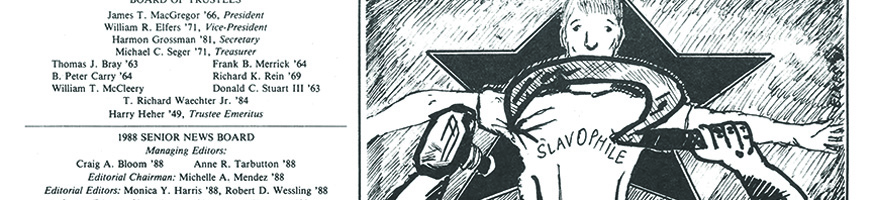
In this week’s installment of our recurring series, student volunteers attend orientation before engaging in dangerous civil rights work, a senior complains about unwarranted accusations of being a communist, and more. October 18, 1964—Seven Princeton student volunteers attend orientation at the headquarters of the Council of Federated Organizations in Jackson, Mississippi. Philip L. Fetzer ’65…
-
This Week in Princeton History for November 1-7
In this week’s installment of our recurring series, some alumni are not pleased that students are cross-dressing for the theater, Abraham Lincoln is the most popular candidate for president on campus, and more. November 1, 1798—Using the “ride and tie” method and sharing one horse, Jacob Lindley and James Carnahan arrive in Princeton to begin…
-
This Week in Princeton History for October 12-18
In this week’s installment of our recurring series bringing you the history of Princeton University and its faculty, students, and alumni, a rally mourns the death of Matthew Shepard, controversy surrounds an advertisement in the Daily Princetonian, and more. October 13, 1998—About 100 Princeton University students rally to mourn the loss of Matthew Shepard, a student…
-
Princeton’s “Saturnalia”: Commencement Prior to 1844
2020 brought changes to Princeton University’s academic calendar, some planned, and some in response to the global coronavirus pandemic. This shift to an earlier start and end of Princeton’s academic year is not its first. Its historically most drastic change in the calendar came about for a surprising reason: Moving Commencement from September to June…
-
Electing an American President
With the 2016 U.S. Presidential Elections just around the corner, we’ve been having fun answering the U.S. National Archives and Records Administration’s #ElectionCollection challenges on Twitter. The timing also seemed right to put some of our elections-related memorabilia on display here at Mudd. Our lobby exhibit case now holds a variety of elections-related materials from…
-
This Week in Princeton History for February 16-22
In this week’s installment of our ongoing series bringing you the history of Princeton University and its faculty, students, and alumni, James Brown performs, Jimmy Stewart ’32 reflects on his college days, and more. February 16, 1996—James Brown, the “Godfather of Soul,” performs in Dillon Gymnasium.
-
MYTHBUSTER — “I Love Lucy” and a lost Presidential election?!
Is there any truth to the story that a commercial for Adlai Stevenson’s campaign interrupted an episode of “I Love Lucy” and cost him the 1952 election? This story has appeared in various books and articles, but none has a verifiable citation. For example, in the book “Lucy A to Z: The Lucille Ball Encyclopedia”…
-
The Election for Woodrow Wilson’s America

The 1912 U.S. presidential election was a turning point for progressivism, both for the nation and for Woodrow Wilson. An exhibition now open at the Princeton University Library illustrates this remarkable election and the life of the man who won it. Drawn from the University Archives and the Public Policy Collection at the Seeley G.…
This blog includes text and images drawn from historical sources that may contain material that is offensive or harmful. We strive to accurately represent the past while being sensitive to the needs and concerns of our audience. If you have any feedback to share on this topic, please either comment on a relevant post, or use our Ask Us form to contact us.