From Physics World newsletter, June 20, 2019
Virtual Fly Brain
Rating: Very Good
Strong Points: Easy to use, tutorials and demonstration videos are available
Weak Points: The new version of the website is still in beta testing
The common fruit fly, Drosophila melanogaster, is an important model organism, particularly in neuroscience research. The Virtual Fly Brain is an excellent resource for researchers who need to closely examine the fly’s neuroanatomy. Users can select an area from an image of an adult fly brain to discover more information about it, including a detailed description of the area, any synonyms used to describe it, and links to references. There is also a search feature for users who know the name of their brain region of interest but not its location. Additionally, image and template data are available for download. The current website only includes information for the adult fly brain, but an updated version including larval information is currently in testing and available for users to peruse. The Virtual Fly Brain is an excellent resource for neuroscientists using Drosophila to interrogate the structure and function of the brain.
Source: GenEngNews, Jan. 2019, vol. 39 (1) “Best of the Web”
NOAA Says The Polar Freezer is In Defrost Mode
Report Card Highlights from NOAA
Surface air temperatures in the Arctic continued to warm at twice the rate relative to the rest of the globe. Arctic air temperatures for the past five years (2014-18) have exceeded all previous records since 1900.
Source: Dan’s Wild Wild Science Journal Dec. 20, 2018. More data, graphs photos, text here:
NOAA’s Says The Polar Freezer is In Defrost Mode
United States has 5 National Libraries: Library of Congress, & National Libraries of Medicine, Agriculture, Education and Transportation
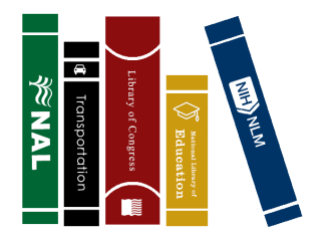 “Today, we’re asking “How many national libraries are there in the United States?”
For most countries, the answer is usually one.
But the United States actually has five.
In addition to the National Library of Medicine, the other national libraries are the Library of Congress, the National Agricultural Library, the National Library of Education, and the National Transportation Library.
National libraries or libraries established by the government of a country serve as preeminent repositories of information. Often, they include numerous rare, valuable, or significant works and play an important role in the preservation of their countries’ cultures and intellectual traditions.
National libraries are commonly open to the public for research, and while members of the public may not directly check out items, they may be able to obtain them through interlibrary loan. National libraries are also increasingly making their collections available online, as copyright and digitization projects allow.”
Source: NLM Announcements from the NLM Office of Communications, July 25, 2018.
CRISPR — HOW IT WORKS, an animation from HHMI
Summary
Explore this dynamic interactive to learn the basic principles of how this revolutionary tool works and the many ways in which scientists are using it in their research.
BenchSci, an antibody-finding search engine free to academics
The Peter B. Lewis Library is pleased to present BenchSci to the Princeton research community.
Registration is free to all scientists with a princeton.edu or affiliated institutional emails at https://www.benchsci.com
BenchSci is a online platform designed to help scientists find antibodies from publications. Their proprietary machine-learning algorithm was trained by PhD-level scientists to identify and understand the usage of commercial antibodies in the research literature.
When searching for a specific protein target, BenchSci curates published data in the form of figures to simplify the literature search process. The figures can then be filtered by specific experimental contexts cited in the paper such as techniques, tissue, cell lines, and more, to help users pinpoint antibodies that have been published under experimental conditions matching their study interest.
For more information about BenchSci, please refer to this article: https://blog.benchsci.com/7-features-to-find-antibodies
To learn how to navigate BenchSci, please watch this short video: https://youtu.be/EFaDwTtqlv4
For further inquiries or feedback, contact Maurice Shen, PhD, the Head of Academic Relations at BenchSci, at maurice@benchsci.com
How to Write a Good Scientific Paper by Chris A. Mack…free download
SPIE Press has published a book that should be valuable to all students and faculty in science and engineering: How to Write a Good Scientific Paper by Chris A. Mack.
We are pleased to announce that it is available, for personal use only, at no charge as a PDF eBook, with the link at the book’s web page.
Alternatively anyone can order How to Write a Good Scientific Paper from SPIE’s Bookstore as a softcover book.
Princeton University Library has a link to the online version here:
https://catalog.princeton.edu/catalog/10712422
From the description: “This book is all about teaching the style and conventions of writing for a peer-reviewed scientific journal. From structure to style, titles to tables, abstracts to author lists, this book gives practical advice about the process of writing a paper and getting it published”.
Contents:Preface — Chapter 1. Getting started — Chapter 2. Structure and organization — Chapter 3. Language and style — Chapter 4. Figures and tables — Chapter 5. Citations — Chapter 6. Abstract and title — Chapter 7. What an editor looks for — Chapter 8. Picking the right journal — Chapter 9. Cover letter — Chapter 10. The editorial review process — Chapter 11. Review articles — Chapter 12. The ethics of scientific publication — Chapter 13. Authorship — Chapter 14. Plagiarism — Chapter 15. Double publication — Chapter 16. Editorial ethics — Appendix: A checklist for editors, reviewers, and authors.
Data Management Plan Presentation – Wed., March 28th
Data Management Plan Presentation
Wednesday, March 28, 12:00 – 1:00 pm
347 Lewis Science Library, Washington Road & Ivy Lane
[Lunch will be provided. RSVP here.]
This one-hour presentation by PU librarians, OIT and PICSciE/Research Computing staff is open to Princeton researchers, graduate students and grants personnel. Please share with those who may benefit from this presentation.
Topics
- Why manage research data?
- Elements of data management
- How to write a data management plan
- Common data management issues
- Best practices for managing research data
- Resources and support on campus
National Service Center for Environmental Publications
https://www.epa.gov/nscep
EPA Publications
“You can search, retrieve, download, print, and order EPA technical, scientific, and educational materials from this site – all free of charge!”
LAST UPDATED ON JANUARY 9, 2018
James Webb Telescope arrives in California (in 2 pieces)
| http://earthsky.org/space/james-webb-telescope-parts-arrive-in-california
Deborah Byrd created the EarthSky radio series in 1991 and founded EarthSky.org in 1994. Today, she serves as Editor-in-Chief of this website.
|

You must be logged in to post a comment.