
(This is our fifth post about the films of diplomat John Van Antwerp MacMurray. See the first post for more background.)
When watching MacMurray’s peaceful films of China, it is easy to forget that the country was torn by civil war for most of the time he served as minister. The films labeled “Peking Misc(ellaneous) I-II,” serve as a reminder. The first film opens with drills of the U.S. Marines of the Legation Guard, who protected the legation and, in emergencies, American citizens. In addition, the second film contains elaborate, rare footage of Nationalist troops, which may have been shot during the “capture” of Peking in June 1928 that ended the Nationalists’ Northern Campaign and left Chiang Kai-shek and his party in control of the country.

Above: Newspaper clipping of June 18, 1928, about a break-in by Nationalist soldiers of Ta Pei Ssu, a temple leased by MacMurray (box 104).
According to a newspaper clipping in MacMurray’s papers, Nationalist soldiers broke into the ‘Ta Pa Ssu’ temple in the Western Hills, which was leased by the MacMurray family. (For more on temple renting, see our previous entry.) Fear of looting and violence against foreigners, as had occurred during the Nationalist capture of Nanking in March 1927, was widespread. These fears proved unfounded, however, as can be read in My Life in China, the memoirs of Hallett Abend, a reporter for the New York Times. After negotiations with the foreign legations, the generals of the armies that surrounded the city agreed that Chang Tso-lin, the Manchurian warlord in control of Peking, would be allowed to leave the city, while his best-disciplined troops stayed behind to retain order. When General Yen Hsi-shan’s troops entered the city through the South Gate, Chang’s troops would exit through the Northeast gate. Does MacMurray’s footage capture these events?
The first film opens with a visit of presumably Admiral Clarence Williams, commander in chief of the US Asiatic Fleet (1:09), and a parade by the Marines of the Legation Guard. (The naval officers with bicorn hats (0:53) are not identified). The footage continues with a long series of drills, in which the Marines are simulating their defense of the Legation Quarter: first, the gates are closed and mounted Marines are sent out to “rescue” Americans (1:39), while heavy machine guns and supplies are retrieved from the armory with two wheel carts (2:01). This is followed by artillery drill practice from the Tartar Wall (2:30). The remainder of the film shows various Peking sites, including Beihai Park, and footage of Peking in snow. In addition, the film contains street and market scenes and shots of musicians and performers.
The second film continues with local scenes of Peking and its surroundings, including a funeral procession (0:12), street and market scenes, ice skating (2:21), and the selling and burning of incense at a temple (4:34). The footage that may capture the entry of Nationalist soldiers in Peking starts at 7:14.
MacMurray filmed an encounter with an unidentified military officer (7:58), groups of vehicles and packed camels, and armed and unarmed troops (8:38, 8:43, 8:54, 9:13, 9:19, 9:35), wearing different armbands and on two occasions carrying different flags (8:38 and 8:54). Filming the groups from different locations, MacMurray appears to have sought a variety of military and uniformed groups, alternating with shots of onlookers and guards. Of particular interest are the men with straw hats wearing armbands with Guomindang stars (9:35). The film ends with footage of a soldier raising the Nationalist flag (10:15), and a scene at a train station, with soldiers leaving on an open car (10:22). The brief footage following, shot aboard a boat, does not seem to be related.
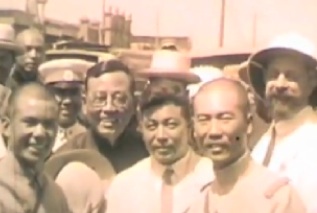 The footage leaves many questions. Did MacMurray film this on June 8 1928, the day that the Nationalist troops entered the city, or was it spread over a few days? Who was the military officer who gets so much attention (the fourth from the left in the picture here)? What do the two flags at 8:38 and 8:54 indicate, and what is the meaning of the different armbands, which were often used to differentiate between forces and units (8:38, 9:19, 9:36)? Ultimately, who are the troops in the end, leaving by train? When the Manchurian troops, who had been promised safe conduct, evacuated the city, they were surrounded and disarmed by the soldiers of a subordinate general, Han Fu-chu. The incident required the intervention of the diplomatic corps. Is any of this footage related to that? If you are able to shed any light on the films, we would love hear from you!
Our thanks to Dirk Haig for his explanation of the Marine drills, Shuwen Cao for her identifications of local scenes, and Edward McCord for his information about Chinese uniforms, armbands, and flags.
On April 17, 2012 Philip Jowett wrote:
I found the clips of the entry of Nationalist troops into Peking in 1928 fascinating. Having studied the armies of warlord China for many years, film like this is essential to finding new information especially regarding uniforms, flags e.t.c. My observations on the film minute by minute are as follows:
07.14 – Northern or Ankuochun soldiers mill around in Peking with a number having modern sub-machine guns.
07.37 – The Ankuochun or Northern soldiers in possession of Peking have distinctive armbands which I believe are red with a blue band at top and bottom.
07.57 – A close up of one of Feng Yu-hsiang’s Kuominchun officers arriving in Peking. By 1928 Feng’s ‘Christian Army’ had joined Chiang Kai-shek’s National Revolutionary Army. The Kuominchun troops are easily distinguished by the straw hats they are wearing.
08.05 – A meeting between the Kuominchun officer and his Ankuochun counterpart to arrange the peaceful handover of the city.
08.36 – This Ankuochun flagbearer leads a column of Northern soldiers out of the city. His flag is a new type not seen before with a red field with three red stars running across a white band. Although the flag looks white it would be most unusual for the field of the flag not to be red.
08.54 – The marching Ankuochun troops are lead by a soldier with a small unit flag stuck into the barrel of his rifle. Smaller unit flags in Warlord Chinese armies usually caried Roman numerals as in this case with the number ’12’ on the flag.
I will be including my observations in my next book on Warlord Chinese Armies which is due to be published later this year. If anyone would like to ask any more detailed questions about the film please feel free to contact me (philipjowett@aol.com)