
Since 1951, the Princeton Plasma Physics Laboratory (PPPL) has conducted research aimed at developing controlled nuclear fusion as an energy alternative to fossil fuels. Founded by Lyman Spitzer *38, the PPPL is a joint project of Princeton University and the US Department of Energy, located on Princeton’s James Forrestal Campus. This 1989 publicity film highlights the PPPL’s history, projects, and progress toward its mission of developing sustainable nuclear fusion.
The film’s focus is the PPPL’s main experiment in the 1980s and 1990s, the Tokamak Fusion Test Reactor (TFTR). This device used magnetic fields to contain a plasma made of hydrogen isotopes which were heated to a temperature so high that their nuclei fuse together into a new molecule, generating energy as a byproduct. TFTR’s goal was to develop a process of generating more energy through the fusion than the amount of electricity required to power the reactor containing the plasma. By 1989, TFTR’s successes included achieving a then record-temperature of 200 million degrees Celsius and confirming existence of a so-called “bootstrap current” within plasmas.
While the PPPL has produced several similar promotional films, the message of optimism in this 1989 promo belies a year of difficulties for the Laboratory, as it faced challenges including the perceived threat of cold fusion, layoffs of 95 people due to a $12 million budget cut, and the resignation of director Howard P. Furth.
Despite these difficulties, the PPPL’s efforts to generate nuclear fusion continued. The Tokamak Fusion Test Reactor would go on to generate record amounts of man-made fusion power (10.7 million watts), produce record temperatures of 510 million degrees, and discover new methods of plasma confinement. While TFTR was retired in 1997, the PPPL continues to research nuclear fusion with a new reactor, the National Spherical Torus Experiment (NSTX).
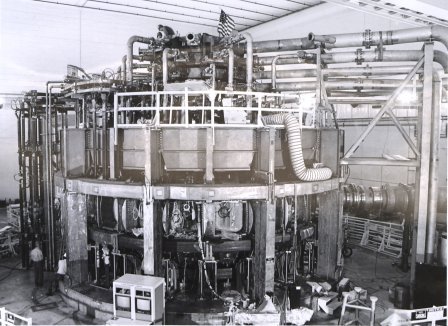
The Tokamak Fusion Test Reactor in 1982.
Historical Photograph Collection: Grounds and Buildings Series, Box MP46.
The Seeley G. Mudd Manuscript Library has a great deal of information concerning the Princeton Plasma Physics Laboratory in a variety of Princeton University Archives collections, including:
-John P. DeLooper
This VHS video is part of the University Archives’ Historical Audiovisual Collection (Item no. 1491)
The need for alternative energy sources to fossil fuels has grown to an almost desperate situation. This country and this world need to get off our dependency to oil and move forward