
“The Princeton of today is not the Princeton of Scott Fitzgerald. And by that I mean you can feel comfortable being Jewish, you can feel comfortable being Asian, you can feel comfortable being African American. And while this might not always have been true (…) it is definitely true today.” The speaker is Erik Ruben ’98 (1:46), one of the students featured in the promotional video below about the Center for Jewish Life, which opened in 1993. Today’s entry takes a brief look at the history of the admission of Jewish students at Princeton since the 1920s.
F. Scott Fitzgerald‘s 1920 debut novel, This Side of Paradise, was set at Princeton and reflected the atmosphere of the eating clubs and of the university itself, which (not to Princeton’s liking) he described as “the pleasantest country club in America.” Fitzgerald wrote his book at a time when some northeastern colleges and universities, particularly in urban areas where many Eastern European Jewish immigrants had settled, perceived they had a “Jewish problem” in that if they admitted too many Jewish students, Protestant middle and upper class students would be driven away. Columbia, which had the largest Jewish enrollment at 40%, was the first to impose a quota in 1921. Princeton, however, always claimed not to use quotas. As late as 1948 Radcliffe Heermance, Princeton’s first director of admissions from 1922 to 1950, vehemently denied a claim that Princeton used a quota to keep Jewish students under 4%. “We’ve never had a quota system, we don’t have a quota system, we will never have a quota system” he told the Daily Princetonian.
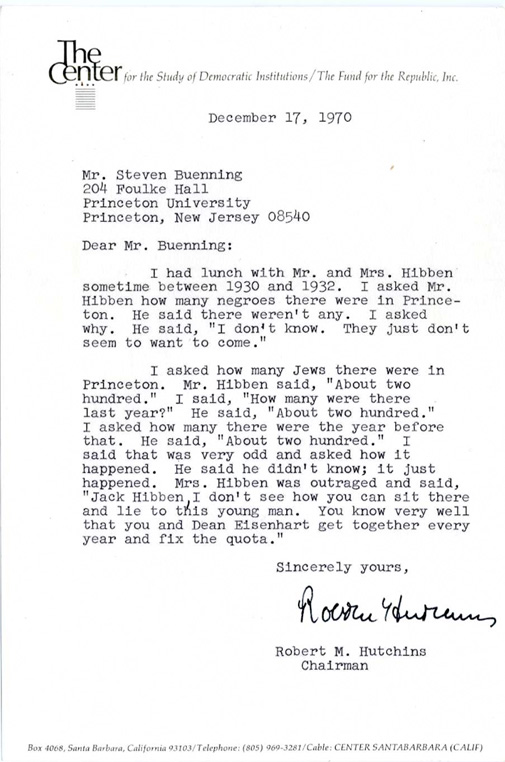 A letter from former University of Chicago president Robert Hutchins, who visited Princeton President John Grier Hibben in the early 1930s, indicated otherwise. Hutchins wrote Princeton senior Steven L. Buenning ’71 In December 1970, as Buenning was seeking information for his senior thesis, a biography about Hibben. In the letter Hutchins recalls how he had asked Hibben about the number of Jewish students at Princeton. According to Hutchins, Hibben claimed that the number just happened, whereupon his wife exclaimed: “Jack Hibben, I don’t see how you can sit there and lie to this young man. You know very well that you and Dean Eisenhart get together every year and fix the quota.”
Heermance limited Jewish enrollment by developing an admission policy that put an emphasis on “character,” which, however subjective, was still regarded as defensible in public. Criteria like “manhood,” “leadership” “participation in athletics” and “home environment and companions” were assessed by using interviews, letters of recommendation, and a social ranking system. A powerful disincentive to even apply was the anti-Semitic reputation of Princeton’s eating clubs, which considered most Jews “unclubbable.”
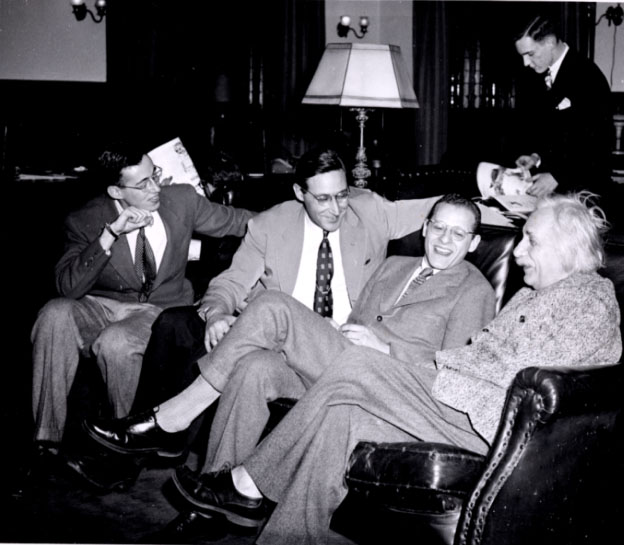 After World War II, greater social forces forced the University to begin to change. In 1947, the Student Hebrew Association was founded and held the first Jewish service on campus, which was attended by Albert Einstein (right). A year later the student organization joined the Hillel Foundation, the national Jewish campus organization founded in 1923 and sponsored by the New York Jewish service organization B’nai B’rith. On October 1, 1948 Rabbi Irving Levey, the new director of Hillel on campus, directed his first Friday evening service. The Prince wrote: “The establishment of Hillel at Princeton marks the recognition that members of all religious faiths shall have the opportunity to worship on the campus. The importance of Judaic thought and the spiritual needs of her Jewish students have at last received the recognition and constructive leadership they deserve.”
When Cliff Stein, president of Hillel, was interviewed for an article in the Nassau Weekly on May 1, 1986, shortly after Princeton’s announcement to establish the CJL, he told the paper that he still met prospective Jewish students who chose “less academically inviting colleges” than Princeton, because of Princeton’s anti-Semitic reputation. “This building will go a long way to break down that image,” he said. The above promotional film, produced three years after the opening of CJL and aimed at prospective Jewish students, should be viewed with this same history in mind.
Pingback: Proudly We Can Be Jews: The Jewish Experience at Princeton | Mudd Manuscript Library Blog
Pingback: The “Marry Ivy” Mom Sure Knows How To Ruin Valentine’s Day, Or, Saturday Morning at 8:13am | Privilege
The aim of our blog is to explain and contextualize the films that are featured. Since the first student quoted in the film refers to the “Princeton of Scott Fitzgerald” we chose to provide an explanation about that and, as stated in the first paragraph, elaborate on the admission policy in Princeton. Information about the “dirty Bicker” can be found in all three books that are suggested for further reading. Gregg Lange ’70 wrote about the subject in his PAW Princeton history column “Rally ‘Round the Cannon”. Those who are interested in contemporary reporting on the “dirty Bicker” are welcome to use the historical archives of the Daily Princetonian (the first article can be found here).
Although the phenomenon of antisemitism on campus and the role of Princeton’s established social system is alluded to, with all due respect I cannot conceive of how an article on this topic can leap from 1948 to 1972 — and thereby completely ignore the infamous 1958 “Dirty Bicker.” That stain on Princeton’s honor has been written about extensively. Here is an excerpt from a 2006 article in the Prince: