
By John Greenwald, Princeton Plasma Physics Laboratory
Corkscrew-shaped instabilities called “snakes” have long been a common feature of the hot, electrically charged plasma gas that fuels fusion reactions, which could provide a future source of clean and abundant energy for generating electricity. Such snakes trap impurities released from the plasma-facing walls of experimental fusion vessels called tokamaks, and these impurities radiate away copious amounts of energy, cooling the plasma to temperatures below those required to create fusion reactions. Understanding the formation and survival of snakes can thus be essential to eliminating the problem so that fusion can take place.
New experimental data reported today in Physical Review Letters sheds light on how snakes form and survive in fusion plasmas. The paper, whose lead author is Luis Delgado-Aparicio of the U.S. Department of Energy’s Princeton Plasma Physics Laboratory (PPPL), cites recent experiments on the Alcator C-Mod tokamak at the Massachusetts Institute of Technology Plasma Science and Fusion Center (MIT-PSFC). The findings compiled by a multidisciplinary team show that the formation of snakes cannot be explained, as previously thought, by plasma pressure alone. Instead, the formation reflects complex interactions among phenomena that include the separately evolving plasma density and temperature conditions that produce the plasma pressure. This separate evolution of density and temperature also enables the snakes to survive periodic relaxations of plasma pressure known as sawtooth instabilities.
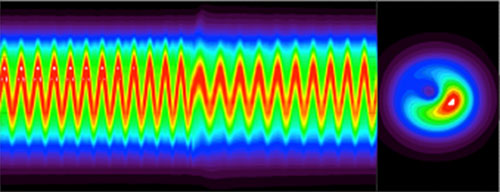
Right: X-ray reconstruction of cross-section of crescent snake inside Alcator C-Mod.
Credit: Luis Delgado-Aparicio
Citation:
Delgado-Aparicio, Luis; Linda Sugiyama, MIT; Robert Granetz, MIT; David Gates, PPPL; John Rice, MIT; Matthew Reinke, MIT; Manfred Bitter, PPPL; Eric Fredrickson, PPPL; Chi Gao, MIT; Martin Greenwald, MIT; Kenneth Hill, PPPL; Amanda Hubbard, MIT; Jerry Hughes, MIT; Earl Marmar, MIT; Novimir Pablant, PPPL; Yuri Podpaly, MIT; Steven Scott, PPPL; Randy Wilson, PPPL; Steve Wolfe, MIT; and Steve Wukitch, MIT. 2013. Formation and stability of impurity “snakes” in tokamak plasmas. Physical Review Letters 110, 065006.
This work was performed under U.S. DOE contracts including DE-FC02-99ER54512 and others at MIT and DE-AC02-09CH11466 at PPPL. Computational support was provided by the National Energy Research Scientific Computing Center under DE-AC02-05CH11231.
You must be logged in to post a comment.