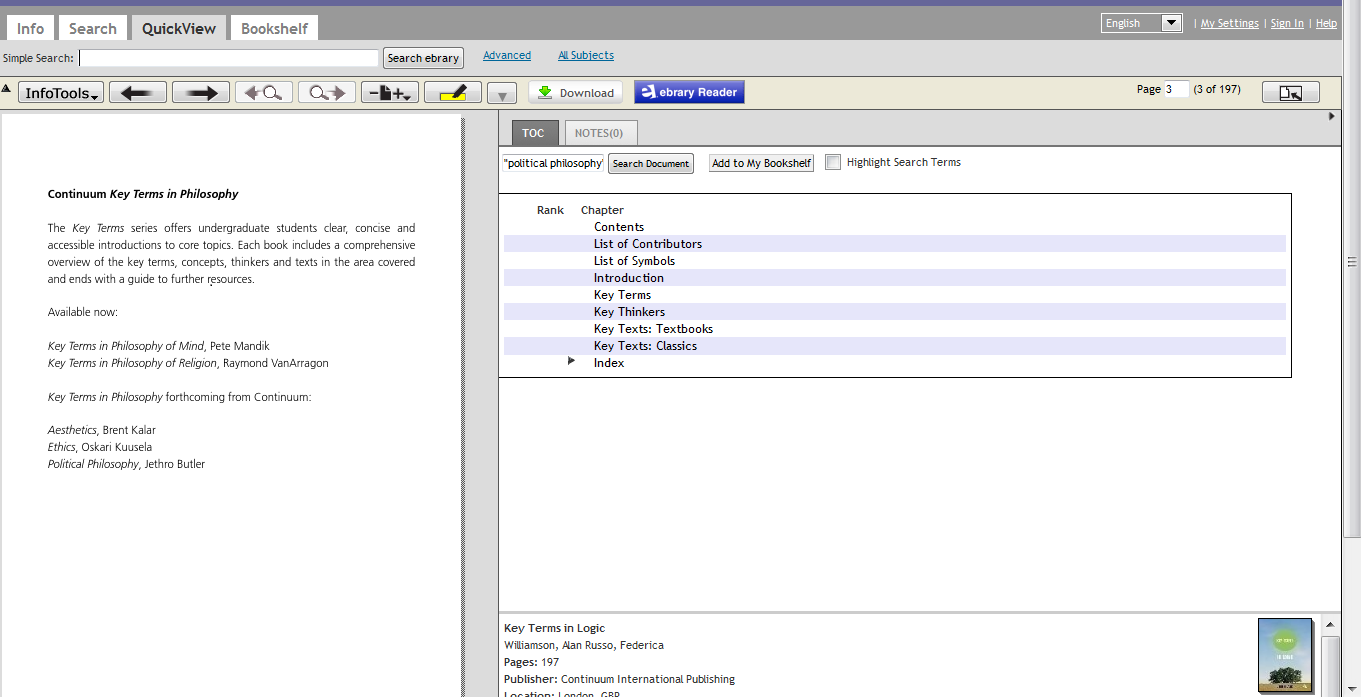
Ebrary Ebook Downloads: the First Time

Ebrary now allows users to download ebooks to devices. Ebrary users can download up to 60 pages of a book into a permanent PDF file or an entire ebook using Adobe Digital Editions, which seems to load onto every ebook reader except the one I own (the Kindle). Ebrary has always had an ebook model similar to the ejournal model we’re all familiar with, where multiple users can access the same item just as they can with journal articles. Reading on the computer screen isn’t great, but having the searchable full text of the ebook is great. The ebook download is a bit trickier than downloading an article from ProQuest or Ebsco, though. Here’s what it’s like the first time:

1. Once you choose your ebook, click the “Download Button.” 


2. In order to download a book, you have to create an Ebrary account, which you don’t need just to view the books online. I had an old one, but couldn’t remember my password.


3. Once you create the account, you have to sign in, of course. From now on, you’ll be prompted to sign in when you want to download.


4. You’re not quite done. Getting the partial ebook on PDF is easy, but to get the entire book you have to download Adobe Digital Editions. If you miss the tiny print, you won’t be able to read your book.


5. At the Adobe Digital Editions site, you have to click “Install.”


6. After you click “Install,” you get another screen, where you have to click “Install” again.


7. Adobe needs you to be really, really sure you want this and that you’re not just toying with their affections, so after clicking “Install” twice, you have to click “Yes” to actually download Digital Editions.


8. Then the setup begins.


9. And another step.


10. One more click and we’re done!


11.Well, almost. You still have to agree to the license terms that you’re almost certainly not going to read, hoping as with all software installations there isn’t something tucked away about you owing anyone the souls of your unborn children.


12. Oh, and you still have a little setting up to do.


13. It turns out you can’t download the ebook without creating accounts with both Ebrary and Adobe. So it’s time to do that.


14. Fill in all that information and “Join Adobe.” Now’s the time to start getting excited about reading that book, because there are only four steps left to go.


15. Success! Adobe Digital Editions activated.


16. Only you don’t have any books yet. So go back to the Ebrary download page and click “OK.”


17. Now you’ll get a prompt to download the ebook into Adobe Digital Editions. If you’re still going at that point, click “OK.”


18. And now we have our book. Through Adobe Digital Editions, it can be moved to various ebook readers and devices. Unfortunately, despite having accounts with both Ebrary and Adobe at this point, it doesn’t sync across computers. So if you download a book onto one computer using Adobe Digital Editions, you won’t be able to log into Adobe from another computer and access the book, which is functionality I expect at this point.


So, there you have it. How to download your Ebrary ebook for the first time, in 18 easy steps. It’s not quite as seamless a process as downloading an article from JSTOR, but Ebrary is doing the best it can with what it has. As with a lot of things, the first time is the hardest, and the download process is much smoother once you have the right accounts and software downloaded. I just wonder how many people will get through that first time.

The Library in the Age of Digital Reproduction (for Artspace New Haven)

Artspace New Haven has an upcoming exhibition about libraries, and a curatorial assistant there asked some library bloggers if they would like to contribute a piece of writing or a photograph for an accompanying volume of some sort, as well as blog about the exhibit. I like art and I like libraries, so I thought it was a great idea. Below is the information about the exhibit (and submission information for librarians who might want to write something), followed by my contribution, a brief essay with a couple of photographs of my personal library. Pity I won’t be in New Haven to see it.

“Library Science” at Artspace New Haven

“Artspace New Haven is a non-profit organization that presents local and national visual art, providing access, excellence, and education to the benefit of the public and the greater arts community. Its upcoming exhibition is titled Library Science, conceived by New York-based curator Rachel Gugelberger. The exhibition contemplates our personal, intellectual and physical relationships to the library, with a focus on how these interactions are changing as libraries adapt to the digital world. From its socio-cultural meaning to its architectural space and classification tools, the library informs the methodology and practice of the artists in Library Science, presenting the work of 17 artists in a variety of media including drawing, photography, sculpture, installation, painting and web-based projects. In conjunction with the exhibition at Artspace, Connecticut artists were invited to submit proposals for research residencies towards creating site and situation-specific projects at local libraries. Library Science seeks to encourage librarians to forge relationships with artists and support the creation and presentation of new artwork by providing assistance with research and access to information. The project will also reach out beyond New Haven to library patrons throughout Connecticut via an online exhibition catalogue.

In a further exploration of personal libraries, Artspace has been contacting librarians (especially those who blog!) to see if they would like to contribute anything written, or even photographs of their personal libraries or top-ten shelves (ten favorite books) and also if they could spread the word about the upcoming exhibition!

Submissions can be sent to sinclaire@artspacenh.org by November 1 (the show opens November 12.) For further information about Artspace, please see www.artspacenh.org.”

The Library in the Age of Digital Reproduction

I barely remember a time when I wasn’t an active library user. From the first grade I recall trips to the school library, where the librarian would seat us at common tables and place a number of books at the center for us to choose among. Instead of choosing one of those books, I always got permission to wander the shelves and find one on my own. Even then, my relationship to the library was active, questing, questioning, and the library was a place I enjoyed visiting. The library was the place with knowledge. It had an aura.

As I grew older the libraries grew larger and my explorations deeper. I found my high school library far too limiting, but I spent a lot of time in the city library reading about whatever passion had lately seized me. My university library was larger than that, with floors of stacks to wander. My graduate school library (the third largest academic library in the country) overwhelmed me, and was the first library that gave me a good picture of just how damn many books there were in the world and how relatively few I would ever be able to read. I spent countless hours in all of those libraries, back in the day when in-depth information about anything was hard to come by without going to the library building.

Even though I’m now a librarian, most of my library use has been as something else—an avid reader, a student, a scholar, a curious human being. People who know libraries but not librarians probably think librarianship is mostly concerned with reading books (or else shelving them, something else I don’t do). When I tell people I’m a librarian, they often say something like, “oh, you must love to read,” or maybe, “you must love books.” Check, and check, but neither has much to do with my daily job. The majority of my work consists of sitting in front of a computer interacting with some form of information technology. The rest of the time is usually spent showing students how to do the same. So my work as a librarian often removes me from direct contact with books, but also with direct contact with the library as place. I could do most of my work from anywhere with an Internet connection. For many people, work no longer describes a place (i.e., I’m “going to work”) but an activity. I might “go to work” in an office or sitting at my dining table. I work for, but not always in, a library. When I’m working, I don’t use the library as a place, the way non-librarians do.

Evolving information technology has altered my relationship to libraries, including the one I now work for. No matter what I’m doing, whether it’s reading for pleasure or doing research for a project, a lot of what I need will be online, available only through my library’s website perhaps, but requiring no visit to the library. Even if it does require a visit to the library stacks, I discover the book through an online catalog. Thus, while my relationship to the library as information provider is as strong as ever, my relationship to the library as a physical place to get information has dwindled. If it weren’t for the library funding and organizing access to information, my life would be significantly poorer, because contrary to popular belief, not everything is free online. But the digital resources of a well funded academic library are significant.

My relationship to the library has changed in this age of digital reproduction, much like our relationship to art that Walter Benjamin examined. In his essay on “The Work of Art in the Age of its Technological Reproducibility,”*  Benjamin argued that technological reproducibility eliminates the “aura” of a unique work of art.

One might focus these aspects of the artwork in the concept of the aura, and go on to say: what withers in the age of the technological reproducibility of the work of art is the latter’s aura. This process is symptomatic; its significance extends far beyond the realm of art. It might be stated as a general formula that the technology of reproduction detaches the reproduced object from the sphere of tradition. By replicating the work many times over, it substitutes a mass existence for a unique existence. And in permitting the reproduction to reach the recipient in his or her own situation, it actualized that which is reproduced.

The aura of a work of art has rarely existed for books. While there are unique books and editions, books for the most part are made to be reproduced, and the reproduction doesn’t detract from them at all. Books need a mass existence.

Printed books physically embody that mass existence. Everyone reading a printed book interacts with the same layout and font.  Digital books are very different objects. Escaping the physical instantiation in a mechanically reproducible printed book means the end of the mass experience of the book as we have known it. Though they will no doubt evolve, current ebook readers remove us from the mass experience of the codex, leaving only the mass experience of the text, but that text is now experienced in numerous different ways, sometimes by the same person. I can read the “same” book in print, on my Kindle, or on the Kindle app on my laptop or my smartphone. Ebooks increase the variety of reading by allowing us to read on different devices, but they also homogenize reading by reformatting every book to the same font and text size. Ebooks dilute the mass experience of reading a book, making it too fluid and changeable to have even a minimal aura.

But our relationship to libraries is, or was, more like our relationship to a work of art. Each individual library has an aura in the Benjaminian sense. It is unique, it is embedded in a tradition, and our relationship to the space is different from that in other libraries. While they all have books, their books are different and in different arrangements. But just as text has escaped the printed book, it has escaped the physical library. Text wants to be free. What was always a relationship with a unique space is now just as often an interaction with a standardized online interface.

My relationship to my personal library (pictured at the end of the essay) is necessarily more intimate than that to a public or academic library, but even it has changed. I check out lots of books from libraries, but other libraries can’t (yet) supply me with instant access to every book with which I have developed a lasting relationship. My library also tells a story about my life. It grounds me in times and places. When using my library, I not only recall a passage or reread a story. I also recollect and reminisce. For most of my library of 2,000 or so volumes, I can recall where I got the book, when I read it, and what else I was reading at the time. In the days before the Internet revolutionized the used book trade, I remember the days of searching through the jumbled shelves of dusty bookshops and the joyful serendipity of finding a book that I had been wanting, or better yet one that I didn’t realize how much I wanted until I saw it. Benjamin also wrote that, “in even the most perfect reproduction, one thing is lacking: the here and now of the work of art—its unique existence in a particular place. It is this unique existence—and nothing else—that bears the mark of the history to which the work has been subject.” My library has a unique existence in a particular place. It has an aura, and it bears the mark of my history.

Technology has altered my relationship to my personal library as well, though. For example, Shakespeare is a favorite author of mine, but good editions of Shakespeare tend to be huge, cumbersome folio editions like the Riverside and the Oxford Shakespeares, or else pricey multi-volume editions like the Arden. Many years ago at a library book sale I rejoiced to find a complete set of the old Yale edition of Shakespeare at a bargain price, not that gigantic reprint sometimes found in the bargain section of chain bookstores, but the French blue octavo editions of each play. They were aging, but still tight copies, easy to hold in a single hand or place in a jacket pocket, and they’re on the shelves behind me as I write this. On many occasions I would pick up a favorite play and reread passages or acts or even the entire play. I still do this, but I’m more likely to read the play on my Kindle or my smartphone. It’s just so much more convenient, and for classics cheaper even than my bargain Yale edition. I’ve got hundreds of Kindle ebooks, most of which I paid little or nothing for (often free downloads of individual works in the public domain from Amazon or munseys.com). For contested works like those of Shakespeare, the cheap digital editions don’t have the best texts, or any notes, but they’re good enough for casual reading. I still prefer printed books, especially if I’m referring to many of them simultaneously or reading for long periods, but I also like the convenience of having not just one volume but a large library in my pocket at all times.

Nevertheless, my library, the Library, has expanded beyond any given space or physical collection.  The Library can no longer be confined to one place, or a few places. Libraries can no longer have the sacred aura they once had for a lot of us, because the Library has expanded beyond the building downtown or the bookshelves in my home. Whereas a trip to the library was once always a unique interaction, the equivalent trip to my laptop isn’t. The variety of a printed collection is homogenized into a web browser. The Library is that big building I work in, those shelves along my living room wall, that laptop with access to millions of articles, and that smartphone with a lifetime of casual reading hiding inside an ebook app. Not everything is or will be digitized, meaning the Library will be a hybrid for a long time to come. The Library in the age of digital reproduction is still a place, but now it’s also everyplace. The library has lost its uniqueness, but has achieved ubiquity. For avid readers, it seems a small price to pay.

*For forty years the essay was known to English-speaking readers as “The Work of Art in the Age of Mechanical Reproduction,” but the 2008 Harvard edition has a better translation of the German “Kunstwerk im Zeitalter seiner Technischen Reproduzierbarkeit,” and allows me to distinguish between things mechanically reproduced—e.g., printed books—and things technologically reproducible—e.g., digital books.

My Library in the Age of Mechanical Reproduction

My Library in the Age of Mechanical Reproduction

The Rest of My Library in the Age of Digital Reproduction

The Rest of My Library in the Age of Digital Reproduction


Tools, not Trends

I’ve been writing lately about “keeping up.” An important part of keeping up is knowing what tools and technologies you absolutely need to use, and what you can ignore for the time being. In academic libraries, it means knowing the tools that students really want and use versus the tools that trendwatching librarians claim they should be wanting and using. You can see some of of those tools in the Educause Center for Applied Research National Study of Undergraduate Students and Information Technology 2011. It’s worth skimming to get an idea of what technology students use and how they use it. Those who believe that students avidly adopt every information technology and social media trend–and who tell us this is essential for librarians to do as well–might get a few surprises.

For example, “one consistent finding is that e-mail remains a potent form of communication, both widely and frequently used—and the tool students most wish instructors would use more often” (5). That’s right, boring old email. Students possibly want the instructors to use it more often because they think instructors don’t communicate enough, but they’re not begging their instructors to tweet them. Also, “Virtually all students (99 percent) use e-mail—and virtually all (97 percent) use it at least a few times a week and most students (75 percent) use it several times a day” (13). If 99% of the students are using email and it remains a potent form of communication, then I think it’s safe to say that librarians shouldn’t feel outdated using it in lieu of some trendier but significantly less adopted social media tool. Though it’s easy to let it get out of control, email is still a remarkably useful communication tool, and one of the best for reflective, in-depth exchanges among people. That’s why 99% of college students use it.

Of course, email wasn’t the only popular medium of communication. “93 percent of students use text messaging, 90 percent use Facebook, and 81 percent use instant messaging” (13). So on the off chance your library hasn’t yet adopted some sort of IM reference service (perhaps with SMS integrated), you’re definitely behind the times, but that doesn’t mean that the more traditional email still isn’t viable and necessary. The study found that while students used Facebook a lot, the desire to interact on Facebook with instructors, and thus presumably librarians, wasn’t great. Ninety percent of students use Facebook, but only “Twelve percent of students say Facebook is ‘extremely valuable’ to their academic success—and one in four students (25 percent) consider it ‘valuable’ or ‘extremely valuable.’ On the other hand, more than half of students (53 percent) think its academic value is limited or nonexistent” (26). If your library has a Facebook page, great. It’s an easy way to make announcements for students who like their information that way, but it’s obviously not an academic necessity.

As for the most hyped social media tool of the moment, Twitter, the student use is much lower. 37% of students use Twitter, but only 11% are “frequent users” (14). Not that those 11% aren’t a vocal minority. The study quotes a “student voice”: “My generation is a social networking generation. We devote most of our time to Tweeting and or reading tweets, it would help if we could communicate with our professors in this way because most of us aren’t able to contact them during their office hours” (26). I don’t know quite what to make of this. If the students are devoting “most of their time to Tweeting and or reading tweets,” then their scholastic success is far from assured anyway. Maybe the student is one of those business majors who don’t work very hard. I can understand an instructor communicating with students through Twitter easily enough if the instructor is already a Twitter user. Set up an account for questions, problems, links to assignments, news relevant to the course topic, etc. But for the rest, that’s maybe a lot of work for the 11% of frequent Twitter users. Instructors also have higher priorities than following all their students’ tweets as well.

For iPad lovers, there might be another surprise in the study: most students aren’t iPad lovers. They prefer more conventional technology. According to the study, “A majority of students own a laptop (87 percent), a USB thumb drive (70 percent), an iPod (62 percent), a smartphone (55 percent), a digital camera (55 percent), and a webcam (55 percent)….Fewer students (11 percent) own a netbook or an iPad (8 percent) or another tablet (2 percent)” (7). I now have a study confirming what I see around me on campus. Most of the time I see students in the library, they’re reading books or articles they printed out on paper (I’ve yet to encounter a student who prefers reading a scholarly book or article any way but on paper), or hunched over a laptop writing papers or crunching numbers. For scholars having to do research and write essays, the affordable laptop computer is a truly revolutionary technology in numerous ways. It changes everything from the discovery of information to its creation. Tablet computers are great for lots of things, but they’re not as useful as laptops for research and writing.

Sometimes the conclusions of the study seem to surprise the writers themselves. We are told that, “students are still attached to ‘standard issue’ technology. A majority of students own a printer (81 percent), a DVD player (75 percent), a stationary gaming device (66 percent), an HDTV (56 percent), and a desktop computer (53 percent)” (9). Anyway, the “still attached” sounds to me like surprise. I’m not sure why anyone would be surprised that students are “still attached” to really useful technologies. Possibly it’s a contrast between the expectations of the authors and the banal reality of students’ real technology use. Even the gaming is conventional. I don’t play a lot of videogames, but I have done enough to know that they’re usually more enjoyable on my big HDTV than on my smartphone.

As with the surprise, the study recommendations sometimes push against the grain of the findings. On a list of generally excellent technology recommendations, they recommend that instructors “Make more and better use of technologies that students value—and that are easily integrated into learning experiences in the shared environments in higher education (e.g., tablets, smartphones, student response systems or clickers) )” (32). However, since we know that only 10% of the students own an iPad or other tablet, compared to 87% with a laptop, why would instructors use valuable time to “make more and better uses” of tablets? Would that be a good use of their time? I just can’t see why tablet computers keep making an appearance when so far they’re not widely adopted among students, except that someone really wants students to use iPads.

Of the technologies seen by students as “extremely valuable” for academic success, here’s a breakdown: Laptop 81%, WiFi 78%, Smartphone 33%, iPad 24% (16). It reflects the reality that a laptop with an Internet connection is a powerful academic tool. An iPad is more of an academic luxury, and with college costing what it does these days, it’s a luxury that most students do without. Everything else pales in comparison. It could just be that students don’t realize how useful these tools are, but that’s for a different blog post. What seems to be the case now is that chasing technology trends isn’t something college students are very interested in, which makes them very different from some of the infotech-savvy librarians interacting with them, including to a great extent me.

The first recommendation of the study is excellent advice: “Investigate your students’ technology needs and preferences and create an action plan to better integrate technology into courses and help students access institutional and academic information from their many and diverse devices and platforms” (32). When dealing with technology, that’s the important thing to remember. What are your students actually using, compared to what some pundit claims they’re using? We’ve all read numerous hyperbolic and poorly supported manifestos about digital natives and millennials and such, but we should ignore them in favor of what we experience on the ground working with students. Recently, I had an interaction with a very bright 20-year-old Princeton student who asked me to slow down on something I was showing her because she “wasn’t good with computers.” Out of curiosity, I asked her if she was familiar with the phrase “digital native.” She wasn’t.

An American Fall

Most of you probably know that the Occupy Wall Street movement in NYC has a library, appropriately enough called the Occupy Wall Street Library. They accept contributions, so as a small gesture of solidarity, I sent the library a couple of books: Brian Barry’s Why Social Justice Matters and Nell Irvin Painter’s Standing at Armageddon: a Grassroots History of the Progressive Era. It seemed the librararianly thing to do.

Why Social Justice Matters was political philosopher Brian Barry’s last book, and while it’s not perfect it makes a good case for the injustice of large social and economic inequalities, and it’s more or less accessible for a work of political philosophy. I considered sending John Rawls’ Justice as Fairness: a Restatement, but Barry’s book is an easier read in my opinion and has a tinge of anger appropriate to the moment.

Painter’s book was one of several histories of the Progressive Era I could have chosen, all of which tell more or less the same story. I really don’t understand all the hostility to the federal government among people who would be significantly worse off if the government shrank to the levels of the nineteenth century, which seems to be what a lot of people claim to want. I believe, but could be wrong, that the hostility is based on a lack of knowledge about what conditions were really like for most Americans before the social legislation of the first seventy or so years of the twentieth century. With income inequality approaching Gilded Age proportions again, Americans should realize that the only thing that makes life secure and tolerable for the majority is that disorganized citizens have some protection against the force of politically connected transnational corporations and totally unregulated markets. Yet, some Americans want to take us back to an age of relative barbarism. Some fool claims Social Security is a Ponzi scheme, another fool believes him, and we’re on the road to misery. There’s a difference between the elderly and infirm who benefit from Social Security and Bernie Madoff, and if Americans can’t tell the difference we’re in trouble.

Some of the radicals trying to destroy the government claim that Social Security, for example, is “broken.” That’s nonsense. Social Security has been a raving success and saved millions upon millions of people from destitution, which is what it was supposed to do. Apply the payroll tax to all income instead of just the income below $106,800, and it would probably be well funded forever. The New Deal social legislation that so-called conservatives want to destroy came about for a reason. It wasn’t created by a bunch of socialists intent on destroying America. It was created after mass protests and misery that threatened the stability of the entire society. Massive income inequality is in itself bad if social order is important, even if you don’t care if people die in front of hospitals because they can’t afford treatment. All you have to do is read about America from 1880-1935 or so to see what I mean. Again, I suspect that a lot of people intent on rolling back the New Deal don’t know much about what it accomplished.

The predictable right-wing criticisms are so rote and hollow that I don’t see how anyone could possibly take them seriously, as I suspect even the politicians and pundits who mouth them don’t. The strangest one is the claim that one must be some sort of socialist to approve of the protests. I, for one, firmly believe in private enterprise and free markets, and that we should rely on free markets to provide what they can. But it’s clear to anyone with eyes to see that there are some things free markets can’t provide: equitable access to education, healthcare, sanitation, safe food, clean water, and breathable air for starters. Reading any history of the Progressive Era will show you that those things cannot be taken for granted for everyone without the government redistributing wealth into social programs, environmental protection, safety regulation, and infrastructure. To want every American child to have the opportunity to get an education, live in surroundings other than squalor, and have clean drinking water and untainted food and unpoisoned air doesn’t make a person a socialist; it just makes them a decent human being. If people live or die, flourish or stagnate, based completely on factors out of their control–like how much their parents make, or if they even have parents, or if they can afford to live in a safe neighborhood–then there is no social justice. The equal opportunity that a lot of Americans believe should be available to people regardless of where and to whom they were born isn’t possible without good government, and plenty of it. If people don’t believe America should be a land of equal opportunity, then they should just come out and admit it rather than crying “socialism”  and “tax cuts” every five minutes.

The more intelligent criticism from the right is still misguided. It always wants to find a focus for the protests, the way the Republicans eventually got the Tea Party movement to focus on the deficit (though not on any of the Republican policies that increased the deficit so much). Why are they protesting J.P. Morgan when Morgan had nothing to do with financing bad mortgages? Why are they protesting the bailouts when the money was all paid back with interest? Focusing on specific concerns is an act of rhetorical prestidigitation, trying to focus your attention on one tree instead of the whole forest. It’s not about bailouts or mortgages or unemployment or the economy or any one given thing. It’s about two generations of American politicians at the federal and state levels favoring corporate interests above all else and steadily eroding the opportunities of the lower and middle classes that had been created in the first seventy years of the twentieth. America has never been a country of truly equal opportunity for all, but the closer we come to that, the more just our society will be.  It’s not about one thing. It’s about everything. It about what America means, and what it means to be an American. We witnessed the Arab Spring. Perhaps we’ll witness an American Fall, one way or another.