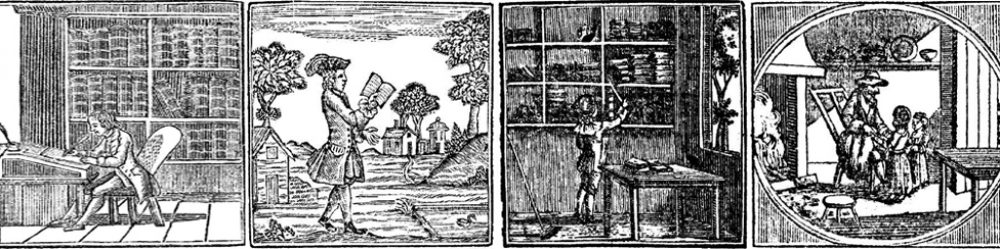
Copies of the four foundational collections of English nursery rhymes are as scarce as proverbial hen’s teeth. There’s less chance of finding in your grandmother’s attic a copy of the two-volume Tommy Thumb’s Pretty Song-Book (1744), Mother Goose’s Melody (1780), or Gammer Gurton’s Garland (1784), than a 42-line Gutenberg Bible. There are forty-eight copies of Gutenberg, versus no copies of the first volume and two copies of the second volume of Tommy Thumb’s Pretty Song-Book, one copy of the 1784 edition of Mother Goose’s Melody, and one copy of Gammer Gurton’s Garland.
Until now, the black swan of nursery rhyme anthologies was the first edition of Nancy Cock’s Song-book, which was assumed to have vanished without a trace. The English Short Title Catalog of eighteenth-century English imprints lists an edition printed around 1786 in Newry, North Ireland, and the Elisabeth Ball copy of a John Marshall edition from the early 1790s, now at the Lilly Library, Indiana University at Bloomington. The nursery rhyme scholars Iona and Peter Opie considered Miss Ball’s copy of Nancy Cock one of the most important books in her collection because it was almost certainly a late edition of an anthology published earlier in the century. The rhymes it contained were recorded in the Oxford Dictionary of Nursery Rhymes (1951).
When and where this mysterious Nancy Cock was published remained a mystery until Brian Alderson and I found an advertisement for it in the May 15 issue of the Daily Post, which identified the publisher as one T. Read of Dogwell-Court while researching the history of the rival Tommy Thumb’s Pretty Song-book. Read is not known to have been a competitor of Thomas Boreman, Mary Cooper, and John Newbery during the 1740s. James Burgh’s Youth’s friendly Monitor; or, The affectionate School-master. Containing his last pathetic farewell Lecture to his young Pupils, on their Entrance into a busy World (1752) was a Thomas Read book, but childrens’ books do not seem to have been part of his stock in trade–unless Joe Miller’s Jests or a ripping yarn like The English Rogue: or, The Life of Jeremy Sharp, commonly called, Meriton Latroon (1741) count. More down Read’s alley were things like A Collection of the most remarkable Trials of Persons for High-treason, Murder, Rapes, Heresy, Bigamy, Burglary; and other Crimes and Misdemeanors (1734), Warm Beer, a Treatise. Proving, from Reason, Authority and Experience, that Beer so qualify’d, is far more wholesome than that which is drank cold (1741), or Celibacy: or, Good Advice to young Fellows to keep single. In which are painted, in very lively Colours, the Pictures of many terrible Wives, both at Court and in the City (1739).
Read’s motives for publishing a novelty like a nursery rhyme anthology are not clear, but he produced a winner. Advertisements for different editions of Nancy Cock in London and American papers between 1747 and 1770 indicate that it was frequently reprinted. No copies by any publisher survive, however. Only one copy of any edition of Nancy Cock has come into the rooms in the last twenty years. Cotsen was the underbidder for the Marjorie Moon-David R. MacDonald copy of a 1795 provincial edition with the imprint “For the booksellers” sold December 2 2014 at Sotheby’s New York. Even though it was likely that this would be my last chance to add a Nancy Cock to the Cotsen, I was philosophical about the loss.

Illustration of “Little Robin Red-Breast” from the “for the booksellers” edition of Nancy Cock previously owned by the collectors Marjorie Moon and David MacDonald.
It is an unwritten law of bibliography that if you publish speculations about a rarity no one has ever seen, a copy will rise up to bite you sooner or later. In the 2013 Cotsen Occasional Press edition of Tommy Thumb’s Pretty Song-book, Brian Alderson and I reconstructed the contents of the lost volume 1 and ever since then we have been waiting for our come-uppance. Instead, we have been rewarded for going out on a limb because the 1744 Nancy Cock turned up this fall. And it’s a very special copy, having been passed down by three generations of English women as a family treasure.
The 13 January issue of the Times Literary Supplement features our account of its discovery and importance in the “Commentary” section. But the essay is not illustrated with pictures from the book, and this post is! Here is the title page spread, with the frontispiece of a cross schoolmaster punishing one of his pupils. Notice that Nancy Cock is credited to the fictitious Nurse Lovechild, who is also supposed to have compiled Tommy Thumb’s Pretty Song-book.

Nancy Cock’s Song-Book. [London]: T. Read, [1744]. (Cotsen 7262290)

This opening, with the swan in full sail on the left, and boys trying out different ways of breaking their playmates’ backs on the right, is another of my favorites. If some of you think you’ve seen the illustrations of the child musicians in the next opening somewhere else, you’re right. It has been copied from this little set of prints by Hubert Gravelot. But it was also adapted in the frontispiece for the second volume of Tommy Thumb’s Pretty Song-book. The lifting of this particular image strongly suggests that the engraver George Bickham, junior may have been involved in the production of Read’s Nancy Cock, along with several other of the “little books” Brian and I discussed in “Nurse Lovechild’s Legacy.”

The Gravelot original of the two child musicians.

The copy of Gravelot in Nancy Cock.

The same two musicians and friend face the title page of Tommy Thumb.
Nancy Cock’s second section consists of twenty-seven nursery rhymes and “Hey my kitten,” a poem imitating nurse’s prattle attributed to Alan Ramsay, chopped up as if it were several rhymes. Tommy Thumb’s Pretty Song-book and Nancy Cock print a handful of the same rhymes, but the illustrations are not the same. “Mary, Mary Quite Contrary” is a good example. In Tommy Thumb, the picture has nothing to do with the text. In Nancy Cock, the illustration brings out the bawdy undertones of the final line, the refrain of a famous song set to a famous tune in John Playford’s 1651 The Dancing Master. The three men waiting on Mary are wearing horns, the cuckold’s signature headgear.

Nowhere in the text is a monkey mentioned…

Mistress Mary and her row of cuckolds.
One of the jolliest English nursery rhymes must be “Boys and girls come out to play.” It is also among the earliest recorded, cropping up first in William King’s Useful Transactions in Philosophy, a 1709 satire on the Royal Society, then alluded to in Henry Carey’s “Namby-Pamby” (1725). It also appears on page 32 of Tommy Thumb’s Pretty Song-Book accompanied with a etching of two children looking up at the full moon, and in Nancy Cock with a picture of three boys, one with a cricket bat, hallooing a boy standing in the doorway. There’s a crescent moon shining in the upper right hand corner.


Nancy Cock makes two appearances on facing pages in her song book, as the newly minted heroine of “Ride a cock horse” and of “Up hill and down dale,” a now unfamiliar rhyme long associated her. The picture of Nancy as a demure milkmaid was adapted from the same set of Gravelot designs, perhaps hoping to distance her from the associations with the name “Nancy Cock,” which in the seventeenth and eighteenth centuries signified a girl who no better than she should be. Thomas Rowlandson seems to be playing on those connotations in his drawing of a luscious young laundry maid with a come-hither expression.

Thomas Rowlandson, “Nancy Cock clear starcher.” National Gallery of Art, Washington, D. C.
I am extremely grateful to the Friends of the Princeton University Library, whose generous contribution helped make poassible the purchase of this wonderful children’s book. And with the addition of Nancy Cock’s Song-book, Cotsen needs just the R. Stockton Gammer Gurton’s Garland to complete the quartet of foundational English nursery rhymes… Who knows?

![Page [1], foreward](https://i0.wp.com/blogs.princeton.edu/cotsen/wp-content/uploads/sites/88/2015/12/page1foreward.jpg?ssl=1)


![page[7]](https://i0.wp.com/blogs.princeton.edu/cotsen/wp-content/uploads/sites/88/2015/12/page7.jpg?ssl=1)
![page[12]](https://i0.wp.com/blogs.princeton.edu/cotsen/wp-content/uploads/sites/88/2015/12/page12.jpg?ssl=1)
![page[18]](https://i0.wp.com/blogs.princeton.edu/cotsen/wp-content/uploads/sites/88/2015/12/page18.jpg?ssl=1)


![page[32]](https://i0.wp.com/blogs.princeton.edu/cotsen/wp-content/uploads/sites/88/2015/12/page32.jpg?ssl=1)
![page[38]](https://i0.wp.com/blogs.princeton.edu/cotsen/wp-content/uploads/sites/88/2015/12/page38.jpg?ssl=1)

![page[44]foldout](https://i0.wp.com/blogs.princeton.edu/cotsen/wp-content/uploads/sites/88/2015/12/page44foldout.jpg?ssl=1)
![page[45]copyright](https://i0.wp.com/blogs.princeton.edu/cotsen/wp-content/uploads/sites/88/2015/12/page45copyright.jpg?ssl=1)