Picturing Progress: A Photo Album for Vladimir Lenin from the Azneft Commune

Dorogomu Vladimiru Il’ichu Ul’i︠a︡novu (Leninu) ot Kommunal’nago Upravlenii︠a︡ Aznefti. [Azerbaijan, 1922]. (Cotsen 30660)

The massive photo album pictured above, measuring nearly 14×19 inches, is definitely a rarity and a bit of a mystery. Created in 1922, probably in Baku, Azerbaijan, the Russian language album features 114 photographs (mostly silver prints) mounted on 30 card stock sheets. The cover title, (badly) translated as “To dear Vladimir Ilyich Ulyanov (Lenin) from the Communal Management of Azneft'”, indicates that this photo album was dedicated to Vladimir Lenin, then leader of the USSR, from the Azneft commune. But the album wasn’t really a gift for Vladimir Lenin (he mostly likely never saw it himself), it is more like a modest predecessor to the large scale Stalinist propaganda campaigns in which the great leader is thanked for the benefits of the revolution.

Cult of personality propaganda would reach new heights under Joseph Stalin, this poster text translates as: Thank you Comrade Stalin, for our happy childhood!

After a brief (18 month) independence from Russian rule during the Russian Civil War, Azerbaijan would find itself forcibly integrated into the USSR in 1922. As a result, the massive oil reserves outside of the capital city Baku would be nationalized and consolidated under the Azneft name (at the turn of the last century Azerbaijan was producing almost half the world’s oil, and continues to be an oil rich nation today). This album was probably arranged for the workers of an Azneft commune in order to showcase the amenities of a newly industrialized (and collectivized) life under Soviet rule.

Though probably made up of mostly oil workers and their families, the (ideal) tenets of collectivization meant that many aspects of material and social life would be provided on the commune including things like education, recreation, health services, and workshops.

Biblioteka (library).

Uchitel’skaya (teachers), faculty of the commune’s school.

Ambulatoriya (literally a “dispensary”, or small health clinic) Though difficult to make out here, the sign at the back of the room reads: “it is strictly forbidden to smoke, litter, and spit on the floor”; a message that was crucially displayed in Armenian, Russian, and Azerbaijani in order to make sure all patients obeyed the rules (strogo vospreshchaetsya kurit’ sorit’ i plevat’ ya pol’).

Clockwise from left: Tokarnaya Masterskaya (lathe workshop), Tokarnaya Masterskaya (lathe workshop), Mashinnoe Otdelenie (machine room), Liteinaya (foundry).

Tokarnaya Masterskaya (lathe workshop), a closer look at lathes.

Throughout the nascent Soviet Union bold educational reforms were being rolled out during the 1920’s. Literacy campaigns were especially emphasized in order to modernize the Soviet nation and educate a mostly illiterate populace. This photo album captures these initiatives in action:

Urok tyurkskago yazyka (Turkish language lesson), here adults are being taught the Perso-Arabic script for “Turkish” (Azeri Turkish) before Soviet authorities would institute a Latin script (1926) and then Cyrillic script (1939).

Urok russkago yazyka (Russian language lesson), children would be instructed in both Russian and Azeri Turkish (not shown here).

Urok arifmetiki (math lesson).

The photo album also depicts life off the commune. Pictures in the second half of the album capture visits to a new hospital in Baku and various sanatoria in Stavropol Krai, Russia; a region well known for it’s climate and health resorts. Perhaps advertising the new found inclusion of the united proletariat into the Russian world of rest and relaxation?

Sabunchinskaia bol’nitsia (Sabunchu hospital) in Baku, Azerbaijan. 

Clockwise from left: Chital’nya (Reading room), Fasad sanatorii v Pyatigorske (facade of a sanatorium in Pyatigorsk), Fasad sanatorii (facade of a sanatorium), Sanatoriya v Pyatigorske (sanatorium in Pyatigorsk).

Stolovaya sanatorii (dining room of the sanatorium), a few comrades enjoying a communal dinner.

As the handwriting below the photographs makes plain, this album wasn’t mass produced. Other Soviet photo albums of this kind are known to exist (later and more elaborate versions would be dedicated to Comrade Stalin), but this one appears wholly unique. We are lucky to have it here at Cotsen so that we can preserve these unique snap shots into a once brave new world that has faded sepia with time.


Many thanks to Thomas Keenan, Slavic, East European, and Eurasian Librarian for invaluable insight into what this item is. All misunderstandings and mistranslations are my own.

A New Picture Book Bio of John Newbery, the Man Behind the Medal

Balderdash! John Newbery and the Boisterous Birth of Children’s Books  (2017) is an explanation of where children’s books came from for preschoolers.   This is the first collaboration of author Michelle Markel and illustrator Nancy Carpenter, but they are both veteran creators of picture book biographies.  Working with other people,  they have introduced  young readers to modern artists Marc Chagall and Henri Rousseau to powerful women Queen Victoria and Hillary Clinton.  They have also tackled more obscure but worthy women subjects, such as Fannie Farmer, founder of the Boston Cooking School and the young Jewish girl who played an important role in the Shirtwaist Strike of 1909 on the East Side. .

Markel and Carpenter are not the first to write a juvenile biography of  John Newbery (1713-1767), the London bookseller widely believed to have “invented” the children’s book as we know it (I discussed their predecessors  in a previous post). For that achievement, Newbery was selected in 1922 as the namesake of the American Library Association’s annual award for the most distinguished contribution to American children’s literature.Can the life of John Newbery be made relevant to a twenty-first century child? And how many will actually find it interesting when so few vivid facts or anecdotes that would make him come alive survive?. The heated controversy about whether he treated his writers like indentured servants obviously won’t do and neither will George Colman’s nasty but hilarious send-up of the proud social climbing papa visiting his son at Oxford.   Tidbits like those would detract from the legend of the philanthropic bookseller who was the friend of the rising generation.  There are no portraits of him, so the imaginary one by Stephen Markel on the cover of Shirley Granaham’s 2014 biography, is all over the Internet for lack of anything else.  How many people assume it was taken from some eighteenth-century original in a museum?

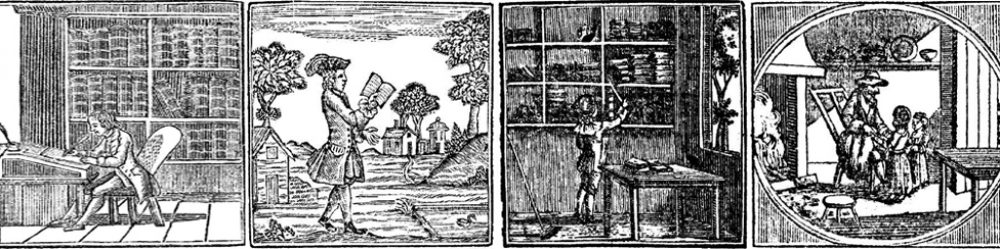
Perhaps the fewer the facts, the better, given the age of the intended audience for Balderbash.  Markel and Carpenter have succeeded in constructing an amusing and uplifting account that only a pedant might take issue with. Carpenter takes the liberty of presenting mid-eighteenth-century society as more literate and diverse than it actually was.  If we can believe illustrations depicting Newbery’s bookshop, the little books were stored not on low ranges of shelves like a modern children’s room, but in drawers.  But why snark at such good-humored illustrations?.  John Newbery would have approved of the way Carpenter incorporated Jack the Giant-Killer and Tom Thumb into the scene above..  I also think the shameless old promoter would have liked even more the scene where Newbery  peeks out of his shop, watching his satisfied little customers begin reading their loot before they are barely out of the door.  Actually the real John Newbery’s usual tactic was to model the desired behavior by showing the grown-ups presenting good children with rewards of his little books.  The goal never deviated from suggesting his books should be gobbled up like plum cakes!Markel’s opening is inspired: “Lucky, lucky reader. Be glad it’s not 1726.”  She goes on to explain that all the wonderful books like Gulliver’s Travels and Robinson Crusoe were for adults and children had nothing of their own except “preachy poems and fables, religious texts that made them fear that death was near, and manuals that told them where to stand, how to sit, not to laugh and scores of other other rules.”  That has more than a grain of truth,  as these two illustrations from children’s books published before 1744 show.What a difference between those two horrifying images and these two from  A Set of Squares, one of Newbery’s earliest works for young people for teaching reading along the principles of John Locke.  It’s not mentioned in Balderdash! (the only surviving copy is in the Cotsen Children’s Library) and in fact there are no facsimile illustrations from actual Newberys (which would have spoiled the concept).Was it all a lark creating those pioneering children’s books?    I doubt that  Newbery dreamed up the concept for the first periodical for children, The Lilliputian Magazine (1751), in the print shop, sitting under drying racks filled with sheets of A Little Pretty Pocket-Book.  Perhaps he should have, but we will probably never know.  It was obviously far beyond the scope of a picture book biography to retell in greater detail the story of  Newbery’s career as a children’s book publisher.  But there is a certain irony that Markel and Carpenter have given the legend of John Newbery (for which he was partly responsible) a charming new form, which will probably guarantee its continued circulation.for another generation.