Entering the Public Domain

Under U.S. Copyright Law, a significant number of classic works first published in 1923 have entered into the public domain this year, which means that they can be republished and sold or read online free-of-charge through Project Gutenberg without permission of (or payment to) rights holders. Among the works entering the public domain this year are particular books by Virginia Woolf, D. H. Lawrence, Aldous Huxley, and other leading authors of the last century. One title represented in the holdings of the Manuscripts Division is The Prophet, a collection of twenty-six brief inspirational essays by the Lebanese-American writer and artist Kahlil Gibran (1883-1931), a Maronite Christian influenced by Sufism and Baha’i. This thin volume has sold tens of millions of copies since it was first published by the New York publisher Alfred A. Knopf on 23 September 1923. This popular book achieved cult status in the 1960s. Even before being discovered by the counterculture, President John F. Kennedy’s inaugural address (1961) paraphrased Gibran’s essay The New Frontier, in which the latter had written (actually about the Middle East), “Are you a politician asking what your country can do for you or a zealous one asking what you can do for your country?” The book has been a perpetual bestseller and has been translated into twenty languages. Even today, Amazon.com rates Knopf’s Borzoi edition of The Prophet among its dozen best-selling works in the categories of “religious philosophy” and “inspirational philosophy.”

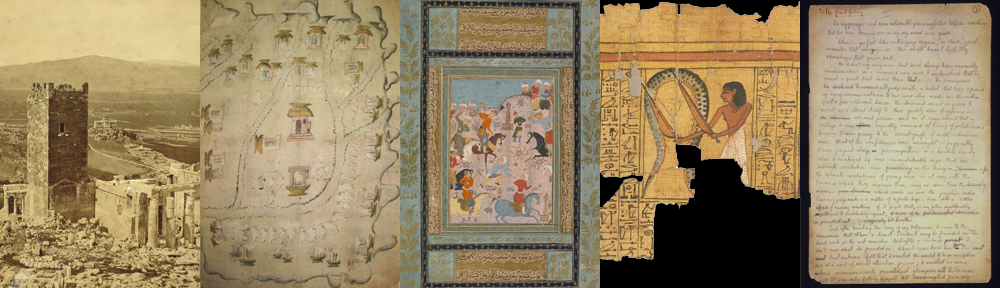
In 2007, the Library received the William H. Shehadi Collection of Kahlil Gibran (C1178) as a gift of the collector’s son Albert B. Shedadi (Woodrow Wilson School *1986). William H. Shehadi was a physician and director of the Department of Radiology at New York Medical College and Westchester Medical Center. He most admired Gibran’s compassion for others. His brother was the late Fadlou A. Shehadi (PhD *1959), a long-time Princeton resident. The collection includes significant portions of Gibran’s working manuscripts and notebooks for four well-known books, all written in English and published by Alfred A. Knopf in New York: The Madman: His Parables and Poems (1918), The Fore-Runner: His Parables and Poems (1920), The Prophet (1923), and The Earth Gods (1931). A page from the collection’s manuscript of The Prophet can be seen below. In particular, the notebooks contain the author’s many textual changes and deletions. The collection also includes fragments of other manuscripts, photographs of his New York studio, and published editions of his works. The Shehadi Collection is one of the main sources on Gibran, in addition to the author’s published works, love letters and private journal of his American friend and muse Mary Haskell, and Gibran manuscripts retained by family members and not readily available for research. In 1991, American University of Beirut published his book Kahlil Gibran: A Prophet in the Making, based on the Shehadi Collection. For more information, contact Don C. Skemer, Curator of Manuscripts, dcskemer@princeton.edu

?

Ancient Egyptian Manuscripts Online

The Manuscripts Division is pleased to announce that ten Pharaonic rolls, written in Hieroglyphic and Hieratic script either on papyrus or linen, have been digitized and are now available online in the Digital Princeton University Library (DPUL). See the listing below, with links to the digitized manuscripts. These rolls are the oldest part of the Princeton Papyri Collections. Most of them came to Princeton as part of the extensive 1942 gift of Robert Garrett (1875-1961), Class of 1897. In the late 1920s, Garrett acquired several such rolls, chiefly from the Ptolemaic period (305-30 BCE), in the antiquities trade. He purchased a fully mounted Saite recension of the Book of the Dead in Hieratic, 26th Dynasty, from Spink & Son (London) in 1928. Others were purchased still fully rolled. One of these, a Hieroglyphic Book of the Dead (Pharaonic Roll, no. 5), New Kingdom, 18th/19th Dynasty, was partially examined at the Metropolitan Museum of Art in 1944-48 by Egyptologist and fellow Princetonian William C. Hayes (1903-63), Class of 1924. Five of Garrett’s Pharaonic rolls were finally unrolled and mounted in the Library’s Preservation Office in 1998-99 under the supervision of paper conservator Ted Stanley. The work was done as part of the APIS Project (Advanced Papyrological Data System), with funding from the National Endowment for the Humanities (NEH). Don C. Skemer, Curator of Manuscripts, supervised the project at Princeton. Leonard H. Lesko, Charles Edwin Wilbour Professor of Egyptology Emeritus at Brown University, was the project consultant who provided guidance during the unrolling and mounting, and then described them for the APIS database. Over the past twenty years, Egyptologists have studied these rolls and published their findings in books and articles. Previous blog posts have focused on three of the Pharaonic rolls: no. 5; no. 8; and no. 10. For more information, contact Don C. Skemer, Curator of Manuscripts, dcskemer@princeton.edu

Book of Amduat. Hieroglyphic script on papyrus. Ptolemaic Period. Contains 12th hour. Pharaonic Rolls, no. 1. https://dpul.princeton.edu/papyri/catalog/dn39x503f

Book of the Dead. Hieroglyphic script on papyrus. Probably from a Theban tomb. Ptolemaic Period (?) Chapter 17 with polychrome illustrations. Pharaonic Rolls, no. 2. https://dpul.princeton.edu/papyri/catalog/0r9677259

Book of the Dead. Hieroglyphic script on papyrus. Ptolemaic Period (?) Owner’s name is (N)es-Ese, a “chantress of Amon.” Contains chapter 110 (Field of Hetep) and beginning of chapter 149 written in retrograde from left. Unrolled and mounted in the Princeton University Library,1998. Pharaonic Rolls, no. 3. https://dpul.princeton.edu/papyri/catalog/xd07gz04k

Book of the Dead. Hieroglyphic script on papyrus, with polychrome illustrations. Ptolemaic Period (?) Owner’s name is Pedimeh(y)et. His father’s name is (N)espautitaui, a “first prophet of Re”; his mother’s name is Lady Nebethutiyti. Pharaonic Rolls, no. 4. https://dpul.princeton.edu/papyri/catalog/sn00b312r

Book of the Dead, with polychrome illustrations. Hieroglyphic script on papyrus. Dynasty XVIII. Owner is Iwt.nyr.syh (Iwtlsyh?), a name possibly of Semitic origin. Includes chapters 84, 77, 86, 85, 88, 114, 38, 105, 31, and 125. Unrolled and mounted in the Princeton University Library, 1999. Pharaonic Rolls, no. 5. https://dpul.princeton.edu/papyri/catalog/ff3658534

Unidentified fragments. Fourteen small pieces with either Hieroglyphic or Hieratic script. Pharaonic Rolls, no. 6. https://dpul.princeton.edu/papyri/catalog/rx913v491

Book of Breathings. Hieratic script on papyrus. Ptolemaic Period. Nearly complete, unrolled and mounted in the Princeton University Library, 1998. Pharaonic Rolls, no. 7. https://dpul.princeton.edu/papyri/catalog/8w32r9117

Book of the Dead. Hieratic script on linen, Two complete rolls of the Saite recension (chapters 67-165), with illustrations in ink. The owner’s name is Hekaemsaf (or Heka-m-saf), whose mother was named Tinetmehenet. The owner should probably be identified with Hekaemsaf, a naval officer who served as Chief of Royal Ships under Pharaoh Ahmose II [or Amasis II] (570-526 BCE), 26th Dynasty. Pharaonic Rolls, no. 8. https://dpul.princeton.edu/catalog/k643b257s

Book of the Dead. Hieratic script on papyrus. Owner’s name is Khay-Hapy, “son of Isis-great-of-truth.” With Hieroglyphic labeling. Includes (from right) chapters 16, 18, 38B (?), 21, 23, 24, 25, 26, 28, 110, 27, 32, and 125. Ptolemaic Period (?). Pharaonic Rolls, no. 9. https://dpul.princeton.edu/papyri/catalog/2514nq85z

Osiris text. Hieratic script on papyrus. Ptolemaic Period. Unrolled and mounted in the Princeton University Library, 1998-99. Pharaonic Rolls, no. 10. https://dpul.princeton.edu/papyri/catalog/t148fm633

Litany or Hymn to Osiris. Hieratic script on papyrus. Pharaonic Rolls, no. 11. https://dpul.princeton.edu/papyri/catalog/0v838406h

Note: A fragment of a Book of the Dead, in Hieratic script on papyrus (Dynasty XXI, ca. 1100-950 BCE), with the owner’s name Pen-Amen-Apt, has been digitized in Treasures of The Scheide Library. The Scheide Library M P95.

Not yet digitized: Crocodile mummy cartonnage made from gesso with polychrome decoration (Tebtunis, 2nd century BC) box 8 Item 1-5.

Pharaonic Roll, no. 5 (detail). Transformation Spell, no. 86: Swallow perched on mummy.

Minassian Islamic Leaf Collection

Over the past dozen years, Library renovation, space reallocation, and staff changes have led to the fortuitous rediscovery of valuable materials acquired long ago, even before Rare Books and Special Collections moved to the newly completed Firestone Library in 1949. One such rediscovery is a collection of early Qur’ānic and Persian decorated manuscript leaves (19 items), dating from the ninth to eighteenth centuries. Below one can see one of the nineteen: a bifolium of an early Qur’ān written on parchment in Kufic, the oldest of Arabic calligraphic scripts. Krikor Minassian (1874-1944), a New York dealer in Islamic manuscripts and Near Eastern art, probably assembled this collection by the late 1920s or 1930s and donated it to Princeton around 1940. The Library accessioned it in May 1945 (AM 13658). Minassian was a native of Kayseri, Turkey, and remained active in the international market for decades. He formed other Islamic leaf collections, which are in various American libraries, such as the Library of Congress and Brown University’s John Hay Library. It is likely that particular leaves in the Princeton collection were from the same manuscripts as those in these collections. The Minassian Collection has been rehoused and designated Islamic Manuscripts, Third Series, no. 885. When cataloging has been completed, it will be digitized and added to the growing Princeton Digital Library of Islamic Manuscripts. At least a dozen additional Islamic manuscripts were found along with the Misassian leaves. For more information, contact Don C. Skemer, Curator of Manuscripts, dcskemer@princeton.edu

Kufic bifolium