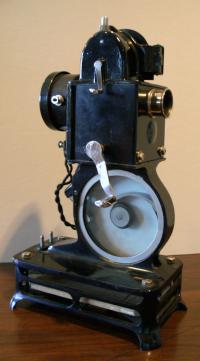
By the early 1920s, the Société Pathé Frères had built the largest film equipment and production company in the world. To increase their 1922 Christmas sales, they released the first projector meant for home use: the Pathé Baby. Kodak quickly released its own brand of home equipment and film, which found greater popularity and by 1935 Pathé was forced into bankruptcy.
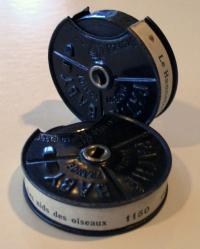
The 9.5 mm Pathé Baby films come in small cassettes holding approximately 30 feet of film that plays for around 60 seconds. What makes it unique is that it has sprocket holes down the center rather than on the sides. The film also has an ingenious little notch cut into each title frame that triggers the projector to stop for a few seconds, even though the operator continues to crank the film, allowing viewers time to read the text.
Princeton's collection of optical devices, and optical prints and photographs, is basically a pre-cinema collection. However, thanks to the help of Professor Rubén Gallo, we recently acquired a 1920s Pathé Baby projector along with approximately 1,000 Pathé films, including natural history, animation, biography, current events, and multi-reel comedies and dramas.
Here is a sample (black & white, no sound):
You need JavaScript turned on and the Flash Player installed to see this video.
There is a group of enthusiasts based in the United Kingdom who still use 9.5 mm film. Their website is www.Pathescope.freeserve.co.uk/Pathe95.htm

need advice. i have 20 pathe baby films which were taken by my grandfather between 1928 and 1936. i would like to have them converted to dvd. any idea who can do this for me
En casa tengo el mismo proyector de películas Pathé Baby que pertenecía a mi tío abuelo,junto con la filmadora respectiva que funciona perfectamente y 79 películas con títulos de Felix el Gato, Harold Lloyd, Charlot, una de Mickey Mouse, una de Charles Chaplin con Charlot y algunas de lugares pintorescos. Me gustaría saber que puedo hacer con estas reliquias.
Podria alguien decirme donde puedo conseguir la lampara del proyector pathe baby? gracias!!!!!!!!!!!
Tengo un proyector de pathe baby y varias películas un poco deterioradas, alguien conoce se se pueden salvar estas joyitas??!!!
for Johanna:
to convert your Pathè Baby films I have used
http://www.dvdinfinity.com.au/index.htm
with graet results.
They are in Australia.
Cheers, Luigi
I need more details about pathe Baby films. Because of i am very intersting photography.
(I mean film direction & cine photography)
so this knowldge useful for me.
Thanks.
Preciso de manual de instrução do projetor Pathé Baby com motor. Ganhei uma tota desmontada e quero colocá-la para funcionar.
Joanna, there is a great film preservation company in Rockville, MD USA called "Colorlab." Email in to info@colorlab.com to request a quote and they would be glad to help you out!
Very neat, I bet those cameras were expensive in those days.
Amazing that they still work even today.
I wish they made equipment that resilient today.