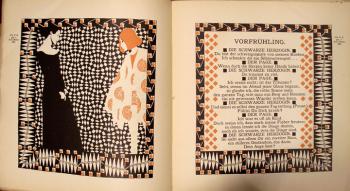
In the September 18, 2009, issue of the Times Literary Supplement on paper, the TLS chose to illustrate Robert Vilain’s review of three books about Rainer Maria Rilke with a double-page spread from Ver Sacrum (correct citation: Heft 21, 1. November 1901). Don’t check the digital article because the online TLS does not include the images from the paper copy, only the words. The Rilke verse is from the dialogue Vorfrühling (Early Spring) from Drei Spiele (Three Plays), spoken by Die Schwarze Herzogin (the Black Duchess) and a servant. There is a credit line for Rilke but no mention of the graphic artist who makes the pages so appealing.
The pages were drawn and printed by Koloman Moser (1868-1918). In the outer margins you can see his small printed signature “Kolo Moser”. As a cofounder of the Vienna Secession, Moser joined Gustav Klimt, Josef Hoffmann, and others to establish a revolutionary new art outside of academia. Moser served as editor of their journal, Ver Sacrum, as well as the chief designer for several years. Through the journal’s pages, Moser endeavored to fuse art and literature, graphics and text. With respect to TLS, I’m not sure he would have approved of their description of his work as illustration or the disconnect between paper and digital versions of their publication.
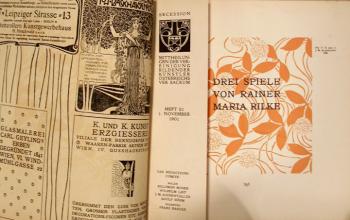
Ver sacrum: Organ der Vereinigung Bildener Künstler Österreichs (Wien: Verlag Gerlach & Schenk, 1898-1903). Marquand Library (SAX) Oversize N6494.W5 V47q
For more information, see also Koloman Moser, 1868-1918 (Vienna: Leopold Museum; Munich; New York: Prestel, c2007). Marquand Library (SA), ND509.M7 A4 2007b
During 1903, Moser and Hoffmann left the Secession group and founded the Wiener Werkstätte. Their Almanach also included texts by Rilke and designs by Moser. See Almanach der Wiener Werkstätte (Wien: Rosenbaum, [1911]). Graphic Arts Collection (GAX) 2007-0687N

Just for clarification: it was the TLS, not me, who chose the Kolomann Moser illustration for my review of books on Rilke; I was not aware it would be used until my copy landed on the doormat on the day of publication. I would also not use the word 'illustration' in this context, and regret very much that Moser was not fully and accurately credited.
Oops! Apologies for the typo in Moser's name in the response above.