The title of this video notwithstanding, Princeton football fell on hard times after the decision to abandon the single wing offense in the late Sixties.
In 1973, hoping to revive their fortunes, they hired Bob Casciola ’58, a former All-Ivy tackle, as head coach. Casciola had been an assistant coach under Robert Colman and is credited with persuading future All-American Cosmo Iacavazzi ’66 to attend Princeton. The team finished last in the Ivy League in Casciola’s first season, but improved in 1974 as Walt Snickenberger ’75 won the Asa Bushnell Cup as Ivy League Player of the Year. That raised hopes that the Tigers could return to the top of the standings in 1975.
Those 1975 Tigers had several good players, including quarterback Ron Beible ’76, a civil engineering major who set several Princeton passing records. The film reflects the changing university. In addition to the long hair and flamboyant ’70s clothes (including Beible’s white shoes), there were African-Americans on the team and female cheerleaders on the sidelines (0:15). Several interviews were filmed outside Jadwin Gymnasium, which opened in 1969. Casciola refers to the lack of spring practice, a rule for Ivy football teams that dates to the early 1950s and predates the formal creation of a league.
The film also shows different helmet logos. Princeton experimented with several designs during this period, including the abstract striped tiger tail and the cartoon running tiger. Not until 1998 did they revert to the classic “Michigan” helmet design that coach Fritz Crisler had inaugurated at Princeton during the 1930s.
Unfortunately, the high hopes for the 1975 season were not realized. The team won its first three games but finished 4-5 and fifth in the Ivy League. Casciola continued as coach until 1977 and later served as chief operating officer of the NBA’s New Jersey Nets.
Nineteen seventy-five was, however, a more successful year for Princeton’s men’s basketball team, which won the National Invitational Tournament.
On March 17, 1989, in the opening round of the NCAA men’s basketball tournament, Princeton University, seeded #16, faced national powerhouse Georgetown University, seeded #1 in the East Region. It was a classic David versus Goliath matchup. Since the tournament was expanded to 64 teams in 1985, a #16 seed has never defeated a #1 seed. There have been some close calls, but none closer than Georgetown’s narrow one point victory over Princeton.
The video below features four segments from the game. At the beginning of the broadcast (0.04), Dick Vitale, noted college basketball commentator and analyst, and John Saunders discuss the game. Vitale promises to don a Princeton cheerleader outfit if Princeton can beat Georgetown. He, like so many others, gave the Tigers little chance against the bigger, faster, and stronger Hoyas. Princeton took the floor as twenty-three point underdogs.
The starting line ups are presented in the second segment (0:28), and viewers can watch the first six minutes of the game (from 3:58), and see the final three minutes of play (from 12:03), including Vitale’s reaction to Princeton’s performance and near victory.
Georgetown, under head coach John Thompson, entered the tournament ranked #2 in the country and had recently won the Big East Conference title. They had a 26-4 pre-tournament record, and the team was loaded with talent, including freshman star and future NBA player Alonzo Mourning and senior captain Charles Smith, the Big East Player of the Year. Many predicted them to win the tournament.
Princeton, led by their famously colorful coach Pete Carril (left), was 19-8 overall, and as Ivy League champions had earned an automatic bid to the national tournament. They were a young team, with only one junior, Matt Lapin, and one senior, Ivy League Player of the Year and captain Bob Scrabis, on the roster. But, this was also a Princeton team that led the nation in defense, allowing only 53 points per game.
How could Princeton stay with Georgetown and keep the game close? The “Princeton Offense,” the hallmark of Carril’s coaching style, slowed down the Hoyas and forced an entirely different style of play. The “Princeton Offense” spread the floor, utilizing a three guard set, and made the contest a half court game. Clock management and patience were key.
In those days the shot clock was 45 seconds, and it was quite typical for Princeton to run the clock down for 30 seconds before they even began their offensive set. With constant ball movement and passing, the guards looked for players moving toward the basket, especially by back door cuts, which led to easy lay ups.
This style of play stymied Georgetown throughout the first half, and Princeton’s confidence seemed to grow with each basket. They picked up rebounds, scrambled for loose balls, limited turnovers, and generally frustrated the Hoyas. At half time, Princeton led 29-21, and there was a noticeable buzz of excitement in the arena.
In the 1946-1947 academic year, Princeton celebrated its 200th anniversary with a series of convocations and events, ending with a concluding ceremony, captured in a newsreel, which included a convocation address by US President Harry Truman. Today’s blog features another newsreel about the University’s bicentennial year that focuses on “Charter Day,” October 19, 1946. In addition to Princeton’s almost 200-year old charter and the “largest procession in Princeton history” at the time (which included 23 honorary degrees recipients), the newsreel addresses the beginning of intercollegiate football, depicting a re-enactment of the first football game between Princeton and Rutgers from November 6, 1869 during halftime of the 1946 Princeton-Rutgers game.
Princeton’s charter, granted to the University on October 22, 1746 (then still known as the “College of New Jersey”) is shown fleetingly in the newsreel (0:38). Readers of our regular blog already know that the charter, on intermittent display during the celebration of Mudd Manuscript Library’s 50th anniversary, is actually not the original (which was lost) but the second charter, drawn up in 1748. (An explanation can be found in our Frequently Asked Questions.) The famous early picture of Nassau Hall that follows at 0:48 is the copper engraving by Philadelphia artist Henry Dawkins (copied from a drawing by Princeton student William Tennent, Class of 1758), which was printed in Samuel Blair’s Account of the College of New Jersey (1764). For more information about the engraver, who was also a counterfeiter of paper money, see Julie Mellby’s Graphic Arts blog.
Over 500 people comprised the academic procession that opened and closed the morning’s convocation, according to the Prince, including faculty, trustees, representatives of all alumni classes and members of the Undergraduate Council. The procession included an official delegation from the United Nations, headed by Secretary General Trygve Lie, and members from the State Bicentennial Commission, including Walter E. Edge, Governor of New Jersey. Lie (1:42) and Edge (2:11) were among the 23 honorary degree recipients, as were the Danish physicist Niels Bohr, the Spanish writer Salvador De Madariaga, and the French philosopher Jacques Maritain (2:21–not all recipients are clearly visible).
The last eight minutes of the newsreel are occupied by the 38th Rutgers-Princeton football game in the afternoon (2:47), with a humorous reenactment of the first Rutgers-Princeton game of November 6, 1869 (5:51), considered the ‘birth’ of intercollegiate football. A description of the football game and the reenactment by Theatre Intime and members of the Rutgers soccer team can be found in the Prince. A copy of the program notes about the 1869 football game, with an explanation of the rules, may be downloaded at Twenty-four Stalwart Men.pdf. A second article from the program, summarizing the history of the Princeton-Rutgers football rivalry, can be viewed at 77 Years Princeton-Rutgers.pdf. More information about early football can be found in Football: the Ivy League Origins of an American Obsession by Mark Bernstein ’83, who wrote our previous blog entry.
The decade after World War II was a Golden Age of Princeton football. Under the leadership of coach Charlie Caldwell ’25, the Tigers were often nationally ranked and it was not unusual for newsreel cameras to film Princeton games. These Paramount newsreels give highlights from across that era, although the clips are not in chronological order.
The first game shown here, a 13-7 victory over Penn in 1951, was almost certainly broadcast on national television, as the Quakers had a lucrative contract with ABC to broadcast all their home games. Dick Kazmaier ’52, a triple-threat tailback in Princeton’s distinctive single wing offense, won the Heisman Trophy that year, graced the cover of Time magazine, and was named the AP’s athlete of the year, beating out such luminaries as Otto Graham and Stan Musial. Kazmaier showed off his passing skills here with a bomb to Frank McPhee ’53. (0:48)
The second clip shows a 42-20 loss to Yale in 1956, the first year of Ivy League competition. Although it is not known if this game was broadcast, one concession to television in those years was a recommendation that the road team wear white uniforms, which made the teams easier to distinguish on black-and-white TV sets. For generations before that, Princeton always wore black and orange, whether playing at home or on the road. Nineteen fifty-six was also Caldwell’s last full season as coach. He died of cancer the following year and was succeeded by his assistant, Dick Colman.
Caldwell was just beginning to build his dynasty in 1947, when the third clip was filmed showing a 26-7 loss to the Quakers. Dick West ’48 provided the lone highlight, connecting with George Sella ’50 for a touchdown. (3:40) West played for the Tigers in 1942 but interrupted his education to join the military. Sella, like Dick Kazmaier, was later drafted by the Chicago Bears but decided to pass up the NFL for Harvard Business School.
The final clip shows a hard-fought 24-20 victory over Navy during the undefeated 1951 season. The win was Princeton’s fifteenth in a row. Their streak would eventually extend to 24 games before Penn snapped it the following year.
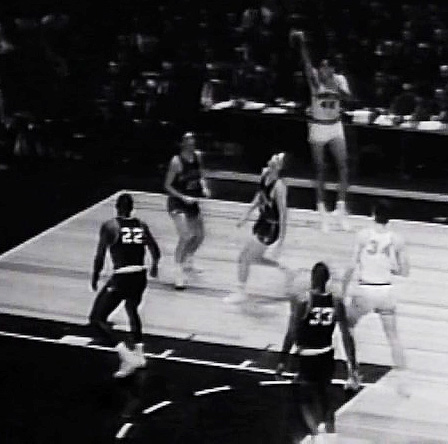
The 1964-1965 basketball season was an unprecedented season of success for the Princeton men’s team as it played some of the finest basketball in the country, led by All-American and captain Bill Bradley ’65. During that magical season, the Tigers won the Ivy League title and earned a trip to the NCAA tournament. By season’s end they had bested teams from Navy, Syracuse, Rutgers, Cornell, and Providence. Bradley, arguably one of the best athletes ever to play at Princeton, led a talented group of juniors and up-and-coming sophomores as they demonstrated that an Ivy League team, devoid of scholarship players, could hold their own, and indeed, compete with basketball powerhouses such as Michigan and North Carolina State.
Princeton’s season opened on December 2nd with an 83-74 victory over Lafayette College. Crowds filled Dillon Gymnasium to watch the team, and as the end of December approached, Princeton was 6-2. Then at New York City’s Madison Square Garden (2:34), where the annual Holiday Festival tournament was played, Princeton opened with a victory over Syracuse. But the match-up everyone was anxious to watch pitted Princeton against the University of Michigan — then the number one ranked team in the country. Michigan’s star player was Cazzie Russell, a versatile 6’ 6” all court player.
The first half was a fairly evenly matched contest, with Princeton securing a 39-37 half time edge. During the second half, Princeton opened up a significant lead. With four and a half minutes to go, the Tigers lead by 12 (4:52). But, the game quickly turned when Bradley was called for his fifth and final personal foul — a costly error that sent him to the bench for the remainder of the game. Without their floor general, Princeton struggled to find its rhythm, but managed to keep things close. With less than a minute to play, they still led by two points. In the waning seconds (6:08), Michigan put the ball in Russell’s hands, and he did not disappoint, nailing the winning shot which gave Michigan an 80-78 victory. It was not the last time that these two teams would meet during the season. Nor would it be the last time that Bradley and Russell would compete together. Both played on New York Knicks teams in the late 1960s. (The Daily Princetonian, January 5, 1965)
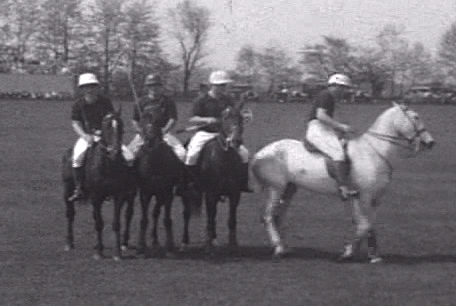
The film featured here, shot around 1928, contains three distinct sections. The first contains images of the Princeton Polo Team playing on W. B. Devereux Jr. ’04 Field (0:00-5:52). The second section opens with a woman and a small boy after the polo tournament (5:53-5:58), followed by scenes of Prospect Avenue and the various eating clubs located on this street (5:59-6:45). The third section documents the annual inspection of the Reserve Officers’ Training Corps (ROTC) Field Artillery Unit, performed by representatives of the United States War Department. The origins of the film, which does not appear on the list of films that were kept by the Graduate Council in 1931, are unclear.
Polo at Princeton
Although polo has been around for millennia, the first documented games on Princeton’s campus occurred in 1902, when Walter Bourchier Devereux Jr. ’04 and a few classmates organized a group of polo matches. The popularity of the sport grew quickly among the students, and by the spring of 1903, Princeton was the first college to officially adopt polo as a collegiate sport. Harvard and Yale soon followed suit. As rapidly as the sport emerged on campus, it soon diminished, due to a number of factors including the cost to secure and maintain horses and lack of interest from later classes.
It was not until 1919, with the creation of the ROTC Field Artillery Battalion, that polo would once again be played at Princeton under the leadership of Major J. E. McMahon, 1st Commandant of the Princeton Unit. He introduced the sport to the unit in order for its members to develop fundamental combat skills. Most of the polo players were members of the ROTC unit and were provided auxiliary horses and equipment by the Unites States War Department; those players, however, who were not members of the unit had to provide their own horses.
During the $53 Million Campaign (1959-1962) a 13 x 10 foot scale model of the Princeton campus toured 19 major cities and displayed at meetings of the regional leaders of the fund drive. To keep Princeton alumni further informed about progress and developments on campus, the Alumni Council sponsored two “Princeton Newsreels” in 1960 and 1961. The two 30-minute films are interesting to watch, not only because they feature new facilities, achievements in sports and science, and notable events (from Hurricane Donna in 1960 to the donation of $35 million for the Woodrow Wilson School in 1961), but because they also document the University’s first attempts to reach out to its donor base through the medium of film. Contrasting the two films, one cannot help but note that the second film is much smoother in its presentation than the first.
The first newsreel opens with an introduction by the 41 year-old president Robert F. Goheen ’40, and a freshmen lecture about the honor system by Walker Stevenson ’35, president of the National Alumni Association (1:30). The scale model of the campus, mentioned above, is featured at 6:41, when administrative vice-president Edgar M. Gemmell ’34 explains the expansions planned for the next three years. The footage following captures the Hibben and Magie faculty apartments under construction (6:41) as well as the five new dormitories of the New Quad (Class of 1937, Class of 1938, Class of 1939, Dodge-Osborn, and Gauss Halls), the first buildings to be finished since the start of the $53 Million Campaign (7:27).
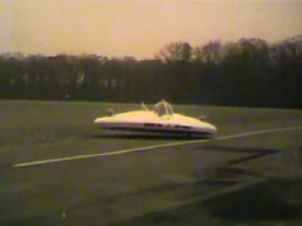
“Examples of Research” opens with a bird experiment on the roof of Guyot Hall (7:55), followed by the Princeton-Pennsylvania Proton Accelerator, a particle research facility on the Forrestal Campus since 1957 (8:59). In addition, the newsreel includes a demonstration of the thermoheliodon and the heliodon, developed by the Architectural Laboratory to determine the effects of sunlight, wind and radiation (10:19), and research at the Department of Aeronautical Engineering into problems that occur with low speed flight (11:29; footage includes “air car” shown above). In addition, the newsreel features faculty who won an award in 1960: the later Nobel Prize winner Eugene Wigner, Professor of Physics, who received the “Atoms for Peace Award” (15:02) and History Professor Robert Palmer, who won the Bancroft prize for his book Age of the Democratic Revolution (15:25).
The second half of the film features particular places and events, including alumni in the “Princeton Today” program who visited the new C-site at the “Matterhorn Project” (renamed the Princeton Plasma Physics Laboratory in 1961), a project for magnetic fusion research funded by the Atomic Energy Commission that had only been declassified in 1958 (15:47, with more about the Princeton Plasma Physics Laboratory in the second newsreel). This is followed by the appointment of three new trustees (17:15), the foreign language laboratory (18:57), achievements in sports (track, squash, and lacrosse at 20:06; football (with coach Dick Colman) at 25:04), and Reunions (20:54, with the Class of ’35). In addition, the film includes footage of Triangle chorines during a performance of Breakfast in Bedlam, which toured various military bases and hospitals in Europe during the summer (18:05). The newsreel also documents Hurricane Donna, the only hurricane on record to have struck every East Coast state between Florida and Maine, which hit the campus on September 12, 1960 (23:38).
The second newsreel that was produced during the $53 Million Campaign is more crisply presented, with a clear division into five chapters. The first chapter, “New Facilities,” shows new campus edifices: the Engineering Quadrangle (1:42), the John Foster Dulles Library of Diplomatic History (2:11), the Hibben and Magie apartments at Carnegie Lake (2:22), the new playing fields (2:37), and the dormitory quad with Wilcox Hall (2:48). It is followed by images of students moving into their dormitories (3:44), Class of 1965 freshmen, the new Dean of the College J. Merrill Knapp with Dean Ernest Gordon (4:36), and keycepts “in operation” (4:57).
“Sports” (6:26), the subject of the second chapter, features basketball (6:28), swimming (7:04), track (8:11), and football (8:24), with brief footage of important games and closeups of athletes. In the next chapter, “The Search for Knowledge” (11:32), the number of research project previously featured is reduced to two. The first concerns the new Model C Stellarator at Princeton Plasma Physics Laboratory (PPPL), the new name of “Project Matterhorn” discussed in the earlier newsreel. The large stellarator, for which facilities had been built in 1960, replaced previous models that had been used in the 1950s. As a second example of Princeton’s achievements in science the research of biology professor Arthur K. Parpart is discussed (14:21).
The fourth chapter, “Going Back” (15:43) includes footage of the Class of 1936’s 25th and the Class of 1911’s 50th reunion, with Joseph Cashman and Dr. William H. Hudnut from the Class of 1886 as members of the Old Guard. (Footage of President Robert Goheen ’40, Grant Sanger ’31, Harold Helm ’21, and Walker Stevenson ’35 is at 16:43). The “major Princeton event of 1961” is saved for last: “Princeton in International Affairs” (19:29) features the $35 million anonymous gift from a foundation (initially called the “X” Foundation, later known as the Robertson Foundation) to establish a professional school for public service at the Woodrow Wilson School. The newsreel ends with a statement by Gardner Patterson, who was the director of the Woodrow Wilson School and of the new program (20:35).
During the Class of 1950’s 60th reunion weekend, Ed Lawrence ’50 donated a DVD to the University Archives that he had made for his former rowing crew teammates from old 8mm movie footage. He gave us permission to put it on Princeton’s YouTube channel, although he doubted that anybody other than his friends would be interested. Within two months, however, the film (initially posted with accompanying music) had been watched over 3000 times. It even almost ended up on CBS’ The Early Show. Why all this interest? Apparently the rowers looked very fashionable!
“Great chinos and sweaters in action at 2:28. Jackets and ties for a trip to Cornell at 4:28. White bucks and grey flannels at 5:51,” wrote a blogger about Ivy style dress. By the time it was picked up by another blog about “preppy” clothes we had reposted the film on YouTube without the music that Ed Lawrence had used to accompany the footage. Although it contained only fragments from an old Glenn Miller piano recording (which gave the film a bit of a slapstick feel), Sony had immediately claimed the copyright to the music, so the film had to return to what it originally had been: a silent movie. Later, when CBS contacted us about using the footage, we discovered why there was this sudden interest: the “preppy look” is back in fashion this fall! We directed them to ask Mr. Lawrence for permission, but unfortunately, he did not return from vacation in time, so CBS used less historic footage.
For the University archives, the film is of interest for other reasons. We have very few audiovisual recordings that capture students’ extracurricular activities and social life on and around campus. This 20-minute film shows the 150lb crew not only at Carnegie Lake and the Boathouse, but also during trips and matches, including a trip to Cornell (5:03), Watkins Glenn State Park (6:09), Columbia University (8:34), the Eastern Intercollegiate Championship Race in Boston (9:54), and the University of Pennsylvania (10:46).
If you have films or videos of your Princeton years and are willing to part with them, we would be happy to incorporate them into the University Archives’ Audiovisual Collection. If you have converted the footage into a DVD and would want us to share it online, we would very much like to do so too. As long as it does not contain music under copyright!
This DVD of silent 8mm films, a gift from Ed Lawrence ’50, is part of the University Archives’ Historical Audiovisual Collection (item no. 2021)
The oldest known silent movie of a Princeton football match is a four minute recording of a Yale-Princeton game, shot at Yale’s stadium in 1903. The film, which was produced by the company of Thomas A. Edison, inventor of the motion picture camera, is held at the Library of Congress and can be viewed online. Featured below is the oldest football film in the Princeton University Archives, which is also the oldest film in our entire audiovisual collection: a recording of the 1919 Princeton-Harvard match at Palmer Stadium. It is interesting to compare the annotated movie, shot from just one spot in the bleachers, with two newsreels of matches in 1941 and 1951, when the excitement of the game could be captured in movement as well as sound.
While Thomas Edison’s cameraman in 1903 tried to capture the excitement of the game with a variety of shots and angles, the unknown cameraman who shot this 1919 Princeton-Harvard match was anchored to one spot. His aim was just to film the highlights, resulting in this annotated 25 minute film of the game on November 8, 1919, which ended in a 10-10 tie. We do not have any information about the context of this film. The earliest references to the practice of filming Princeton football and other events date from the early 1920s. The Princeton University Archives holds some football films from 1928, but most films found in the Football Films collection date from the 1950s forward. (Additional newsreels of games from the 1950s will be posted at a later date.)
The 1941 football newsreel, which captures Princeton’s loss to Pennsylvania 23-0, includes footage of the traditional tearing down of the goal post after the game (1:18). The second newsreel captures Princeton’s 5th game of 1951, which ended with a 53-15 victory (mistakenly announced as 53-14) over previously undefeated Cornell (01:44). The game has been called the ‘finest hour’ of Dick Kazmaier ’52, who was voted “All American” in both his junior and his senior year, and won the Heisman trophy as the player of the year in 1951.
These films are part of the University Archives’ Historical Audiovisual Collection. The 1919 film is a 16mm film (item no. 0166) and the newsreels were found on a Betacam 30 video capture of the original newsreels (item no 1344).