 Balderdash! John Newbery and the Boisterous Birth of Children’s Books (2017) is an explanation of where children’s books came from for preschoolers. This is the first collaboration of author Michelle Markel and illustrator Nancy Carpenter, but they are both veteran creators of picture book biographies. Working with other people, they have introduced young readers to modern artists Marc Chagall and Henri Rousseau to powerful women Queen Victoria and Hillary Clinton. They have also tackled more obscure but worthy women subjects, such as Fannie Farmer, founder of the Boston Cooking School and the young Jewish girl who played an important role in the Shirtwaist Strike of 1909 on the East Side. .
Markel and Carpenter are not the first to write a juvenile biography of John Newbery (1713-1767), the London bookseller widely believed to have “invented” the children’s book as we know it (I discussed their predecessors in a previous post). For that achievement, Newbery was selected in 1922 as the namesake of the American Library Association’s annual award for the most distinguished contribution to American children’s literature. Can the life of John Newbery be made relevant to a twenty-first century child? And how many will actually find it interesting when so few vivid facts or anecdotes that would make him come alive survive?. The heated controversy about whether he treated his writers like indentured servants obviously won’t do and neither will George Colman’s nasty but hilarious send-up of the proud social climbing papa visiting his son at Oxford.
  Tidbits like those would detract from the legend of the philanthropic bookseller who was the friend of the rising generation. There are no portraits of him, so the imaginary one by Stephen Markel on the cover of Shirley Granaham’s 2014 biography, is all over the Internet for lack of anything else. How many people assume it was taken from some eighteenth-century original in a museum?
Perhaps the fewer the facts, the better, given the age of the intended audience for Balderbash. Markel and Carpenter have succeeded in constructing an amusing and uplifting account that only a pedant might take issue with. Carpenter takes the liberty of presenting mid-eighteenth-century society as more literate and diverse than it actually was. If we can believe illustrations depicting Newbery’s bookshop, the little books were stored not on low ranges of shelves like a modern children’s room, but in drawers. But why snark at such good-humored illustrations?.  John Newbery would have approved of the way Carpenter incorporated Jack the Giant-Killer and Tom Thumb into the scene above.. I also think the shameless old promoter would have liked even more the scene where Newbery peeks out of his shop, watching his satisfied little customers begin reading their loot before they are barely out of the door. Actually the real John Newbery’s usual tactic was to model the desired behavior by showing the grown-ups presenting good children with rewards of his little books. The goal never deviated from suggesting his books should be gobbled up like plum cakes!
 Markel’s opening is inspired: “Lucky, lucky reader. Be glad it’s not 1726.” She goes on to explain that all the wonderful books like Gulliver’s Travels and Robinson Crusoe were for adults and children had nothing of their own except “preachy poems and fables, religious texts that made them fear that death was near, and manuals that told them where to stand, how to sit, not to laugh and scores of other other rules.” That has more than a grain of truth, as these two illustrations from children’s books published before 1744 show.
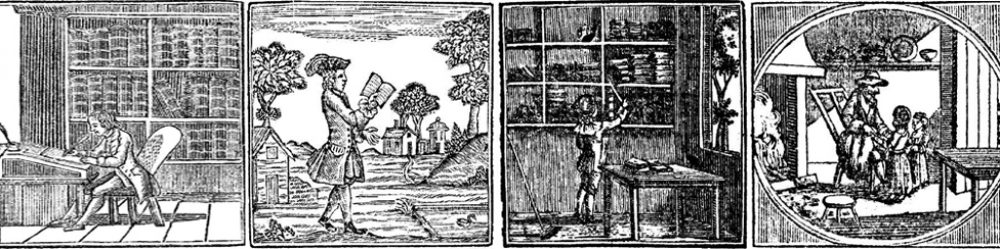
 What a difference between those two horrifying images and these two from A Set of Squares, one of Newbery’s earliest works for young people for teaching reading along the principles of John Locke. It’s not mentioned in Balderdash! (the only surviving copy is in the Cotsen Children’s Library) and in fact there are no facsimile illustrations from actual Newberys (which would have spoiled the concept).
 Was it all a lark creating those pioneering children’s books? I doubt that Newbery dreamed up the concept for the first periodical for children, The Lilliputian Magazine (1751), in the print shop, sitting under drying racks filled with sheets of A Little Pretty Pocket-Book.
  Perhaps he should have, but we will probably never know. It was obviously far beyond the scope of a picture book biography to retell in greater detail the story of Newbery’s career as a children’s book publisher. But there is a certain irony that Markel and Carpenter have given the legend of John Newbery (for which he was partly responsible) a charming new form, which will probably guarantee its continued circulation.for another generation.


 T
T


