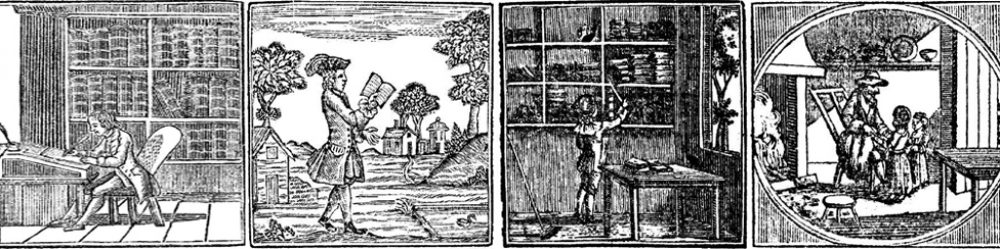

Front wrapper with an engraving illustrating a fable. Golden Precepts. Hartford, 1776. (Cotsen 34370)
Since we are inaugurating a long weekend celebrating Independence Day today (huzzah for a holiday on Monday!), I thought it might be appropriate to share an equally important contemporaneous manuscript to the Declaration of Independence from the Cotsen collection.
The above image is the front wrapper of Samuel Holbrook’s copy book. Composed between June and September 1776 in Hartford, Connecticut and Boston, Massachusetts, this copy book is a rare written artifact that has survived from the time of the founding of this country. A copy book (or copybook) is an educational practice book in which a pupil practices penmanship and the basics of reading (and often arithmetic) by copying as closely as possible passages from an engraved instruction manual. So of course, they often contained alphabets of Roman and italic letters, upper and lower case to copy.
![page [8]](https://i0.wp.com/blogs.princeton.edu/cotsen/wp-content/uploads/sites/88/2016/07/34370page8.jpg?ssl=1)
page [8]
![34370page[1]](https://i0.wp.com/blogs.princeton.edu/cotsen/wp-content/uploads/sites/88/2016/07/34370page1.jpg?ssl=1)
page [1]. Notice that Sam is using red ink for the headings and black for the precepts.
![page [11]](https://i0.wp.com/blogs.princeton.edu/cotsen/wp-content/uploads/sites/88/2016/07/34370page11.jpg?ssl=1)
page [11]. Notice that Sam used red, blue, and black ink on this page.
![page [13]](https://i0.wp.com/blogs.princeton.edu/cotsen/wp-content/uploads/sites/88/2016/07/34370page13.jpg?ssl=1)
page [13]. Sam was probably using a British copy book, which might also explain all the pro-English sentiments.
Happy Fourth of July, everyone!

![7411plate[13]](https://i0.wp.com/blogs.princeton.edu/cotsen/wp-content/uploads/sites/88/2016/08/7411plate13.jpg?ssl=1)

![6344921plate[1]](https://i0.wp.com/blogs.princeton.edu/cotsen/wp-content/uploads/sites/88/2016/05/6344921plate1.jpg?ssl=1)
![7411plate[8]](https://i0.wp.com/blogs.princeton.edu/cotsen/wp-content/uploads/sites/88/2016/05/7411plate8.jpg?ssl=1)
