The Christmas season is a most wonderful time of the year to praise the children’s bookseller. In this post, I’ll pay tribute to one of the most famous: John Newbery, the friend of Dr. Samuel Johnson and Oliver Goldsmith, who made a fortune selling children’s books and patent medicines (references to the nostrums like Dr. James’ Fever Powder were strategically planted in his books).
One of Newbery’s really clever publishing projects for young readers was a series of books that were suitable as presents for any major holiday– Christmas, New Year’s, Twelfth Night, Valentine’s Day, Easter, and Whitsuntide. Could this series been the answer to the prayers of every brother, sister, papa, mama, uncle, aunt, godfather and godmother who needed a present at the last minute? Thanks to Newbery, the philanthropic bookseller of St. Paul’s Church-Yard, perukes, product placement, and plum pudding go together like Macy’s, Santa, and Sedaris.
Many critics feel that Newbery’s reputation is sullied by his shrewd commercial instincts, even though it is probably true that his success in creating needs that could be gratified only at his bookstore in St. Paul’s Church-yard were instrumental in the creation of children’s literature as we know it. This does not seem to have bothered a handful of modern writers who decided to explain to children the debt of gratitude they owe Mr. Newbery as the namesake of the American Library Association’s annual award for the best American work written for children. There is Josephine Blackstock’s Songs of Sixpence: A Story about John Newbery (1955) and Russell Roberts’ John Newbery and the Story of the Newbery Medal (2003). The latest entry in the field is Shirley Granahan’s John Newbery: The Father of Children’s Literature (2009).

For some reason, John Newbery (of whom no portraits survive) always bears a striking resemblance to Ben Franklin. Front board, Songs of Sixpence: A Story about John Newbery (New York: Follett, 1955), (Author’s collection)
Quite by accident, I discovered in the Cotsen stacks what appears to be the earliest children’s book about John Newbery: A Book for Jennifer (1940) by Alice Dalgleish, founding editor of Scribner & Sons Children’s Book Division and author of well-regarded historical novels for children. It was illustrated by Katharine Milhous, perhaps best known for murals she painted for the Pennsylvania WPA and The Egg Tree, the picture book about Pennsylvania Dutch Easter traditions that won the 1950 Caldecott Medal.
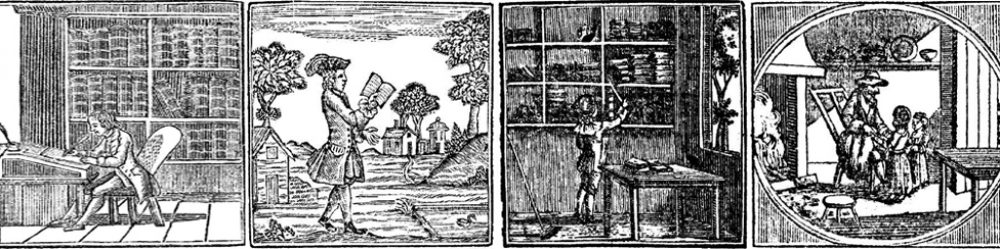
If you are familiar with the dark urban landscape of Leon Garfield’s historical fiction set in the eighteenth century, the recreation of Dr. Johnson’s London by Dalgleish and Milhous in A Book for Jennifer is a bit prim and dull. Milhous’s full-page color plates were paired with the line art based on cuts in eighteenth-century children’s books in Wilbur Macy Stone’s collection, which Dalgleish consulted so that her readers would have some idea of what Jennifer’s books actually looked like. Dalgleish did not identity the sources of those illustrations, but only one or two were reproduced from Newbery titles. There is one howler: the cut identified as a picture of Newbery’s store front is actually the early nineteenth-century one for the Juvenile Library of William Godwin.
True to the spirit of her subject, Dalgleish has repackaged the Newbery myth of enlightened entrepreneurship for American youngsters as a story about a little girl named Jennifer getting not one, but two Newbery books as Christmas presents. With that snow coming down, shouldn’t someone break into a song?

Page 2, (New York : Scribner, 1941), A Book for Jennifer, (Cotsen 7267)
Here is the scene where Jennifer’s doting godmother gives her a copy of The Important Pocket-Book. Her godmother is about to leave for America and she would like Jennifer to track her good and bad deeds and present the diary for inspection upon her return to England. Jennifer looks underwhelmed by this thoughtful and useful gift, which was published by Newbery and is now of legendary rarity.

Pages 11, A Book for Jennifer
When Jennifer falls ill on Christmas day, her two brothers are driven down to Newbery’s shop to find something to cheer her up while confined to quarters until the plum pudding is ready for flaming. Tempted by John-the-Giant-Killer’s Food for the Mind, a collection of riddles which the boys mistake for a version of the famous gory English folk tale, they think better of their first choice and unselfishly select The History of Goody Two-Shoes as perfect for girls, who should not be upset by anything too stimulating Newbery himself makes a cameo appearance.

Page 25, A Book for Jennifer
“Quaint” was the verdict of the anonymous reviewer in Kirkus.
A final Digression for Christmas Shoppers that should not be Skipped
I would be doing my gentle readers a disservice if this tribute to the great-grandaddy of children’s booksellers did not close with a puff for three marvelous independent booksellers in the Princeton area, who could give the old man some stiff competition. To wit…
The Bear and the Books on Broad Street in Hopewell has over 4000 titles lovingly and knowledgably selected by Bobbie Fishman, who was the long-time children’s book buyer at Micawber’s and Labyrinth before going out on her own.
Jazam’s on Palmer Square has a small but choice selection of books—many signed by the authors or illustrators—complementing with all the wonderful toys and games.
Labyrinth Books on Nassau Street has a cozy nook in the back with everything from board books to YA fiction. Buyer Annie Farrell has real bookish creds as the daughter of librarian and a rare books curator and a mother of two.
Yes, it’s supposed to be more convenient and cheaper to order from Amazon, but why not visit stores where people who are passionate about children’s literature want to put the best of the best in hands of their customers’ children? In Princeton we are really lucky to have easy access a truly priceless resource, great children’s booksellers…