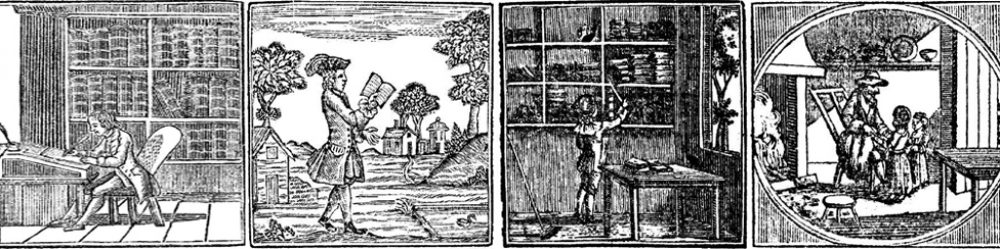

Early Impressions; or Moral and Instructive Entertainment for Children, Illustrated by Richard Dighton. London: Hatchard and Son, 1828. (Cotsen 34073)
Here’s how the room pictured above got into such a shocking state:
When little Benjamin returned from school, he always threw his books around the room; though he had a book-case to put them in. They became dirty and damaged. The binding of many of them was torn. When he read a book he left it in the place where he had been reading it. So one lay on the stairs, another in the parlour, and a third in the garden.
When he dressed himself in the evening, he laid his boots on the table. He threw his clothes about the room. Sometimes his hat lay upon the bed in which he slept.
He slept very long in the mornings. He frequently rose from bed when the other children were at school. Then he dressed himself in haste. It was some time before he could recover all his things.
This woeful description concludes with the author’s trenchant judgment, “It was not pretty of Benjamin to let his things be scattered about so that they must be torn and spoiled.”
How would an adult in 1828 try to motivate the little recidivist to change his ways? Well, by lecturing the class at school. Little Benjamin’s master makes a terse case for tidiness: one’s clothes and books cost enough money that they cannot be replaced every day, so they must be cared for properly. That means having a place for everything and always putting it in its place. Being orderly saves not just money, but time, which is even more important. Time isn’t wasted retrieving things kicked under the bed, draped on the furniture, dropped on the floor, or left on the table. And when a great deal of time that was wasted is now saved, it will elevate your mood.
Instead of poo-pooing his teacher, little Benjamin decides to conduct an experiment and test the truth value of the lecture. A trial quickly convinces him that it is better to be orderly than messy.
How different is this approach from that of a modern-day psychologist advising parents on how to get children to do violence to themselves and clear away the scenes of chaotic clutter which are their bedrooms? Today’s experts would insist on leading by example and on working side by side with the child until has internalized the routine. But one bit of advice has not changed a whit–if anything it is now couched in even stronger terms of utility. In her post “Tips for Getting Kids to Clean Their Rooms, Marie Hartwell-Walker offers this one-two-punch:
Those who are the most professionally successful tend to be those who know how to manage people, money, and stuff. Teaching our kids how to tidy up regularly, calmly, and eventually without prompting, contributes to mastery of one of these important three skill areas. Teach your kids how to organize today and you may be ensuring career success tomorrow.
Maybe. But a shovel and a pile of trash bags will come in handy until the pitch sinks in…


