 That is the soothing promise made in the title of a booklet published in London in 1836, in anticipation of the annular eclipse that would be visible in the northern part of Great Britain on May 15 of the same year. As the clock is ticking steadily towards the total solar eclipse of August 21, 2017, Team Cotsen became curious about how exactly eclipses and other astronomical knowledge have been explained to children in the past. Were eclipses truly made easy to understand for them?
To be honest and fair, even in the digital era when information is purportedly one click away, and with the aid of instructional animations and videos freely available on the Internet, my not-so-young mind/head starts spinning whenever it tries to hold the image of Earth rotating on its axis as it revolves around the Sun–which, mind you, is not still but just as busily carries on with its own rotation while whizzing around the center of the spiral Milky Way Galaxy. To understand the business of eclipses, you will have to visualize, in three-dimensional space, how the Moon orbits around Earth, but on a tilted plane relative to Earth’s orbit until it should circle to such a sweet spot as to be aligned with both Mother Earth and Apollo.

Left: The Moon is above the horizon of the Princeton area from 5:57am to 7:52pm on August 21, 2017.
Right: The sun rises at 6:16am and sets at 7:47pm on that same day.
(Sources: Timeanddate.com; Helpingwithmath.com)
You will have to make sense of the fact that, on the day of a solar eclipse, the Moon is actually hanging out in the sky in broad daylight, patiently abiding its time to ambush the sunlight. On August 21, 2017, for example, the Moon works a day shift in the Princeton area, rising at 5:57 am and disappearing off the horizon at 7:52 pm—on a schedule similar to the Sun’s. (May this be called “sunlighting”?)
Last but not least, a crucial piece of information that is mentioned less often is that totality is made possible by a mathematical coincidence of the distance and sizes of the Sun and the Moon. The “tiny” Moon, with a diameter about 1/400 of that of the Sun, is able to briefly block our view of the gigantic fireball, because the latter happens to be about 400 times as far from Earth as the Moon does. (I learned this from a talk given by Dr. Amitava Bhattacharjee, Princeton professor of astrophysical sciences, to a full house of eager listeners in the Princeton Public Library.)
Keeping in mind the complexity of solar eclipses and subsequently the challenge of negotiating simplification and accuracy for a child audience, let’s examine a few titles on astronomy from the Cotsen collection. The purpose is not to evaluate how thoroughly eclipses are explained, but to draw attention to features that add to the interest level and the diversity of ways science can be taught to children. Some of the features still hold fresh, engaging and aesthetic appeals a century or two later, even as all the content of the books don’t necessarily stand the strict test of scientific advancement.
Eclipses Made Easy: The Harmony Between Astronomy and God

Eclipses Made Easy to the Minds and Capacity of the Young / by the Rev. W. Fletcher. 2nd edition. London: N. Hailes, 1836. (Cotsen 20585)
Eclipses Made Easy to the Minds and Capacity of the Young was written by the Reverend William Fletcher, who had taught in St John’s College, Cambridge. He was also the author of a grammar book published in 1828. The title, The Little Grammarian, or, an Easy Guide to the Parts of Speech, And Familiar Illustrations of the Leading Rules of Syntax: In a Series of Instructive and Amusing Tales (Cotsen 19946), conveys a similar intention of providing accessible and interesting instructions to children.
Published in April 1836, a month before the upcoming annular eclipse, and already in its second edition, Eclipses Made Easy capitalized on the peaking curiosity of young people in a rare celestial phenomenon to teach astronomy. As a prominent theme throughout the Reverend’s writing, the harmony among the study of astronomy, reason, and faith is emphasized. Fletcher wrote in the beginning paragraph,
I beg to present my juvenile readers with a few such simple observations on Eclipses in general, as may serve not only to inform their minds on the subject, but also lead them in after days to a more intimate knowledge of that sublime science, Astronomy, which has for its primary objects the promotion of the honour and glory of God, and the convenience, comfort, and mental improvement of man. (Fletcher 2)
Later in the book Fletcher (31) would give examples of the “ancient follies and phantoms of superstitious ignorance” in people’s anxious interpretations of eclipses. He even quoted from John Milton’s Paradise Lost, gently disapproving the poet for “subscribing in his immortal verse to the erroneous superstition of the times” (35). Milton’s reference to an ominous solar eclipse is made in lines about Satan’s appearance–“In dim eclipse, disastrous twilight sheds / On half the nations, and with fear of change / Perplexes monarchs”–from Paradise Lost (1667), Book 1, lines 597-599, as quoted by Fletcher (36).
The booklet covers an impressive number of knowledge points important for the understanding of eclipses. The first piece of information Fletcher (5) taught was that Earth and other planets revolve around the Sun! More than two centuries had lapsed after Galileo’s telescopic observations yielded evidence for heliocentrism, but it was still no trivial matter that what he championed was no longer classified as heretical but passed to children by a member of the clergy. Fletcher explained how long it takes the Moon to complete a circle around Earth: “29 days, 12 hours, 42 minutes nearly” (8), which is two minutes shorter than our current consensus. When the Moon is directly between the Sun and Earth, he continued, it could glide over the Sun’s face and thus obscure the latter (9). The book instructs children how to use a lamp placed in a dark room and a round object held in hand for a more experiential understanding of the phenomena (10-13). (Teachers are still using essentially the same experiment to help students visualize celestial movements, as can be seen in “Moon Phases Demonstration,” a video made by the National Science Teachers Association.)

The back of a movable diagram that illustrates three types of solar eclipses, in Eclipses Made Easy.
The most spectacular feature of the book is a movable diagram that illustrates the difference among three solar eclipses: total, annular, and partial. By turning a round-shaped card, fastened by a knotted thread to the back of a partially hollowed plate facing the title page, a young reader can see through a peep hole how the three eclipses differ.
The Cotsen copy is a rare one that has the volvelle intact and working. The Harvard University Library has a nicely digitized version of the same title online. Perhaps attesting to the popularity of the movable part, the revolving card in that copy is no longer extant.


Turning the movable disk to reveal different solar eclipses through a peep hole.
The movement of the diagram, interesting as it is, does not really reflect the relative movement of the Sun and the Moon. It can be disorientating, because the diagram presents eclipses as they are viewed from Earth, but it is juxtaposed with a picture of Earth globe viewed from space. Still, the design should receive credit for making astronomy fun and participatory.
Popular Astronomy in Transparent Charts: Gazing at a Sublime Starry Sky
Astronomie Populaire en Tableaux Transparents, or “Popular Astronomy in Transparent Charts,” contains 12 plates of lithographs on thick card, illustrating the solar system, solar phenomena, telescopic appearance of the Moon, the lunar phases, eclipses, the theory of the seasons, comets and aerolites, etc. Two publishers, one in Hall, Württemberg, Germany and the other in Brussels, Belgium, are jointly listed. The set appears to be a French translation of Astronomical Diagrams, published in London around 1851. Cotsen has collected both versions.

Astronomie Populaire en Tableaux Transparents. Hall, Württemberg: Librairie de W. Nitzschke; Bruxelles: Kiessling & Comp, [ca. 1856] (Cotsen 661)

Astronomical Diagrams. London: James Reynolds, [1851?] (Cotsen 28140)
I will focus on the French-language edition for a reason that will become transparent. Even though the two language editions seem to carry equivalent texts (distance was converted from miles in English to kilometers in French) and identical visuals, small details in manufacturing let the French version outshine the original English edition. For that same reason, you will want to hold the plates in your hand to fully appreciate the wonder of the design, because there are sensory experiences a digital surrogate is not yet capable of delivering through an electronic screen. (The
third edition of the French version has been digitized by the Linda Hall Library in full and made freely accessible online.)
In half of the plates of Astronomie Populaire, the stars, the Sun, the Moon, and other planets are hollowed out or partially so, with colored tissue sheets mounted to the versos of the cards. When you hold up a plate like that against the light, you find yourself suddenly gazing at illuminated celestial bodies. Even the most saturated color splashed on solid paper cannot compete with the amazing glow, which changes intensity like real stars do, as you will no doubt be tempted to play with the position of the plates relative to the light source, trying to achieve the sublime view.

The hollowed star chart held against the light. Astronomie Populaire en Tableaux Transparents (Cotsen 661).

The back side of the star charts is mounted with translucent tissue paper.
Left: English edition, with white tissue paper; right: French edition, with yellow one.
The English edition employs the same design, but the newer, French version has improved its implementation in small details. The French star chart shines more brightly for three reasons. First, the tissue paper used in the French copy is more translucent than that glued to the English plates. Second, the bright yellow sheets used by the French one render vivid glows more easily than the white tissue paper found in the English copy. Lastly, the French copy took pains to punch slightly larger round holes through the stars, letting more light through. Mostly impressively, first magnitude stars received special treatment, with holes punched in the elegant shape of…stars.

Alert: there are two errors in this diagram. Astronomical Diagrams (Cotsen 28140).

Solar eclipse as illustrated in Astronomie Populaire en Tableaux Transparents (Cotsen 661).
For illustrations of eclipses, neither edition employs the design of a hollowed card backed by translucent paper. The English edition contains two errors. First, the Moon’s penumbra is not depicted in the diagram of a solar eclipse. Second, the line that demarcates the illuminated half of the Moon and its dark side should have cut straight across the circle that represents the Moon. It should not be curved. Both are corrected in the French version.
“Aerobic Astronomy” for Chinese Children
If the aforementioned books suggest that the study of astronomy involves endless reading, gazing, and mathematical calculation, then it is time to introduce what I call “aerobic astronomy,” befitting for an increased appreciation of multiple intelligences and diverse learning styles.
Solar and Lunar Eclipses 日食和月食, published in Shanghai in 1958, explains the titular topics to readers at the elementary school level. One of the book’s coauthors, Bian Depei (1926-2001), was a prolific Chinese writer of popular astronomy. A minor planet, 6742 Biandepei, is named after him, honoring the important role he played in establishing the Beijing Planetarium in 1954 and launching Amateur Astronomer magazine in 1958, both the first of their kind in China (Schmadel 532).

Solar and Lunar Eclipses 日食和月食 / written by Bian Depei and Xu Qingshan; illustrated by Jin Kairong, Si Ming, and others. Shanghai: Shao nian er tong chu ban she, 1958. (Cotsen 102528)
Bian introduced a physical exercise to help children visualize the occurrence of eclipses. Three children, each representing the Sun, the Moon, and Earth, are to demonstrate their revolutions. “The Sun” will stand still at the center of a big circle, along which “Earth” will move counterclockwise. Meanwhile, “the Moon” makes a smaller circle, also counterclockwise, around “Earth.” Whenever the three children form one straight line is an occasion for either a solar or a lunar eclipse. I think the game will be more fun and challenging if “the Sun” is also required to move.
What these titles share is palpable excitement about the wonder and beauty of astronomical phenomena, an excitement we relate to on the eve of the 2017 totality. Whether you plan to experience and celebrate the total eclipse visually, or musically, or kinesthetically, or gastrologically, we wish you a cloudless Monday wherever you are.
Ian Dooley and Miriam Jankiewicz contributed to this post.
 Balderdash! John Newbery and the Boisterous Birth of Children’s Books (2017) is an explanation of where children’s books came from for preschoolers. This is the first collaboration of author Michelle Markel and illustrator Nancy Carpenter, but they are both veteran creators of picture book biographies. Working with other people, they have introduced young readers to modern artists Marc Chagall and Henri Rousseau to powerful women Queen Victoria and Hillary Clinton. They have also tackled more obscure but worthy women subjects, such as Fannie Farmer, founder of the Boston Cooking School and the young Jewish girl who played an important role in the Shirtwaist Strike of 1909 on the East Side. .
 Can the life of John Newbery be made relevant to a twenty-first century child? And how many will actually find it interesting when so few vivid facts or anecdotes that would make him come alive survive?. The heated controversy about whether he treated his writers like indentured servants obviously won’t do and neither will George Colman’s nasty but hilarious send-up of the proud social climbing papa visiting his son at Oxford.
  Tidbits like those would detract from the legend of the philanthropic bookseller who was the friend of the rising generation. There are no portraits of him, so the imaginary one by Stephen Markel on the cover of Shirley Granaham’s 2014 biography, is all over the Internet for lack of anything else. How many people assume it was taken from some eighteenth-century original in a museum?
 John Newbery would have approved of the way Carpenter incorporated Jack the Giant-Killer and Tom Thumb into the scene above.. I also think the shameless old promoter would have liked even more the scene where Newbery peeks out of his shop, watching his satisfied little customers begin reading their loot before they are barely out of the door. Actually the real John Newbery’s usual tactic was to model the desired behavior by showing the grown-ups presenting good children with rewards of his little books. The goal never deviated from suggesting his books should be gobbled up like plum cakes!
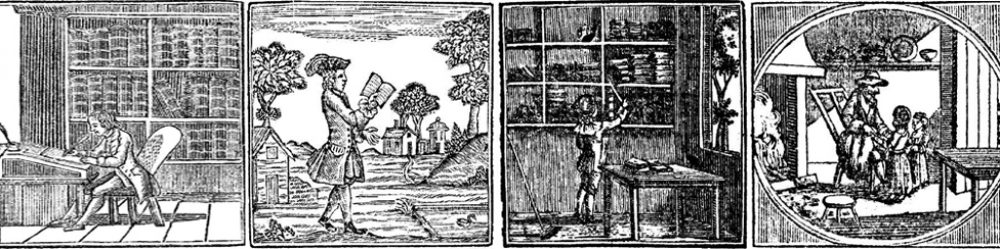
 Markel’s opening is inspired: “Lucky, lucky reader. Be glad it’s not 1726.” She goes on to explain that all the wonderful books like Gulliver’s Travels and Robinson Crusoe were for adults and children had nothing of their own except “preachy poems and fables, religious texts that made them fear that death was near, and manuals that told them where to stand, how to sit, not to laugh and scores of other other rules.” That has more than a grain of truth, as these two illustrations from children’s books published before 1744 show.
 What a difference between those two horrifying images and these two from A Set of Squares, one of Newbery’s earliest works for young people for teaching reading along the principles of John Locke. It’s not mentioned in Balderdash! (the only surviving copy is in the Cotsen Children’s Library) and in fact there are no facsimile illustrations from actual Newberys (which would have spoiled the concept).
 Was it all a lark creating those pioneering children’s books? I doubt that Newbery dreamed up the concept for the first periodical for children, The Lilliputian Magazine (1751), in the print shop, sitting under drying racks filled with sheets of A Little Pretty Pocket-Book.
  Perhaps he should have, but we will probably never know. It was obviously far beyond the scope of a picture book biography to retell in greater detail the story of Newbery’s career as a children’s book publisher. But there is a certain irony that Markel and Carpenter have given the legend of John Newbery (for which he was partly responsible) a charming new form, which will probably guarantee its continued circulation.for another generation.


