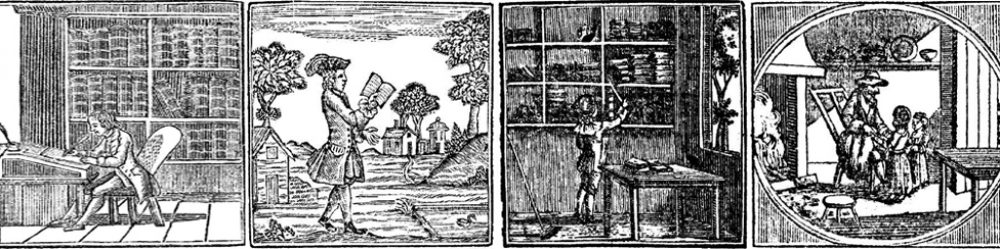
The noted children’s book collector Pamela K. Harer was in friendly competition with Mr. Cotsen from the 1990s, when she was still practicing law in Southern California. In spite of their rivalry, she gave Cotsen over fifty eighteenth- and early nineteenth-century English, American, and French books, which were described in the “New and Notable” in the Autumn 2000 Princeton University Library Chronicle. Downsizing for a move to Seattle in 2004 prompted a second gift, this time illustrated nineteenth-century pamphlets, the majority published by the Dean firm.
As a collector of 19th- and 20th-century children’s books, including early Soviet picture books and propaganda aimed at children produced between World Wars, early modern educational books were not a priority for Pamela. However the first sale of her collection at PBA Auctions on November 6 2014 contained some choice hornbooks, a copy of the Mohawk Primer, and two editions of the Orbis Sensualium Pictus in the first She held back the Thomas Malin Rodgers copy of the Kleines Bilder-Cabinet zu Erlernüng Vier Sprachen (ca. 1740?) consisting of one hundred leaves of engraved plates, each with nine hand-colored images arranged in three rows of three, acquired at Bonham’s in 2012. Knowing that Mr. Cotsen had slowly built up a cache of early modern books for teaching foreign languages, she thoughtfully presented this polyglot schoolbook to the collection this fall.

Title page, Kleines Bilder-Cabinet zu Erlernüng Vier Sprachen. Augspurg: Martin Engelbrecht, [ca. 1740?] (Cotsen 21019). Gift of Pamela K. Harer

Plate 24, Kleines Bilder-Cabinet zu Erlernüng Vier Sprachen (Cotsen 21019)
Martin Engelbrecht (1684-1756) was one of the most important engravers working in the Bavarian city of Augsburg, a major center for print production during the seventeenth and eighteenth centuries. He is most famous for his engraved dioramas designed to be displayed as peepshows that are the forerunners of the nineteenth-century toy theater. There isn’t much evidence in the standard reference books on 18th century German-language children’s books that he was a major player in the juvenile book market.
Engelbrecht’s Kleines Bilder-Cabinet is a genuinely rare book, as is so often the case with school books. A quick search revealed that it survives in a copy of the forty-seven-leaf 1708 edition in the Berlin Staatsbibliothek and an undated one with ninety leaves in the Koninklijke Bibliotheek in the Hague. Cotsen has an uncolored, undated copy of the one hundred leaves of plates in a somewhat later binding. Someone else is welcome to solve the little mystery I uncovered about it: another important Augsburg engraver, Johann Andreas Pfeffer, issued a book under the same title in 1734 and 1735 with what look like the same plates, but it has only ninety-six. There are copies at the University of Groningen, the Bayerische Staatsbibliothek, the Staats- und Stadtbibliothek Augsburg, and the Getty Research Center in Los Angeles.

The plate on the left is reproduced from the Pfeffer edition of the Kleines Bilder-Cabinet reproduced on p.58 of the exhibition catalog Deutsche Kinderbücher des 18. Jahrhunderts. Wolfenbüttel: Die Bibliothek, 1978, (Cotsen Reference Z1035.3 .D52). It faces the same plate in the uncolored copy of Engelbrecht edition (Cotsen 21019).
Given the interest in educational reform during the early modern period, I was curious how the Kleines Bilder-Cabinet would compare to others from the period, so I lined up some more polyglot school books on my desk. The Kleines Bilder-Cabinet has been described as a picture dictionary, but that turns out to be something of a misnomer. Here’s a contemporary example of a picture dictionary, Primitiva Latinae linguae, which was published by Peter Conrad Monath in Nurnberg in the 1730s. It is quite easy to see that one book is an apple, and the other an orange.

Title page, Primitiva latinae linguae. Nürnberg: Peter Conrad Monath, [1761] (Cotsen 1088)

Page 1 and plate 1, Primitiva latinae linguae (Cotsen 1088)
In the Primitiva Latinae linguae, the vocabulary is arranged alphabetically by the Latin word, followed by its German and French equivalents. The words are numbered sequentially, so that it is easy to find the corresponding pictures on the plate opposite. But there are more words on the page than there are illustrations on the plate. Quite logically, the words that are unillustrated like “acerbus” and “adulter” are also unnumbered, so the student knows not to go hunting for a picture. One of the students who owned the book made neat additions to text pages in the right hand and lower margins throughout the book. So the Kleines Bilder-Cabinet really can’t be considered a pictionary, if only because the content isn’t arranged in alphabetical order. Only the name of the thing is provided, I suppose, because the picture makes a verbal description unnecessary.
And it’s not a direct descendant of Johann Amos Comenius’ Orbis Sensualium Pictus, where the author gave considerable thought as to how to best visualize a thing, a category, a process, a concept, etc. and then provided a pithy description of the illustration in order to give the reader a clear idea of it. Comenius’ inspired pedagogy is nicely reflected in the section on the bedroom, where he succeeds in demonstrating how the objects’ interrelated functions are determined by their location in a particular space.

Title page, (London : J. Kirton, 1659.) Orbis sensualium pictus, reproduced from Cotsen Ref LT101.C6 1659a. Orbis sensualium pictus. [Sydney]: Sydney University Press, 1967.

Pages 148-9, Orbis sensualium pictus (Cotsen Ref LT101.C6 1659a)
And the Kleines Bilder-Cabinet isn’t a hybrid text like J. G. Seybold’s Teutsch-Lateinisches Worterbuchlein (Nurnberg: J. F. Rudiger, 1733), which is part dictionary, part encyclopedia. Seybold classified some 6000 words into categories and each one is illustrated with a block about the size of a man’s thumbnail. The page is laid out in six columns, three of images, and three of words, so a lot of information can be packed into a small page. Even though it can be difficult to make out the thumbnails or read the words, the page looks legible overall rather than cluttered because of all the white space.

Title page, Teutsch=Lateinisches Wörterbüchlein zum Nutz und Ergötzung der Schul=Jugend…(Nürnberg): Johannis Friderici Rüdigeri, 1733. (Cotsen 90784)

Pages 116-7, Teutsch=Lateinisches Wörterbüchlein (Cotsen 90784)
Where Comenius described the ship in a double-page spread illustrated with one block, Seybold offered the reader five pages covered with dozens of blocks showing all the ship’s parts. The student who used Seybold would certainly acquire a much more extensive nautical vocabulary than he would from the Orbis Pictus, but it would come at the expense of a basic understanding of the interconnection of parts.
The Kleines Bilder-Cabinet represents yet another approach to impressing foreign-language vocabulary on school-boy brains. The model for the book may be a mid-seventeenth-century French work for teaching Latin, with which Engelbrecht might have been familiar: Louis Couvay’s set of plates based on the work of fifteenth century Belgian grammarian Johannes de Spater, Method nouvelle et tres-exacte pour enseigner et apprendre la premiere partie de Despautaire (1649). Couvay was related to the engraver Jean Couvay, who executed the handsome plates. The volume was subsequently issued under the more pithy and accurate title, Le Despautaire en tables. It seems to have been in circulation until the 1700s, although it has to be said that the surviving copies are not easy to date with much precision.
The family resemblance between the two books isn’t hard to see. Each plate in Couvay is devoted to the particular Latin declension identified in the heading. The picture plane is divided into a grid and each box contains a small picture with a caption. Note that the size and number of the boxes varies considerably from leaf to leaf, as does the quantity and placement of explanatory text.

Plate 14, Methodus nova et accurata docendi ac ediscendi Primam Despauterii [Paris: Jean Galliard, ca. 1649] (Cotsen 133)

Plate 17, Methodus nova (Cotsen 133)

Plate 49, Methodus nova (Cotsen 133)
Engelbrecht did not copy Couvay religiously, however, designing a regular grid of nine boxes all the same size. The plate has a heading for the Latin declension it illustrates, but no text beyond the captions. Inside each box, the Latin word ought to come first, but perhaps because the book was produced in Germany, the German translation precedes it in large type, and after the Latin comes the French and Italian translations. It’s hard to know if the change in order was confused or helped students, but it could have been dictated more by marketing than pedagogy. Books or toys produced in Germany with polyglot texts — the content usually radically simplified to so that captions in three or four languages can be squeezed into a small space — I tend to regard as evidence for plans to distribute in German and abroad on the Continent.

Plates 29 and 30, Kleines Bilder-Cabinet zu Erlernüng Vier Sprachen (Cotsen 21019). Gift of Pamela K. Harer.
Engelbrecht was not the only engraver who preferred a simpler layout: Nurnberg engraver Christoph Weigel stripped it down even more radically in the Neuer Lust-Weg. Here the grids have just six boxes and they are large enough to allow for a clear and legible layout of the Latin, German, French, Italian captions within (the German words at the bottom of the boxes are written in Sutterlin script). All attempt to integrate grammar and visuals has been abandoned and the pictures are arranged on the plates in random order. While it makes for an undeniably attractive presentation, it is harder to imagine how the teacher used the book during lessons.

Title page, Neuer Lust-Weg zum ziel nützlicher Künste und Wissenschaften Nürnberg: Christoph Weigel, [179-?] (Cotsen 86)

Plates 60-1 Neuer Lust-Weg (Cotsen 86)
It struck me that the engraved grids in the Kleines Bilder-Cabinet, Couvay, and the Neuer Lust-Weg resemble wall charts that have been part of school room décor since the early nineteenth century. Or at least that is what histories of education that cover the subject tell us. And I couldn’t help but notice that the Kleines Bilder-Cabinet and the Primitiva latinae linguae both have frontispieces showing classrooms decorated with floor-to-ceiling grids of pictures. Could illustrations like these be one of the few sources we have for this alternative to wall charts?Somewhere has a school room wall decorated in this manner survived miraculously?

On the left is the frontispiece for the Kleines Bilder-Cabinet zu Erlernung der Vier Sprachen (Cotsen 21019) and on the right is the frontispiece to the Primitiva latinae linguae (Cotsen 1088)
Should the these books I’ve been comparing in this post be thought of as collections of miniature charts that students could have at hand where ever they happened to be working on their lessons? Of course such books have to have been expensive, but even so, would they have been accessible to more students than those fortunate enough to live where there were dedicated school rooms with painted walls, or walls hung with tables painted on fabric or glazed prints?
This attempt to learn more about Pamela’s gift turned out to be a fascinating exercise: the descriptions in the Princeton on-line catalogue suggested that they all might be different attempts to further the pedagogy of visible language pioneered by Comenius, but it turns out that there was no consensus as to the best way to integrate the pictures with the text. Different books offered different solutions to the very real problem of how to impress the thing, the word, and its representation on the student’s memory.
Pamela will not see this post. I’m sorry to have to close this with the sad news that the small world of American collectors of early children’s books was reduced and diminished by her death at age eighty-one in September 2014. Pamela was one of a kind and her sharp mind, engaging curiosity, and high energy will be missed.
Special thanks go to Pamela’s daughter Cynthia Gibbs and Pamela’s beloved husband of sixty-one years, W. Benson Harer MD, a distinguished collector in the field of Egyptology, for donating this splendid book to Cotsen as a final remembrance of Pam.

Benson and Pamela Harer