Recently in Conferences, lectures, etc. Category

paintings4.jpg

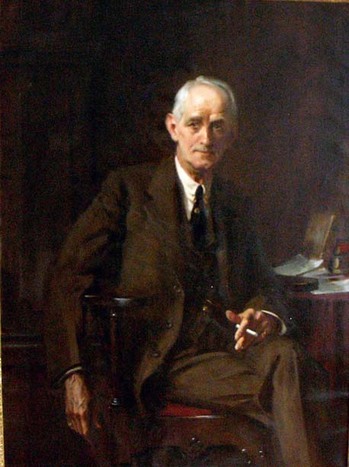
In the inaugural issue of Biblia, A Publication Devoted to the Interests of the Princeton University Library (June 1930), an introduction was penned by PAR (Philip Ashton Rollins, Class of 1889), co-founder and the first Chairman of the Friends of Princeton University Library.

“Dr. Osler originated for Oxford University’s benefit an adjunct which he styled Friends of the Bodleian. Presently Harvard University … duplicated the scheme; and, as a result, her Friends of the Library have, during the past five years, been vigorously furthering her effort to improve … [its] collections of books. Following Harvard’s example … a group of men some two months ago launched in Princeton’s interest an association known as Friends of the Princeton Library.”

“The aim of the association is the obtaining of printed and manuscript material for Princeton, doing this indirectly through creating an intimate acquaintance between Princeton’s library and such Princetonians and other sympathetic folk as may desire the library’s betterment. Lovers of books can, by making or inducing gifts of volumes, do much to strengthen Princeton. If the goal is to be reached, the association’s membership should include all the persons who have fondness both for Princeton and for printed pages.”

On Sunday, March 25, 2012, the Friends of the Princeton University Library will hold the third biennial Book Adoption Party from 3:00 to 5:00 p.m. in the Chancellor Green Rotunda. To get your own invitation, click here: http://www.fpul.org/bae/BookAdoptionInvite12.pdf

Image: John Young-Hunter (1874-1955), Philip Ashton Rollins, 1934. Oil on canvas. American paintings

James Joyce copyright expires 2012

| No Comments

James Joyce passed away in 1941. Under the 1886 Berne Convention for the Protection of Literary and Artistic Works, the author’s copyright lasted throughout their life and for fifty years thereafter. The Copyright Term Extension Act (CTEA) of 1998 extended copyright terms in the United States by twenty years, matching the updated European laws now also requiring seventy years.

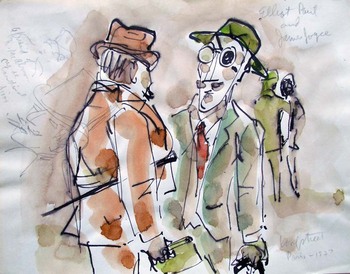
joyce1.jpgStephen Longstreet (1907-2002), Elliot Paul and James Joyce, 1927. Pen-and-wash drawing on paper. GC088
It is now seventy years after Joyce’s death and the copyright on works produced within his lifetime has expired. A symposium will be held in Dublin this June to rethink Joyce’s writings and the new challenges presented by open access to his work. See: http://www.jamesjoyce2012.ie/index.html. This includes the publication, adaptation, and performance of Dubliners, A Portrait of the Artist as a Young Man, Ulysses, Finnegans Wake and his only play, Exiles.

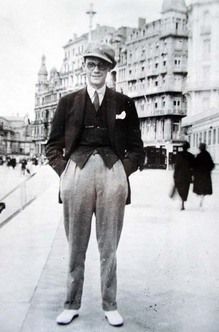
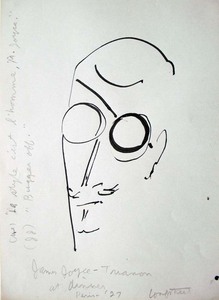
Graphic Arts holds a number of Joyce portraits and caricatures including these (copyright still with the artist):

joyce2.jpgPhotograph labeled: James Joyce at the Brighton Beach Esplanade, no date [ca. 1907]. Gelatin silver print. Graphic Arts GA 2010.01797
joyce3.jpgStephen Longstreet (1907-2002), James Joyce - Trianon at dinner - Paris, 1927. Pen drawing on paper. Graphic Arts GC088
Beginning Monday
looking-at-michaelangelo-correct-flat-no-text.jpg

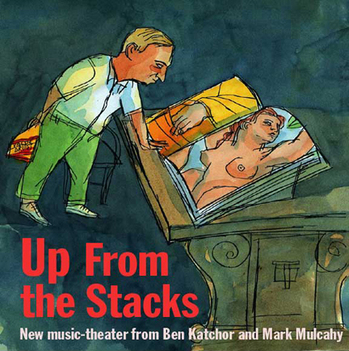
Up From the Stacks is a new music-theater performance by Mark Mulcahy and Ben Katchor, with Ken Maiuri, Dave Trenholm and Brian Marchese.

Set in The New York Public Library at Fifth Avenue and 42nd Street and in the environs of Times Square circa 1970, Up From the Stacks is the story of Lincoln Cabinée, a college student working part-time as a page, retrieving books for readers from the Library's collection of 43 million items. This routine evening job inadvertently thrusts young Cabinée into the treacherous crossroads of scholarly obsession and the businesses of amusement and vice that then flourished in the 42nd Street area. The intellectual life of the city and the happiness of a young man hang in the balance.

Find the rest at Mr. Katchor's blog: http://benkatchor.wordpress.com/2011/09/23/up-from-the-stacks/

William Hogarth and The Roast Beef Cantata

| No Comments
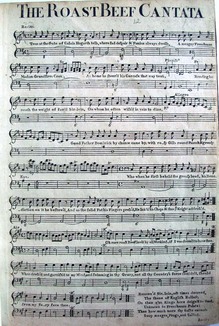
roast beef .jpg
Detail from The Roast Beef Cantata, 1748. Courtesy of a private collector.
In conjunction with

Sin & the City
William Hogarth’s London

The Practitioners of Musick will present a concert at 3:00 Sunday November 13, 2011 in Firestone Library’s main gallery, which will feature a performance of the rarely heard Roast Beef Cantata.

The musicians will include John Burkhalter, English & small flutes; Clara Rottsolk, soprano; Donna Fournier, Baroque cello; and Donovan Klotzbeacher, harpsichord. For more information, see http://rbsc.princeton.edu/hogarth/.

According to Grove’s Dictionary of Music, The Roast Beef of Old England was an English national song whose tune has become associated with the serving of dinner at public functions, and occasionally used as a signal for the same in the army. The air is a fine marked specimen of English melody, and is probably the composition of Richard Leveridge, who doubtless sang the song in public. The first two verses were inserted in Henry Fielding’s ballad opera, Don Quixote in England, produced in 1733. They are considered to be by Fielding himself, and are marked as to be sung to the air The Queen’s old Courtier.

Other sources indicate there were three versions of the words of this song: the original two verses by Fielding (1731); Leveridge’s six verses, the first being simply an appropriation of Fielding’s; and The Roast Beef Cantata, by Theodosius Forest, as seen in William Hogarth’s print, The Gate of Calais (1748).

Here are a few lines:

THE ROAST BEEF CANTATA.
‘Twas at the gate of Calais, Hogarth tells,
Where sad despair and famine always dwells,
A meagre Frenchman, Madame Grand-sire’s cook,
Ah home he steered, his carcase that way took.
Bending beneath the weight of famed Sirloin,
On whom he’d often wish’d in vain to dine,
Good Father Dominick by chance came by,
With rosy gills, round paunch, and greedy eye;
Who, when he first beheld the greasy load,
His benediction on it he bestowed;
And as the solid fat his fingers press’d,
He lick’d his chaps, and thus the knight address’d:
“Oh, rare roast beef, lov’d by all mankind,
If I was doom’d to have thee, when dress’d and garnish’d to my mind,
And swimming in thy gravy, not all thy country’s force combin’d
Should from my fury save thee.

Hogarth’s print and the broadside with the poem are both on view in our gallery.

MobilityShifts and its Think Cast

| No Comments
badge1.png

Several of our colleagues will be speaking at Mobility Shifts, an international conference to be held in New York City October 10-16, 2011. http://mobilityshifts.org/

Panels include:
The Library in Your Pocket: Library Tech Development and DIY Learning with Kim Dulin (Harvard Library Innovation Lab); Linda Johnson (Brooklyn Public Library); Deanna Lee (The New York Public Library); and Shannon Mattern (The New School). Their introductory text states, “Libraries, in their dual - and often precariously balanced - commitments to cultural uplift and cultural outreach, have long been, at least in theory, places of self-directed, DIY learning. Yet as materials once available only in the stacks have become ever more accessible in people’s homes and in their pockets, libraries’ strategies for cultural outreach, and for supporting patrons’ self-education, have evolved… “

The conference will offer a wide variety of hands-on workshops including:
Learning with Mobile x Printed Media with Orkan Telhan, University of Pennsylvania, who will explore “alternative models of learning using mobile media and paper-based interfaces that are augmented with computational and electronic capabilities… .”

In addition, you might want to try Book Sprints and Booki, which will introduce the participants to Book Sprints and the Social Book Production environment, Booki. “The workshop will cover the Booki production process, export tools, and the social features which are integrated into the workflow of Booki… .”

We will see if they hand out paper programs on the days of the event.

Out of the Sky, 9/11

| No Comments

On Saturday, September 17, 2011, at 3:00 in the Chancellor Green Rotunda, artist Werner Pfeiffer will assemble Out of the Sky: 9/11, a tribute to the victims of the terrorist attack on the World Trade Center in New York City. This three-dimensional book/sculpture was produced in an edition of fifty-two copies on the fifth anniversary of the attack in 2006. When assembled, it presents a model of the twin towers nearly six feet high with images and names of the victims printed throughout.

A reception in Firestone Library will follow. This event is part of Memory and the Work of Art, a collaborative investigation into the relationship between the arts and cultural memory. The presentation is free and open to the public.

German American artist Werner Pfeiffer was born in 1937 and studied at the Akademie der Bildenden Künste in Stuttgart before immigrating to the United States. Following an award winning career in graphic design, he was appointed Professor of Art at Pratt Institute and director of the Pratt Adlib Press. Many of Pfeiffer’s books are held in the Graphic Arts Collection including Liber Mobile; An Experimental Book (GAX 2006-0070E); Werner Pfeiffer: Endangered Species (GA 2007-1002N); B (GAX 2007-0982N); Alphabeticum (GAX 2007-0234Q); and Out of the Sky: Remembering 911 (GAX 2007-0031E).

18th-Century Typography on the Road to Princeton

| 1 Comment

This post is in honor of James Mosley, written in the hope that he will correct me.

bridge question12.jpg

The second oldest stone bridge in New Jersey (and the oldest with a period sign), sits just outside Princeton along Route 27. Additional information can be found at: [http://www.alpsroads.net/roads/nj/nj_27/o.html]. The abbreviated text says: Kingston Bridge, 45 miles to Philadelphia, 50 miles to New York, 1798.

bridge question10.jpg

I was introduced to the bridge and its sign by Steve Ferguson, Curator of Rare Books, as we were returning from Rare Book School, where I studied typography with Mr. Mosley (http://typefoundry.blogspot.com/).

In 1776, Benjamin Franklin (1706-1790) chose the British typeface “Caslon” for the first printing of the American Declaration of Independence and for the Constitution. So the question is, when the Kingston Bridge was built in 1798, only twelve years after the American revolution, did they label it with a British font or a French font?

bridge question11.jpg

I was convinced that P. Dorn (the builder) did not use “Caslon,” so I looked at the British face by John Baskerville (1706-1775) developed in 1757 and a French romaine du roi designed by Fournier, le jeune (1712-1768) in 1742.

bridge question8.jpg
bridge question7.jpg

Examples of each were available in their books:


bridge question3.jpg
bridge question2.jpg


Virgil, Publii Virgilii Maronis Bucolica. Georgica. Aeneis. (Birminghamiae: Typis Johannis Baskerville, 1757) Graphic Arts Collection (GAX) Baskerville 1771


bridge question4.jpg
bridge question6.jpg
Fournier, le jeune (1712-1768), Manuel typographique (Paris: Imprimé par l’auteur …, 1764-66). Graphic Arts Collection (GAX) 2007-0822N


The M, N, Y could be either but the R appears French. The clearest distinction, to my eye, is in the figures or numbers, with a sweeping French lower case 7 and 9, and a curling 5. It is unfortunate there is no Q in Kingston.

So, does our little American bridge have a French face? I think so but I will wait to see whether my classmates agree. Or if the master will correct me.

*********

Well, I did, in fact, guess wrong. Mr. Mosley has kindly corrected me:

“That inscription of 1798 on the bridge is very handsome. I think its style is more Baskerville than Fournier — that is, more British than French — but then that is what one would expect.”

He continues, “Letters cut in stone in the old British colonies would naturally tend to show an influence from the former homeland, just as those made further north among the snows of Québec might — I imagine — have a certain echo of the work of French stonemasons.”

Welcome ARLIS New York and Delaware Valley

| No Comments
graphicarts2.jpg Graphic Arts collection
firestone22.jpg Firestone Library
viewfromplaza.jpgMarquand Library

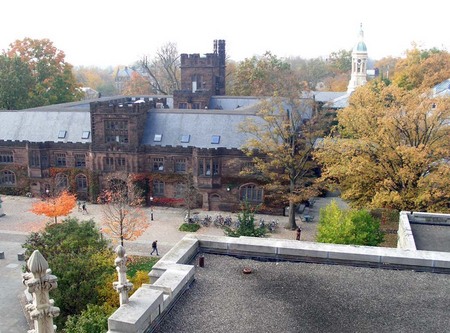
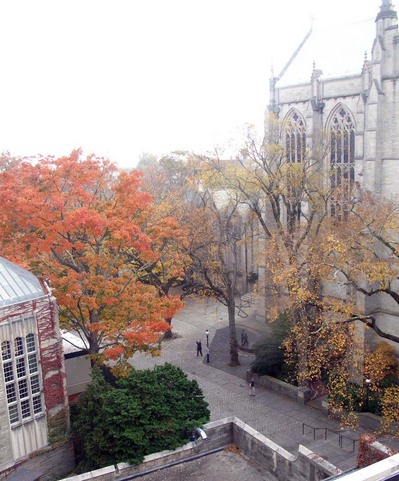
The Delaware Valley and the New York Chapters of the Art Libraries Society of North America (ARLIS NA) are being welcomed to Princeton University on Thursday, May 26, 2011, by local ARLIS members. The day will include presentations, viewings, and tours at the Marquand Library of Art and Archaeology, the Visual Resources Collection, the Index of Christian Art, the Princeton University Art Museum, Firestone’s Graphic Arts Collection and Cotsen Children’s Library; along with a rain or shine campus architecture walking tour.

The visit has been organized by Hannah Bennett, Librarian, Architecture Library, School of Architecture; Sandra Brooke, Librarian, Marquand Library of Art & Archaeology; Rebecca K. Friedman, Assistant Librarian, Marquand Library of Art & Archaeology; Trudy Jacoby, Director, Visual Resources Collection, Department of Art and Archaeology; and Julie Mellby, Graphic Arts Librarian, Rare Books and Special Collections. Enormous help has been provided by staff members at each of these collections and departments.

Quoting from the organization’s website “The Art Libraries Society of North America was founded in 1972 at the initiative of Judith Hoffberg by a group of art librarians attending the American Library Association annual conference in Chicago. This group realized that to fulfill the need among art librarians for better communication and cooperation, and to provide a forum for ideas, projects, and programs, an entirely new and separate organization was required. Inspired by the model of the Art Libraries Society, established in 1969 in the United Kingdom and Ireland, ARLIS/NA was created.”

http://www.arlisna.org/join.html

A Mesostic of Words

| No Comments
_HAM0123.jpg

At last week’s College Book Arts Association conference, graphic arts was fortunate to collect a broadsheet printed by artist Ann Hamilton in association with her permanent installation, Verse, at the William Oxley Thompson Memorial Library, Ohio State University. In conjunction with the renovation of their library, the Buckeye Reading Room has been installed with a 6080 square foot, two-color field of words set in relief on a cork floor.

The text is an alphabetic intersection of three different accountings of world history, which are arranged in a literary concordance. The spine along the north-south axis is composed of 299 words, A to Z, adapted from a White River Sioux story entitled The End of the World. The east-west lines intersect this story with prose fragments from A Little History of the World by E. H. Gombrich (1936) and Mirrors: Stories of Almost Everyone by Eduardo Galeano (2009).

According to the library’s press release, Verse in its form and woven organization is a reflection of how the reader intersects with and culls information and meaning from the library’s collection.

_HAM0341.jpg

As part of Hamilton’s continuing exploration of words and communication, the nearly 500 people attending her lecture joined in a communal phone call to the Pulitzer Foundation for the Arts in St. Louis. Hamilton’s work, stylus, is the Pulitzer’s first commissioned installation and the first multi-sensory exploration of Tadao Ando’s architecture.

Annhamilton.pulitzerarts.org explains how you can contribute your voice to the reverberations of stylus. Whether calling in a song, a call, or a story, your words become part of an archive, which over the course of the project, constitutes stylus’s vocal body. (314) 884-1553. Call and add your voice.

Su Friedrich Talks about The Heretics

| No Comments

Heresies (New York, NY: Heresies Collective, 1977-1993), Firestone Library (F), HQ1101 .H4

At 7:30 p.m. on Friday, March 12 there will be a screening of The Heretics in the Solley Theater at the Paul Robeson Center for the Arts, 102 Witherspoon St., Princeton, New Jersey. https://web47.mysecureserver.com/artscouncilofprincetonorg/default.asp?p=CAL#heretics

The Heretics, a feature film by Joan Braderman, documents the 1970’s Heresies Collective and their magazine Heresies. The Collective is presented as a microcosm of the larger international women’s movement, in which thousands of small, private groups of women met together in forms unique to their own settings, to consider their situation—as women in a man’s world—and to devise strategies for unlocking the potential in women’s lives.

Princeton professor Su Friedrich, an original member of the collective, will speak after the screening. More about Su Friedrich: http://helios.hampshire.edu/nomorenicegirls/heretics/#friedrich http://helios.hampshire.edu/nomorenicegirls/heretics/photo/friedrich1.html

Hypochondriacs

| No Comments

Princeton University’s science historian and an editor at Cabinet magazine, Professor D. Graham Burnett will be part of a panel entitled “The Art of Hypochondria” along with Brian Dillon and Marina van Zuylen on Tuesday, 9 February 2010, from 7:00 to 9:00 p.m. at The Kitchen, 512 West 19th Street, New York City. In honor of their talk, here are a few of our own hypochondriacs:

Thomas Rowlandson (1756-1827), The Hypochondriac, 1788. Etching. Graphic arts, GC112, Rowlandson Collection. Gift of Dickson Q. Brown, class of 1895. Inscribed: ‘The mind disemper’d - say, what potent charm, // Can Fancy’s spectre-brooding rage disarm? // Physics prescriptive, art assails in vain, // The dreadful phantoms floating cross the brain! - Until with Esculapian skill, the sage M.D. // Finds out at length by self-taught palmistry, // The hopeless case - in the reluctant fee, // Then, not in torture such a wretch to keep // One pitying bolus lays him sound asleep.’


Anonymous, The Cramers or Political Quacks, ca. 1762. Etching. Graphic arts, GC021 British Cartoons and Caricatures Collection. Gift of Dickson Q. Brown, class of 1895. “Britannia tormented with discord and Strife … For Poison lurks their and deconstruction ensues”.


Thomas Rowlandson (1756-1827), after a design by George Moutard Woodward (ca. 1760-1809), A Visit to the Doctor, no date. Etching. Graphic arts, GC112 Thomas Rowlandson Collection. Gift of Dickson Q. Brown, class of 1895.


Thomas Rowlandson (1756-1827), Wonderfully Mended. Should’t Have Known You Again!!, 1808. Etching. Graphic arts, GC112 Thomas Rowlandson Collection. Gift of Dickson Q. Brown, class of 1895.


Charles Ramelet (1805-1851) after a design by Honoré Daumier (1808-1879), Le malade imaginaire. Je suis perdu…. il faut faire mon testament……. ils vont m’ensevelir… m’enterrer…. adieu!, 1833. Lithograph. Graphic arts, GA 2009.00086. Gift of William H. Helfand. From the series L’Imagination, no. 10 published in Le carivari May 21, 1833.


Isaac Cruikshank (1764-1811), after a design by George Moutard Woodward (ca. 1760-1809), The Sailor and the Quack Doctor, 1807. Etching. Bound with Caricature magazine, v. 1. Graphic arts, Rowlandson R 1807.51F. Gift of Dickson Q. Brown, class of 1895.


George Cruikshank (1792-1878), Radical Quacks Giving a New Constitution to John Bull, 1821. Etching. Graphic arts, GC022 Cruikshank Collection. Gift of Richard W. Meirs, class of 1888. “Designed by an Amateur. May 25, 1820.”

Orphan Works

| No Comments

On Tuesday, October 20th, from 6-8pm, the New York City Bar Association will present

Lost and Found: A Practical Look at Orphan Works

You will hear from a diverse panel of speakers, including: Brendan M. Connell, Jr., Director and Counsel for Administration, The Solomon R. Guggenheim Foundation; Frederic Haber, Vice President and General Counsel, Copyright Clearance Center, Inc.; Eugene H. Mopsik, Executive Director, American Society of Media Photographers; Maria Pallante, Associate Register for Policy & International Affairs, U.S. Copyright Office; Charles Wright, Vice President and Associate General Counsel, Legal and Business Affairs, A&E Television Networks; Moderator: June M. Besek, Executive Director, Kernochan Center for Law, Media and the Arts, Columbia Law School.

This free public program will be held at 42 W. 44th Street, in the Meeting Hall of the Association. Please register at: http://www.nycbar.org/EventsCalendar/show_event.php?eventid=1222

Sir Hubert von Herkomer (1849-1914), Orphans, 1878. Drypoint. GA 2006-02669

In addition, The Society of American Archivists (SAA) has issued:
Orphan Works: Statement of Best Practices

a 16-page report that provides what professional archivists consider the best methods to use when attempting to identify and locate copyright holders. The statement, which primarily focuses on unpublished materials because they are usually found in archives, is available on the association website as a PDF at http://www.archivists.org/standards/.

Orphan works is a term used to describe the situation in which the owner of a copyrighted work cannot be identified and located by someone who wishes to make use of the work in a manner that requires permission of the copyright owner. Eight archivists and a recognized legal expert in intellectual property and copyright law developed the statement, based upon their experiences researching copyright status.

We created this statement to provide archivists with a framework to discover what materials they hold are truly orphaned works, and in the hopes of empowering them to provide wider access and use of those materials as a result
said Heather Briston, chair of SAA Intellectual Property Working Group.

The primary authors of the statement include Briston (University of Oregon), Mark Allen Greene (University of Wyoming), Cathy Henderson (University of Texas, Austin), Peter Hirtle (Cornell University), Peter Jaszi (American University) , William Maher (University of Illinois, Urbana-Champaign), Aprille Cooke McKay (University of Michigan), Richard Pearce-Moses (Arizona State Library), and Merrilee Proffitt (OCLC). Financial and administrative support was provided for this project by OCLC Research and the RLG Partnership. More information on SAA’s Intellectual Property Working Group can be found at: http://www.archivists.org/saagroups/ipwg/.

Congratulations Tim Barrett

| No Comments

Congratulations to Timothy Barrett, master papermaker and paper historian, who is one of twenty-four recipients of the five-hundred-thousand-dollar “genius awards,” announced this morning by the John D. and Catherine T. MacArthur Foundation. See more: http://www.uiowa.edu/~ctrbook/people/staff/Barrett/Barrett.shtml and the papermaking studio: http://www.uiowa.edu/~ctrbook/facilities/paper/index.shtml

Timothy Barrett, Nagashizuki: the Japanese craft of hand papermaking (North Hills, Pa.: Bird & Bull Press, 1979) Graphic Arts Collection (GAX), TS1109 .B267

Grand Conclave of the Miniature Book Society

| 1 Comment

Welcome Miniature Book Society to your XXVII Grand Conclave in Princeton! Collectors, artists, and enthusiasts for small print will spend four lovely days in Princeton this week, holding meetings, touring, eating, and sharing their latest treasures (under 3 inches please).

We will entertain the group on Saturday, August 29, 2009 with tours of the Cotsen Children’s Library, the Graphic Arts Collection, and the Princeton University Art Museum. Sunday afternoon is a huge book fair, which is open to the public: http://www.mbs.org/conclave.htm. If you are in the area, I recommend you drop by the fair.

Pictured above: John Taylor (1580-1653), The Thumb Bible (New York: A.D.F. Randolph & Co. …, [1889?]). 288 p. 49 x 54 mm. Facsimile reprint of Verbum sempiternum (Adomeit B89). Graphic Arts Collection (GAX), 2007-0064S. Thank you for holding it Miriam.

An illustrated lecture entitled “Making Pictures for the Floating World: Ukiyo-e Artists and Publishers” will be presented by Julie Davis, Professor of Art History, University of Pennsylvania, on Sunday, May 3, 2009, at 3:00 p.m. in 101 McCormick Hall, followed by a reception in the Milberg Gallery. This event is in conjunction with the exhibition “Beauty & Bravado in Japanese Woodblock Prints: Highlights from the Gillett G. Griffin Collection given in honor of Dale Roylance” on view in the Milberg Gallery, Firestone Library, through June 7, 2009.

The Milberg Gallery is open to the public, free of charge, weekdays 9:00 a.m. to 5:00 p.m.; Wednesday evenings, 5:00 to 8:00 p.m.; and weekends, noon to 5:00 p.m. The gallery is located on the second floor of Rare Books and Special Collections, Firestone Library, Princeton University, One Washington Road, Princeton, New Jersey. For information on visiting the campus, see: http://www.princeton.edu/main/visiting


Utagawa Kunisada (Toyokuni III, 1786-1865), Chapter Thirty-four: Wakana No Jô, from the series: Parody on the Fifty-four Chapters of the Tale of Genji (Genji gojûyojô), 1858, 9th month. Signed: Toyokuni ga. Publisher: Wakasaya Yoichi. Ôban tate-e diptych. Color woodblock print (nishiki-e).


Legislating Mandatory Drawing Classes in the United States

| 1 Comment

Dr. Paul Bolin of the University of Texas at Austin presented a paper entitled “Preparing Children for the World of Work: Influences of Legislation in the Proliferation of Drawing Manuals…1860-1876” at this weekend’s conference “Home, School, Play, Work.” http://www.princeton.edu/cotsen/research-collection/academic-conferences/home-school-play-work/

Bolin pointed out that Massachusetts passed legislation making drawing a compulsory subject of study within the public school curriculum in 1870, followed by Maine in 1871, New York in 1875, and Vermont in 1878. Dr. Bolin went on to remind us that it was Warner Miller (1838-1918), NY Senator and President of the American Wood & Paper Association, who pushed the legislation forward. As a result, Miller made a fortune from the increase demand in paper. Similarly in Vermont, it was members of the Burlington stationery factories who backed the legislation and received enormous profit from the increased sales of their products.

Read an abstract: http://www.princeton.edu/cotsen/research-collection/academic-conferences/home-school-play-work/bolinabstract/index.xml

Here are a few early American drawing manuals from the graphic arts collection:

Fielding Lucas (1781-1854) Lucas’ Progressive Drawing Book … Consisting Chiefly of Original Views of American Scenery… (Baltimore: F. Lucas, jun’r [c1827]) Graphic Arts Collection (GAX) Oversize NC710 .L84q

John Hill (1770-1850), A Series of Progressive Lessons, Intended to Elucidate the Art of Flower Painting in Water Colours. New ed. (Philadelphia: Published by Desilver, Thomas & Co., 1836) Graphic Arts Collection (GAX) Oversize 2007-0154Q

John T. Bowen (ca. 1801-1856?), The United States Drawing Book: Comprising Elements of the Art of Drawing with the Lead Pencil, Chalk, or Crayon, or with Water Colours (Philadelphia: Thomas Wardle, 1839). Graphic Arts Collection (GAX) Oversize NC407 .B68q

John Gadsby Chapman (1808-1889), The American Drawing-Book: a Manual for the Amateur, and Basis of Study for the Professional Artist (New York: J.S. Redfield, 1847). Graphic Arts Collection (GAX) Oversize Hamilton 493q

The Theory of Effect: Embracing the Contrast of Light and Shade, of Colour and Harmony (Philadelphia: J.W. Moore, 1851). Graphic Arts Collection (GAX) Hamilton 841

College Book Art Association

| 1 Comment

I will be away later this week at the first meeting of the College Book Art Association. http://www.collegebookart.
org/
The CBAA supports and promotes academic book arts education by fostering the development of its practice, teaching, scholarship and criticism.

Despite summer floods and winter storms, book arts survive in Iowa City and the conference offers, among other things, a great opportunity to explore the Center for the Book, an interdisciplinary arts and research unit located within the University of Iowa Graduate College. The UICB integrates the art of book production with the study of the book in society by offering a curricula in book technologies and book history.

The first CBAA biennial is entitled: Art, Fact, and Artifact: the Book in Time and Place. More information is available at the conference website: http://uicb.grad.uiowa.edu/uicb-cbaa-conference/. Along with session programming, the conference agenda will include keynote speakers, exhibits, tours of facilities, open discussion time, and portfolio reviews.

My presentation is Between the Biblia Pauperum and the Graphic Novel: A Survey of Block Books, Plate Books, and Books from Stone. It is a work in progress. I post the powerpoint images for the talk here, in case you can’t make it to Iowa. http://libweb5.princeton.edu/visual_materials/
ga/cbaa.pptm

A Modern Ubu Roi

| No Comments

Alfred Jarry (1873-1907), Ubu roi: drame en cinq actes. Eight etchings colored à la poupée by Matta (1912-2002). Paris: Atelier Dupont-Visat, 1982. Copy no. 27 of 150. Graphic Arts Collection (GAX) Oversize PQ2619.A65 U3 1982f

The French writer Alfred Jarry is chiefly remembered as the creator of Ubu roi (King Ubu). The play is a loose parody of Shakespeare’s Macbeth, presenting the characters of mother and father Ubu, who plot to assassinate the King of Poland. The first commercial production opened on December 11, 1896 at the Théâtre de l’Oeuvre. But when the first line was spoken, “Merdre” (Shitter) the audience caused such uproar that it took the stage manager nearly fifteen minutes to quiet the auditorium. Those who did not walk out continued to jeer and interrupt the performance throughout the evening. For the complete French text, see: http://www.gutenberg.org/etext/16884.

There will be a reading from Ubu roi by Florent Masse of L’Atelier, the French Theater Workshop, and students from Princeton University’s French department on March 7, 6:00 p.m., at the Princeton University Art Museum in conjunction with the exhibition “Invoking the Comic Muse.”

Jarry created his own illustrations for the published play, in particular the figure of father Ubu, with a distinctive spiral across his stomach. Since then, other artist have published their interpretations of Jarry’s notorious play, including in 1982, the Chilean artist Matta (Roberto Matta Echaurren). Born in Santiago, the young Matta spent time in Paris as an assistant to the architect Le Corbusier. In the 1930s, he became an active member of the French surrealists, who all looked to Jarry for inspiration and courage. As a sign of Matta’s appreciation to Jarry, the distinctive spiral appears in many of his paintings.

Carmen Boullosa speaking at Princeton

| No Comments

On Sunday, October 7 at 3:00, Mexican novelist, poet, and playwright Carmen Boullosa will give a talk entitled “The Struggle is on the Walls: Antecedents and Inheritors of the TGP,” in conjunction with the opening of the exhibition El Taller de Gráfica Popular / The Workshop of Popular Graphic Arts. The talk will be held in Aaron Burr Hall, Rm. 219, and is open to the public free of charge. A reception will follow the lecture at 4:00.

The Graphic Arts collection is fortunate to have acquired a small group of posters and fliers by the TGP (http://diglib.princeton.edu). A selection are on view until February 10, 2008 in the Milberg Gallery for Graphic Arts. The exhibition and associated events are made possible with the joint support of the Friends of the Princeton University Library and the Program of Latin American Studies. For more information, see http://www.princeton.edu/rbsc/exhibitions/milberg.html.

Recent Comments

  • Barbara McArdell Redmond: Hello: Do you have additional information about James McArdell? Sincerely, read more
  • Cecelia Valverde: I purchased an engraving on ebay by wil Worthington called read more
  • Elyane de Hornes: Auguste Brouet was a close friend of my father. I read more
  • Mary Clark: I think it was Aventuros, not Aventurors, but I am read more
  • Ben: You wouldn't happen to know who cut the non-latin type read more
  • Shortshanks: Johnston's design seems to be heavily based upon 'The read more
  • herbert lotz: I'm searching for an e-mail address for libros san cristobal. read more
  • Roz: Hello Julie, Thank you for highlighting in your blog post read more
  • bren yule: Hi I saw your beautiful J.P. Sebah photos. I just read more
  • Andrew: Wow, the clothes have changed but funny how the look read more