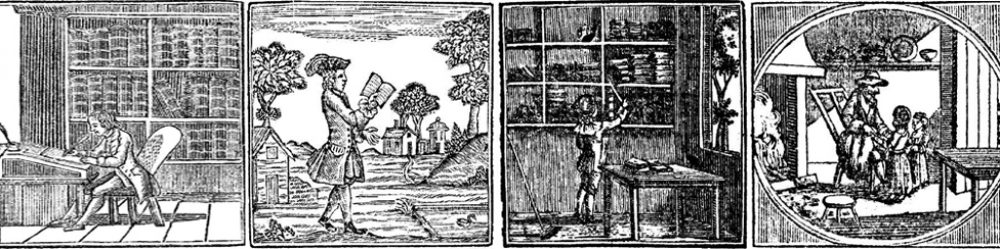
 Children were reminded constantly to take care of their books before the rise of untearables on cloth, board, and textured paper in the second half of the nineteenth century. Cotsen has hundreds of examples of these books and pamphlets for the unintentionally destructive hands of babies and toddlers—or careless older children– should anyone want to write a history of the genre.

Nursery Rhymes. [New Orleans?, 1897]. (Cotsen 18522)
One of the most interesting examples in the collection is a nursery rhyme collection made by a grandmother for “petit cher William,” which she gave him on September 1,1897. Two pieces of cloth are sewn together with blanket stitch around three of the four edges. The style of the illustrations look American, but there aren’t any definitive clues pointing to her state and city of residence. The title is embroidered on the dark red cloth cover and illustrated with paper cut-outs of Mother Goose holding a goose on a lead, now partly torn away. Although the inscription is in French, the rest of the book’s text is in English, copied on differently shaped slips of paper attached to the cloth pages, as seen to the right.

(Cotsen 18522)
Grandmère’s large selection of rhymes for William includes many familiar ones, such as “Pat-a-cake,” “Humpty Dumpty,” and “Little Bo-Peep,” with others like “Richard and Robin” or “Come, butter, come,” which appeared in the first nursery rhyme collections from the 1740s, but have dropped out of the canon.
The rhymes are illustrated with cut-out pictures. The black page has an especially nice example of her collages. “This little pig went to market” consists of a hand with “O. N. T,” which almost certainly comes from an Our New Thread advertisement for Coats and Clark. She then pasted pictures of the pigs on its fingertips, then wrote the text on curlique shapes, which resemble Struwwelpeter’s uncut nails. Below it is “There was a little man, and he had a little gun.” The “little man” is a little boy in soldier’s helmet, not hunter’s green. Opposite him is “See-saw, Margery daw” illustrated with a sawhorse, with one child balanced against the three at the other end of the plank.

(Cotsen 18522)
Displayed on this page of beige cloth are several eighteenth-century rhymes: “Lucy Lockit lost her pocket” in the lower left is acted out by a girl dressed in mourning and her adversary in a rather short skirt waving a parasol. Above them to the right is “Old woman, old woman, shall we go a’shearing?” a humorous take on a failed attempt at courtship. The “old woman” has the head of the Cheshire cat pasted on a body to which has been added an ear trumpet. Shouting into it is a much smaller pig dressed in a suit. (Was the choice of animal for the man was deliberate?) She also divided the page in half diagonally to accommodate the long rhyme “When I was a little boy, I lived by myself,” with the main character illustrated by three figures in completely different costumes.

(Cotsen 18522)
Manuscript nursery rhyme collections usually contain unrecorded appearances of songs and this one is no exception. It falls within the time period when Frank Green’s song “Ten Little N*****s” was considered amusing and performed frequently at Black minstrel shows. In the upper left hand corner of this page is a rhyme about organ grinder’s monkey, which turns out to be an early, possibly unrecorded, version of the tongue-twisting song “I wish I was in Monkey land / The place where I was born,” sometimes called “The Malalankey Song.” The verbal pyrotechnics start in the second stanza “I wililish I walalaas in mololonkey Lalaland.” While unfamiliar to me, it turns up in on blogs, Reditt, and several Youtube videos, some of which call it an Indian, i.e. South Asian, children’s song. Unfortunately, Grandmère illustrated it with a grotesque Illustration of old black man, a reinforcement of the ugly old stereotype familiar to Americans.
Homemade books like this one for a grandson deserve to be appreciated for what they preserve, both the good and bad. It simultaneously displays the creativity of a woman fashioning a unique object for a beloved child that will introduce him to an important genre of poetry for the young while also reflecting typical attitudes of her time, which make us uncomfortable today.
Thank you very much for your postings, Andrea. They always broaden my understanding of children’s publications and that’s no bad thing at all. It’s so easy to stay focussed on primary interests but they’re diminished without a wider context.
Would you consider a couple of suggestions for possible inclusion in the future?
I write this with trepidation because you might well have done so in the past but what about children’s marginalia which can be quite witty as well as rebellious or plain ‘naughty’. And one other as well – that of badly behaved children as characters in the stories beyond the usual contenders such as Streuwwelpeter, Pinocchio, or, somewhat before, R.R.s The Good Boy’s Soliloquy (H1282) or its successor ‘The Assembled Alphabet’ (H1281). I think in both the naughtiness is suggested entirely through the illus. which depict the opposite to what the text suggests. Have a very good Thanksgiving and a enjoyable break over the Christmas /New Year holidays
Best wishes,
Nick Darton