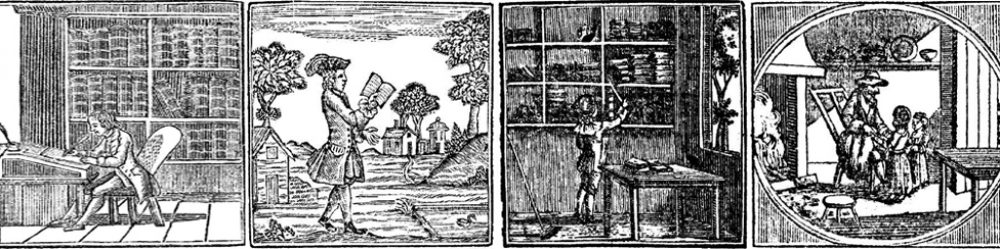
School Days in Children’s Books…

One of the interesting aspects about cataloging children’s books is that you get to see quite an amazing variety of materials–“children’s books” includes fiction, stories, poetry, history, as well as books about history, science, technology, nature, animals, birds, insects, not to mention illustrated books of all shapes and sizes, and books meant to educate children, “juveniles” and what we would now term “young adults”.  Some scholars don’t really consider instructional books and materials to be children’s “literature” per se, but these non-classroom educational books and materials constitute an important part of the Cotsen collection too–along with certain kinds of  games, and ephemera… The list goes on and on…

When cataloging, I often encounter a dizzying array of material on a semi-random basis, since books are generally cataloged in the order that they’ve been acquired by a curator or collector.  The sheer variety is part of the fun.  But sometimes, I serendipitously encounter books on similar subjects that seem to complement each other or to suggest connections that wouldn’t have occurred to me if only looking at one alone.  Just this week, I saw several  educational books about teaching children that also pictured children themselves in the accompanying illustrations.  Let’s take a look…

Frontispiece : The Boys' School

Frontispiece: The Boys’ School, or Traits of Character in Early Life / by Miss Sandham (London: John Souter, 1821?) (Cotsen 153737)

The engraved frontispiece of The Boys’ School, or Traits of Character in Early Life (undated but published about 1821) shows a well-appointed (and generally quite orderly!) school-room–notice all the books and several globes on the shelves in the background.  A well-dressed boy expounds an astronomical problem to a smiling master sitting at his desk in front of a small class.  Note the compass the boy holds, the telescope, and the other astronomy, navigation, or  time-keeping paraphernalia in the foreground too.  Looking at the illustration, it’s not clear to me how much attention the other boys are paying to the recitation though, but at least they’re in their seats!  Generally, a scene of enlightened decorum is effectively presented.

The frontispiece pretty much speaks for itself, but the text it accompanies tells us that this is a private school for a “limited number of boys,” and that Mr. Morton, the master was “good-natured” with a “steadiness of temper.”

It’s worth pointing out that, while the process of education is depicted in the frontispiece, the real object of this book is the moral education of its readers, as the author makes clear in her preface. The main character is one of the “children of affliction”–an orphan named William Falkner of small size and weak body–who is at first ridiculed by other students for his “personal defects” at the school, but who shows his mental and moral strength in the course of the story via his accomplishments.  In many respects, this presentation is characteristic of English “moral tales” for children of its era.

Moving back in time, Elementary Dialogues for the Improvement of Youth (published in 1790 as the first English version, of Joachim Campe’s Kleine Seelenlehre für Kinder) is presented in the form of a dialogue between a tutor and his students.  While generally benevolent, the tutor employs some educational techniques not exactly in accord with current practices today.  At one point, for instance, he appears at the beginning of the day “with a knotted handkerchief in his hand; and without speaking, strikes each of the boys with it.”  This isn’t as punishment for misbehavior though, but to demonstrate cause and effect to the boys in a way they’ll remember.

"the poor blockhead at his wit's end

“The poor blockhead at his wit’s end”: Elementary Dialogues for the Improvement of Youth / by J.H. Campe (London: Hookham and Carpenter, 1792) (Cotsen 153736)

One of the illustrations depicts what I first thought was a studious boy in a library or study–maybe a model scholar?.  There’s no caption to key a response, but notice the books, including one open on the desk before the boy. Take a look for yourself and see what you think!

Yet the accompanying text tells a different story.  The tutor’s narrative describes the boy as a “poor blockhead at his wit’s end.”  Unable to do a merchant’s apprenticeship text in writing and arithmetic, the boy “struck his forehead to correct himself for want of diligence … having profited little by education and…lost his time in running about and at play.”

As the text makes explicit, the tutor first shows this illustration to his students–as he does with the fifteen others presented in the book–and then elicits responses from them as he explains the context–which is immediately apparent to the boys in this case, who “read” the illustration more correctly than I did!  Perhaps the moral here–at least for catalogers–is that you can’t tell a story by looking at one picture!

In some books, the illustrations make visible in graphical terms what the author is trying to describe in the text–they play a secondary or supporting role.  In other books, such as toybooks by Caldecott, the illustrations ironically comment upon, or even undercut, the text; they can even become the primary narrative element.  (And, to be honest, in some children’s books, there’s little relation between text and illustration; the illustrations are essentially decorative.)  In Elementary Dialogues, text and illustration work together, the pictures intended to “make sensible” to children the “ideas” that the author wants to present.  This method is meant to leave “the pleasure of discovering [the ideas] to the children,” and is consistent with the theories that Locke presented for using illustrations and objects for children’s education.

Having had all this moral and conceptual education, it’s time for a break, don’t you agree?

And so apparently do the students shown in the engraved frontispiece of Christmas Holidays: a Poem Written for the Amusement & Instruction of All Good Masters & Misses in the Known World by Tommy Tell-Truth, B.A., published circa 1767 (some titles are too good to shorten!).

Frontispiece: Christmas Holidays

Frontispiece: Christmas Holidays: a Poem (London: H. Roberts & H. Turpin [ca. 1767] (Cotsen 153700)

Here we see an eighteenth-century English class on the verge of their Christmas break.   A benevolent-looking master gives out a prize, or treat, to one student, perhaps a star pupil? The rest of the students look like they’re about to explode with delight.  (Remember that feeling yourself when in school?) One boy skates out of the picture at lower right, school-bag and hat in hand; other students stand and cheer (Huzza!) or chatter amongst themselves–a sense of festive jollity prevails over order or decorum. Compare this scene with that depicted in the 1820’s Boy’s School frontispiece above, in particular the number of students, their clothing and the general classroom decor.  (We’ve moved from the world of Jane Austen back to the world of Tom Jones, or so it seems to me.)

Detail of frontispiece: (Cotsen acc. no. 6143802)

Detail of frontispiece: Christmas Holidays (Cotsen 153700)

Of particular interest to me are the boys shown on the left side of the engraving.  In the foreground, one boy stuffs his school-bag (his back completely turned to the master) while another sprawls on the floor, holding his stomach in laughter while clutching a paper, perhaps his term grades?  Meanwhile, two boys feed the fire with what appears to be the master’s birch rod and disciplinary paddle.  The whole scene is one of blissful abandon and festive misrule, not inappropriate considering that another engraving in the book, titled “Twelfth Night,” depicts the festivity of a group of carousing adults, some apparently in their cups.

Cotsen Research Projects: Vienna Secessionist Book Illustration for Children

Note: The Friends of the Princeton University Library offer short-term Library Research Grants to promote scholarly use of the research collections, which are awarded via a competitive application process.  Researchers usually offer a short informal talk or presentation to library staff and others in the Princeton academic community near the end of their work on campus about the results of their research and how it fits into their broader research project or interests.

The text below was kindly provided by Megan Brandow-Faller, recipient of a 2012 Library Research Grant, following her July 2012 research project at Princeton in both the Cotsen Children’s Library and Marquand Art Library, following her July, 13, 2012 talk entitled: “An Artist in Every Child–A Child in Every Artist: Avant-Garde Frauenkunst and Kinderkunst in Vienna, 1897-1930.”  (The images accompanying the text are adapted from select slides in her PowerPoint presentation.)  Dr. Brandow-Faller is currently Assistant Professor of History at the City University of New York/Kingsborough. Her research focuses on women’s art institutions in early twentieth century Habsburg Central Europe.

Vienna Secessionist Book Illustration for Children 

by Megan Brandow-Faller

The art of the child found fertile ground in Vienna 1900, cultivated by Franz Čižek’s renowned Jugendkunstkursen (Youth Art Classes), at important exhibitions of children’s art, and in the pages of Ver Sacrum and other periodicals.  Rejecting the elaborate technological miniatures popular in the nineteenth century–toys intended to ‘dazzle’ but which would ultimately leave a child cold–artists associated with the Vienna Secession and Wiener Werkstätte (the applied arts commercial workshops co-founded by Josef Hoffmann and Koloman Moser in 1903) designed objects conceived ‘with the eyes of a child.’ Secessionist toys, illustrated books and graphics using simple shapes and bright colors were designed to awaken children’s creative impulses in a design language that children could understand.

Figure 4b: Kolomann Moser & Therese Trethahn, turned wooden toys, in Jan. 1906 issue of Kind and Kunst. (Cotsen Children's Library)

Figure 4b: Kolomann Moser & Therese Trethahn, turned wooden toys, in Jan. 1906 issue of Kind and Kunst. Leipzig: A. Koch, 1904-1909. (Cotsen 87516)

In designing these so-called ‘reform toys,’ Secessionists tapped two main sources for inspiration: the untutored drawing of children and traditional turned wooden peasant toys. The January 1906 issue of Alexander Koch’s progressive journal Kind and Kunst, for instance, devoted a richly-illustrated twenty-three page article to Wiener Werkstätte items (including finely-illustrated children’s books, games, silver rattles, and furniture suites) for children, including toy designs by Hoffmann, Moser, and Carl Otto Czeschka.

Kolo Moser’s crudely-shaped wooden figurines (illustrated in Figure 4b) reveal how Secessionists interpreted traditional toys in a highly-stylized manner verging on the grotesque.

Figure 1a: Minka Podhajska, cover illustration for Sept. 1902 issue of Ver Sacrum. (Marquand Library)

Figure 1a: Minka Podhajska, cover illustration for Sept. 1902 issue of Ver Sacrum. Wien: Verlag Gerlach & Schenk, 1898-1903. (Marquand N6494.W5 V47q)

Yet, it was actually the female students of Hoffmann, Moser, and Czeschka who produced some of the most important work in artistic toys and children’s book illustration. Contemporary critics found toy design and book illustration particularly appropriate fields for female craftswomen, given women’s ‘natural’ stake in childrearing (i.e. that women were believed to better understood children’s thought processes than men). Female craftswomen training at Austria’s progressive School of Applied Arts and Vienna’s Women’s Academy exploited such discursive linkages to the fullest.


Figure 1b: Fanny Harlfinger-Zakucka, stenciled image in Sept. 1902 Issue of Ver Sacrum. (Marquand Library)

Figure 1b: Fanny Harlfinger-Zakucka, stenciled image in Sept. 1902 Issue of Ver Sacrum.
(Marquand N6494.W5 V47q)

One popular method of graphic art and book illustration for children involved the use of painted stencils to produce clear, simple images. Stenciling had experienced a recent revival during the English and Scottish arts-and-crafts movement. In conjunction with the so-called Schablonieren Kurs (Stenciling Course) taught by Secessionist Adolf Böhm at the Women’s Academy, Böhm’s students published illustrated fairy tale and picture books and gained recognition through replication of such illustrations in the pages of Ver Sacrum, die Fläche and other periodicals. A special September 1902 issue of the Secessionist periodical Ver Sacrum featured the work of Böhm’s students. (Figures 1a & 1b)  His students’ toy designs were regularly featured in the pages of The Studio.

Figures 2a & 2b: Fanny Harlfinger Zakucka, stenciled images from Schablanon Drücke, ca. 1903. (Cotsen Children's Library)

Figures 2a & 2b: Fanny Harlfinger Zakucka, stenciled images from Schablanon Drücke, ca. 1903.
(Cotsen 103414)

One such book of children’s stencils (housed in the Cotsen Collection) created by Women’s Academy classmates artist/designers Minka Podhajska and Fanny Harlfinger-Zakucka around 1903 employs a fresh and original graphic language using negative white space in lieu of the black borders that Čižek encouraged his students to bound their drawings.

Packing a strong expressive punch into a minimal number of marks expressed as abstract geometrical shapes, Harlfinger-Zakucka’s stenciled image of a reform-clothing-clad mother, sporting what looks to be Wiener-Werkstätte style textiles, guiding her toddler plays on negative and positive space to reveal the interconnected forms and hence psychological closeness of mother and child (Figure 2b). Her stencil of a children’s Jause (snacktime) employs similar techniques (Figure 2a). These stenciled images reveal a striking encounter with Japanese printmaking techniques in their unusual manipulation of spatial perspective and boldly ‘cropped’ nature.


Figures 3a & 3b: Minka Podhaska, stenciled images from Schablanon Drücke, ca. 1903. (Cotsen Children's Library)

Figures 3a & 3b: Minka Podhaska, stenciled images from Schablanon Drücke, ca. 1903.
(Cotsen 103414)

Likewise carving her images out of negative white space, Podhajska’s depiction of a dancing couple (Figure 3a) reveals her fascination with folk art, an important source of influence for the turned-wooden toys she and Harlfinger-Zakucka produced. Her stencil of a witch conjuring her brew employs a wonderfully expressive sinuous curve associated with the new art movement (Figure 3b), which also relates well to the idiosyncratic use of turning-lathe methods in her turned-wooden figurines. The tangible figure of the witch and cauldron is expressed in a curvilinear fashion. Yet it is the intangible aspects of the image–the suggestion of smoke, fire and more abstractly the witches’ incantations–lending it its fiery expressiveness. While both artists tapped into folk imagery and design idioms, their work freely reinvented and modernized traditional folk design into images that were designed to awaken children’s creativity through subtle narrative elements. Images stood alone to leave the rest of the story to children’s imagination.