
The History of Jacky Idle and Dicky Diligent. London: E. Newbery, 1797. (Cotsen)
A few weeks ago I was cataloging a new addition to the Newbery collection,The History of Jacky Idle and Dicky Diligent, a generous gift of The Friends of the Princeton University Library in 2018. I felt sure I had seen this image of two boys enjoying the shade of a great oak, one lost in a book, the other fast asleep, with his book dropped on the ground. Only a Bewick could have drawn and wood engraved that tree, so I checked Nigel Tattersfield’s bibliography of John Bewick, the gifted younger brother of the more famous Thomas. Bingo, there was the frontispiece and three other illustrations from Jacky Idle and Dicky Diligent in the appendix of unattributed illustrations.
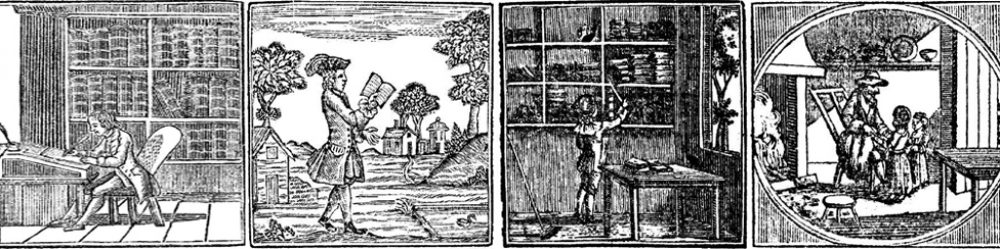
During a brief career cut short at age thirty-five by tuberculosis, John provided sets of illustrated blocks for sixteen Newbery children’s books, including this one just attributed to him. A dozen of those accompanied texts that were written, edited, or abridged by Richard Johnson, a professional writer who helped uphold the reputation of the Newbery firm as one of the leading firms of children’s book publishers. He is one of the few writers in the Newbery stable who sometimes signed his children’s books with his initials “R. J.” and Jacky Idle includes as a portrait of him hard at work at his desk by John Bewick. Johnson was paid two pounds two shillings for composing this thirty-two page pamphlet, which doesn’t sound like much until its purchasing power is converted into its equivalence in modern currency: 285 pounds. In Jacky Idle and Dicky Diligent, Johnson spun out another variant on the favorite eighteenth century tale of two children with opposite characters, one who thrives, the other who dies, derived from William Hogarth’s immensely popular progresses of a harlot, a rake, and two apprentices. A wealthy retired merchant marries his housemaid, who is very proud of having married above her station. Bewick shows her before and after her social elevation by dividing the circular image in two. I don’t recall seeing him do this anywhere else.
  The Idles have one son, Jacky, who is bright, but lazy. Instead of forcing him to apply himself to anything he has no inclination for, his mother encourages him to do nothing with her constant reminders that he will inherit a sizeable fortune and never have to work. His father decides that Jacky had better to go school anyway, where he makes friends with Dicky Diligent. Dicky is not as clever as Jacky, but he makes the most of what he has by working hard and tries to be a good influence on his friend..
Of course the story goes downhill after the boys finish their education. Jacky goes to work as a clerk a merchant, is made a partner in the firm, and eventually takes over the business. 
Jacky comes into his fortune after his father dies and he squanders it in short order. Here he is being fleeced by card sharks. Almost every one played cards for money in the eighteenth century, but it is quite unusual to find any illustrations of a scene like this in a children’s book. Notice that the man standing up behind Jacky on the left is signaling to his accomplices across the table which cards Jacky has in his hand.
Homeless and penniless, Jacky retreats to St. James Park, where he is discovered brooding on a bench by his old friend. As soon Dicky.learns that he is not only destitute but friendless, having been cast off by the mother who spoiled him rotten, he takes him in as a permanent guest. Jacky realizes that he has wasted his life and cannot in good conscience sponge on his friend forever. He writes a letter addressed to Dicky advising others not to do what he has done and has the decency to expire thereafter. Although rather formulaic, Johnson has supplied many interesting details about the characters’ boyhood I haven’t described here.
It’s not every day you discover new work by a major English children’s book illustrator!


