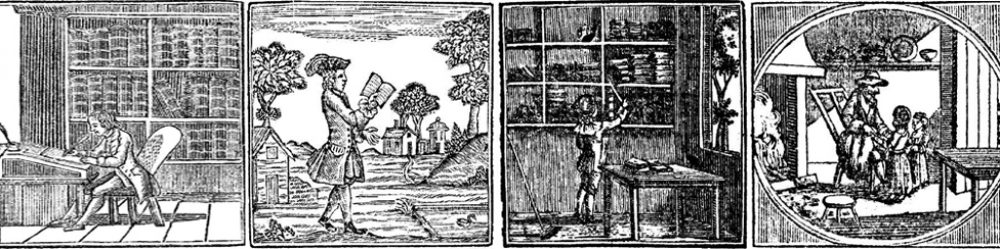
Learn to Make Invisible Inks and Other Projects from The Young Gentleman’s & Lady’s Magazine (1799)

It is a truth universally acknowledged that a child with time on its hands must be in need of something to do.  This was a truth understood very well by Dr. William Fordyce Mavor, the editor and chief compiler of The Young Gentleman’s and Lady’s Magazine, which appeared in monthly numbers between February 1799 and January 1800.  One of the features that sets The Young Gentleman’s and Lady’s Magazine apart from its predecessors, The Lilliputian Magazine (1751) and The Juvenile Magazine (1789-1790) was the promotion of learning through doing across the disciplines.

One of the magazine’s chief selling points was its engraved plates.  Their function was to encourage accurate observation and artistic activity.   A subject from botany or natural history was reproduced in two versions, one professionally hand-colored, the other in outline “intended as an Exercise for the juvenile Pencil.”  The passion flower graced the pages of the seventh issue, and the male bird of paradise the third.

No instructions to the juvenile wielding the pencil were offered, as if Mavor assumed most of his readers’ parents employed drawing masters. Perhaps to remedy this oversight, in the sixth issue Mavor ran an article with directions for mixing colors.  It seems to have been contributed professional artist, who noted that he hoped this would alleviate the frustration he had observed in children attempting to complete the plain copies.

Brainteasers could be found in every issue.  There were complicated charades and enigmas to solve, with the understanding that readers were invited to submit their clever verse answers or original specimens for possible publication. In the correspondents’ sections, Mavor always politely acknowledged the receipt of readers’ efforts, but accepted only the best ones (most of them were probably by himself).  Arithmetical word problems only appeared in the first three issues and they may have been too forbidding to have very wide appeal (how many children in the audience were burning to learn how to convert French livres to pounds sterling?).  Another more engaging example of a different kind of brainteaser was a piece that consisted of a model dialogue of two boys playing “Twenty Questions.”

Raising the spirit of enquiry was among Mavor’s other educational priorities.  He did not  want to spark his readers’ passive sense of wonder through descriptions of inventions and discoveries, he wanted them to roll up their sleeves and try to replicate the results of easy experiments.  One that many children probably would have wanted to try at home was making “sympathetic (i.e. invisible).”  The recipes are vague as to quantities, so I suspect there were unsuccessful trials and tears of rage.  One of the suggested uses of sympathetic ink was the sprucing up of artificial flowers, an inducement to the young ladies in the audience.  They probably employed them in the writing of letters whose contents were supposed to be kept secret.. Much messier would have been the preservation of birds and butterflies caught in the field.  Directions for butterflies follows, being the less gory of the two.  I wonder how well this method actually works and if similar methods can still be found in children’s books now.

While none of these features looks revolutionary to us now, it gave The Young Gentleman’s and Lady’s Magazine a much more modern feel than eitherThe Lilliputian or Juvenile Magazine, whose contents were very similar to any eighteenth-century miscellany.  Dr. Mavor’s attempt to include more hands-on projects for children may well have been a response to the increased anxiety in the 1790s about making sure children did not waste leisure time in stupid, cruel, or unproductive ways, at least in families that were sufficiently well-off not to need children’s paid labor for the unit’s maintenance.  Dr. Mavor may not have been among the great writers for children of this era, but he certainly deserves recognition in the history of British magazines for children for mixing up the contents of The Young Gentleman’s and Lady’s Magazine with non-fiction materials to appeal to a much broader range of interests..

Criers and Vendors: Street Life in Nineteenth-century Naples

One of the characters featured in Cotsen 55086. But who is he and what’s on his head?

All rare books have something distinctive about them, whether they present a famous story in an unusual version, feature striking illustrations–often beautifully designed or rendered via a process that’s a feat of artistic skill or technological innovation – or have unique histories revealed by annotation, marginalia, reader markings, inscriptions or dedications by their author or some other person of note.

Can you tell a book by its cover? (Cotsen 52086)

Some rare books combine several of these aspects.  A case in point is this book of nineteenth-century street vendors whose cover  embodies the old saying that you can’t tell a book by its cover: here, an ordinary roan spine and marbled paper-covered boards, both somewhat the worse for wear.

This book lacks a title page and was quite possibly issued that way, as several other similar books of cries apparently were.  Based on the contents, bibliographer Karen F. Beall assigns the descriptive title “Neapolitan Street Cries.”1  Within the unprepossessing covers is a set of beautifully-rendered, hand-colored lithographs of an array of street vendors crying their wares in mid-nineteenth-century Naples. These provide a window into a kind of commercial activity quite remote to us today. Adding to the book’s interest is a noteworthy, if somewhat puzzling, inscription by the renowned English Victorian artist Dante Gabriel Rossetti.

Hey, Mr Tambourine Man… Tambourine seller with his wares balanced on his head

This book is collection of illustrated plates and the only “text” is an Italian-language caption below each illustration.  For instance, the “mystery” illustration of the man with the elaborate headgear featured at the head of this blog posting is a tambourine seller, shown with a range of the instruments somehow balanced on his head and captioned “Tamburraro.”  A reader has penciled in an English-language version of the title — “dealer in tambourines” — as has been done on most other illustrations in the book.  Was someone practicing their Italian, or (I think more likely) translating the captions for a non-Italian reader?

Several other illustrations feature gravity-defying collections of objects balanced on vendors’ heads.  Take a look at the watermelon seller and the glass carafe vendor.

Glass Carafe Vendor

Watermelon Seller


Despite the wealth of apparently naturalistic detail, I have to think that art has enhanced life in these depictions.

The depictions of the Neapolitan vendors combine both men and women. Among the women are an egg merchant and a seat caner, the latter conducting her work not in a shop but right there in the street.  She has made herself comfortable for working by taking her shoes off; or perhaps that’s to aid in her work?

Egg Merchant, with her live supplier of eggs close at hand.

Caning seats with a supply of reeds readily at hand.


In an era of farmer’s markets and street fairs, we tend think of street vendors as people selling actual products.  But nineteenth-century street vendors provided services as well as products.  Suppose you were a tourist, just having arrived in Naples.  How would you buy things?  What sort of currency would you use, and where would you get it?  Probably from a local money changer like the one illustrated, who is depicted with a stern seriousness, or perhaps just with extreme concentration, as she counts out coins from one of the moneybags on her street-side desk.  The illustrator has also captured something of the role of a money changer at the time — a testament to skill and insight.)Likewise, the depiction of the public scribe in the midst of scrivening seems to capture something of the essence of the man at work, as he pauses in the middle of writing, perhaps somewhat absentmindedly, or perhaps in response to a client just out of view?  His expression, slightly grizzled face, and clothing — nineteenth-century business attire, but well worn, bordering on threadbare — all suggest a man who has seen better days.

Neapolitan sorbet seller

These days, it may be a little hard to imagine why anyone would be performing such a role in the first place.  But at a time when many people were illiterate, some literate but unable to write out a clear business letter or other grammatical, well-composed communication, and professionally-written letters in a clear hand were  needed for various reasons, professional scribes filled an important need.

Other characters depicted remind us of the pleasurable and entertainment aspects of Naples street vendors and performers. A sorbet seller — certainly not the friendliest-looking of the characters depicted! — holds up one his tiny cups of sorbet, apparently made for being enjoying while walking along the street. His other hand holds the ladle for the sorbet, placed within what looks like an ice-packed cooler. Next to him is a basket with a lot of little paper cups — apparently, he’s expecting good business!

Street theater featuring Pulcinella.

Although the “Pulcinella” street theater actor’s depiction looks a little less than comical, at least to my eye, Pulcinella was a much-loved stock character in Neapolitan puppetry.  The baggy white outfit, conical hat, and mask were all part of his standard appearance, as was some sort of a stick or cudgel, a horn-like version which he seems to be wielding here.

He’s related to the character of Punch in English Punch and Judy puppet shows, which were tremendously popular street theater in eighteenth- and nineteenth-century England.  Pulcinella, like Punch, had aspects of the “all-licensed fool,” who could say and do outrageous things with impunity that members of the audience could not.  He would have been a fixture in Naples streets whenever street theater and street vendors were at work, and where shoppers or tourists were passing by.  A reader has captioned this illustration as “Punch & Judy,” an annotation that is not really accurate but quite understandable — and possibly a way of of contextualizing Pulcinella for an English reader?

The beautifully-rendered lithographed illustrations and the lost world they depict are reason enough, I think, to find this book interesting. Further interest — and at least one more question — is added by Rossetti’s gift inscription to his sister Maria on the book’s front free endpaper.  (The poet, Christina Rossetti was another, more famous, sister, whose work included children’s poetry.)

Inscribed: Dante C.G. Rossetti / to his sister Maria. 1837 1841.

Born in 1828, Dante Gabriel Rossetti was a major Victorian artist, one of the founding members of the Pre-Raphaelite Brotherhood, along with John Everett Millais and William Holman Hunt, in 1848.  At the time of this inscription (either 1837 or 1841), Rossetti would still have been a school-boy. His father was Italian, and his mother was the English daughter of an Italian exile, so a childhood interest in Italy — and books about Italy — is no surprise.  But was is perplexing is why Rossetti changed the date of his gift inscription.  Did he first get the date wrong?  Unlikely, even for an otherworldly character such as Rossetti. Did he inscribe the book in 1837 and somehow forget to give it to his sister then?  Again, unlikely.  Did he write his name in his own book in 1837 and then decide to give it to Maria in 1841, inserting a gift inscription line and changing the date?  Possibly, but the ink and hand look remarkably the consistent throughout.  Or did Rossetti decide to give the book to Maria a second time in 1841 for some reason, and simply update the gift inscription?  That may be the most plausible explanation, as unusual as it sounds.  Perhaps there’s some other, better explanation, which has something to do with the relationship between Rossetti and his sister and their personal libraries?  Something to investigate, but for now, a puzzle of sorts about Cotsen’s unusual copy of this interesting title.


  1. Karen F. Beall, Kaufrufe und Straßenhändler: Eine Bibliographie  / Cries and Itinerant Trades: A Bibliography: Hauswedell & Co., Hamburg (p.346).