
Humours of a Fair. London: W & T Darton, 1807. (Cotsen)
Fairs and their attractions have always been a destination for entertainers, gawkers, pickpockets, prostitutes, children, vendors of food, drink, and cheap trinkets. The carnivalesque atmosphere has been celebrated and reprobated, often in the same breath. Artists with a taste for satire, like William Hogarth, captured the press of people on the grounds in one of his most famous prints, “Southwark Fair.”
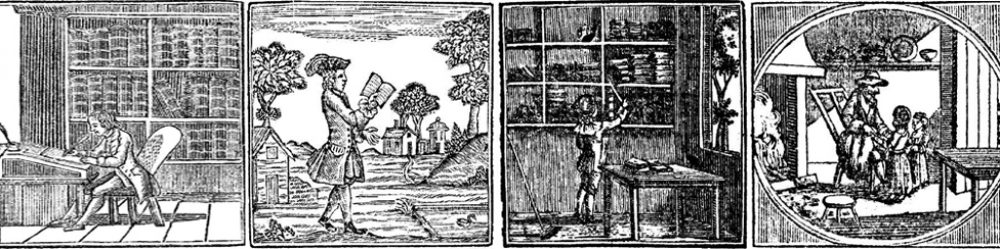
Eighteenth and early nineteenth-century children’s books and prints also depict young people visiting fairs, although the representations are somewhat tame in comparison with Hogarth’s seething engraving. Cotsen has just acquired a very rare writing sheet, “The Humours of the Fair” (London: W. & T. Darton, 1807), illustrated with an engraved headpiece and seven vignettes capturing the sights, sounds, and smells of the grounds.
 While there are no agricultural displays or tractor pulls so characteristic of American state and county fairs, some things have hardly changed from the 1800s. Competitive eating contests, it seems, were not invented in the late nineteenth century. Here a yokel and a gentleman are seeing who can finish first his steaming basin of whitepot straight from the oven. They are allowed the use of spoons, although they could not have prevented serious burns on the lips and the insides of the cheeks. Whitepot, originally a specialty of Devonshire, is a bread-and-butter pudding loaded with cream and topped with a sugar crust.
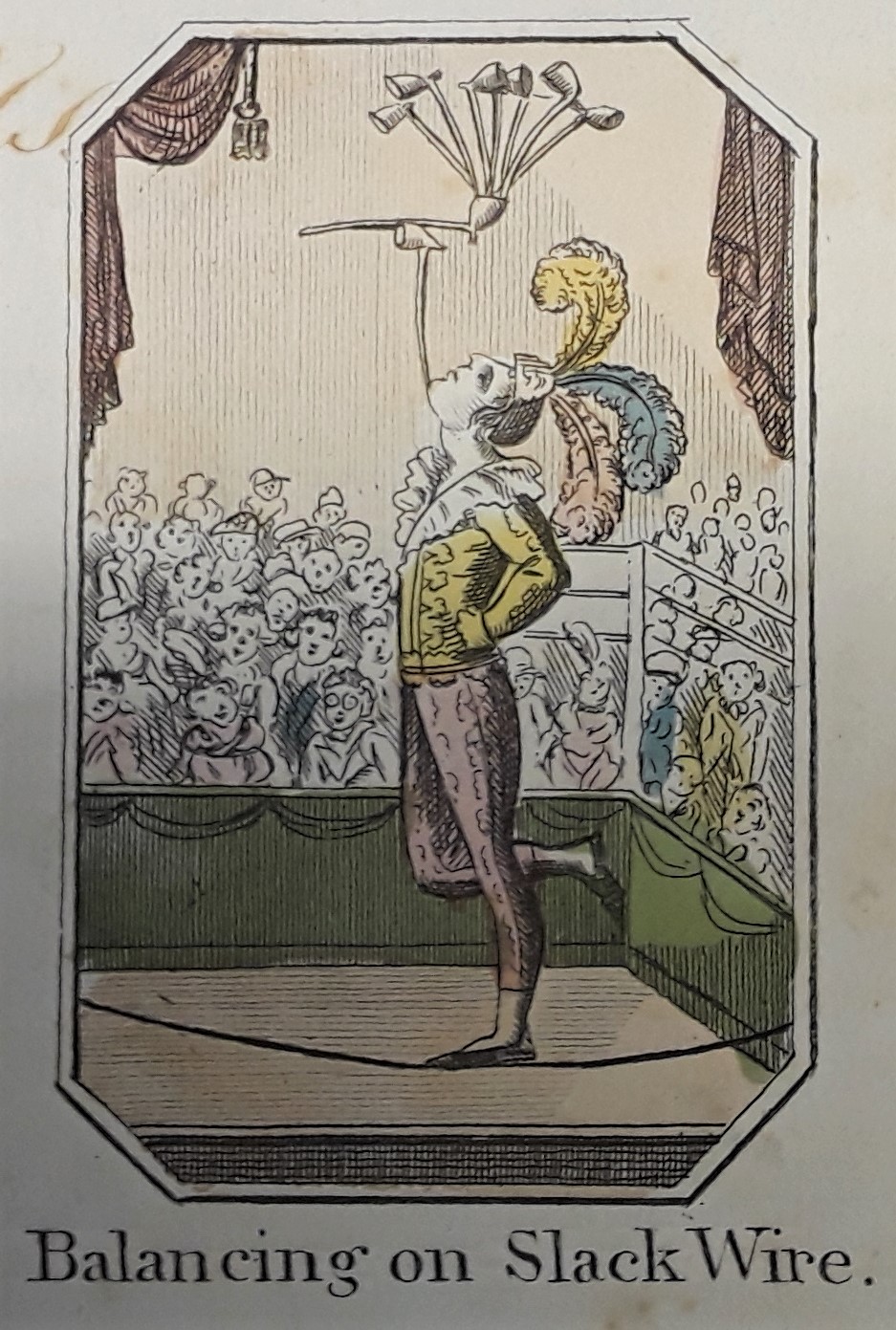
Then there were the shows. On view were amazing displays of strength and dexterity, such as this rope walker balancing on his chin a pipe, upon which is resting another pipe with an clutch of pipes arranged like a bouquet of flowers in its bowl. The wire looks to be only a few inches above the floor. Children were always warned away from the tables where games of chance were being operated, which might explain why they are frequently shown gathered there watching or trying their luck. The conjurer looks just like the rope walker, so he seems to have more than one string to his bow as an showman–unless the engraver was working against a deadline and saving time. Perhaps he gathered a crowd with the balancing act and then moved on to sleigh-of-hand tricks, drawing in the marks with the assistance of a clown, who pretends that his eyes are just as quick than the magician’s wand. 
 No trip to a fair would be complete without the purchase of souvenirs then called fairings—cheap toys, ribbons, sweets. The children troop up to their mother to show her their treasures, probably to be broken, discarded, or forgotten the next day.
This writing sheet, which was known only from a minimal description in a British dealer’s catalog from the 1970s, is a perfect addition to Cotsen’s superb collection of these illustrated prints. Nicholas Wallin, a student at the Bettesworth School (location in England unknown) filled the center, with sentiments about the meaning of Christmas in his best handwriting, probably for presentation to his parents when he came home for the holidays.
It was purchased at the third of a series of auctions dispersing the magnificent collection of magic, the allied arts, and their ephemera by the late, great, light-fingered laureate of legerdemain Ricky Jay (1946-2018).
 Ricky was unusual for being honored in three worlds which rarely collide—conjuring, collecting, and curating. A sorcerer of sleight of hand, he could confound people standing a foot away with cup and balls as easily as crowd watching him on stage propel playing
  cards into “thick, pachydematous outer melon layer” of the “most prodigious of household fruits” at the distance of ten paces. He also did mean turns as conmen on the silver screen and as the sole star of several stage shows. His delight in the search for materials documenting the peculiar history of his confraternity, which comprised cheats, hustlers, hoaxsters, pranksters, jokesters, impostors, pretenders, sideshow showmen, never flagged, any more than his glee in sharing them with the uninitiated in a series of books and exhibition catalog, among them Cards as Weapons, Learned Pigs and Fireproof Women, Many Mysteries Unraveled, The Magic Magic Book, Jay’s Journal of Anomalies, Dice: Deception, Fate, and Rotten Luck, and mesmerizing learned lectures at museums and rare book libraries, sometimes accompanied by demonstrations. His lecture on Dr. Graham’s Celestial Bed, an aide to conception which famous aristocratic ladies like Georgiana, Duchess of Devonshire, resorted to in desperation, brought down the house at the Grolier Club. As generous as Ricky was with his collection and knowledge, he never revealed the secrets of the techniques that astounded onlookers with the pleasure of being hoodwinked.
 There were three words that could never be uttered in his presence: “children’s birthday parties.” In spite of his well-known aversion to the infant race, I would like to think he wouldn’t have minded at all that this engraving illustrating raffish popular entertainments has found its way to the Cotsen Children’s Library, where it will be in the company of operators of peep shows, a Dutch blow book, magic lanterns, and Cajanus the Swedish Giant.