Recently in Ephemera Category

A musical conversation between the Monument and St. Paul's

| 1 Comment
conversation song4.jpg

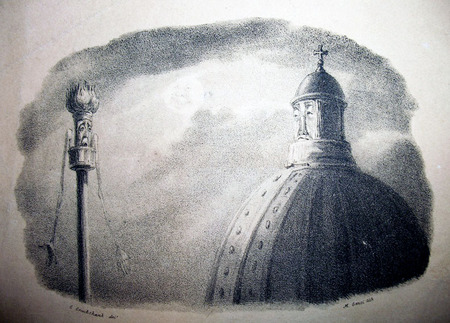
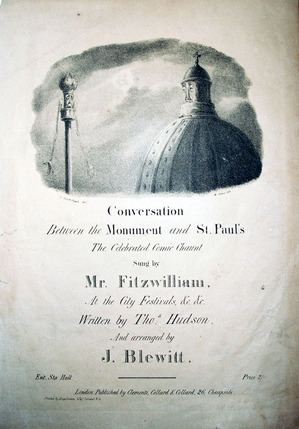
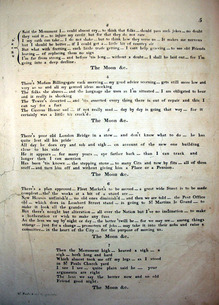
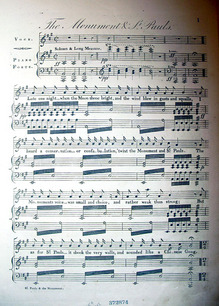
Thomas Hudson [lyrics] and Jonathan Blewitt (1782-1853) [music], Conversation between the Monument and St. Paul’s; the Celebrated Comic Chaunt sung by Mr. Fitzwilliam at the city festival, &c.&c. … (London: Clementi, Collard & Collard [no date]). Sheet music cover designed by George Cruikshank (1792-1878) and lithographed by Maxim Gauci (1774-1854). Graphic Arts Collection (GA) Cruik 1817.27q

conversation song3.jpg

George Cruikshank’s illustrated sheet music presents the Monument to the Great Fire of London speaking with St. Paul’s Cathedral in the City of London. The Monument, located near the northern end of the London Bridge, is a Roman Doric column topped with a gilded urn of fire, designed by the architect Christopher Wren (1632-1723). St. Paul’s Cathedral, a few blocks away, was also designed by Wren between 1675 and 1710, after its predecessor was destroyed in the same fire.

The music presented here is by the British composer Jonathan Blewitt, who spent time as a young man in Dublin as director to the Theatre Royal and the grand organist to the masonic body of Ireland. Around 1825, Blewitt returned to London, where he wrote pantomimes, musical plays, and light operas. His last work, the pantomime Harlequin Hudibras, was performed at Drury Lane on December 27, 1852. At various times, he also served as music director for Sadler’s Wells Theatre, Vauxhall, and at the Tivoli Gardens.

The vocalist may have been the actor Edward Fitzwilliam (1788-1852), who performed in various London theaters at roughly the same time as Blewitt. Fitzwilliam joined the company at Drury Lane in 1821, specializing in Irish roles.

conversation song1.jpg
conversation song2.jpg

The song begins:
Late one night - when the Moon shone bright, and the wind blew in gusts and squalls,
I heard a conver sation - or confa bu lation, ‘twixt the Monument and St. Pauls.
The Mo muments voice - was small and choice, and rather weak than strong;
But as for St. Pauls - it shook the very walls, and sounded like a chi nese Gong.

seventh5.jpg

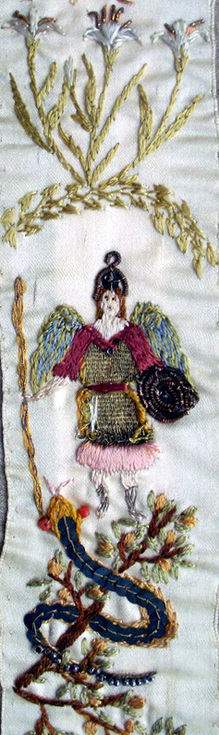
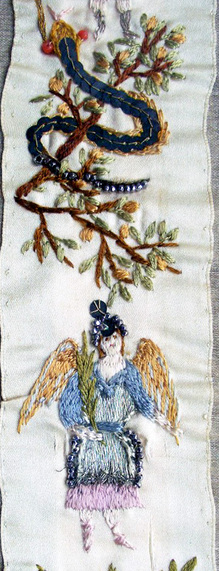
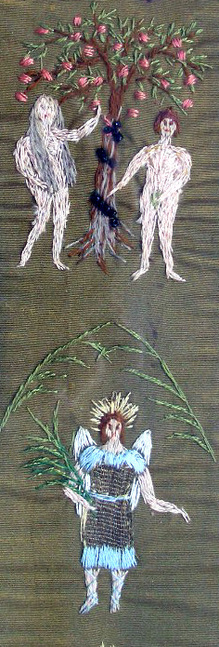
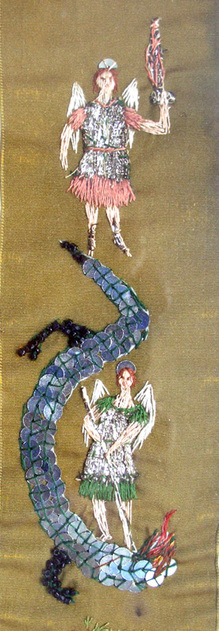
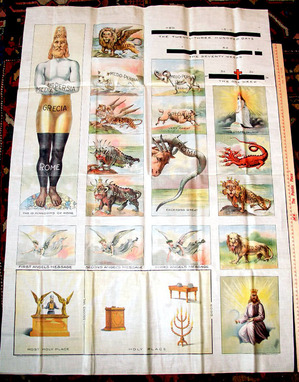
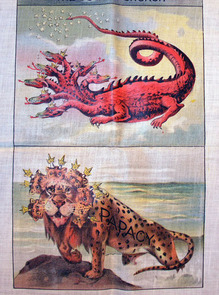
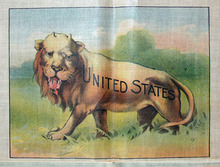
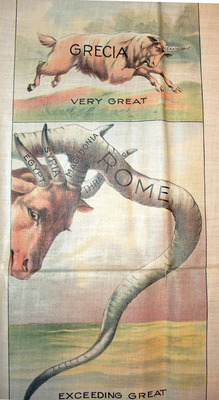
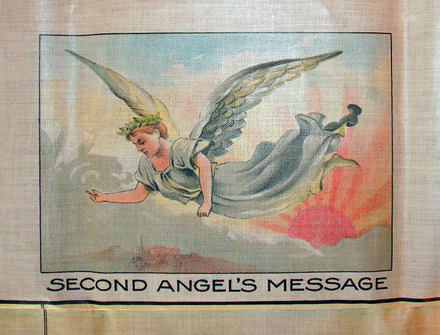
William Ward Simpson (1872-1907), Wall chart illustrating the Apocalyptic and Messianic Prophecies of the Book of Daniel (Buffalo, New York: Courier Co. (Litho Dpt.), [ca. 1900s]). Chromolithographed linen. Graphic Arts GAX 2012- in process

Seventh-Day Adventist William Ward Simpson was converted in 1890 and ordained as a minister in 1899 at the age of twenty-seven. For the next eight years, Simpson preached to enthusiastic crowds throughout California and the Midwest using large, colored wall charts to illustrate the hidden biblical prophecies.

seventh3.jpg
seventh2.jpg
seventh1.jpg
seventh4.jpg

See also Liberty: a Magazine of Religious Freedom (Washington: Review and Herald Pub. Association, 1906- ). Firestone Library (F) BV471.S48 L534

National Photo and Lantern Slide Color Company

| No Comments
colors1.jpg

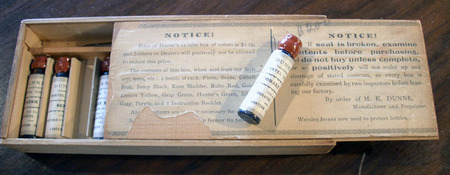
Dunne’s Transparent Pastel Colors … For All Photographs, Pictures, and Lantern Slides ([New York]: M.K. Dunne, [ca. 1910]. Graphic Arts GAX 2012- in process

Mary Katharine Dunne established the National Photo and Lantern Slide Color Company at 2021 Fifth Avenue in New York City. From here, she not only sold boxes of “Dunne’s Color” but also taught the hand coloring of photographs. In the June 1910 issue of The Photo-Miniature a short note asks the reader:

“Are you interested in the coloring of photographs and lantern slides? If you are, then you should know Mrs. M.K. Dunne, of the National Photo and Lantern Slide Color Company …Mrs. Dunne is a charming Southern woman, expert in her art, with a great big enthusiasm for the beauties of color in nature and American scenery. I thoroughly enjoyed my hour with her and, as one result of the interview, can advise readers to invest, say ten dollars, in the Dunne Correspondence course of Photograph coloring and the necessary coloring outfit, as the simplest and surest way of getting a practical mastery of this special branch of work. For those who really want to know, this expenditure is abundantly worth while. The Dunne color outfits are sold by dealers everywhere in the United States, Canada, and Great Britain, but Mrs. Dunne will gladly answer any inquiries about instruction, if those who write her will mention this magazine as an introduction.”

Learned Birds and Other Acts

| 1 Comment
broadside6.jpg

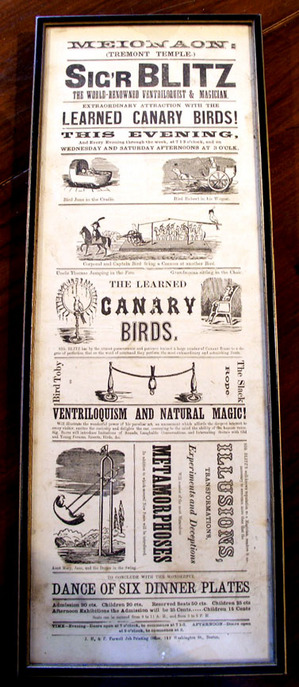
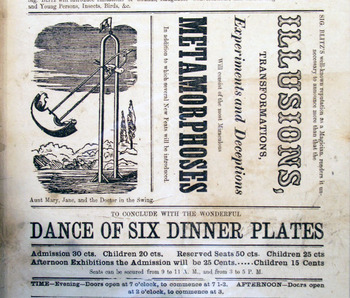
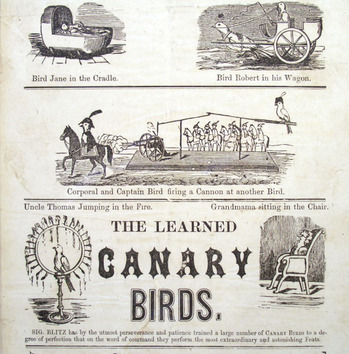
Sig’r Blitz The World-Renowned Ventriloquist & Magician. Extraordinary Attraction with the Learned Canary Birds!… (Boston: J.H. & F. Farwell Job printing Office, [ca. 1860-1968]). Illustrated broadside. Graphic Arts GAX 2012- in process

The British magician, ventriloquist, juggler, and animal trainer Antonio van Zandt (1810-1877) performed under the name Signor Blitz, a name pirated by a dozen other magicians in an effort to capitalize on his extraordinary popularity. Blitz emigrated to the United States in 1834, settling in Philadelphia.

broadside5.jpg

When Blitz died in 1877, obituaries ran in newspapers throughout the United States. The Chicago Tribute stated, “In the death of Signor Antonio Blitz … the whole public will feel as if it had lost a friend, so many years had he devoted himself to its entertainment. His name has literally been a household word. He was born in Deal, England…and his peculiar talents were shown so early that at the age of 13 he made his first appearance at Hamburg and then performed in succession at Lubeck, Potsdam, and other continental cities, exciting wonder wherever he went.”

The Detroit Free Press noted that “Signor Blitz deserves to be remembered as the prince of prestidigitateurs in his [time]. …Three generations at least of Americans owed to him some of the happiest hours of their lives. He was ‘the’ conjurer of the republic; the most incredible of ventriloquists; the most insatiable consumer of yards of ribbon, omelettes made in badly astonished hats, and miscellaneous cutlery; the most indefatigable producer of canary birds from watch cases, rabbits from waistcoat pockets, and butterflies from egg shells, that America ever knew.”

broadside1.jpg

Read the magician’s autobiography:
Antonio Blitz (1810-1877), Life and Adventures of Signor Blitz; Being an Account of the Author’s Professional Life; His Wonderful Tricks and Feats; with Laughable Incidents, and Adventures as a Magician, Necromancer and Ventriloquist (Hartford, Conn.: T. Belknap, 1872). Firestone Library (F) GV1545.B6 A3 1872

Thomas Nast archive

| No Comments
nast book1.jpg
nast book7.jpg

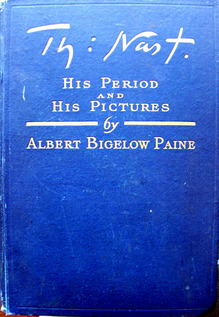
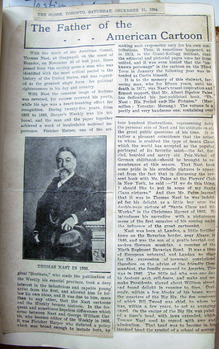
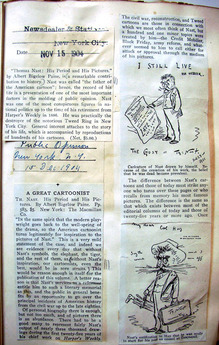
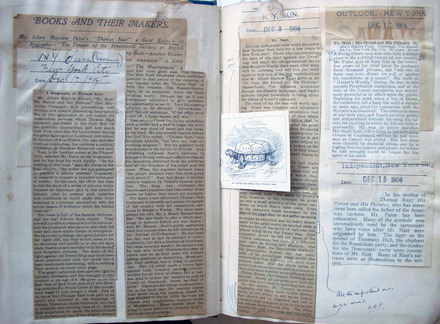
Albert Bigelow Paine (1861-1937), An archive of reviews and memorabilia relating to the book Th. Nast, His Period and His Pictures, in an album supplied by the book’s publisher Macmillan Company, [1904]. Graphic Arts GAX 2012- in process


nast book4.jpg
nast book5.jpg

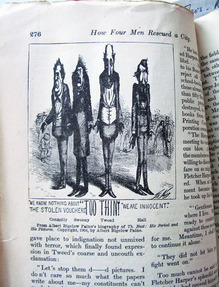
Two years after the death of caricaturist Thomas Nast (1840-1902), his biographer Albert Paine finished the story of Nast’s life and published it with Macmillan Company. The publisher bound another unique book for Paine to look exactly like the biography but with blank pages. In this book, he glued reviews of his book.

nast book8.jpg
nast book15.jpg

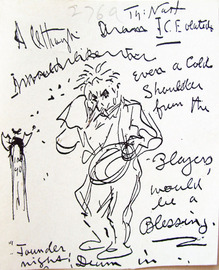
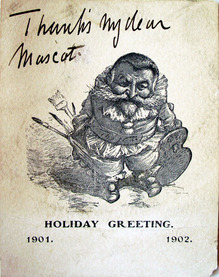
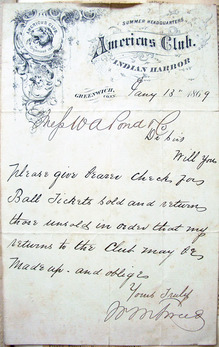
Paine tracked down every article, commentary, newspaper column, and publisher’s announcement regarding Nast’s life and stuffed them into the volume’s nearly 600 pages. The collection includes interesting pieces of ephemera in a variety of formats. There is an ALS (a letter hand-written and signed by the same individual) from William Magear “Boss” Tweed (1823-1878) to a correspondent dated 1869. On the verso is a note written by Paine that reads “two or three years before his exposure by Nast.” There is a 1902 holiday greeting card from Nast to Paine inscribed “Thanks my dear mascot” and a note from Paine offering sympathy to Mrs. Nast at Nast’s death.

nast book9.jpg
nast book12.jpg

Several complete stories are inserted, small brochures and booklets, and a fund raising booklet entitled Testimonial to Thomas Nast. The last was written in 1873 by N.P. Chipman to update readers on Thomas Nast’s poor health. It ends with an appeal for subscribers to pledge one hundred dollars each “toward a fund which, if sufficiently large, shall be used first, to pay off a mortgage of $10,000 upon his home in Morristown, New jersey; and , second, to defray the expense of himself and family to Europe, or elsewhere, as many seem best to him.”

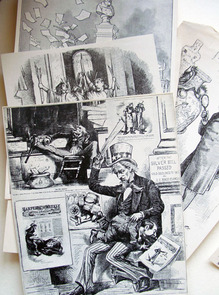
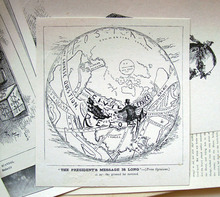
Copies of wood engravings, line block prints, and a few original pen drawings are dropped in between the pages.

nast book13.jpg
nast book14.jpg

Oldest film based on Charles Dickens found

| No Comments

Congratulations to our British colleague curator Bryony Dixon who discovered the world’s oldest surviving Charles Dickens film. The discovery of The Death of Poor Joe, which dates back to March 1901, was made at the British Film Institute (BFI) in February 2012. Until now the earliest known Dickens film was Scrooge or Marley’s Ghost released in November 1901.

Footage courtesy of BFI.

Scribner's logo

| No Comments
scribners24.jpg
scribners22.jpg
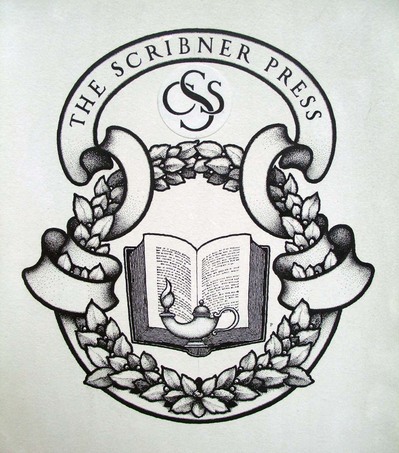
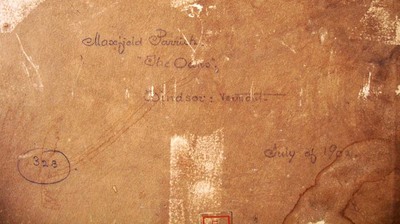
Maxfield Parrish (1870-1966), Scribner Press Logo, [1902]. Pen and ink drawing attached to block. Graphic Arts GA 2006.02471

In July of 1902, Maxfield Parrish completed his design for a colophon device commissioned by the new Scribner Press. “The Scribner logo, with its three key elements of burning antique (Greco-Roman) lamp, books, and laurel wreath, dates back to the Beaux-Arts architect Standford White’s original design for the cover of Scribner’s Magazine (January 1887).”

“The symbol of the book hardly needs to be explained; the laurel crown is a symbol of the highest achievement in poetry or literature, or the arts in general, and it is associated with the classical god of Apollo; the lamp is not Aladdin’s lamp but rather the lamp of wisdom and knowledge. There is a long tradition in art, going back at least to the time of Petrarch, of a poet being crowned with a wreath of laurel, and such scholars as St. Jerome and St. Thomas Aquinas are traditionally depicted beside such a burning lamp” (Charles Scribner III, unpublished memo dated 2 June 1994).

This printer’s seal appeared on the copyright page of all books printed by the Scribner Press. For more, see John Delaney’s webpage: Charles Scribner’s Sons: An Illustrated Chronology: http://library.princeton.edu/libraries/firestone/rbsc/aids/scribner/

John Bristow's Fire Engines

| No Comments
AN00440125_001_l.jpgBritish Museum

On March 25, 1748, there was a fire in Cornhill, at the center of the City of London. The London Magazine records the events in its Monthly Chronologer section:

“About One this Morning, a Fire broke out at Mr. Eldridge’s a Perriwig-Maker in Exchange-Alley, Cornhill, which prov’d one of the most terrible, before it was extinguished, that has happen’d since the Fire of London in 1666. The Flames in a few Minutes spread themselves 3 different Ways, and before Noon consumed, … very

nearly 100 Houses, about 20 of which fronted Cornhill, … notwithstanding all possible Means were used to stop them, there being upwards of 50 Engines, …”

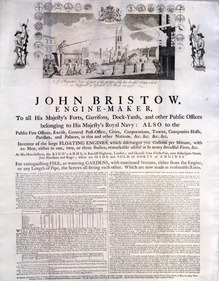
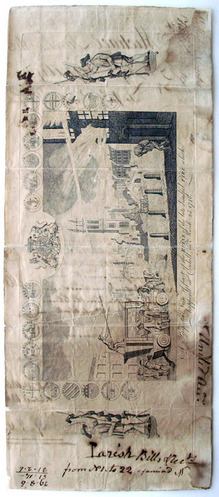
Within days, William Henry Toms (active 1724-1765) engraved and published a print of the tragedy. Twelve years later, the copper plate was reprinted to decorate the top of a broadside advertising the services of the fire engine manufacturer John Bristow (active 1769-1795).

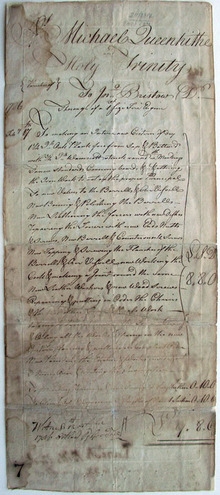
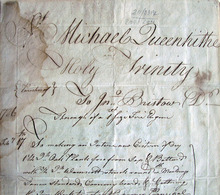
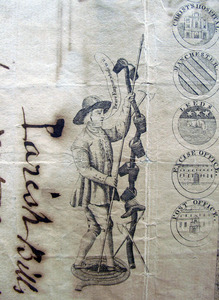
We recently acquired a copy of the print from the top of the broadside. The back of the sheet has been used as a manuscript bill, dated October 12 1787, relating to work carried out by Bristow on the fire engine belonging to the combined city parishes of St. Michael, Queenhithe and Holy Trinity. Possibly, Bristow kept a series of these prints to use for bills and receipts.

firemen7.jpg
firemen5.jpg

A Perspective View of Part of the Ruins of the Late Dreadful Fire which Happened in Cornhill, on March 25, 1748. Engraving ca. 1770; manuscript text 1787. Graphic Arts GAX 2012- in process

firemen4.jpg
firemen2.jpg

To see one of Bristow’s fire engines, visit the Bicester Local History Society: http://www.blhs.org.uk/index.php?page=fire-engine

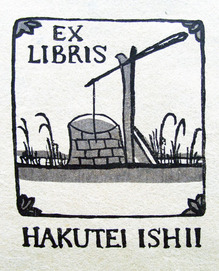
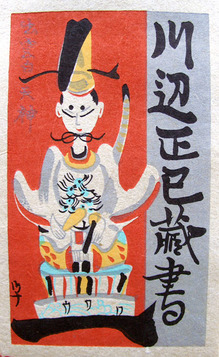
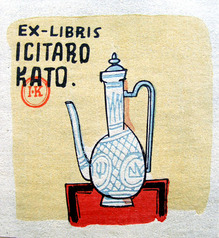
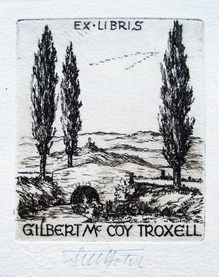
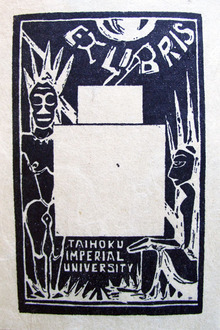
Bookplates in Japan

| 1 Comment
bookplates japan5.jpg
bookplates japan.jpg
bookplates japan10.jpg
bookplates japan2.jpg
bookplates japan3.jpg
bookplates japan6.jpg
bookplates japan4.jpg
bookplates japan7.jpg
bookplates japan8.jpg
bookplates japan9.jpg

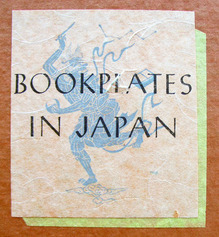
Saitö Shözö (1887-1961), Bookplates in Japan (Tokyo: Meiji-Shobo [1941?]). GAX 2009-2016N c.2. Gift of Gilbert McCoy Troxell.

Poetry in the digital age. Does it matter how it looks?

| 1 Comment

Even the slightest visual aspects of a poem seem to be coming to an end with digital delivery. Here is a selection from Prof. Paul Muldoon’s poem in the current Times Literary Supplement paper version and then, two digital options:

Barrage Balloons, Buck Alec, Bird Flu and You

~Paul Muldoon

there’s no denying a rooster
will put most of us in a flooster
while the pig that turns out to be less pig than ham
is every bit as alarming. Am I right in thinking that’s meant to be a ram
in a ferraiolo cape?
Hasn’t the ewe with scrapie got herself into a scrape?

TLS e-paper (complete poem in one paragraph):

…potato-moth. On Cave Hill, meanwhile, the hunt was on and the time was ripe for the limer-hounds to revert to type. Though you may dismiss as utter tosh my theory this gung-ho stallion’s by Bacon out of Bosch, there’s no denying a rooster will put most of us in a flooster while the pig that turns out to be less pig than ham is every bit as alarming. Am I right in thinking that’s meant to be a ram in a ferraiolo cape? Hasn’t the ewe with scrapie got herself into a scrape? I don’t suppose the moorland streams over which the huntsmen ride roughshod and the puddles through which their horses plod will give rise to enough salmon to fertilize the soil and stave off another famine. I hadn’t seen the connection between “spade”…


Factiva, journal delivery service (poem in several paragraphs):

…ripe for the limer-hounds to revert to type.

Though you may dismiss as utter tosh my theory this gung-ho stallion’s by Bacon out of Bosch, there’s no denying a rooster will put most of us in a flooster while the pig that turns out to be less pig than ham is every bit as alarming. Am I right in thinking that’s meant to be a ram in a ferraiolo cape? Hasn’t the ewe with scrapie got herself into a scrape? I don’t suppose the moorland streams over which the huntsmen ride roughshod and the puddles through which their horses plod will give rise to enough salmon to fertilize the soil and stave off another famine. I hadn’t seen the connection between “spade” and “spud” and “quid” and “cud” till I noticed the mouth of an Indian elephant from the same troupe the film-makers fitted with “African” ears and tusks was stained with nettle soup.

It’s taken me thirty years to discover…

Adler Advertising

| No Comments
adler advertising5.jpg

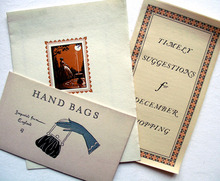
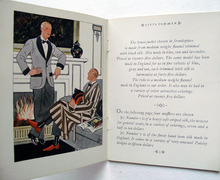
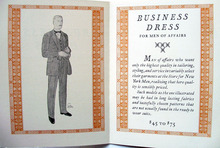
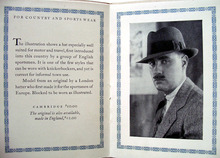
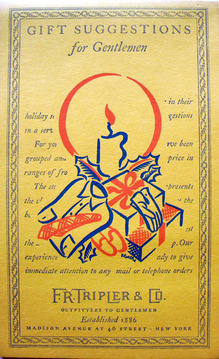
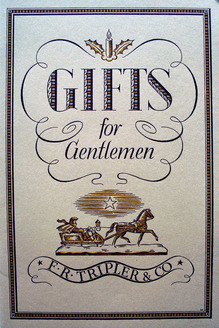
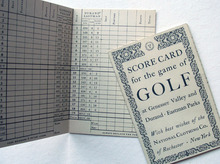
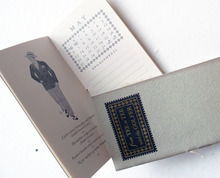
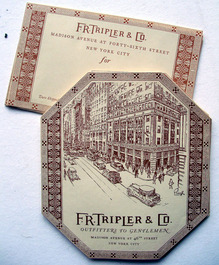
Before Elmer Adler (1884-1962) came to Princeton University and before he entered the world of publishing, Alder worked in the family business, L. Adler Brothers & Co., a Rochester, N.Y. clothing manufacturer. As salesman and later, advertising manager, Adler promoted and defined their men’s line to gentlemen “with whom correctness of clothes is a creed.” To give the advertising a unique style, Adler hired designers T.M. Cleland, Walter Dorwin Teague, and James Montgomery Flagg, among others. Here are a few examples of their work.

adler advertising11.jpg
adler advertising7.jpg
adler advertising1.jpg
adler advertising10.jpg
adler advertising9.jpg
adler advertising4.jpg
adler advertising8.jpg
adler advertising6.jpg


adler advertising3.jpg

Lurline, the Nymph of the Lurlei Berg

| No Comments
actress.jpg

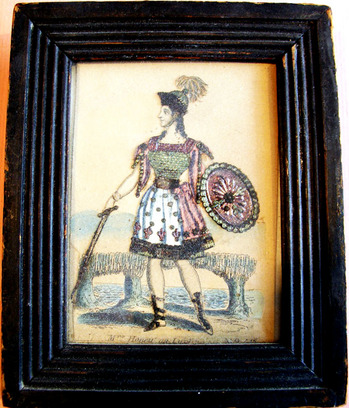
Unidentified artist, Mrs. Honey as Lurline the Nymph, ca. 1834. Etching with hand coloring and beading. Graphic Arts 2011- in process.

Laura Honey (1816?-1843) played the part of Lurline, the Nymph of the Lurlei Berg in the fairy drama of the same name from January 13 to March 22, 1834 at the Theatre Royal, Adelphi. The play began every evening at 6:45, and a second, half price show was performed at 8:30. Ticket prices: box 4/-, pit 2/-, gallery 1/-.

“Laura Honey, a delightful vocalist, and comedy actress, first appeared at the Strand in a piece of Leman Rede’s Loves of the Angels. Mrs. Waylett sang a telling ballad, directed to Mrs. Honey’s eyes: ‘Those eyes, those eyes, so beautiful and rare!’ Yates engaged her for the Adelphi. Her progress speedily attracted the notice of Bunn and Charles Kemble. A ballad, O My Beautiful Rhine, with imitations of Tyrolese singers, attracted great attention. Endowed with rare musical gifts and a lovely face, Mrs. Honey had not long to woo fortune: it wooed her. She retired from the stage and died at an early age (thirty-two), lamented by all who knew her kindly nature and real worth.”—obituary.

This print is also know as a tinsel print. Tinseling enthusiasts bought plain or colored prints, then added costumes made of die-cut metal foils (tinsel) as well as bits of fabric, leather, feathers, and any other suitable material.


adelphi.jpg
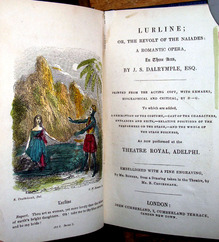
J.S. Dalrymple, Lurline, or, The Revolt of the Naiades: a Romantic Opera, in Three Acts (London: J. Cumberland, [1835?]). Frontispiece by C.W. Bonner, after a design by Robert Cruikshank. Graphic Arts Collection (GA) Cruik R 1830.9
nyts.jpg

Was there an argument about which articles to run above the fold?

The Caudle History: A Droll Game

| No Comments
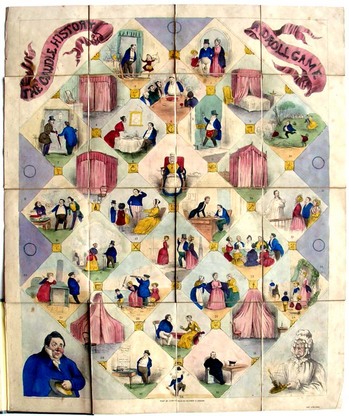
caudle1.jpg

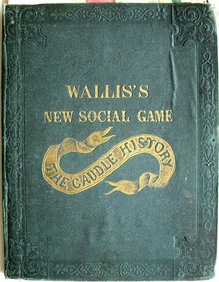
Douglas William Jerrold (1803-1857), The Caudle History: a Droll Game (London: Edward Wallis, 1845-47?). Also called Wallis’s New Social Gamer, the Caudle History. Designed and lithographed by G. E. Madeley, 3 Wellington Street on the Strand. Graphic Arts GAX 2011- in process

caudle2.jpg

From January to November 1845, the British dramatist Douglas Jerrold published a humorous series of monologues entitled Mrs. Caudle’s Curtain Lectures each week in Punch magazine. The garrulous character of Mrs. Caudle was an immediate hit with the British public. Theatrical presentations of the lectures followed, along with volumes of collected Lectures published in Great Britain and in the United States. To further capitalize on the enormous success of Jerrold’s series, a satirical board game was released.

Composed of thirty-four hand-colored panels, the game follows closely on the thirty-six chapters or lectures published in Punch. There are six bed and five wedding ring squares that might set a player back. On square thirty-three, Mr. Caudle is dressed in mourning over the loss of his wife but in square thirty-four he is jumping for joy on the winning panel.

Introduction: “Poor Job CAUDLE was one of the few men whom Nature, in her casual bounty to women, sends into the world as patient listeners. He was, perhaps, in more respects than one, all ears. And these ears, Mrs. Caudle … took whole and sole possession of. They were her entire property; as expressly made to convey to Caudle’s brain the stream of wisdom that continually flowed from the lips of his wife, as was the tin funnel through which Mrs. Caudle in vintage time bottled her elder wine. There was, however, this difference between the wisdom and the wine. The wine was always sugared: the wisdom, never. It was expressed crude from the heart of Mrs. Caudle who, doubtless, trusted to the sweetness of her husband’s disposition to make it agree with him.”

See also Charles Zachary Barnett, Mrs. Caudle! or, Curtain Lectures! A Dramatic Sketch in One Act, Founded on the Celebrated Series of Papers in “Punch”. The only edition correctly marked, by permission from the prompter’s book … As performed at the London theatres. Embellished with a fine engraving by Mr. T. Jones … (London: J. Duncombe [1845?]). Rare Books: Theater Collection (ThX) TC023 (Playbooks Collection) Box 7

Douglas William Jerrold (1803-1857), Mrs. Caudle’s Curtain Lectures: Delivered During Thirty Years by Mrs. Margaret Caudle (New York: E. Winchester, 1845). Firestone Library (F) PR1105 .H665 v.20

Douglas William Jerrold (1803-1857), Mrs. Caudle’s Curtain Lectures, Illustrated by Charles Keene (New York : D. Appleton, 1866). Graphic Arts Collection (GAX) 2003-0371
japanese cards6.jpg
japanese cards2.jpg
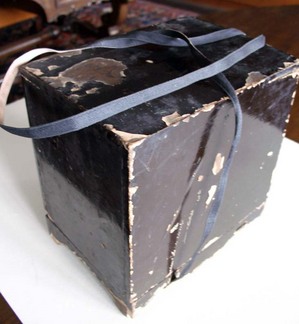
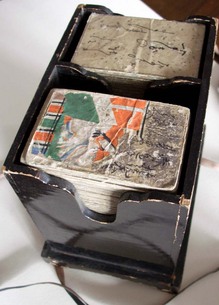
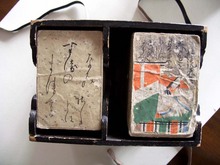
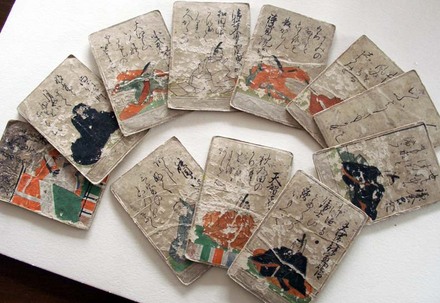
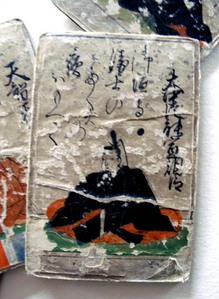
japanese cards.jpg Hyakunin Isshu: Uta Karuta (One hundred poets, one poem each, card game) (Japan: ca. 1850 or earlier). 200 cards in lacquer black box. Graphic Arts GAX 2011- in process.
japanese cards4.jpg
japanese cards3.jpg

Here are the rules, as posted by the University of Virginia:
There are two sets of 100 cards. On one set the complete five-line poems are printed. On the other set only the last two lines (“shimo-no-ku”) of each poem appear. Usually there are two players or sides. Each player takes twenty-five of the shimo-no-ku cards and spreads them in front of him or her. A third person, acting as reader, reads from the cards with the whole poems on them. As the reader reads the first lines of a poem, each of the two players tries to find the card with the corresponding final two lines. The first player to find the right shimo-no-ku card removes it from the playing area. If the card is in the opponent’s area, the player gives one of the cards from his or her own area to the opponent. The first player to get rid of all the cards in his or her own area is the winner.

Very similar to another set in the Cotsen Children’s Library (CTSN): Cards 55195

See also Peter McMillan, One hundred poets, one poem each: a translation of the Ogura Hyakunin Isshu (New York: Columbia University Press, 2008). East Asian Library (Gest): Western PL758.5.O4 A3 2008

French Wrappers

| No Comments
wrappers4.jpg
wrappers2.jpg

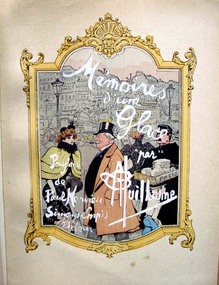
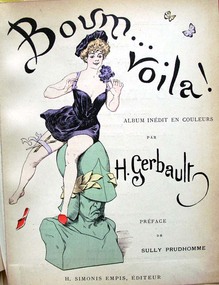
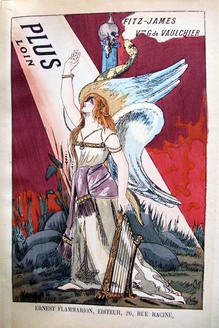
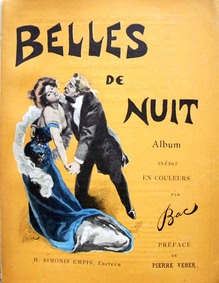
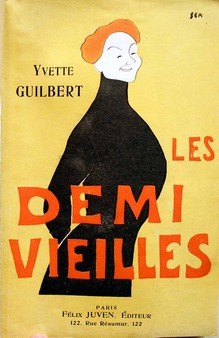
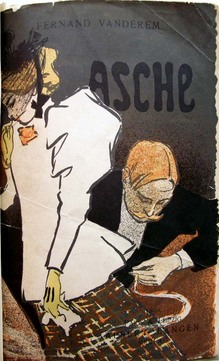
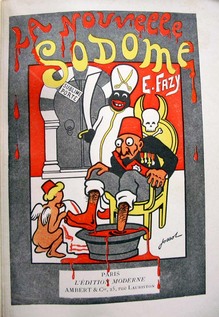
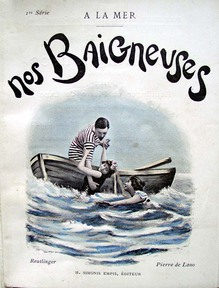
Often when someone buys a new book, the first things they do is throw away the dust jacket or wrapper. Certainly libraries do. This might also help to conceal the subject matter of the book, should your spouse object to particular genres of literature.

One French collector removed but saved the illustrated wrappers and advertising copy from his book collection. Eventually, the wrappers were bound together and are now in the collection of graphic arts. Authors include Guy de Maupassant, Alphonse Daudet, Armand Silvestre, Catulle Mendes, Jules Hoche, Emile Driant, and many others.

wrappers5.jpg
wrappers3.jpg

wrappers6.jpg
wrappers8.jpg
wrappers9.jpg
wrappers1.jpg


A collection of over 200 French illustrated wrappers and publisher’s specimens (Paris, 1882-1907). Graphic Arts 2011- in process.

Round the World with Nellie Bly

| No Comments
nellie4.jpg

J. A. Grozier, Game of Round the World: a Novel and Fascinating Game with Plenty of Excitement by Land and Sea: with Nellie Bly (1864-1922), the World’s Globe Circler (New York: McLoughlin Brothers, 1890). Graphic Arts GAX 2011- in process

nellie3.jpg

nellie2.jpg

On November 14, 1889, investigative journalist Nellie Bly (whose real name was Elizabeth Jane Cochran), began a journey “around the world in eighty days.” Inspired by Jules Verne’s fictitious character Phileas Fogg and financed by the New York World, Bly was challenged to beat Fogg’s time and write about the journey for the newspaper. Over 1,000,000 people entered the newspaper’s contest to guess the time it would take Bly to finish.

On January 25, 1890, she made it back to New York City, beating Fogg in 72 days, 6 hours and 11 minutes. And, like Verne’s hero, her journey was celebrated in a board game.
nellie.jpg

Post-hurricane post: The Wet and Dry Question

| No Comments
wetanddry5.jpg
wetanddry.jpg
wetanddry6.jpg
This just happened to be on my desk when I returned after the hurricane.
wetanddry4.jpg
During the 1910s and 1920s, the S.D. Warren Company produced a number of small brochures and instructional booklets to promote its papermill. Many were designed by Boston artist W.A. Dwiggins (1880-1956), although not the one illustrated here. It is interesting that although trying to be helpful, Warren was the first American paper company to use wood fibers in their products. From wikipedia: "S. D. Warren Paper Mill is a small mill built on the Presumpscot River in the 1730s. . . . In 1867, Warren decided to add wood fibers with rags fibers for paper, making it the first mill in the United States to do so . . . By 1880, the mill produced 35,000 pounds of paper per day. After S. D. Warren's death in 1888, the mill continued to grow through the 20th century, employing close to 3,000 Westbrook residents."
wetanddry3.jpg
wetanddry2.jpg
Read more on the paper industry by John Bidwell: http://www.oakknoll.com/bookexcerpt.php?booknr=52297

Inner Beauty

| No Comments
spine2.JPG

Our rare books conservator, Mick LeTourneaux, shared this with me. He was handed a book to repair: Enrique Udaonda, Diccionario Biográfico Argentine (Buenos Aires: Casa editora “Coni,” 1938). Firestone Non Circulating (Fnc) F2805 .U36.

And found this:

spine1.JPG

Tired of Bridge? Play Dickens

| No Comments
dickens cards3.jpg
dickens cards4.jpg
dickens cards1.jpg

dickens cards2.jpg
Characters from Charles Dickens. A Game. [London, Jaques & Son, ca.1858.] 54 cards (94 × 65 mm).

One of many Victorian card games developed by the firm John Jaques & Son to capitalize on the popular novels of the period. We assume the date of these cards is around 1858, since there is no mention of A Tale of Two Cities (1859), Great Expectations (1861), or Our Mutual Friend (1865). According to the rules, any number can play up to eight. Each of the thirteen “quartettes” of characters equals a suit and when one player collects the whole suit, he gets the “trick.” The first player to get three “tricks” is the winner.

1 2 3 4 5 6 7

Recent Comments

  • John Baky: I was sad to hear this news. I had known read more
  • Linda Felcone: I had the pleasure of taking The Art of the read more
  • John Fleming: I saw Dale Roylance only infrequently since his retirement, but read more
  • Isabel Ribeiro: Thank you for your reply. I would indeed love to read more
  • Isabel Ribeiro: Gorgeous! Is there any way to access the rest of read more
  • S. Scudder: Mary Stilwell is my ggg-grandmother ... thank you for posting read more
  • V.E.G.: James Franklin, Benjamin Franklin's half-brother is a direct descendant of read more
  • Bob Fleck: Nice comments and well worth it. read more
  • N. Sutherland: Do you have any further biographical material on this Thomas read more
  • john W: Have the complete collection of EA Seguy papillons including front read more