Recently in Photography Category

stereocards8.jpg
stereocards5.jpg
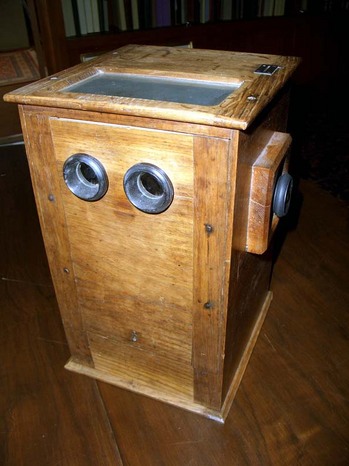
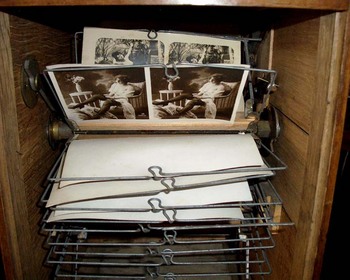
French tabletop stereo viewer, ca. 1890. Graphic Arts (GA) 2011- in process
stereocards2.jpg

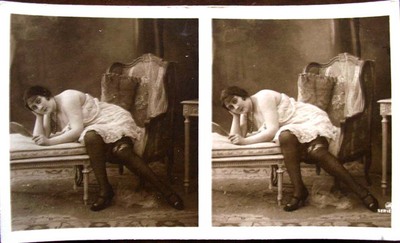
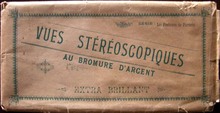
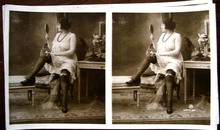
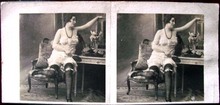
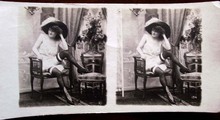
This Visionneuse (viewer) was discovered by Madame Nicole Canet and included in her 2009 exhibition Maison Closes (Brothels) at the Galerie Au Bonheur du Jour, Paris. The tabletop stereo viewer originally sat in the waiting room of a Paris brothel. Gentlemen would drop coins through the top slot and then, turn the right hand knob to view a series of paper stereo cards depicting the pensionnaires travaillant dans la maison (boarders working in the house). Our box holds two dozen cards on a wire frame linked together in a continuous loop. Each coin must have allowed for one sequence through the cards.

In her exhibition catalogue, Canet writes that she attempted “to re-open the doors to these secret houses and hotels, the bordellos and brothels of Paris, which for many years have remained stubbornly closed. The maisons closes are an integral part of the history of Paris from the Belle Époque to the first decades of the twentieth century.”

stereocards6.jpg
stereocards7.jpg

She continues “I opened Au Bonheur du Jour on 13 April 1999, exactly fifty-three years after the law was passed that meant the destruction of the national register of prostitutes and the closure of some 1,400 establishments, 180 of which were in Paris. Coincidentally, the gallery, at number 11 rue Chabanais, is situated just opposite a house, at number 12, where for many years one of the legendary bordellos of Paris operated: Le Chabanais.”

stereocards.jpg
stereocards3.jpg

Our unlabeled viewer, with its simple revolving wire chain, is a late nineteenth-century variation of the Alexander Beckers tabletop viewer. A trained Daguerreian, Beckers worked as a photographer in New York City for many years before he was sidetracked with his inventions. On April 7, 1857, he patented a revolving stereoscope with a metal belt that held up to 144 glass or 288 printed views. Since then, the many variations of his device are often referred to generically as “Beckers.”

Special thanks go to Rubén Gallo, Professor of Spanish and Portuguese Languages and Cultures; and Director, Program in Latin American Studies, for his patient assistance in the acquisition of this historic optical device.

David Octavius Hill and Robert Adamson

| 1 Comment
hilladamson.jpg

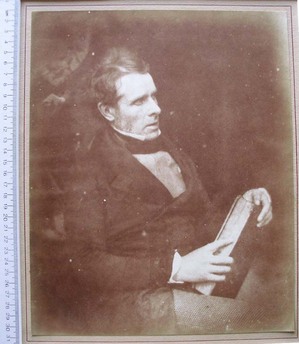
David Octavius Hill (1802-1870) and Robert Adamson (1821-1848), Mr. Alexander Hill, ca. 1845. Salted paper print. GC137 Early Photography Collection. GA 2005.00252
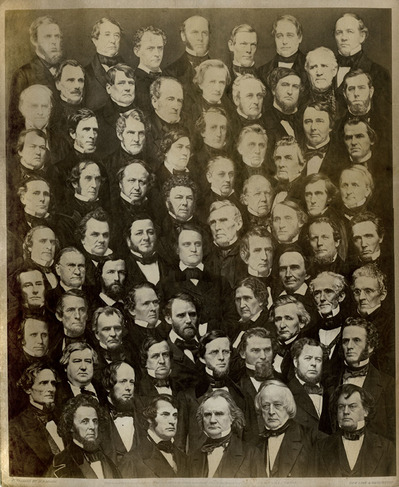
John Szarkowski wrote, “David Octavius Hill was a properly trained painter, a member in good standing of the British art establishment … [who] took up photography (with the assistance of the young chemist Robert Adamson) as a sketching medium, in order to produce likenesses of 470 Scottish clerics [for] a monstrous historical painting …. When the painting was finally finished in 1866, twenty-three years [later], it established Hill as one of the first artists to have converted good photography into bad painting.”

Scottish photographers Hill and Adamson formed a partnership that lasted only four years, from 1843 to 1847, but the art they created represents the best paper photography of that period. They made more than 3,000 photographs and sold the work through David’s older brother, Alexander Hill also known as Bailie Hill (1800-1866), a book dealer, stationer and artists’ colorist (pictured above).

hilladamson2.jpg

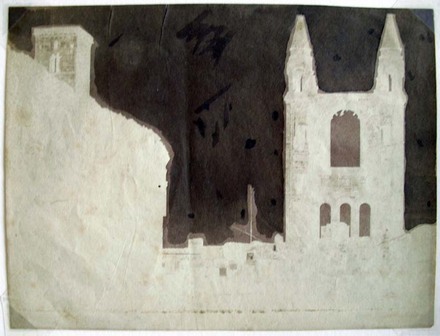
David Octavius Hill (1802-1870) and Robert Adamson (1821-1848), St. Andrews [East Gable End of the Cathedral with Tower of St. Regulus], [1843-1847]. Calotype. GC137 Early Photography Collection. GA 2005.00255


hilladamson3.jpg

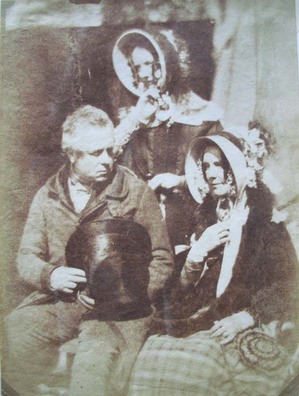
David Octavius Hill (1802-1870) and Robert Adamson (1821-1848), Mrs. Maule, Mr. and Mrs. Hamilton, ca. 1845. Salted paper print. GC137 Early Photography Collection. GA 2005.00254

By 1843, Hill was already an established painter while the twenty-one-year-old Adamson had only just set up shop as Edinburgh’s first professional calotypist. During their brief partnership, Adamson worked the camera and Hill managed the pose. They planned a series of photographic publications including The Fishermen and Women of the Firth of Forth; Highland Character and Costume; Architectural Structures of Edinburgh; Old Castles, Abbeys, &c. in Scotland; and Portraits of Distinguished Scotchmen. Unfortunately, none were realized.

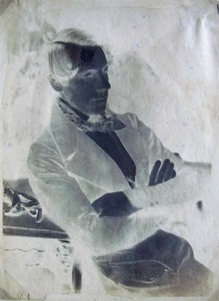
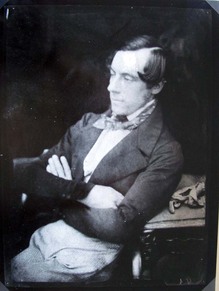
Hill and Adamson are remembered for their calotypes (also called Talbotype after William Henry Fox Talbot), a paper negative that could be used to print multiple positive prints. Strictly speaking, the term calotype refers only to the negative process. Positive prints were made using Talbot’s original photogenic or salted paper process. The negative is developed out chemically (DOP) and the positive print is printed out (POP) by the sun. Whatman’s Turkey Mill paper was a favorite.

hilladamsonneg.jpg
hilladamsonpos.jpg

David Octavius Hill (1802-1870) and Robert Adamson (1821-1848), Portrait of a Dandy, n.d. [1843-1847]. Calotype and contemporary gelatin silver positive. GC137 Early Photography Collection. GA 2005.00243 and GA 2005.00256


hilladamson4.jpg

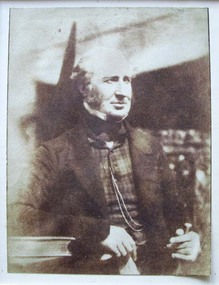
David Octavius Hill (1802-1870) and Robert Adamson (1821-1848), Alexander Earle Monteith, Esq., Sheriff of Fifeshire, ca. 1845. Salted paper print. GC137 Early Photography Collection. GA 2005.00244

hilladamson5.jpg
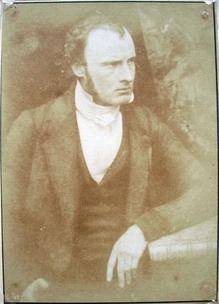
David Octavius Hill (1802-1870) and Robert Adamson (1821-1848), Rev Dr James McCosh (1811-1891) [at this stage Free Church minister of Brechin, and later President of Princeton], 1848?. Salted paper print. GC137 Early Photography Collection. GA 2005.00245


For more information, see:
Sara Stevenson, David Octavius Hill and Robert Adamson: Catalogue of Their Calotypes Taken Between 1843 and 1847 in the Collection of the Scottish National Portrait Gallery (Edinburgh: National Galleries of Scotland, 1981). Marquand SAPH Oversize TR680 .xS3q
and
Sara Stevenson, Hill and Adamson’s The Fishermen and Women of the Firth of Forth (Edinburgh: Trustees of the National Galleries of Scotland, 1991). Marquand SAPH Oversize TR680 .S907 1991

Platinotypes by William Willis

| No Comments
willis1.jpg
willis2.jpg
willis3.jpg
willis4.jpg

In the early nineteenth century, the American author Nathaniel Parker Willis (1806-1867) wrote a travelogue in the London Quarterly under the heading Pencillings by the Way, collected and published in 1835.

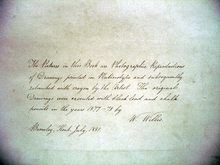
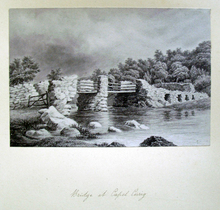
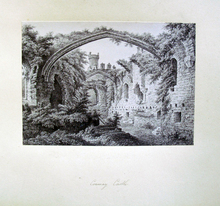
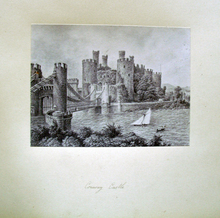
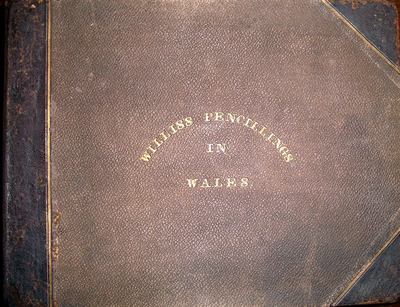
In 1873 William Willis (1841-1923) patented the photographic process he called platinotype and used the popular title for a series of his own pictorial travelogues. In this 1881 album, recently acquired by graphic arts, he writes, “The Pictures in this Book are Photographic Reproductions of Drawings printed in Platinotype and subsequently retouched with crayon by the Artist. The original Drawings were executed with black lead and chalk pencils in the years 1877-78 by W. Willis. Bromley, Kent, July 1881.”

willis5.jpg

William Willis (1841-1923), Willis’s Pencillings in Wales ([Bromley, Kent: Willis], 1881). Graphic Arts GAX 2010- in process

Platinotype is a photographic process using a finely precipitated platinum salt and an iron salt in the sensitizing solution to produce prints in platinum black. Mike Ware describes Willis’s invention in his site Alternative Photography: “Despite the best endeavours of the founders of photography in the 1840’s, nearly fifty years were to elapse before a viable platinum printing process was established by William Willis (1841-1923) who had himself devoted twenty years’ research to perfecting it.”

http://www.mikeware.co.uk/mikeware/Eighth_Metal.html

See also W.Willis, “A Recent Improvement in the Platinotype Process,” Journal of the Camera Club, 2, 47 (1888).

The Mind Unveiled

| 1 Comment
kerlin2.jpg
kerlin1.jpg

Dr. Isaac Newton Kerlin (1834-1893) was the Assistant Superintendent of the Pennsylvania Training School for Feeble-Minded Children from 1856 to 1862, first located in Germantown and then, Elwyn, Pennsylvania. After one year as a medic during the Civil War, Kerlin returned to serve as Superintendent until 1893.

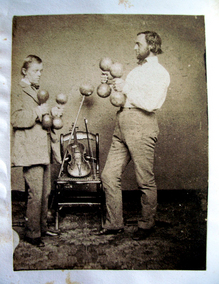
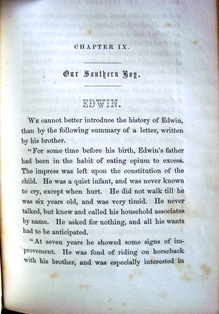
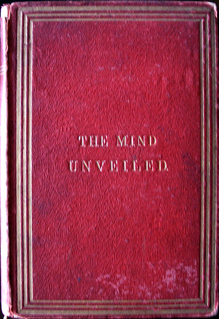
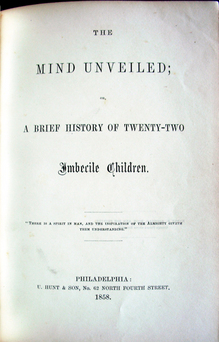
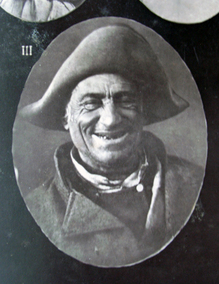
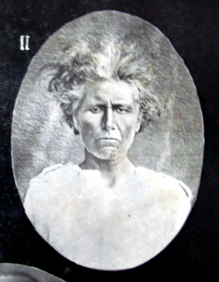
As part of a fund-raising campaign in 1858, Kerlin published The Mind Unveiled, which Weston Naef called “the first photographically illustrated medical book published in the United States.” It is an unscientific chronicle of Kerlin’s early years working with twenty-two of the young adults living at his institution.

Copies of this book vary as to the images and number of plates that are included. A copy at the Houghton Library holds two photographic prints and Yale’s has none. The newly acquired copy at Princeton University has one varnished salt print taken by Philadelphia photographer Frederick Gutekunst (1831-1917).

According to Michael J. Brody, Director of the Marvin Samson Center for the History of Pharmacy, Gutekunst learned to make daguerreotypes from Robert Cornelius, founder of Philadelphia’s first photographic studio. In 1856, Frederick and his brother opened a studio of their own on Arch Street, which is where Kerlin came in 1858 to hire someone to illustrate his text.

kerlin4.jpg
kerlin3.jpg

Isaac Newton Kerlin (1834-1893), The Mind Unveiled; or a Brief History of Twenty-Two Imbecile Children (Philadelphia: U. Hunt & Son, 1858). Graphic Arts GAX 2011- in process

Mental Illness in 1876

| No Comments
dagonet2.jpg
dagonet7.jpg

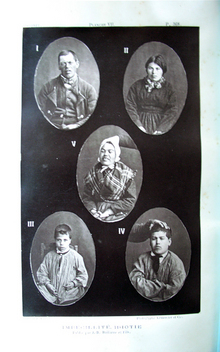
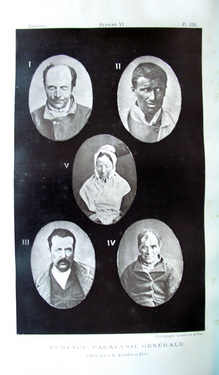
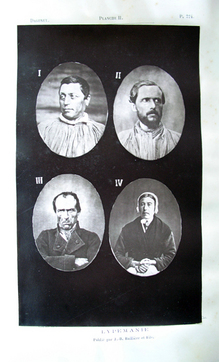
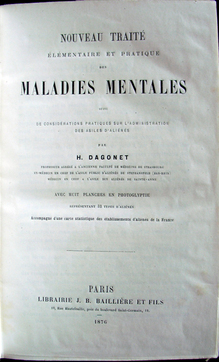
Henri Dagonet (1823-1902), Nouveau traité élémentaire et pratique des maladies mentales, suivi de considérations pratiques sur l’administration des asiles d’aliénés (New Elementary and Practical Treatise on Mental Illness) (Paris: Bailliere, 1876). Graphic Arts GAX 2011- in process.


dagonet1.jpg

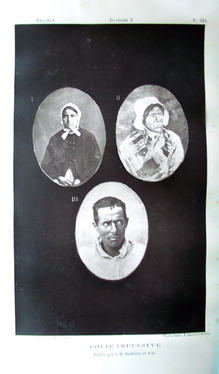
When Henry Dagonet (1823-1902) published his first textbook on mental illness in 1862, he didn’t bother with illustrations. Fourteen years later when a second edition was planned, Dagonet corrected this by contacting photographer J. Valette.

Valette created a series of photoglyptie or woodburytype portraits of Dagonet’s patients at Sainte Anne’s asylum in Paris. The images chosen to be published were meant to represent Dagonet’s classification of nine principle mental disorders: Manie (3 portraits); Lypémanie (4 portraits); Stupidité (5 portraits); Mégalomanie (3 portraits); Folie Impulsive (3 portraits); Démence, grouped with Paralysie Générale (5 portraits); Imbécillité-Idiotie (5 portraits); and Cretinismé (5 portraits).

dagonet6.jpg
dagonet5.jpg


dagonet4.jpg
dagonet3.jpg

Frederick Evans' platinotypes for the Immortal Don

| No Comments
evans4.jpg
Miguel de Cervantes Saavedra (1547-1616), The History of Don Quixote of the Mancha. Translated from the Spanish … by Thomas Shelton, annis 1612, 1620. Introductions by James Fitzmaurice-Kelly, 1896 ([London: privately printed, 1913]). 4 volumes extra-illustrated with 99 platinotypes. Vol. 1 contains an addition title-page: “Illustrations to Cervantes’ Don Quixote by Arthur Boyd Houghton, 1866. Facsimile reproductions in platinotype of Dalziel Brothers’ woodcuts by Frederick H. Evans. Privately printed, MCMXIII.” Graphic Arts GAX 2010- in process.

evans2.jpg
evans9.jpg
This four volume set of Don Quixote belonged to the photographer and bookseller Frederick Henry Evans (1853-1943). The set is extra-illustrated with 99 photographic facimiles of illustrations drawn by Arthur Boyd Houghton (1836-1875) and printed by the Brothers Dalziel (Edward, George, John, Margaret Jane!, and Thomas), the most influential British wood engraving firm in the 1860s and 1870s. Evans made these plates by photographing the ink prints and then, using the negative to make platium (photographic) positives.

evans10.jpg
evans7.jpg
evans3.jpg
evans1.jpg
According to a note from Evans, only three platium prints were made from each negative and then, the negative was destroyed. Evans printed and privately published this edition of three, as he did with a number of classic illustrated books in his personal library. Each volume has two Frederick Evans’ bookplates: one designed by F.C. Tilney and the other an adaptation of the Morte Darthur borders by Aubrey Beardsley (possibly authorized by the artist).

Evans also wrote: “The smaller drawings have been enlarged to make the set uniform in size. These drawings - the most imaginative, respectful and comedically heroic ever made for the immortal Don - have been reproduced in this beautiful photographic process expressly to illustrate the best English translation….”


evans5.jpg
evans8.jpg


And if that is not enough, laid-in is an autographed letter dated 1916, from Charles Ricketts. “Dear Mr. Evans, I remember you quite well and congratulate you on your reproductions of Houghton’s Don Quixote illustrations. …It may interest you to know that Whistler, who admired Houghton greatly, has a special liking for the Don Quixote series which he was the first to bring to my notice. Ever sincerely yours, C. Ricketts”.

http://www.kimeia.com/pdf/history.pdf

Out of darkness, cometh light

| No Comments
expo4

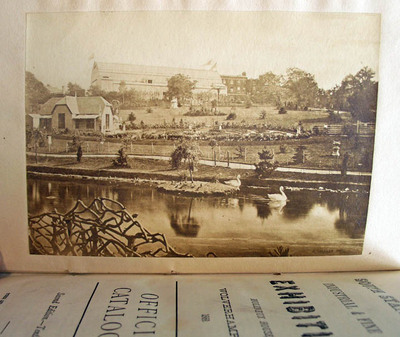
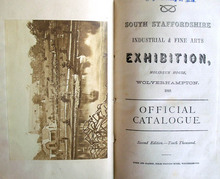
Wolverhampton is an industrial city in the West Midlands of England, in the county of Staffordshire. When I looked it up, I found the motto of the city is “Out of darkness, cometh light.”

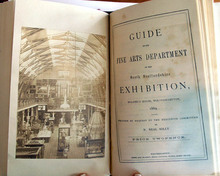
This is significant in that the South Staffordshire Industrial & Fine Arts Exhibition, opening May 11, 1869, highlighted the relatively new art of painting with light, or photography. The catalogue of the exhibition, seen here, featured two original albumen prints trimmed and pasted into every copy. Note that ours is the second edition, tenth thousand issue. Such a large edition was necessary, given the fair welcomed over 200,000 visitors in just five months.

In his opening speech, Lord Granville said “The treasures of art and the products of skilled industry, both past and present, collected within these walls are invaluable by suggesting ideas and planting seeds that should bear good fruit in the future, and instill into their minds a will and taste for the beautiful and the refined.”

expo1
expo3

South Staffordshire Industrial & Fine Arts Exhibition, Molineux House, Wolverhampton, 1869: official catalogue. Second edition, Tenth thousand (Wolverhampton: Steen and Blacket, Steam Printing Works, 1869). Graphic Arts Collection (GAX) 2008-2487N

Exposition coloniale internationale, 1931

| No Comments
1931 expo7a.jpg
1931 expo6a.jpg
1931 expo view.jpg

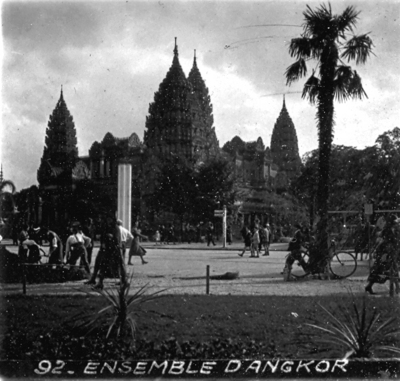
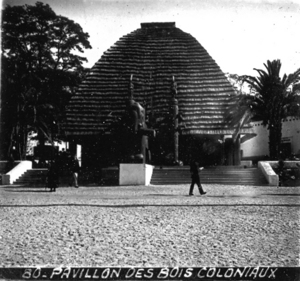
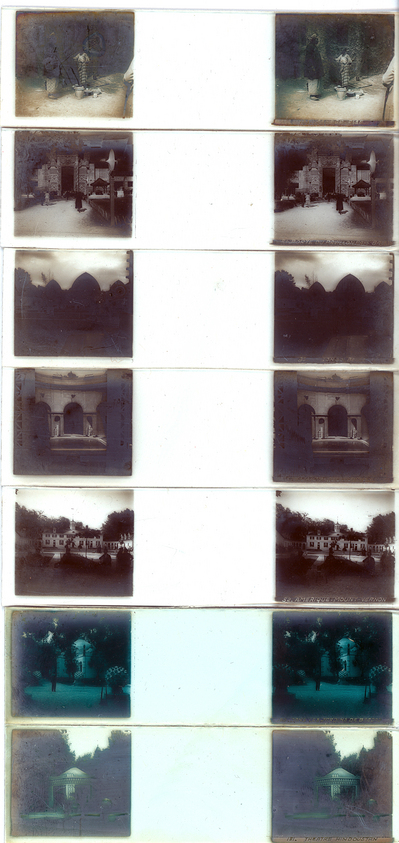
On May 6, 1931, the first of 33,000,000 people walked through the gates of the Exposition coloniale internationale in the eastern suburbs of Paris. The exposition, which continued for six months, included a recreation of Mount Vernon from the United States, along with pavilions from Italy, Japan, and many other countries.

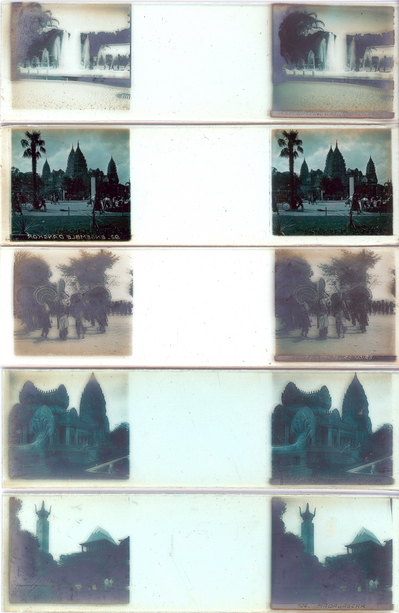
The majority of the expo’s 500 acres of land was used to present the French colonies of the period. Buildings were recreated and native men and women traveled to Paris to perform their music and dance; demonstrate their crafts and foods; and present the customs of their daily life. Particularly popular was a display of an entire tribe of nomadic Senegalese peoples.

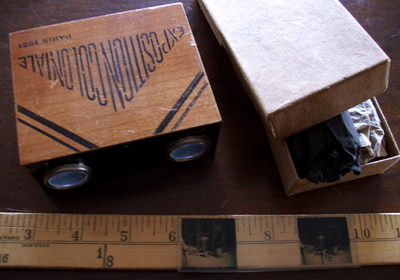
Graphic Arts holds a souvenir stereoscopic viewer with 46 tiny glass slides from the 1931 exposition. Here are a few of the images. I apologize for the quality. The miniature scale (approximately one inch square) and uneven photography means we will have to digitize each image individually, rather than in groups.

Stereoscopic slides and viewer depicting scenes from Exposition coloniale, 1931. GA 2007.04407. Purchased with funds provided by Robert J. Ruben, Class of 1955.
1931 expo8.jpg
1931 expo7.jpg

For more information, see: 1931, les étrangers au temps de l’exposition colonial (Paris: Gallimard: Cité nationale de l’histoire de l’immigration, 2008). Firestone Library JV7915 .A15 2008.

M. Cloche, 60 aspects de l’exposition colonial (Paris: Studio Deberny Peignot, 1931). Marquand Library (SA) Oversize NA6610.C62q

Exposition coloniale internationale: guide offert par les Grands Magasins Au Bon Marché … ([Paris: Au Bon Marché, 1931]) Rare Books (Ex) 2004-2213N

Benoit de L’Estoile, Le goût des autres: de l’exposition coloniale aux arts premiers (Paris: Flammarion, 2007). Marquand Library (SA) T805.1931.G1 L47 2007

Didier Grandsart, Paris 1931: revoir l’exposition coloniale (Paris: FVW, 2010). Firestone Library (F)

Rodolfo Micacchi, Sculptures antiques en Libye; 32 planches avec introduction et texte explicative (Bergamo: Istituto italiano d’arti grafiche [1931]). Marquand Library (SA) NB85 .I67

Patricia A. Morton, Hybrid Modernities: Architecture and Representation at the 1931 Colonial Exposition, Paris (Cambridge, Mass.: MIT Press, 2000). Architecture Library (UES) NA6750.P4 E956 2000

Polyorama Panoptique

| 1 Comment
polyorama
polyorama3
polyorama
polyorama


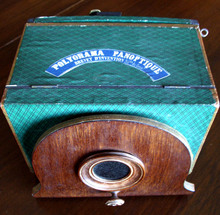
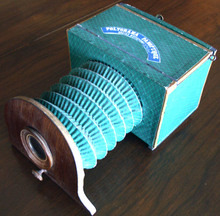
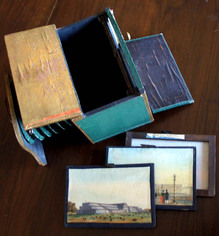
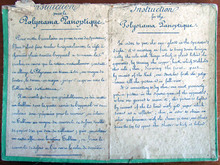
The polyorama panoptique was first sold in 1822 as a souvenir to visitors of the auditorium-size diorama designed by Louis Jacques Mandé Daguerre (1787-1851). Janet Buerger credits the French optician Lemaire with the invention of the toy viewing device. Simply constructed with a wooden frame and paper bellows, the box holds a single hand-colored lithographic slide that has been pierced with small holes and hidden additions of color, which are illuminated when the light source moves from the front to the back.

megalethoscope.jpg

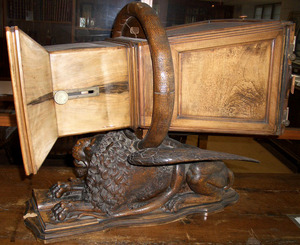
In the 1870s, the Italian opitian Carlo Ponti adapted the device for the viewing of photographic slides. Unlike Lemaire’s simple boxes, Ponti’s megalethoscopes were often resting on elaborate, carved tables or figures, like our winged lion.

Polyorama Panoptique, Paris, ca. 1850. Graphic Arts (GAX) 2010- in process

Frith's Holy Bible

| No Comments
firth holy.jpg

Frith's Holy Bibl

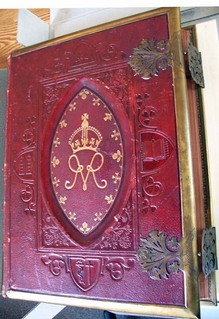
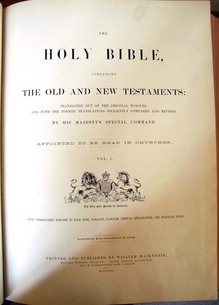
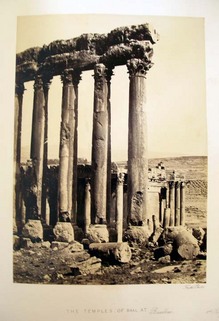
The Holy Bible … Illustrated with Photographs by [Francis] Frith. Glasgow: Printed and published by William Mackenzie, 1862-1863. Albumen silver print. Graphic Arts Collection. Purchased in 2002 with assistance from the Friends of the Princeton University Library in honor of Peter Curtis Bunnell upon the occasion of his retirement as the David Hunter McAlpin Professor of the History of Photography and Modern Art and Faculty Curator for Photography at the Princeton University Art Museum.

Frith's Holy Bible

This is the deluxe (one of three editions) illustrated Holy Bible published by William Mackenzie with fifty-six photographs taken by the British artist and publisher Francis Frith (1822-1898). Our copy is specially bound in red morocco with gilt and blind stamped decorations, and brass mounts and clasps.

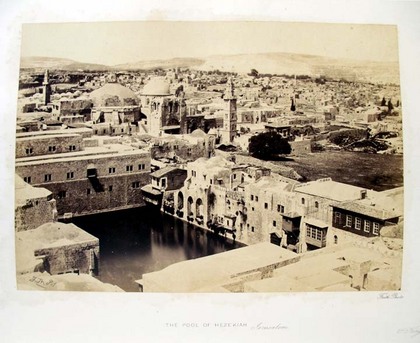
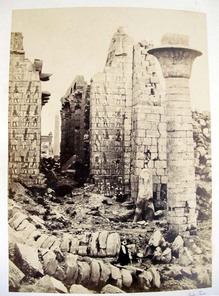
A devout Quaker and a successful grocer, Frith sold his business in 1855 to devote himself to photography. Between 1856 and 1860, he traveled extensively in Egypt, Sinai, Ethiopia, and Jerusalem, documenting Middle Eastern architecture and culture. For these Bibles, the titles of the photographs were changed slightly to better associate them with a particular chapter and verse of the King James text. Because this lavish publication was dedicated to Queen Victoria, who was an amateur photographer and enthusiast, it has become known as the Queen’s Bible.

Frith's Holy Bible

Frith's Holy Bible

Frith’s photographic work is important in both technique and methodology. In the first instance, he used the new wet collodion process that had replaced the paper-based calotype used by earlier travel photographers. The wet plate negatives rendered rich detail and broad tones, and the resulting contact prints on albumen paper rival even today’s gelatin silver papers. Frith’s method was meticulous and thorough; he photographed most of the major monuments several times, and combined general views with close studies of their significant details.

The acquisition of the Queen’s Bible makes Princeton’s collection of Frith’s photographically-illustrated books one of the most outstanding and complete in the United States. It joins Frith’s works: Egypt, Sinai and Jerusalem; Egypt and Palestine; Cairo, Sinai, Jerusalem, and the Pyramids of Egypt; and Upper Egypt and Ethiopia, held by Graphic Arts and his Lower Egypt, Thebes, and the Pyramids, held by the University Art Museum.

Die Olympischen Spiele 1936

| No Comments

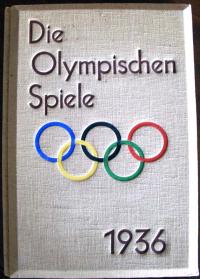
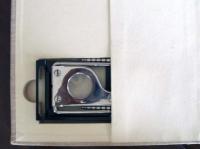
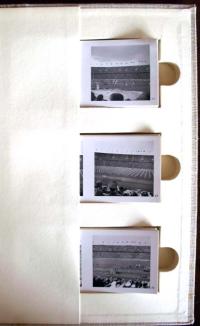
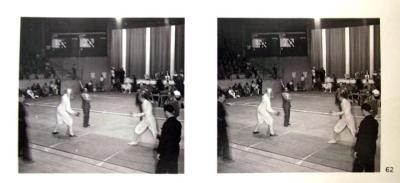
Ludwig Haymann, Die Olympischen Spiele 1936 (The Olympic Games 1936). With 100 stereographs by Heinrich Hoffmann (Dießen/Ammersee: Raumbild-Verlag Otto Schönstein 1936). Graphic Arts GAX 2010- in process

The German artist Heinrich Hoffmann (1885-1957) was the friend and official photographer for Adolf Hitler (1889-1945). He wrote and illustrated a number of books about Hitler, as well as creating propaganda images for the Hitler government.

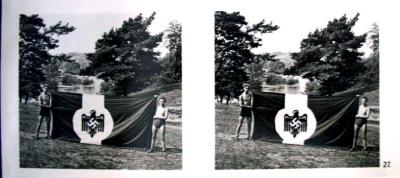
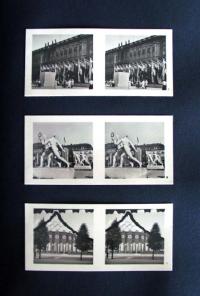
Hoffmann was assigned to document the 1936 summer Olympics in Berlin, at which American athlete Jesse Owens (1913-1980) won four gold medals. This volume presents 100 gelatin silver stereographic photographs of the games pasted to leaves and housed in slots along the back cover. A stereo viewer is inserted at the front.

Readers can view three-dimensional images of the opening ceremonies, the architecture of the Olympic Stadium and Village, Adolf Hitler, marching Hitler Youth, competing athletes, Leni Riefenstahl, and many other recognizable figures at the Olympic Games.

U. S. Navy photographs. The end of World War II.

| 1 Comment

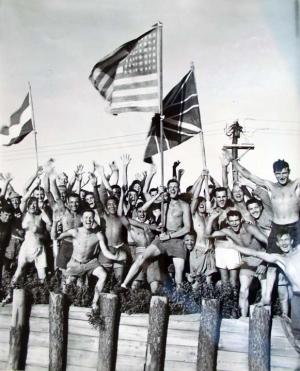
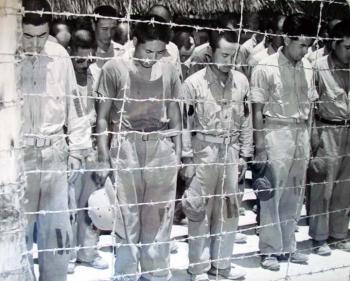
Here are two photographs published by the U.S. Navy photography unit, headed by Edward Steichen, to document the end of World War II.

Top. Allied prisoners of war cheering their rescuers, as the U.S. Navy arrives at the Aomori prison camp, near Yokohama, Japan, on 29 August 1945. They are waving the flags of the United States, Great Britain and The Netherlands. Gelatin silver print. Graphic Arts GA 2010.02142. Gift of Moses Bigelow.

Princeton owns a print of this Official U.S. Navy photograph. The original negative is now in the collections of the National Archives.Photo #: 80-G-490444. Department of the Navy, Naval History Center. 901 M Street SE, Washington Navy Yard, Washington D.C. 20374-5060. For more, see http://www.history.navy.mil/branches/org11-2.htm

Bottom. Japanese Prisoners of War on Guam stand with heads bowed after listening to Emperor Hirohito announce Japan’s acceptance of Allied surrender terms, 15 August 1945. Gelatin silver print. Graphic Arts GA 2010.02141. Gift of Moses Bigelow.

Princeton owns a print of this Official U.S. Navy photograph. The original negative is now in the collections of the National Archives.Photo #: 80-G-490320. Department of the Navy, Naval History Center. 901 M Street SE, Washington Navy Yard, Washington D.C. 20374-5060.

Souvenirs d'Egypte

| No Comments

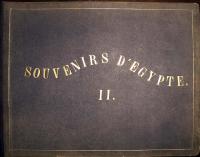
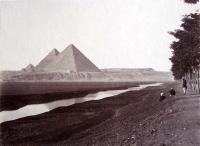
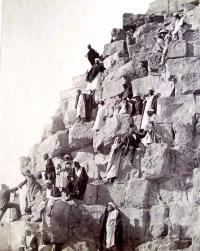
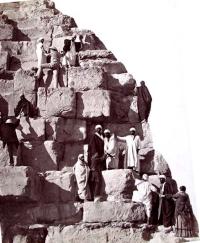
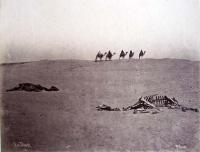
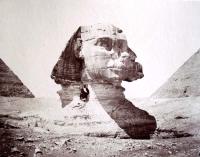
Souvenirs d’Egypte, ca. 1880s. Albumen silver prints. Graphic Arts GAX 2010. in process

Graphic Arts recently acquired a two-volume set of nineteenth-century albumen silver prints, which include the work of Turkish photographer and publisher J. Pascal Sébah (1823-1886) and the French photographer Félix Bonfils (1831-1885), among others. Although the primary focus is Egypt, the album begins with photographs in Venice and takes the viewer on a tourist’s journey to Cairo and then, Constantinople.

The fifty-five photographs, taken in the 1870s and 1880s, include two iconic images of Victorian tourists climbing the Great Pyramid of Khufu (Cheops). The negatives are not signed but they may have been created by Émile Béchard, who worked for the Sébah studio. Note, the printer had one of the glass negative up-side-down and made an image in reverse of the original.

Attribution on these prints is difficult. They can be loosely attributed to the Sébah studio, where tourists could choose from a library of images, which were then printed on demand. The negatives signed “P. Sébah” may have been by Pascal himself while those signed “Sébah” might have been by his brother Cosimi, who ran the studio after 1883. Pascal’s son Jean signed his negatives “J.P. Sébah” and also formed a partnership with the Frenchman Policarpe Joaillier (1872-1947) in the 1890s, publishing as “Sébah & Joaillier.” All negatives were printed and sold for many years with little distinction between vintage prints and those created much later.

See Engin Ozendes, Sébah & Joaillier ‘den Foto Sabah ‘a (Istanbul: YKY, 1999). Marquand Library (SAPH) TR562 .O93 1999

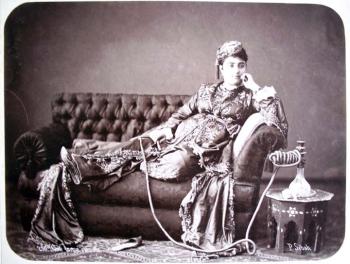
Besides the landscape views, these albums include a number of portraits, believed to have been staged by the Turkish painter Osman Hamdi Bey (1842-1910), who dressed and posed models to form exotic tableaux vivants.

230: Dame turque chez elle [Turkish lady at home], ca. 1870. Albumen silver print.

Kennedy's Anatomy Lesson

| No Comments

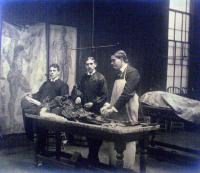
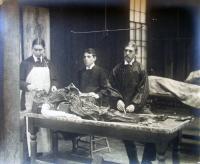
The graphic arts collection holds a large group of early twentieth-century gelatin silver prints by the American photographer Thomas William Kennedy (1837-1923), about whom little has been recorded. Scenes include landmarks in New York City, Washington D.C., Baltimore, New Orleans, and various European cities. Many are occupational studies, such as these two views of an autopsy or anatomy lesson, labeled only Baltimore Hospital.

The three young men pose casually around their work. Two are smoking and one even puts his foot up on the table next to the cadaver. We presume this is a classroom, given the charts on the wall and the age of the doctors. Thank goodness for modern medicine.

Thomas William Kennedy (1837-1923), Baltimore Hospital, [1910s]. Gelatin silver prints. Graphic Arts GA 2010. in process.

Steichen's Navy Photography

| No Comments

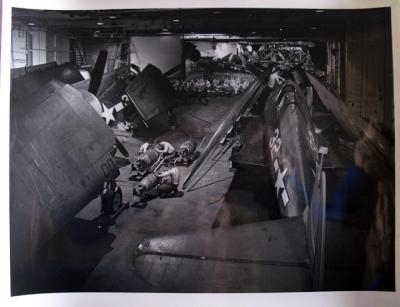
Edward Steichen (1879-1973), Surrounded by Hellcat fighters, ordnancemen work on bombs on the hangar deck of the USS Yorktown. Officers and men in background are watching a movie, ca. 1944. Gelatin silver print. Graphic Arts GC131.

Photographer Edward Steichen was thirty-eight when he joined the U.S. Army’s photography division during World War I. Specializing in aerial reconnaissance, Steichen finished his commission with the rank of Colonel. When the United States entered World War II, Steichen tried to reenlist but, at age sixty-one, he was turned down.

Finally, in 1943, he was asked if he would like to help with the Navy’s effort to recruit young pilots. Steichen was given the title of director of the U.S. Naval Photographic Institute, working as a lieutenant commander in the Naval reserve. He and his hand-picked unit created images of good will and patriotism, with very little evidence of the actual war.

This is one example of his work, depicting soldiers at work making bombs while others watch a movie. For more, see: http://www.archives.gov/research/ww2/photos/

Not Photographs, They Are Parmelian Prints

| No Comments

Is photography over? This is the question posed by a sold-out symposium at SFMoMA later in the month. http://www.sfmoma.org/pages/
researchprojectsphotography_over
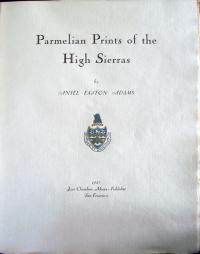
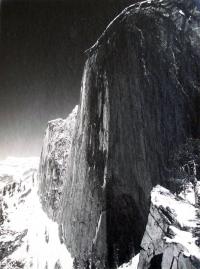
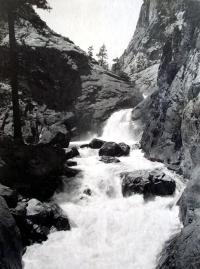
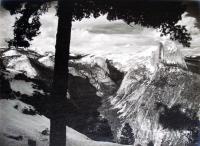
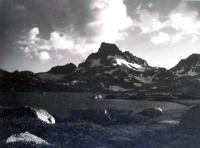
. Those who could not get tickets are voicing their opinions online, filling the listservs and blogs. It reminded me of Ansel Adams (1902-1984) and his first portfolio: Parmelian Prints of the High Sierras (San Francisco: J.C. Moore, 1927).

When Adams met arts patron Albert Bender (1866-1941) and accepted Bender’s help to publish a portfolio of photographs, he also accepted the suggestion to call them “parmelian prints” (a made-up word). Bender felt the label of “photographic prints” would not allow them to be taken seriously as fine art.

Bender immediately committed the money to purchase ten portfolios (priced at fifty dollars each). Then, he got on the phone and sold fifty-six others before lunch. Adams had not even begun working on the prints. Ultimately, Adams produced a set of eighteen photographs: gelatin silver prints printed on Kodak Vitava Athena Grade T Parchment. No matter what they were called, the prints were a spectacular success.

The colophon and folders for the portfolio were printed at Grabhorn Press, in Oakland, California. Princeton University’s copy was donated by Isabel Shaw Slocum as part of the Myles Standish Slocume, Class of 1909, Grabhorn Press Collection. It is personally inscribed to Mr. and Mrs. Slocum from Adams. (WA) Oversize F868.S5 A42q.

African American Portraits, 1860s-1880s

| No Comments

One hope in posting this new collection of, primarily, hand-painted tintype portraits of African American men, women, and children is to have as many people as possible view the images, leading to someone recognizing and identifying the sitters. Could you help us by sharing this with others? To enlarge the image, just click on it.


Unknown sitter, ca. 1880, full-plate tintype


Unknown sitter, ca. 1880, full-plate tintype


Unknown sitter, ca. 1880, hand-colored full-plate tintype


Unknown sitter, ca. 1880, hand-colored full-plate tintype


Unknown sitter, ca. 1880, hand-colored full-plate tintype


Unknown sitter, ca. 1870, hand-colored albumen silver print


Unknown sitter, ca. 1860s, hand-colored salted paper print


Unknown sitter, ca. 1880, hand-colored full-plate tintype


Unknown sitter, ca. 1880, hand-colored full-plate tintype


Unknown sitter, ca. 1880, hand-colored full-plate tintype


Unknown sitter, ca. 1860s, hand-colored salted paper print


Unknown sitter, ca. 1880, full-plate tintype


Unknown sitter, ca. 1880, hand-colored full-plate tintype


Unknown sitter, ca. 1880, hand-colored full-plate tintype


Unknown sitter, ca. 1880, hand-colored full-plate tintype


Unknown sitter, ca. 1880, hand-colored full-plate tintype


Unknown sitter, ca. 1860s, hand-colored salted paper print


Unknown sitter, ca. 1880, hand-colored full-plate tintype


Unknown sitter, ca. 1860s, hand-colored salted paper print in frame


Portrait of Sally Rice, Bourbon, Georgia, ca. 1860s, hand-colored albumen silver print


Purchased with funds from the Graphic Arts Collection, African American Studies, and Women’s Studies.

A good source of information is Stanley B. Burns, Forgotten marriage, the painted tintype & the decorative frame, 1860-1910: a lost chapter in American portraiture (New York: Burns Press, Burns Collection, 1995). Marquand Library (SAPH): Photography, Oversize TR680 .B871 1995q. See their website: http://www.cmp.ucr.edu/exhibitions/forgotten_marriage/

A Talbotype Illustration for the Art-Union

| No Comments

William Henry Fox Talbot (1800-1877) began production of his first photographically illustrated book, The Pencil of Nature, in 1844. The following year Talbot made a deal with Samuel Carter Hall (1800-1889), the editor of the Art Union Monthly Journal, to include one of his paper photographs in every copy of volume 8 (1846). The Art-Union was particularly known for its illustrations (including lithography, etching, engraving, and wood engraving) and Talbot was anxious for paper photography to be seen as equal to these graphic mediums.

To make the approximately 6,000 calotypes for the Art-Union edition, Talbot’s printer, Nicolaas Henneman, used every negative he could find in the shop. More than half of the twenty-four images that are published in Pencil of Nature also turn up in copies of the Art-Union. Unfortunately, Henneman’s print shop was not yet capable of such mass production and poor workmanship resulted. The paper was not properly exposed, not well fixed or washed, and badly pasted onto the magazine leaves. The images faded almost as soon as they were created and the publicity Talbot received was all negative (the image here was Photoshopped so it could be seen). Pencil of Nature ceased production that same year after only six fascicles.

Marquand Library has a complete set of Art-Union, but the talbotype was cut out and taken to the Princeton University Art Museum many years ago (a common practice). We have recently acquired another copy of the 1846 Art-Union with a photograph intact, offering the print as it was originally meant to be seen.

For more, see the wonderful Glasgow Library page: http://special.lib.gla.ac.uk/exhibns/month/Feb2007.html

Victor Hugo

| 1 Comment


Gustave Brion (1824-1877), Illustrations to “Les Misérables,” of Victor Hugo. Scenes and Characters Photographed by A. A. Turner, after the Original Designs of G. Brion (New York: Carleton, 1863 [c1862]). Graphic Arts Collection (GAX) 2003-0617N

This is a volume of illustrations published without the novel they illustrate.

In 1840, the French painter and illustrator Gustave Brion (1824-1877) joined the studio of the portrait and history painter Gabriel-Christophe Guérin (1790-1846). He then earned his living mainly by teaching, drawing, and copying paintings. In the summer of 1850 Brion moved to Paris, where he took a studio in a house shared by Realist artists. He exhibited regularly but little of his work has been remembered by historians. Brion’s most notable project came in 1862, when he created portraits of the characters in Victor Hugo’s novel Les Misérables.

Brion’s paintings were photographed by the American artist Austin Augustus Turner (ca. 1831-1866) and the albumen prints were pasted onto printed mounts for this volume. Note the extreme warping as the photograph, the paste, and the paper all age at different rates.

The earliest information on Turner has him employed as an operator at the photography gallery of B.F. Campbell in Boston, Massachusetts. By 1854, he moved to New York City, where he worked at Mathew B. Brady’s photography gallery for a brief period. After stays in Paris, Boston, and Lynchburg, Virginia, Turner finally resettled in New York where he established a business in partnership with D. Appleton & Company specializing in photolithography. It is around this period that he received the commission to photograph Brion’s paintings of Les Misérables, published first by Pagnerre in Paris and two months later by Carleton in New York.

Flaubert did not care for Hugo’s novel but Baudelaire’s review for Le Boulevard was quite positive. To read it, see: http://www.biblisem.net/etudes/baudmise.htm. Since the first illustrated edition of Les Misérables in 1862 there have been many reprints. Several Paris editions, 1870 and 1879 in particular, used etchings of Brion’s painting for illustrations.

"Un Eldorado aux enfers," A Hold-To-Light Photograph

| 1 Comment

“Un Eldorado aux enfers,” number 22 from a set of Stereo-Diableries (Paris, 1870s?). Graphic Arts GA 2005.01266. See more at: http://www.visual-media.eu/diableries.html

Engraved scenes that could be viewed through a set of lenses were a popular phenomenon in eighteenth century. The prints or vues d’optique were designed with an enhanced perspective so that, when viewed with a zograscope or in peep show boxes, the scene appeared to be three-dimensional. To further enhance the views, lights, stars, candles, or other bright parts of the image were pricked with a needle so that when the print was lit from the back, the picture turned into a nighttime scene. Colors were also painted on the back of the print, which were only visible with back lighting.

Once photography was invented, pricked or back-lit views continued to be made using photographs. Carlo Ponti (1823-1893), in particular, developed the megalethoscope for viewing pricked photographs with both front and back lighting so that the image appeared to shift from day to night. Stereoscopic views were invented by Charles Wheatstone (1802-1875) in 1840 but were not mass produced until the 1860s. The fanciest stereos, such as these, were pricked and had a second layer of tissue with added color. These elements were only visible when the stereo holder was pointed at the window or a candle. It is interesting here to look at the cards both with and without back lighting.

Graphic Arts also holds a complete set of La Biche au bois (The Doe in the Forest). Twelve stereoscopic views (Paris: Actualites de Theatre, after 1865). Graphic Arts 2005.01264-2005.01276

These “hold-to-light” stereoscopic photographs show scenes from the light opera: La biche au bois (5 acts, by the Cogniard Brothers), in Porte Saint-Martin, 1865. Katherine Singer Kovács commented on a performance of La Biche au bois in an article about the early filmmaker Georges Méliès:

An extremely successful feerie called La Biche au Bois contributed to this trend. In this work by the Cogniard brothers grotesque and comic forms were introduced on a large scale. Prior to this time (1845) characters in feeries had confined their travels to allegorical or mythological lands, in the heavens or beneath the seas. This all changed with La Biche. In addition to investigating these conventional locales, characters in La Biche au Bois explore new domains, such as the kingdom of bells, the kingdom of fish, and the kingdom of vegetables where they talk with fruits and vegetables of colossal dimensions. Each of these tableaux contains a grotesque ballet in which men dress as animals and the intention is comic.

Katherine Singer Kovács, “Georges Méliès and the ‘Féerie’,” Cinema Journal, 16, no. 1 (Autumn, 1976): 1-13.

See also: Jac Remise, Diableries: la vie quotidienne chez Satan à la fin du 19e siècle (Paris: Balland, 1978). Interlibrary loan for now.

1 2 3 4 5 6

Recent Comments

  • Elizabeth Van Riper: Thank you for sharing this wonderful tribute to Ulli Steltzer. read more
  • Jonathan Greene: I am trying to reach any member of Eric Sackheim's read more
  • eric adler: I am interested in the issue #2 31 Aug 1919. read more
  • Luffy: Quelle chance d'être tombé sur ce rare album ! Puis-je read more
  • Sigrun Siladji: I have got a set of these Wellington Picture Medals read more
  • Melvin Franklin: Thank You !!! I'm one the kids that Ulli helped. read more
  • Shortshanks: Of course this print was actually a direct copy of read more
  • pamela wesson: Thanks for this. Joe was an important figure to me read more
  • Sarah: Thank you for posting these - I've never seen grotesquerie read more
  • Wendy Hodgden: I have two signed etchings By Brouet that I inherited read more