Recently in Photography Category

Cincinnati photographer James Landy

| No Comments

James Landy (1838-1897), Cincinnati Past and Present: or, its Industrial History, as Exhibited in the Life-Labors of its Leading Men (Cincinnati: Printed by the Em Street Printing Co., 1872). Graphic Arts GAX 2009-0858N

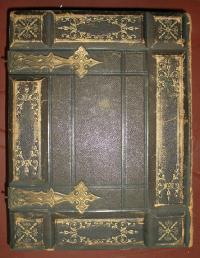
Each volume of this biographical series on prominent Cincinnati men contains 125 albumen silver prints. Photographer James Landy said he spent over two years making the nearly 70,000 prints that were required for the whole edition.

In an interview with Landy, published in the Commercial Gazette (January 26, 1896) just a year before his death, Landy discussed his life and work:

“During my career as photographer I have met hundreds of men and women, who were or are still prominent in politics, or in the professions, and I could tell you many an interesting reminiscence. My collection of portraits of celebrities, taken during the last thirty-five years, numbers many hundreds, and at present I am at work cataloguing them. They will be exhibited some time this year.”

Mr. Landy has been exceptionally successful during his career, and many are the acknowledgments of the superiority of his artistic work which have been awarded to him. His series of seven photographs, representing Shakespeare’s “Seven Ages,” has become famous all over the world. A set of these pictures, tastefully framed, adorns the walls of the Shakespeare Memorial Library in Stratford-on-Avon, and a handsome letter of thanks from the Shakespeare Memorial Association is in Mr. Landy’s possession, and treasured highly by him.

At many exhibitions valuable prizes have been awarded to Mr. Landy for his excellent and artistic work. At the Chicago Exhibition of the Photographers Association of American, in 1887, he was awarded the Blair Cup for his “Man, Know Thy Destiny,” and at the Convention in 1888, in Minneapolis, his “Hiawatha” again won him the Blair Cup.

Thanks to Gary W. Ewer for finding the quote.

Fredericksburg architecture

| 1 Comment

Graphic Arts GC216 Civil War Photographs

These two half stereos are part of a large collection of Civil War photography given to the Graphic Arts Division by Augustin J. Powers, through Charles Powers, Class of 1938. All were published by the Brady National Photographic Art Gallery (Washington, D.C.), although no individual photographers are credited.

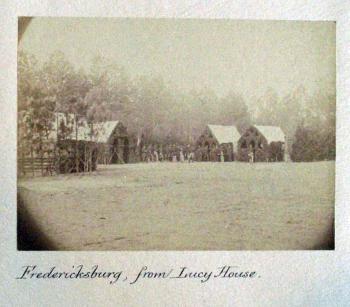
We know very little about the odd structures seen here, beyond the few words written below. They were built near the estate known as Chatham or the Lacy House, which overlooked the Rappahannock River and Fredericksburg, Virginia. We know that near the main house were dozens of supporting structures, although we have yet to find images of any other elaborate sod houses such as these.

During the American Civil War the house’s owner, James Horace Lacy, enlisted as a Confederate soldier. While he was away, the Union army took over his estate and used it as their headquarters. Then in November 1862, General Ambrose E. Burnside crossed the Rappahannock River below Chatham, seized Fredericksburg, and attacked Robert E. Lee’s Confederate camp. Burnside’s army lost, suffering 12,600 casualties in the battle. Chatham was turned into a temporary hospital. For several days army surgeons operated on hundreds of soldiers inside the Lacy House, assisted by such eminent volunteers as poet Walt Whitman and Clara Barton, who later founded the American chapter of the Red Cross.

Photographer Timothy O’Sullivan is known to have visited and photographed Chatham in March 1863 and may be the author of these images. If anyone knows more, please let us know. For more about the Lacy House, see http://www.nps.gov/frsp/chatham.htm

British Officer's photography album, part two

| No Comments

In the previous post, we described the first section of a nineteenth-century photography album compiled by a British Army officer, attributed to be the Army surgeon Alexander Dudgeon Gulland, MD Edinburgh University. The second section of the album includes photographs of the Indian Northwest Frontier Hazara Campaign (1867-1870) and others taken in Malta, Ireland, Guernsey, Spain, and elsewhere.

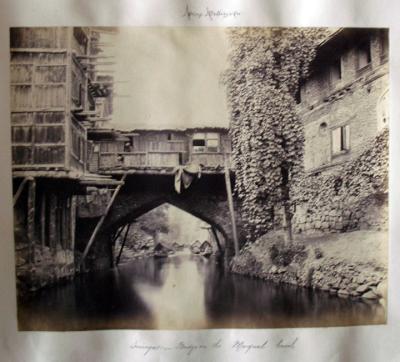
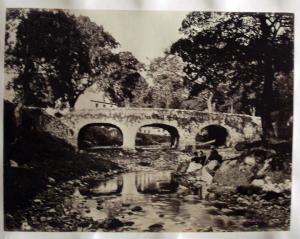
After the Jamaica photography, the album moves on to India and includes 32 photographs of Kashmir and the Northwest Frontier, in particular 8 fine photographs of Kashmir by the British photographer Samuel Bourne (1834-1912). The Bournes are numbers 792, 805, 815 (prize-winning photograph Srinagaar a Bridge on the Margual Canal above), 782, 776, 261, 818, and one titled Glimpse through the Forest.

There are also group portraits of the Sixth Royal Regiment, all annotated with names, including one with Gulland as a blurred figure at the edge of the frame, perhaps suggesting he was the photographer and moved into the frame at the last minute? A two-part panorama of the camp of the Hazara Field Force includes notes on all the batteries and contingents of Sikh, Gurkha, and Punjabi troops as well as men from the Maharaja of Cashmere and the Nawab of Ulm. The British recognized that collaborating with native troops was an essential part of sustaining the campaigns they had to fight to keep India.

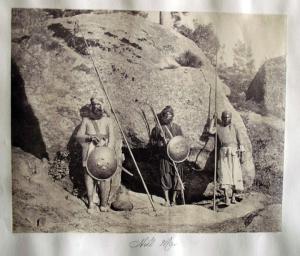
There are also two striking and unusual images: one is of Hill Men in chainmail armour; and the other of what is noted as The Attack on Mhunnah-Ka-Dhunnah showing a cannon ball arching through the air and landing on a hillside. The other areas included in the album are mainly ports and bases used by the British Army and Navy. Most of these photographs are by commercial studios, which indicates that Gulland, like many nineteenth-century tourists, bought photographs of the places he visited.

One of 5 views of Malta is by Giorgio Sommer (1832-1914) and taken around 1860-1865. Among the 20 of Ireland are 12 large blind-stamped views and 3 others by William Lawrence. One of the 19 views of Guernsey is a mammoth print of the Harbour and Castle Cornet, most unusual for the time, and the views of Gibraltar and Spain are from Francis Frith’s Series.

This album is still being processed but will soon be available for research in the reading room of Rare Books and Special Collections, Firestone Library. Special thanks go to Katherine Spears who did the majority of the research on this unique album.

On October 11, 1865, several hundred native Jamaicans marched into the town of Morant Bay, the capital of the predominately sugar-growing parish of St. Thomas, to demonstrate against injustices. Several members of the crowd, on both sides, were killed. In the days that followed, the British Army was called in and over 500 people were murdered along with hundreds wounded.

We recently acquired an album with 165 rare albumen photographs: 59 of the Morant Bay Rebellion in Jamaica (1865), 32 photographs of the Indian Northwest Frontier Hazara Campaign (1867-1870), and 64 others depicting Malta, Ireland, Guernsey, and elsewhere. The prints are primarily by unidentified amateur photographers, although there are 8 by Samuel Bourne, 5 by G. Sommer, 3 by William Lawrence, several by Francis Frith.
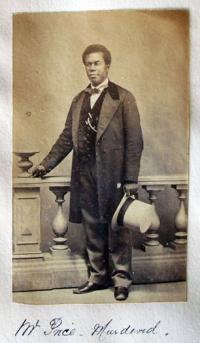
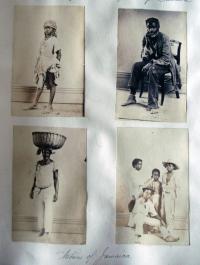
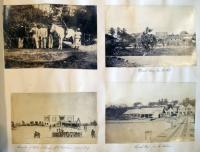
This post will describe the 59 photographs relating to the 1865 Morant Bay Rebellion and future posts will deal with the other sections. The album’s careful compilation includes detailed notes of the people, places, and dates relevant to each photograph. It may be the work of a surgeon in the British Army, Alexander Dudgeon Gulland, MD Edinburgh University, who appears in the album. Appointed Staff Assistant Surgeon in 1854, he served with the 6th Foot which was in Jamaica in 1865 and is listed as having been in China from 1860-62 and Hazara in the Northwest Frontier in 1868 (See: Hart’s Army Lists and Returns Relating to Medical Officers (Army) 1854). The Jamaica section of this album begins with photographs of the Morant Bay military base including a view from the Surgeon’s Quarters and general views of the area to set the scene.

My thanks to Dr. Mimi Sheller, Professor of Sociology, Director, Center for Mobilities Research and Policy Department of Culture and Communication Drexel University, for the following summary of these events.

The events at Morant Bay in 1865 followed on the heels a period of public meetings known as the Underhill Meetings, and peaceful expression of grievances through petitions. Complaints included a series of economic issues related to wages, land tenure, access to markets, and labor rights; political issues related to unfair taxation, no justice in the courts, and elite-biased government policies; and civil issues that included voting rights, and access to healthcare, education, and land. In that sense it was not a riot so much as a social movement, which was rejected by the Governor and finally turned to violence against the representatives of the local government.

Here is a basic description of the facts of what took place before the government sent in military reinforcements to “suppress” the rebellion. During a trial for trespass held in the Morant Bay Court House on the 7th of October 1865, James Geoghagan disrupted proceedings by shouting that the defendant should not have to pay the costs. He was ordered out of the court. When he did not go quietly the Judge ordered his arrest. However, his sister Isabella challenged the police, and when they got outside a “mob” including the Native Baptist deacon Paul Bogle and some of his followers from the hamlet of Stony Gut rescued him from the police. The following day the police went up to Stony Gut to arrest those involved, but the policemen were instead captured and made to swear an oath to “cleave to the black”. To continue reading Dr. Sheller’s description, click on the extended entry link below.
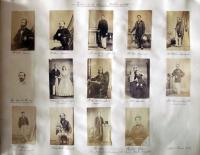
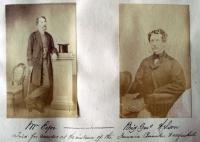
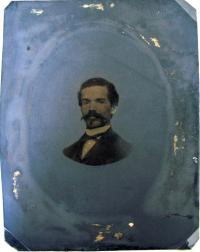
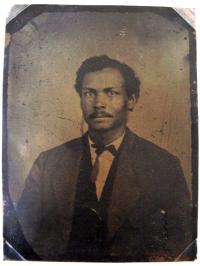
Portraits of key figures from the rebellion tell more of the story. Among them are a page of portraits of “The Victims of the Jamaica Rebellion of 1865”, a portrait of George William Gordon who is now considered a Jamaican national hero, portraits of unidentified Jamaican natives, and of British Army officers. Listed among the victims are not only those who were murdered but also those in the colonial government who were later tried for murder and acquitted.

It is probable that these portraits were gathered after the rebellion and some may have been taken by the only commercial studio we can identify in Jamaica at the time, run by Adolphe Duperly (1801-1865) and taken over by his son, Armond.
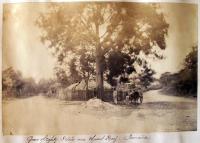
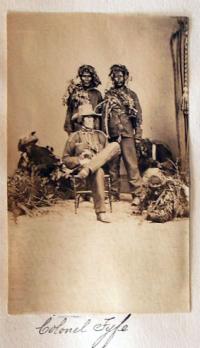
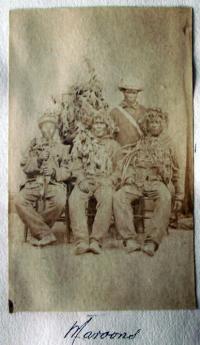
Two small photographs of Jamaican Maroons, including one of Maroons in camouflage with Colonel Fyfe, reflect an interesting social dynamic in the rebellion. Originally runaway slaves who set up communities that engaged in guerrilla warfare against the British, the Maroons eventually cooperated with the British authorities after they started to deport them and confiscate their land in 1796. Used to suppress slave revolts until 1838, they were also used to suppress the 1865 rebellion.

For more information, see “The Town of Morant Bay, Morant Bay, Jamaica,” Harper’s Weekly, December 23, 1865.

“Morant Bay, Jamaica, the Scene of the Negro Insurrection,” The Illustrated London News, November 25, 1865.

Gad Heuman, The Killing Time, The Morant Bay Rebellion in Jamaica (London: Macmillan, 1994) Firestone F1866.H48 1994b

Arvel B. Erickson, “Empire or Anarchy: The Jamaica Rebellion of 1865,” The Journal of Negro History, 44, no. 2 (April 1959): 99-122.

Henry Bleby, The Reign of Terror: a Narrative of Facts concerning Ex-Governor Eyre, George William Gordon, and the Jamaica Atrocities (London: s.n., 1868). Firestone HF 1569.E53
World War I book drive

| No Comments

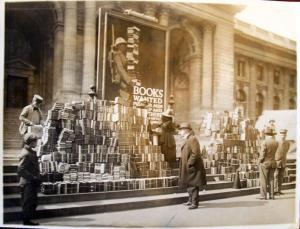
The caption on the back of this photograph states: “The New York Public Library steps are much used now. Books in the centre and at the right [is] the tent where purchasers of War Savings Stamps gained a look at a new Brow[n]ing gun.” The poster seen in the back, designed by Charles Buckels Falls, ca. 1918 reads: Books Wanted For Our Men in Camp and ‘Over There’. Take your gifts to the public library.

Graphic Arts photography collection GA 2009 -in process

Hindenburg presenting medal to Richthofen

| 1 Comment
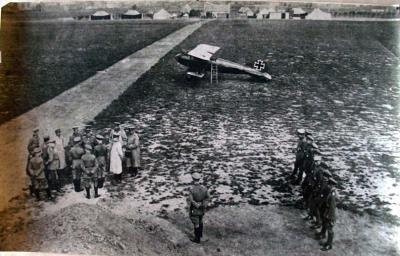
Unidentified photographer, Hindenburg presenting medal to Richthoven, 1917. Gelatin silver print. GC131 Photography. Gift of Paul van Dyke (1859-1933)

The German aviator Manfred von Richthofen (1892-1918), also known as the Red Baron, was the commander of a World War I squadron dubbed The Flying Circus. Together, they shot down eighty-nine British airplanes from 1916 to 1917, when Richthofen was finally wounded. This 1917 photograph shows Richthofen receiving a medal from Paul von Hindenburg, while Erich Ludendorff watches. His red Albatros D.III is seen in the background.

The following is a portion of Richthofen’s book Der Rote Kampfflieger, from the English language version translated by J. Ellis Barker and published in 1918 under the name The Red Battle Flyer.

I Am Shot Down. (Middle of March, 1917)
I was flying with the squadron and noticed an opponent who also was flying in a squadron. It happened above the German artillery position in the neighborhood of Lens. I had to fly quite a distance to get there. It tickles one’s nerves to fly towards the enemy, especially when one can see him from a long distance and when several minutes must elapse before one can start fighting… We Germans had five machines. Our opponents were three times as numerous. The English flew about like midges. It is not easy to disperse a swarm of machines which fly together in good order. It is impossible for a single machine to do it. It is extremely difficult for several aeroplanes, particularly if the difference in number is as great as it was in this case. However, one feels such a superiority over the enemy that one does not doubt of success for a moment.
I watched whether one of the fellows would hurriedly take leave of his colleagues. There! One of them is stupid enough to depart alone. I can reach him and I say to myself, “That man is lost.” Shouting aloud, I am after him. I have come up to him or at least am getting very near him. He starts shooting prematurely, which shows that he is nervous. So I say to myself, “Go on shooting. You won’t hit me.” He shot with a kind of ammunition which ignites. So I could see his shots passing me. I felt as if I were sitting in front of a gigantic watering pot. The sensation was not pleasant… But suddenly I heard a tremendous bang, when I had scarcely fired ten cartridges. Presently again something hit my machine. It became clear to me that I had been hit or rather my machine… I went right down.
Instinctively I switched off the engine and indeed it was high time to do this. When a pilot’s benzine tank has been perforated, and when the infernal liquid is squirting around his legs, the danger of fire is very great. In front is an explosion engine of more than 150 h. p. which is red hot. If a single drop of benzine should fall on it the whole machine would be in flames. I left in the air a thin white cloud. I knew its meaning from my enemies. Its appearance is the first sign of a coming explosion. I was at an altitude of nine thousand feet and had to travel a long distance to get down.

This photograph was gift from Dr. Paul Van Dyke (1859-1933) class of 1881 and professor of Modern European History. He also donated a album of photographs taken by Lt. Edward C. Olds, class of 1909, during World War I. Manuscripts collection MSS CI199 (no.803).

Notable Women, too

| No Comments

Notable Women [London, no. 1, 1890-no. 4, 1891]. Graphic Arts GAX 2009-0236Q

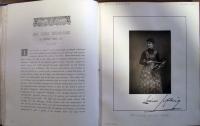
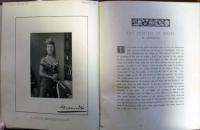
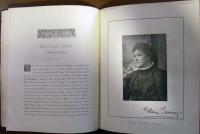
Although publications such as Men of Mark (posted below) celebrate only men, women had their own share of bio-journals in the late 1800s. Notable Women is one example. Each issue includes 3 original mounted carbon prints by commercial photographers Alexander Bassano (1829-1913), Elliot & Fry, Winslow and Grove, and others. Princeton holds four issues, which include flowery biographies for the sitters Alexandra, Princess of Wales; Lady Dorothy Nevill; Mrs. Arthur Stannard (John Strange Winter); Lady Brooke; Mrs. Louise Jopling-Rowe; Mrs. Campbell Praed; Lady Hallé (Norman Neruda); Miss Ellen Terry; Mrs. Lynn Linton; Lady Algernon Borthwick; Lady Monckton; and Miss Jessie Bond.
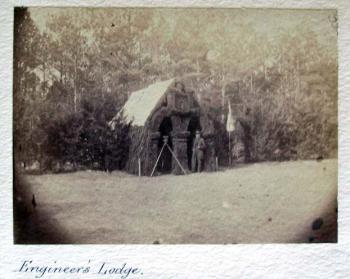
Less grand in their format but with better information are: Notable Women Authors of the Day; Biographical Sketches, by Helen C. Black, 1893, Firestone Library (F) 3565.183
Notable Women in History; the Lives of Women Who in All Ages, All Lands and in All Womenly Occupations Have Won Fame …, by Willis J. Abbot, 1913 Firestone: CT3203 .A2

Men of Mark

| No Comments

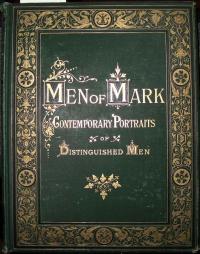
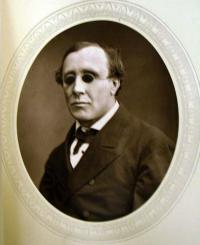
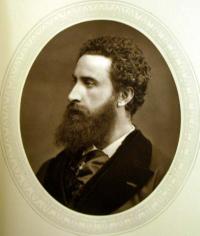
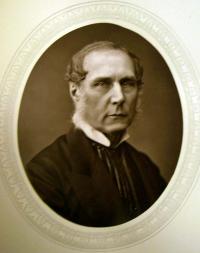
Thompson Cooper (1837-1904), Men of Mark, a Gallery of Contemporary Portraits of Men Distinguished in the Senate, the Church, in Science, Literature and Art, the Army, Navy, Law, Medicine, etc. [Woodburytyped] from Life by Lock and Whitfield (London: S. Low, Marston, Searle and Rivington, 1876-1883). Graphic Arts Collection (GAX), Oversize 2003-0077Q vol.1-7


The credit for this seven-volume set of photographic portraits is often given to Thompson Cooper, a journalist for the London Times who wrote the brief biographical entries. However, the title page lists Samuel Robert Lock (1822-1881) and George Carpe Whitfield (born 1833), the names of the photographers first and gives only a lesser mention to Cooper. Even today, scholarly respect for images is almost always less than that for words.

From 1876 to 1883, Lock and Whitfield produced a volume of 36 oval woodburytype portraits each year. Each original print had to be individually printed, trimmed, and tipped onto the page, so that for a run of 200 copies at least 7,200 prints had to be produced. Lock died in 1881, leaving Whitfield to complete the project alone.

Lock and Whitfield formed a partnership in 1856, operating out of a studio at 18 Regent Street in London. Lock specialized in painted miniatures and Whitfield in albumen photographs. Their advertisement read: “carte de visite and every description of photograph, colored or uncolored, on paper, ivory or porcelain.”

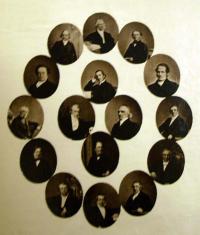
Graphic Arts holds a complete, immaculate set of Men of Mark, which came with an additional group of loose albumen prints inside the first volume. In particular, three composite sheets each hold sixteen circular miniature portraits (one shown here).

Lincoln's Funeral

| 2 Comments
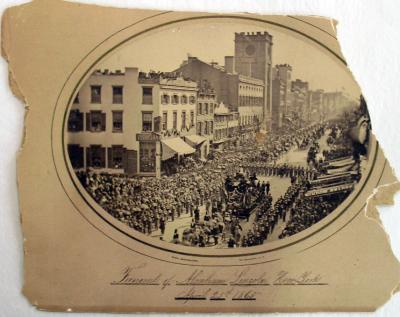
Photographer unknown, Funeral of Abraham Lincoln New York, April 25th 1865. Albumen silver print. Graphic Arts division GA2009- in process

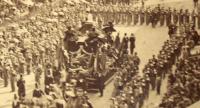
When President Abraham Lincoln (1809-1865) was assassinated, his body was carried by train and by carriage through 180 cities before reaching Springfield, Illinois, where it was buried. The route passed through New Jersey and Princeton students are reported to have stood in silence as it passed. The train stopped briefly in New Brunswick and Newark, before the body was transferred to a ferry, which carried it from Jersey City to New York City.

Once in NYC, the casket remained at City Hall Park all day and through the next morning, when it was loaded into a glass-sided hearse pulled by sixteen horses and taken to the Hudson River Railway Depot at 10th Avenue and 30th Street. This albumen photograph taken on April 25 shows the procession moving up Broadway, just south of Astor Place. The Church of the Messiah (Unitarian) is seen at the center of the frame.

The platform of the hearse was fourteen feet long, eight feet wide, and five feet from the ground, so the crowds could see the coffin through the glass. The New York Times’ Henry J. Raymond wrote that “the hearse, drawn by six [sic] gray horses, heavily draped in black, took its place in the procession, headed by General [John A.] Dix and other officers, escorted by the Seventh Regiment, and the whole cortege moved, through densely crowded streets and amidst the most impressive display of public and private grief, to the City Hall.” (Henry Raymond, The Life of Abraham Lincoln, John Shaw Pierson Civil War Collection W96.587.75.3)

Brady's National Portrait Gallery

| 7 Comments
Albert Berghaus, M.B. Brady’s New Photographic Gallery, corner of Broadway and Tenth Street, New York. Wood engraving published in Frank Leslie’s Illustrated Newspaper, January 5, 1861. Graphic Arts GA2009-in process

In 1860, the celebrated American photographer Mathew Brady (1822-1896) opened his fourth and last New York studio at 785 Broadway, near Tenth Street. He named it the National Portrait Gallery and it was here in 1862 that Brady exhibited photographs of the Battle of Antietam. Brady advertised the exhibition as “The Dead of Antietam,” and it was the first time the bodies of contemporary dead soldiers were seen by the general public. An extended biography of Brady can be found at http://memory.loc.gov/ammem/cwphtml/cwbrady.html

Portrait photograph album, [186-?]. 125 photographs (122 albumen carte-de-viste and 3 tintypes). Graphic Arts Collection (GAX) Oversize 2007-0513Q

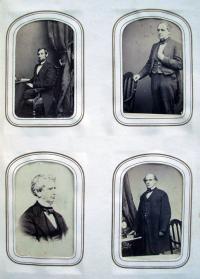
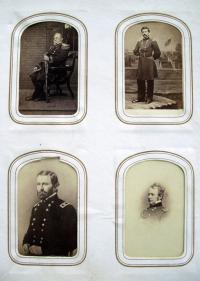
Many of Brady’s commercial prints can be found in this photography album in the graphic arts collection. It holds a collection of studio portraits, primarily during the American Civil War, along with a visiting card for Charles Lamson, which might be a clue to the original owner. Several CDVs bear the imprint “Brady’s National Photographic Portrait Galleries” or “published by E. & H.T. Anthony from photographic negative in Brady’s National Portrait Gallery.”

There are individual portraits of Abraham Lincoln and his cabinet members: Hannibal Hamlin, Vice President; William Seward, Secretary of State; Salmon P. Chase, U.S. Treasury Secretary; Edwin M. Stanton, Attorney General (1860-1861), Secretary of War; Gideon Welles, Secretary of the Navy; Montgomery Blair, Postmaster-General; and Edward Bates, Attorney General (1861-1864).

Also included are portraits of Union generals Ulysses S. Grant; Ambrose Burnside; Nathaniel P. Banks; Winfield Scott; Joseph Hooker; Edwin Vose Sumner; Benjamin Franklin Butler; and Daniel E. Sickles. Some of the other individuals identified includes portraits of Jefferson Davis, Thomas J. “Stonewall” Jackson, Henry Wadsworth Longfellow, Henry Ward Beecher, and Richard Cobden.

In particular, three photographs are by Chas. Paxson, N.Y. and J.E. McClees, Philadelphia with the verso caption: “The nett proceeds from the sale of these photographs will be devoted to the education of Colored people in the department of the Gulf, now under the command of Maj. Gen. Banks.” One photograph bear captions: “Rebecca, A slave girl from New Orleans”; one is titled: “Charley, A slave boy from New Orleans.”

The photographers represented in the album include Mathew Brady; Chas. Paxson, NY; J.E. McClees, Philadelphia; Charles Fredericks; Hargrave & Gubelman, NY; LeRoy’s Gem Gallery, Newburgh, NY; W. Notman, Montreal; D. Appleton & Co., NY; Geo. G. Rockwood & Co., NY; Golder & Robinson’s Ferrotype Rooms; H.S. Myer, Yonkers, NY; Brasier & Co., Brooklyn; Johnston Brothers, NY; Faris, 751 Broadway; W. Kurtz; Sarony, NY; New Orleans Photographic Gallery, A.A. Turner, photo.; Tourtin, Paris; Norman May, Malvern; Scidmore, Gloversville, NY; Martin Jacolette, South Kensington.

Writers at Onteora Park

| 1 Comment
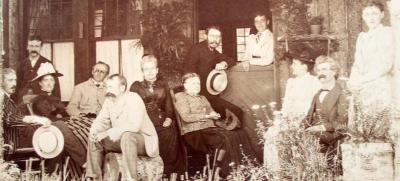
Photographer unknown, Group of Laurence Hutton’s friends, 1890. Albumen silver print. Gift of Laurence Hutton. Graphic Arts GA 2009- in process

In the summer of 1890, Samuel Clemens (second from the right), his wife Livy, and their three daughters rented a cottage called The Balsam at Onteora Park. Twain’s good friend and literary editor of Harper’s Magazine Laurence Hutton (fifth from the left) and his wife were also in residence.

Onteora Park was the first of several private communities built in the Catskills during the 1880s as a summer residence for artists, writers, and select wealthy families. Candace Wheeler (center chair) and her brother, Frank Thurber, bought the land and founded the colony, which quickly developed into a lively seasonal community. Clemens famously did not finish a single story that summer, although he did have his portrait painted by Carroll Beckwith (far left). There was an orchestra to play during meals and at the dances in the evenings. There were theatrical productions in which everyone took a role, as well as pantomimes, charades, and stories told by firelight.

That summer frequent dinner parties moved between the Clemens and Hutton cottages, such as the one that brought these men and women together. Several prints of this photograph were made and the individual sitters signed each of the mounts. For whatever reason, the print at Princeton (donated by Hutton) is missing one signature, which is present in other published examples.

Those who did sign include painter James Carroll Beckwith (1852-1917); W.F. Clarke; Mary Elizabeth Dodge (1830-1905); Lillie Hamilton French (1854-1939); Laurence Hutton (1843-1904); Brander Matthews (1852-1929); Richard Heber Newton (1840-1914); Samuel Clemens (Mark Twain, 1835-1910); Onteora’s founder Candace Wheeler (1827-1923); Dora Wheeler (1849-1916).

Egypt, Sinai, and Jerusalem

| No Comments
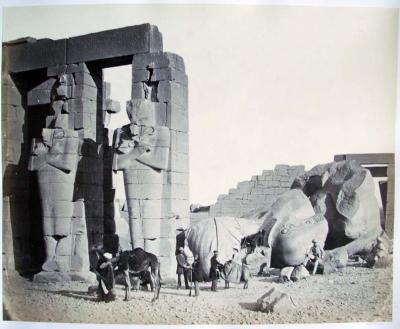
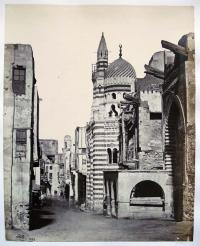
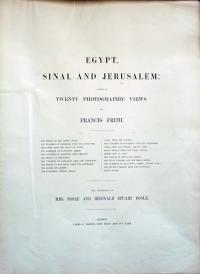
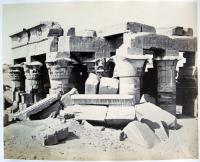
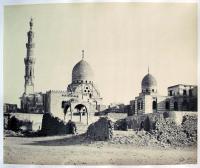
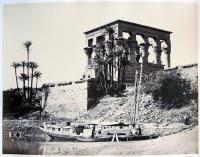
Francis Frith (1822-1898), Egypt, Sinai, and Jerusalem: a Series of Twenty Photographic Views; with descriptions by Sophia Lane Poole (1804-1891) and Reginald Stuart Poole (1832-1895) (London: James S. Virtue, [after 1858]). 20 albumen silver prints, sheet: 53.3 x 73.6 cm. Graphic Arts Collection (GAX) Oversize 2004-0006E

Francis Frith collaborated with a lecturer and scholar of antiquities at the British Museum, Reginald Poole, and with Poole’s mother, Sophia, to produce this mammoth album of photographs. It is interesting that at the same time, Sophia’s brother Edward W. Lane (1801-1876), a scholar of Oriental linguistics, was working with Reginald on an illustrated edition of the Arabian Nights (The Thousand and One Nights, a new translation from the Arabic, with copious notes by Edward William Lane; illustrated … by William Harvey; edited by his nephew Edward Stanley Poole, 1859. Rare Books (Ex) 2263.2869).

The Poole’s had spent over seven years living and working in Egypt, and were fluent not only with the languages of the region but the history and culture. Frith on the other hand made only three trips to the area—1856-57, 1858, and 1859—passing through some cities only once. His objective was to capture photographic images that could be reproduced in many formats and sold as widely as possible. In this, he certainly succeeded.

In the beginning, Frith contracted with Thomas Agnew and Son to sell individual prints made from 16 x 20 inch negatives and with James S. Virtue to publish groups of photographs in a series of albums. Negretti and Zambra handled the stereoscopic views sold both individually and in sets. In addition, Frith formed his own company, F. Frith & Co. to sell his own work and the photographs of others, specializing in scenic travel views, which were of great interest to the British public. Frith built the largest photographic archive in Great Britain and then, in the 1880s, handed the business over to his sons and moved to a villa along the French Riviera to write his memoirs.

To see more of Princeton’s holdings of Frith albums and photographs, continue below.

Walt Whitman

| No Comments

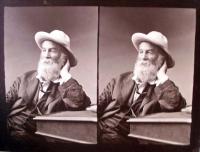
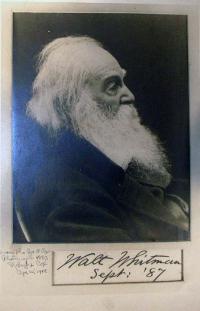
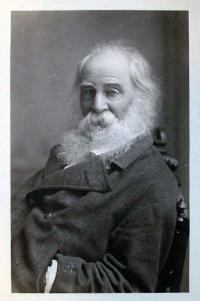
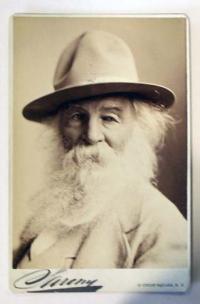
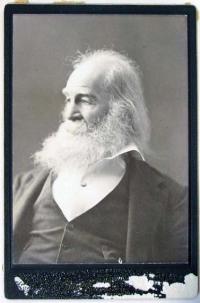
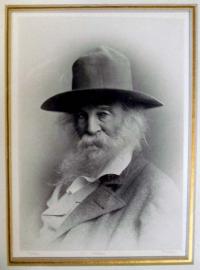
In the first edition of Walt Whitman’s Leaves of Grass (1855), a wood engraving after a daguerreotype portrait of the author was published as a frontispiece, although the author’s name was left off the title page. Whitman (1819-1892) was one of the first writers to understand the importance of the new medium of photography for the promotion of his work and his own celebrity. This appreciation continued throughout his life and made Whitman one of the first authors to be known as much for his image as for his words.

The Library of Congress holds over 100 individual portrait photographs of Whitman, the earliest from 1848. Princeton University has its own smaller collection, with some as loose prints and others bound into volumes of his poetry. These are a few.


Selection from Song of Myself

I know perfectly well my own egotism,
Know my omnivorous lines and must not write any less,
And would fetch you whoever you are flush with myself.

Not words of routine this song of mine,
But abruptly to question, to leap beyond yet nearer bring;
This printed and bound book—but the printer and the printing-office boy?
The well-taken photographs—but your wife or friend close and solid in your arms?
The black ship mail’d with iron, her mighty guns in her turrets—but the pluck of the captain and engineers?
In the houses the dishes and fare and furniture—but the host and hostess, and the look out of their eyes?
The sky up there—yet here or next door, or across the way?
The saints and sages in history—but you yourself?
Sermons, creeds, theology—but the fathomless human brain,
And what is reason? and what is love? and what is life?

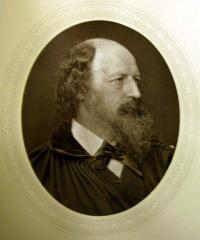
Julia Margaret Cameron and Alfred Lord Tennyson

| 2 Comments

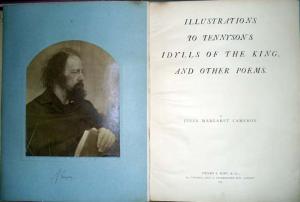
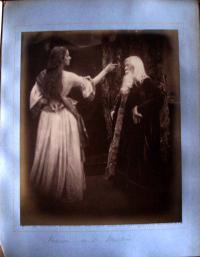
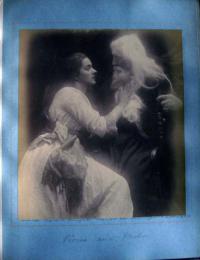
Julia Margaret Cameron (1815-1879), Illustrations to Tennyson’s Idylls of the King, and other poems (London: Henry S. King, 1875). volume 1, 12 albumen silver prints. Graphic Arts Collection (GAX) Oversize 2007-0055F. Purchased with David H. McAlpin Fund of the Art Museum, Friends of the Library Fund, and the Elmer Adler Memorial Fund. 1974.


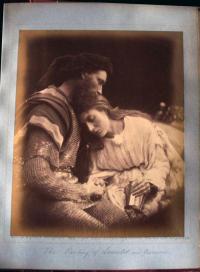
“The Parting of Sir Lancelot and Queen Guinevere,” 1874. Albumen silver print. Idylls of the King and Other Poems


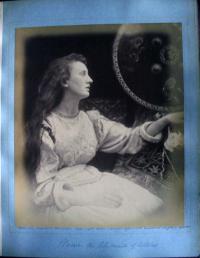
“Elaine, the Lily Maid of Astolat,” 1874. Albumen silver print. Idylls of the King and Other Poems

“Vivien and Merlin,” 1874. Albumen silver print. Idylls of the King and Other Poems

“Vivien and Merlin,” 1874. Albumen silver print. Idylls of the King and Other Poems

In the summer of 1874, Julia Margaret Cameron (1815-1879) was living next door to Alfred Lord Tennyson (1809-1892) at Farringford, Freshwater, on the Isle of Wight. Tennyson had taken “Morte D’Arthur” published in 1842 and expanded it into “Idylls of the King” in 1859. He asked Cameron to make illustrations for a new publication of these poems and she produced over 200 prints from wet-plate collodion-on-glass negatives. Unfortunately, the publisher chose only two to be reformatted as wood-engravings and even those did not reproduce well in the final book.

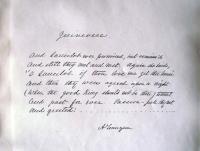
At Tennyson’s encouragement, Cameron went on to produce a book of her own with albumen silver prints interspersed with texts by Tennyson lithographed from Cameron’s hand-writing. The first volume appeared in January 1875 and the second in May, selling for six guineas. The frontispiece for each volume was a portrait of Tennyson dressed as “The Dirty Monk,” dated 1869.

Cameron wrote, “My aspirations are to ennoble Photography and to secure for it the character and uses of High Art by combining the real and ideal sacrificing nothing of Truth by all possible devotion to Poetry and beauty.”

Alfred Lord Tennyson (1809-1892), Idylls of the King (London: E. Moxon, 1859). Contents: Enid. - Vivien. - Elaine. - Guinevere. PUL nine copies available

Travels amongst the Todas

| No Comments

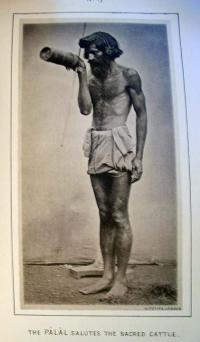
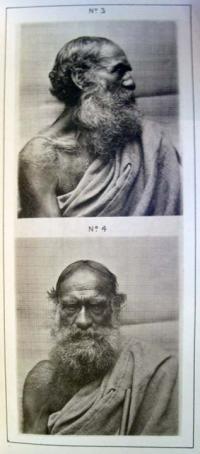
William Elliot Marshall, Lieutenant Colonel of Her Majesty’s Bengal Staff Corps, was an amateur ethnographer. He was introduced to the Todas people, who lived on the Nilgiri Hills in southern India, while on a furlough to Ooty. Although he did not speak their language, Marshall decided to study the small tribe in order to uncover physiognomic proof of their “primitive nature.”

His final report was published in two similar editions, one titled A Phrenologist amongst the Todas and the other Travels amongst the Todas or the Study of a Primitive Tribe in South India. Both are illustrated with 14 carbon prints from glass negatives. At least two of these plates are from the Simla photography firm Bourne & Shepherd (founded by British photographers Samuel Bourne 1834-1912 and Charles Shepherd) and printed by the Autotype Fine Art Company.

Bourne and Shepherd sold their business in 1870 and Bourne returned to England (although their stock of glass negatives remained in circulation for many years). The images of the Todas are clearly made from life and so, must have been taken a number of years before Marshall’s book was finally published in 1873.

William E. Marshall, Travels amongst the Todas, or The Study of a Primitive Tribe in South India (London: Longmans, Green, 1873) “A brief outline of the grammar of the Tuda language by the Rev. G.U. Pope … From a collection of Tuda words and sentences presented by the Rev. Friedrich Metz”: p. [239]-269. Graphic Arts Collection (GAX) 2006-2348N

For more information, see Kavita Philip, Civilizing Natures : Race, Resources, and Modernity in Colonial South India (New Brunswick, N.J.: Rutgers University Press, c2004). Firestone Library Q127.I4 P48 2004

Home and Haunts of Shakespeare

| 2 Comments

James Leon Williams (1852-1932), The Home and Haunts of Shakespeare (New York: C. Scribner’s sons, 1892) Graphic Arts (GAX) oversize 2009- in process


American born dentist Dr. James Leon Williams (1852-1932) moved to London in 1887. He spent summers in Stratford-on-Avon making photographs and printing the negatives as photogravures. In 1890, his first project matched these gravures with the poem “Elegy Written in a Country Churchyard” written by Thomas Gray (1716-1771). Boston publisher Joseph Knight brought it out in a small edition.

Two years later, Williams followed this with a massive folio entitled The Home and Haunts of Shakespeare published by Charles Scribner’s Sons in New York. Reproductions of 15 watercolors by 15 different American artists are completely overshadowed by Williams’ 45 pictorialist gravures. The New York Times published a review before the book was even finished, crediting Williams with reviving America’s interest in Shakespeare.


Berenice Abbott (1898-1991)

| No Comments
Robert Benchley?, no date. Graphic Arts American Photography, GC131

Berenice Abbott (1898-1991) moved to New York City in 1918 at study sculpture. Her work caught the attention of Marcel Duchamp (1887-1968), who commissioned a chess set and introduced her to his circle of friends. Abbott moved to Paris in 1921, Berlin in 1923, and back to Paris in 1925, where she convinced Man Ray (1890-1976) to give her a job as his assistant. Man Ray specifically wanted someone who knew nothing of photography and Abbott fit the description. Over the next four years, she learned enough to have an exhibition of her own and return to New York as a professional.


Bar 228, no date. Graphic Arts American Photography, GC131

Mary Muller’s Shop, no date. Graphic Arts American Photography, GC131

Back in NYC, Abbott emulated her favorite Paris photographer Eugene Atget by documenting the “Changing New York” under the support of the Federal Art Project. A book of the same title was published in 1939. Although the NYC images shown here were not part of the official published series, they were taken around the same time.

Magnetic Field (current-bearing wire and steel filings), ca. 1959-60. Graphic Arts American Photography, GC131

Magnetic Field (key and iron filings), ca. 1959-60. Graphic Arts American Photography, GC131

Parabolic mirror, 1959-60. Graphic Arts American Photography, GC131

Abbott became interested in the connection between art and science and worked from 1944-45 as photography editor for Science Illustrated. “There is an essential unity,” she wrote, “between photography, science’s child, and science, the parent.” In 1958, Abbott joined the MIT-initiated Physical Science Study Committee of Education Service’s Inc. based in Cambridge, Massachusetts. She made images to demonstrate the laws and processes of physics. An exhibition of these photographs for PSSC were toured by the Smithsonian Institution in 1960 and published in three books from 1964 to 1969: Magnets, Motion, and The Attractive Universe (Gravity).

See also: Museum of the City of New York “Berenice Abbott’s Changing New York” (1998). http://www.mcny.org/collections/abbott/abbott.htm

New York Public Library, http://digitalgallery.nypl.org, with nearly 600 images by Abbott.

Adler's Pynson Printers Photographed by Ralph Steiner

| No Comments

Born in Rochester N.Y., Elmer Adler (1884-1962) reluctantly joined the family clothing business as advertising manager and designer. In his spare time, he collected books and taught himself the importance of great typography, paper, and binding. In 1920, the Rochester Memorial Art Gallery opened an exhibition entitled “The History of the Art of Printing,” curated by Adler primarily from his own collection (catalogue available full-text on google).

Less than two years later, Adler packed up his books and moved to New York City where he organized a printing company of his own, The Pynson Printers. As a long-time member of The Stowaways, a private club for men involved in graphic arts, he was already acquainted to many of the leading printers and publishers in New York. His friend Arthur Hays Sulzberger (1891-1968), son-in-law and heir to the publisher of The New York Times, invited Adler to move the business into the spacious new Times Annex at 229 West 43rd street. Adler’s rooms consisted of a printing shop with three presses, a library, an exhibition gallery (opened to the public in 1938), and offices elegant enough to hold afternoons teas for his colleagues. He was proud to say “in the eighteen years of its existence Pynson Printers charged more than any other shop in the country and never made a profit.”

These photographs of Adler’s rooms at 43rd Street were taken by Ralph Steiner (1899-1986). The year Adler moved to NYC, Steiner had graduated from Dartmouth and was finishing an extra year studying at the Clarence White School of Photography. Steiner got a job making photogravure plates at the Manhattan Photogravure Company, until he had enough commissions to work as a freelance advertising photographer.

It is no wonder Adler chose Steiner. Considered one of the best modern art photographers of the period, Steiner worked primarily in advertising photography, in a precisionist style. Adler thought so much of Steiner’s work that he gave the artist an exhibition in the Pynson gallery in 1930.

Steiner began moving into film in the late 1920s, first with the avant-garde short H2O edited by Aaron Copeland (available through the media lab or online through Youtube. This was followed by Redes/The Waves with Paul Strand; Pie in the Sky with Elia Kazan; and The Plow that Broke the Plains with Strand and Pare Lorentz. Two years later, Steiner and Willard Van Dyke founded American Documentary Films and collaborated on The City, shown to acclaim at the 1939 New York World’s Fair.

In 1940, Adler and Steiner both left New York; Adler for Princeton University and Steiner for Hollywood.

Photoxylography and Timothy Cole

| No Comments
Timothy Cole (1852-1931), Abraham Lincoln, 1928. Wood engraving. Graphic Arts division GC030.
Timothy Cole (1852-1931), Untitled portrait of white-haired man, 1917. Wood engraving. Graphic Arts division GC030.

Timothy Cole (not to be confused with the painter Thomas Cole) was a “new school” reproductive wood engraver who made a career of reproducing famous works of art for Scribner’s Monthly. His technique, developed in the 1870s, involved painting a wood block with light-sensitive chemistry, then placing a photographic negative on the block, and developing out the image in a few minutes of sunlight. This allowed him to carve the block without redrawing the image and to create an ink print that had all the subtly of the continuous tone photograph. The technique is sometimes called “photoxylography.”

“Now the engraving is nothing, absolutely nothing,” wrote Cole. “It is the reproduction of the original alone that concerns me … [The engraver] must not speak his own words, nor do his own works, nor think his own thoughts, but must be the organ through which the mind of the artist speaks.”

“Old school” engravers deplored the “new school” kids. William James Linton wrote many articles against reproduction without interpretation, including “Art in Engraving on Wood,” Atlantic Monthly June 1879, criticizing Timothy Cole in particular. As often happens, the younger generation won out and most wood cutting from then on was done with the assistance of photography.


Timothy Cole (1852-1931) after a painting by John Singer Sargent (1856-1925), John D. Rockefeller, Sr., 1921. Wood engraving. Graphic Arts division GC030.

Timothy Cole (1852-1931) after a painting by Albert Gustaf Aristide Edelfelt (1854-1905), Louis Pasteur in His Laboratory, Paris, 1925. Wood engraving. Graphic Arts division GC030.

L'Exposition surréaliste de 1938

| 1 Comment

Man Ray (1890-1976), Résurrection des mannequins (Paris: Jean Petithory, 1966). 15 gelatin silver photographs. Graphic Arts (GAX) 2008- in process

In 1938, the writer André Breton (1896-1966) and poet Paul Éluard (1895-1952) organized the Exposition Internationale du Surréalisme at the Galerie Beaux-Arts in Paris. Each of fifteen artists were given a dressmaker’s mannequin as their canvas and encouraged to transform the figure in any way they desired. The artists included Salvador Dalí, Óscar Dominguez, Marcel Duchamp, Leo Malet, André Masson, Joan Miró, Wolfgang Paalen, Kurt Seligmann, Yves Tanguy, Marcel Jean, Max Ernst, Espinoza, Maurice Henry, Sonia Mosse, and Man Ray.

Man Ray organized the lighting and photographed the show. Twenty-eight years later, he printed and published a limited edition of these photographs, along with a descriptive text, under the title Résurrection des mannequins. Man Ray designed the binding and pursuaded the great surrealist printer Guy Lévis Mano to design and print the pages.

Princeton’s copy is inscribed by Man Ray to his friend William Copley (1919-1996). In 1947, Copley opened a Los Angeles gallery dedicated to the Surrealists and to Man Ray’s work in particular. When nothing sold, he closed the gallery, purchasing much of the art for his own private collection. In 1979, Copley sold this collection for $6.7 million, at the time the highest auction sale of a single owner’s collection in the United States.

1 2 3 4 5 6

Recent Comments

  • Elizabeth Van Riper: Thank you for sharing this wonderful tribute to Ulli Steltzer. read more
  • Jonathan Greene: I am trying to reach any member of Eric Sackheim's read more
  • eric adler: I am interested in the issue #2 31 Aug 1919. read more
  • Luffy: Quelle chance d'être tombé sur ce rare album ! Puis-je read more
  • Sigrun Siladji: I have got a set of these Wellington Picture Medals read more
  • Melvin Franklin: Thank You !!! I'm one the kids that Ulli helped. read more
  • Shortshanks: Of course this print was actually a direct copy of read more
  • pamela wesson: Thanks for this. Joe was an important figure to me read more
  • Sarah: Thank you for posting these - I've never seen grotesquerie read more
  • Wendy Hodgden: I have two signed etchings By Brouet that I inherited read more