Recently in Photography Category

London Illustrated

| No Comments

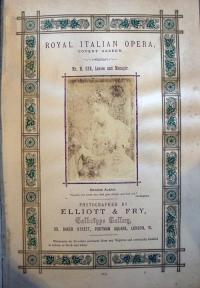
Joseph John Elliott (1835-1903) and Clarence Edmund Fry (1840-1897) founded the celebrated photography studio of Elliott & Fry in 1863. Their business succeeded by offering noted actors, scientists, politicians, and writers a free photographic portrait, which could then be reproduced on hundreds of cartes-de-visite for sale to the Victorian public. By 1886, they had outgrown their studio at 55 Baker Street, Portman Square, and opened a second branch in South Kensington.

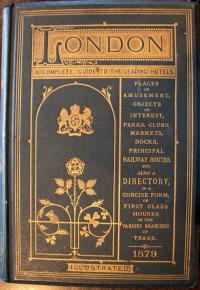
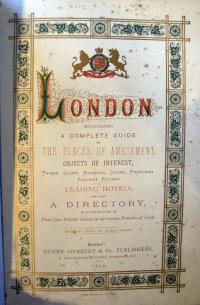
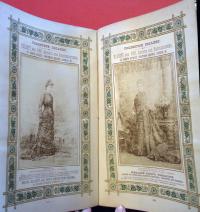
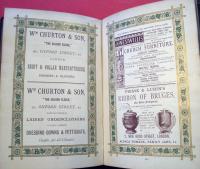
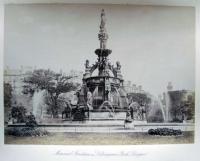
Elliott & Fry received a commission in 1870 to provide photographs for a deluxe London guidebook. Twelve portraits of contemporary actresses and actors were chosen to augment a series of steel engravings. Hundreds of original photographs had to be hand-trimmed and pasted onto pages with lithographed borders to illustrate these volumes. A lively descriptive text provides details on contemporary hotels, parks, clubs, theaters, markets, railway routes, and houses of trade.

Henry Herbert, London (Illustrated). A Complete Guide to the Places of Amusement. 8th edition (London: Herbert, 1879). Graphic Arts (GAX) 2008- in process
Early Views of Philadelphia

| No Comments
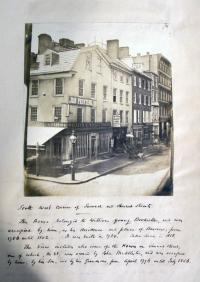
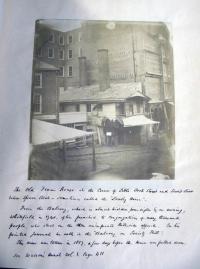
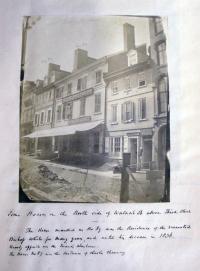
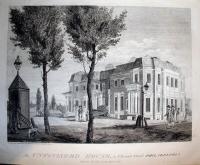
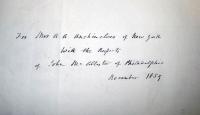
Album assembled by John McAllister Jr. (1786-1877) containing 26 prints (mounted restrikes of engravings by William Birch and others) and 16 photographs (salted paper prints from glass plate negatives) of streets and buildings in Philadelphia. ca. 1859. Previously owned by Mrs. A. A. Auchincloss, Martin P. Snider, and Jay T. Snider. Graphic Arts (GAX) 2008- in process


The prints and photographs in this album represent some of the earliest images made of Philadelphia. A similar album was given to the Library Company by McAllister’s son, John A. McAllister, in 1886.

John McAllister Sr. (1753-1830) immigrated to America in 1775 and moved to Philadelphia in 1781 where he opened a shop that grew into an optical business specializing in eyeglasses. John McAllister Jr. joined the business in 1807 and listed his occupation as optician. In addition to spectacles, they sold microscopes, spyglasses, magic lanterns, camera lucidas and obscuras, lenses, and other photography equipment. The shop was frequented by the earliest practitioners in photography who became John Jr.’s friends and colleagues.

McAllister was also a noted antiquarian and collector of Philadelphia history. His diary indicates that he hired Frederick Debourg Richards (1822-1903) to photograph the homes of his father and himself, along with other Philadelphia landmarks. Throughout his life, Richards pursued a career as a landscape painter while making his living primarily through photography. He settled in Philadelphia in 1848, opening a daguerreotype studio across from Independence Hall. In the 1850s, like many photographers, Richards made a transition from images on copper plates to paper, forming a partnership with John Betts. Several of the paper prints in this album hold the blind stamp from the studio of Richards and Betts. Other photographs in the album can be attributed to another prominent Philadelphia paper photographer James McClees.

Eight of the restrikes included in this album are from The City of Philadelphia by William Birch (1779-1851), published in 1800. Birch made the engravings “as a memorial of [Philadelphia’s] progress for the first century.” The deluxe edition included hand-colored plates and sold for the enormous sum of $35. Today, this volume is extremely rare and even the loose plates highly collectable. Eight restrikes from his second book, The Country Seats of the United States of North America, published 1809, are also included in this McAllister album.

For a complete list of the salted paper photographs, continue below.

Alphabet pour adultes

| No Comments
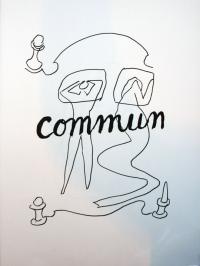
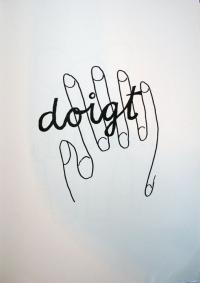
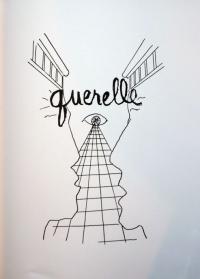
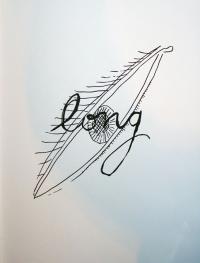
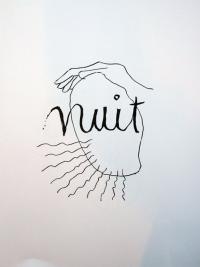
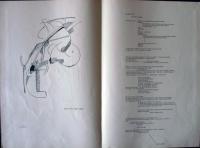
Man Ray (1890-1976) Alphabet pour adultes (Paris: Éditions Pierre Belfond, 1970). Copy no. XVI of XXX hor commerce. 37 lithographs and one signed rayograph. Graphic Arts Collection (GAX) Oversize ND237.R19 A46 1970f


Man Ray painted his first letter “Y” in 1923 as an homage to his friend Yves Tanguy. Even earlier, he contemplated creating an alphabet of Rayographs (photograms) but gave up the idea as too lengthy.

He eventually realized his project in 1947 in two entirely different versions. Alphabet was published by the Copley Galleries, Beverly Hills in 1948 and Analphabet was presented to a California collector around the same time. This second series of letters was published by Timothy Baum for Nadada Edition in 1974.

In 1970, at the age of 80, Man Ray completed a French edition, entitled Alphabets pour Adultes, seen here. The artist wrote, “A letter always suggests a word, and a word always suggests a book. There are words that are for every day use and there are words reserved for the more special occasions, for poetry … To make a new alphabet of the discarded props of a conversation can lead only to fresh discoveries in language.”


Designing the Brooklyn Bridge

| 1 Comment

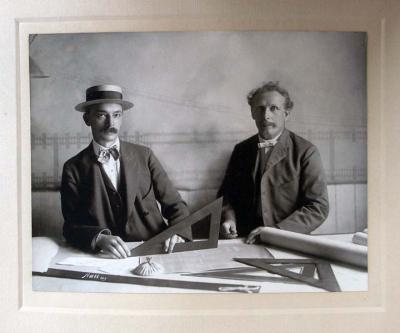
The Great East River Bridge, known today simply as the Brooklyn Bridge, opened to the public May 24, 1883. Designed by John Augustus Roebling (1806-1869) and Wilhelm Hildenbrand, the bridge took 13 years to build at a cost of 15 million dollars.

When John Roebling died unexpectedly in 1869 of a foot injury, his wife and sons continued the project. His first son Washington Roebling was also injured and confined to bed. Charles Roebling not only worked onsite but also invented an 80 ton wire rope machine, which made the project a success.

This photograph shows Charles Roebling and Hildenbrand consulting on the bridge. The drawing on the wall is by Hildenbrand. Graphic Arts division, GAX American Photography

Rivers Pollution Prevention Act 1876

| No Comments

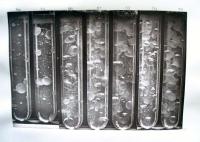
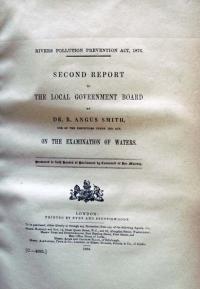
R. Angus Smith (1817-1884), Rivers Pollution Prevention Act, 1876. Second Report to the Local Government Board (London: Eyre and Spottiswoode, 1884). Illustrated with woodburytypes. Graphic Arts division GAX 2008- in process.

The Scottish environmental scientist Dr. Robert Angus Smith (1817-1884) studied air and water pollution, coining the term “acid rain” in 1852. After working at the chemical laboratory at the Royal Manchester Institution, Smith was named the first Alkali Inspectorate by the Alkali Act of 1863. He went on to publish numerous texts on the control of urban pollution, most notably Air and Rain. The Beginnings of a Chemical Climatology (London: Longmans, Green, and co., 1872). Recap 85083.863

In 1876, an Act of Parliament was passed to attempt to control London’s water pollution. Smith was appointed the inspector to uphold the new laws. His methods for determining the number of microbes in water led to significant development in environmental science and law.

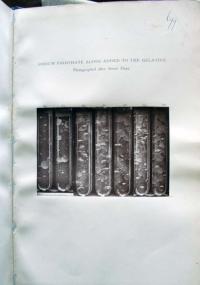
Seven mounted woodburytypes of Smith’s experiments were used to illustrate the 1884 second edition of Smith’s report to the government board. The prints were made by Vincent Robert Alfred Brooks (1814-1885) a lithographer who purchased the patent for Woodbury’s photo-relief process in 1879 and specialize in this method of book illustration through the turn-of-the-century.

Mammoth Inauguration

| No Comments
GA 2008-01237

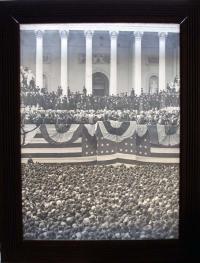
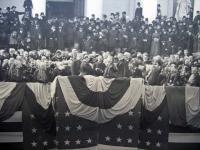
Although it may be difficult to tell from a thumbnail, this is a mammoth plate (23 x 17 inch) collodion on glass positive photograph of Grover Cleveland’s 1885 inauguration as the twenty-second president of the United States. The spectacular image represents the end of one era and the beginning of another for American photography.

Mammoth glass plates had been used with great success since the 1860s when Carleton Watkins and other members of the government expeditions carried them through the West. Commercial photographers in the East, such as Mathew Brady, also used mammoth plates to make celebrity portraits on a grand scale.

However, for most photographers, glass plates were heavy, difficult to handle, and easily broken. Even with the development of an emulsion-coating machine in 1879, there was a demand for better, cheaper materials to support the light-sensitive chemistry. In 1885, George Eastman introduced his Eastman American Film and in 1888, offered a camera that held a pre-coated roll of his flexible film. Now anyone who could afford to buy the camera could make photographs.

It is not surprising to find this seminal photograph at Princeton. When he retired from office, Cleveland chose Princeton, New Jersey, for his home and served for a time as a trustee of Princeton University. When he died in 1907, he was buried in the Princeton cemetery of the Nassau Presbyterian Church.

Cleveland’s papers are available in the Grover Cleveland collection, 1860-1907 (Manuscripts Collection MSS C0237). In addition, the books from his personal library are now part of Princeton’s rare books collections, including his copy of the 1885 Message from the President of the United States to the two Houses of Congress at the commencement of the first session of the forty-ninth Congress (Rare Books (Ex) CL 1090.24.9).

For more information on Cleveland’s connections with Princeton, see http://etcweb.princeton.edu/CampusWWW/Companion/cleveland_grover.html

Historia de una Afeccion Anestestica

| 1 Comment

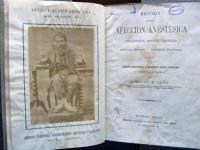
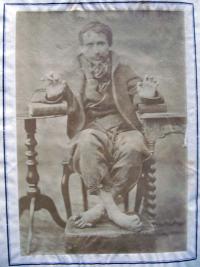
In 1877, physician and public health specialist Emilio R. Coni (1859-1907) published an article entitled “Historia de una Afeccion Anestesica. Contracturante, Amputante y Dactiliana,” in the professional journal he edited Revista Medico-Quirurgica. A 16 page off-print was released at the same time by the Buenos Aires press of Pablo E. Coni, with a photographic frontispiece showing a man with macular leprosy.

Coni expanded the piece and the following year, published Contribucion al Estudio de la Lepra Anestesica. Coni fought all his life for the reform of the health practices of Latin-American families, and was eventually named president of the Medical Association of Argentina.

His memoirs were released after his death: Memorias de un médico higienista: contribucion a la historia de la higiene pública y social Argentina (1867-1917) (Buenos Aires: Talleres Gráficos A. Flaiban, 1918). Recap, RA459.xC6

The Yosemite Book

| 1 Comment
Josiah Dwight Whitney Jr. (1819-1996), The Yosemite Book: A Description of the Yosemite Valley and the Adjacent Region of the Sierra Nevada … (New York: Julius Bien, 1868). Western Americana (WA) 2008- in process


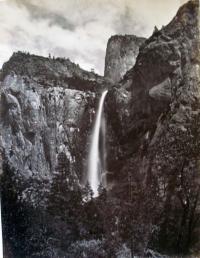
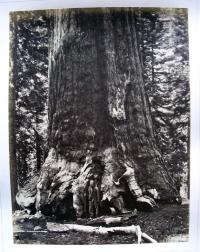
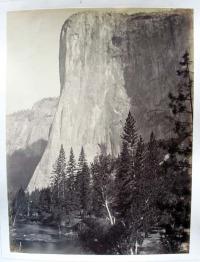
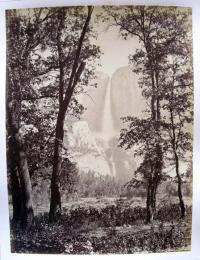
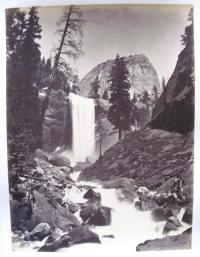
It is hard to overestimate the importance of The Yosemite Book in the history of the United States. Only 250 copies of this lavish quarto volume were published, with 24 albumen photographs by Carleton E. Watkins (1829-1916) and 4 by William Harris. Watkins made the photographs on an 1866 trip to Yosemite with the Geological Survey of California and Harris made his on a trip the following year.


Watkins’ spectacular photographs record the beauty of Yosemite, not the geography or topography required of other survey artists, and his images found an immediate audience. Watkins used 8 x 10 inch glass-plate negatives, which had to be developed in California and then, carried back across the country to the photographer’s studio in Washington D.C. to be printed.

According to photography historian Peter Paulquist, “The task of printing 250 copies of each of the 28 negatives, a total of 7,000 individual prints, was accomplished by Watkins and his staff in the winter of 1867-68. Assuming that Watkins received at least $6 per book, and that all the books were sold, he would have netted $1,500 for [one year’s] work.”

For more information, see Martha A. Sandweiss, Print the Legend: Photography and the American West (New Haven: Yale University Press, 2002). Marquand Library (SAPH) TR23.6 .S25 2002.

Thomas Annan and the Glasgow Water Works

| No Comments

James M. Gale, Photographic Views of Loch Katrine and of Some of the Principal Works Constructed for Introducing the Water of Loch Katrine into the City of Glasgow… (Glasgow: Glasgow Corporation Water Works; printed by James C. Erskine, 1889). Graphic Arts division, GAX 2008- in process


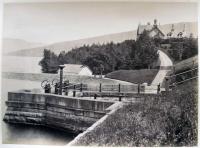
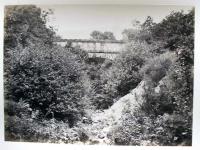
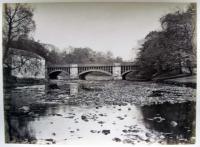
The Scottish photographer Thomas Annan (1829-1887) is best known for his images of the Glasgow slums, published as Photographs of Streets, Closes, &c. Taken 1868-71, 1872 (Graphic Arts dividion (GAX) 2007-0023E). Not long after this commission, the city of Glasgow hired Annan again to photograph the 25 mile water system between Loch Katrine and Glasgow. This was the first successful aqueduct project in Scotland, designed to provide Glasgow with cheap, clean water.

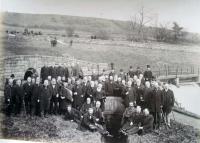
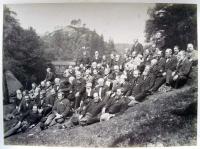
Annan finished the first set of photographs in 1876 and a portfolio was published in 1877. He returned to take a second photograph of the commission members in 1880 and a third portrait of the group in 1886.

In the late 1880s, Glasgow had outgrown the original water works and needed a second reservoir. To raise the money for this project they again called Annan, who made additional photographs and a second expanded edition of the Water Works album was published in 1889. This is the rare volume of 33 albumen photographs that Princeton’s graphic arts division recently acquired.

Photographie Vulgarisatrice

| 2 Comments

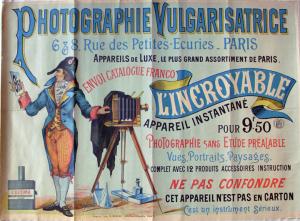
A late nineteenth-century poster showing an incredible instantaneous photography outfit.

“Don’t be confused. This apparatus is not cardboard. It is a serious instrument.”


Photographie Vulgarisatrice (Paris: S. Glaise, 180 Rue Lafayette, [ca.1900]). Color lithograph. Graphic Arts division GAX 2008. in process


How Hot Is It Where You Are?

| No Comments

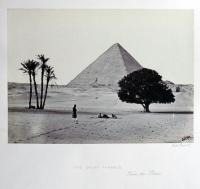
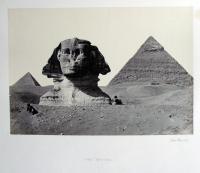
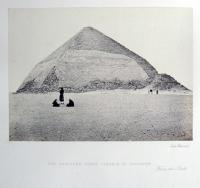
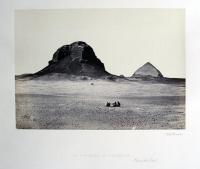
Francis Frith (1822-1898), Cairo, Sinai, Jerusalem, and the Pyramids of Egypt: a Series of Sixty Photographic Views; with Descriptions by Mrs. Poole and Reginald Stuart Poole (London: J.S. Virtue; New York: Virtue & Co., [1860]). Gift of Hertha Cordis Conway.Graphic Arts Collection (GAX) Oversize 2006-0146F

A successful grocer, Francis Firth took a chance in 1850 when he formed a partnership and opened The Frith and Hayward Photography Studio in Liverpool. In 1856, Frith made an extended trip to Egypt, traveling up the Nile from Cairo to Abu Simbel. He carried with him four cameras and all the equipment necessary to take and develop wet collodion glass-plate negatives. He often complained about the chemicals boiling-over inside the tent he used as a darkroom.

Frith made other trips to the Middle East in 1857 and 1859, then printed and published 1,000s of albumen photographs in a series of deluxe books and albums. The public went crazy for these images and Frith made a small fortune. Although he retired soon after this, his publishing company in Reigate, Surrey, continued to operate until 1970.

Un espejo de nuestro mundo

| No Comments
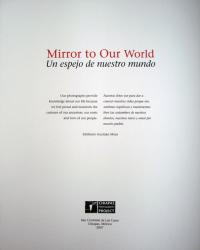
Mirror to Our World / Un espejo de nuestra mundo (Chiapas, México: San Cristóbal de Las Casas, 2007). Copy no. 5 of 100. Graphic Arts (GAX) 2008- in process

Recently acquired for the Graphic Arts division is this limited-edition portfolio celebrating the achievements of the Maya photographers in and around San Cristóbal de Las Casas in the Chiapas Highlands. The portfolio was produced under the auspices of the Chiapas Photography Project, which assists and promotes the artistic work of the region’s indigenous peoples. For information, see http://www.chiapasphoto.org/

The Project has developed two distinct programs: the Archivo Fotográfico Indígena / Indigenous Photography Archive (AFI) and Lok’tamayach, Fotógrafos Mayas de Chiapas / Mayan Photographers from Chiapas. The Archive holds over 75,000 photographs by more than 200 photographers from 10 different ethnic groups.

Un espejo de nuestro mundo comes in a cloth slipcase made by Paxku’ Pavlu from Nabenchauk, Zinacantán. The design is taken from a pirik mochebal of the 1970s/80s, which was a type of shawl used by women in Tzotzil-speaking Zinacantán, a community in the Chiapas Highlands. The shawl was worn for everyday activities and has traditionally been characterized by a basket-weave pattern dating from pre-Columbian times. http://www.chiapasphoto.org/shop.html


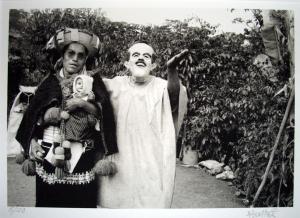
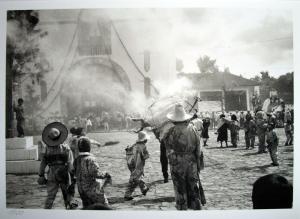
Petul Hernández Guzmán, Te ants jlo’bile meybil yu’un te jkaxlane. The male clown dressed as a woman is embraced by the white clown. La mujer marucha está abrazada por el ladino, 2001


Genaro Sántiz Gómez, K’in ta Chamula. Celebration in Chamula. Fiesta en Chamula, 1997.

Richard Willats' Collection of Paper Photography

| 3 Comments

The Graphic Arts division holds a scrapbook of early paper photography compiled by the British optician and amateur photographer, Richard Willats. After several years of work by many staff members, the entire scrapbook has been digitized and is available for public view at http://diglib.princeton.edu/
xquery?xq=getCollection&xsl=collection
&_pid=gc131willats

In the early 1840s, T. & R. Willats was one of the leading scientific instrument makers in London, specializing in barometers, thermometers, and telescopes. It was also one of only two companies supplying photographic chemistry and equipment to the amateur practitioners of the day. Opticians (and brothers?) Thomas and Richard Willats had shops at 98 Cheapside (1840s-50), 28 Ironmonger Lane (1851-56), and 2 Church Lane, Homerton (1857-60).

Richard Willats was an amateur photographer in his own right. In the Princeton scrapbook, he collected 254 paper photographs by his friends and colleagues, along with a selection of autographs by 19th-century authors, authors, and politicians. Photographers identified in handwritten captions by Willats include Robert J. Bingham; Captain Henry Brewster; Brodie; Samuel Buckle; Archibald Cocke; John H. Croucher; Joseph Cundall; Field; Charles Henry;


Sir John Herschel; Horne, Thornewaite, & Wood; John Johnston; Negretti & Zambra; Nicholson; T. S. Redman; J. Sherrington; G. Wharton Simpson; Thomas Sutton; William Harding Warner; Richard Willats; and Walter Bentley Woodbury.

These photographs include portraits, architectural scenes, and events of the day, such as the collapsed Fleet Street Sewer and of the destroyed Underground Railway Works. Geographic locations in these images include London, Paris, Holland, and Japan. One print, by an unidentified photographer, is captioned “The first photograph taken from a negative on glass.”

Many of these men were leading practitioners of early paper photography. Robert Bingham was the author of his own manuals including Photogenic Manipulation. Part I: Containing the Theory and Plain Instructions in the Art of Photography, or the Production of Pictures through the Agency of Light…. 4th ed. (London: George Knight and Sons, [1847]) and The Collodion Process: being a supplement to Part I of Photogenic Manipulation (London: G. Knight and Sons, [1852]).

Sir John Herschel was a scientist, chemist, and astronomer. Herschel discovered the chemistry for a fixing agent or “hypo”, and then in 1839, invented a photographic process using sensitized paper. Herschel coined the use of the terms “photography,” “positive,” and “negative.”

Joseph Cundall was a leading book binder and publisher, known for his handsome illustrated children’s books. He also experimented with early paper photography.

Opticians Henry Negretti and Joseph Warren Zambra formed a scientific instrument company, Negretti & Zambra, in 1850. They also printed and published photographs using various early processes.

American Visual Poetry

| 3 Comments

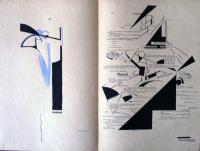
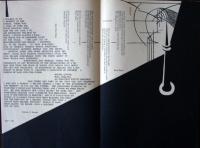
291, no.2 April 1915. [Untitled] by Katherine N. Rhoades. "Mental Reations" by Marius De Zayas and Agnes Ernst Meyer. Graphic Arts Collection (GAX) Oversize 2007-0018E


In 1954, Princeton received a gift from the painter Georgia O'Keeffe (1887-1986). This donation included issues of 291, a monthly magazine published out of The Little Galleries of the Photo Succession, run by her husband Alfred Stieglitz. Today, the graphic arts division holds issues no. 2-7/8 (although no.1, 9-12 are currently missing, things have a way of turning up).

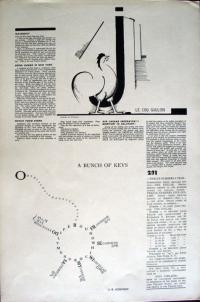
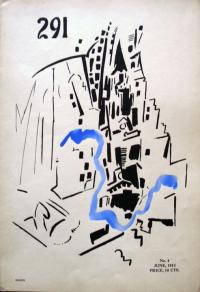
291 was edited by Alfred Stieglitz (1864-1946), Marius de Zayas (1880-1961), Paul Haviland (1880-1950), Agnes Ernst Meyer (1887-1970), and to a lesser extent Francis Picabia (1879-1953), and Katherine N. Rhoades (1885-1986). Many of the prints include hand-coloring and issue no. 7/8 has a photogravure by Stieglitz.

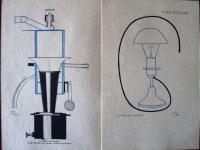
291 no.3 May 1915. Page design by Marius De Zayas, poems by Katherine N. Rhoades and Agnes Ernst Meyer.
291 no.3 May 1915. Le Coq Gaulois drawn by Edward Steichen. "A Bunch of Keys" by J.B. Kerfoot.

The inspiration for 291 came in 1914, when De Zayas was in Paris searching for art to exhibit in the New York gallery. In one of his letters back to Stieglitz, he mentions the visual poetry of Guillaume Apollinaire (1880-1918) "[who] is doing in poetry what Picasso is doing in painting. He uses actual forms made up with letters. All these show a tendency towards the fusion of the so-called arts." When De Zayas returned, he convinced Stieglitz of the need for a new magazine devoted to visual poetry and satire. Together with Haviland and Meyer they began 291.

291 no.4 June 1915. "Fille née sans mêre" drawn by Picabia, poem by Rhoades.


192 no.4 June 1915. "291" drawn by John Marin.

Only about 100 copies of the regular and deluxe (heavy paper) editions were sold to subscribers. The magazine never found an audience in New York and the publication only survived for one year before closing. Stieglitz sold the entire back stock to a ragpicker for $5.80.


291 no.5/6 July/August 1915. "Canter" and "Voila Haviland" drawn by Picabia.


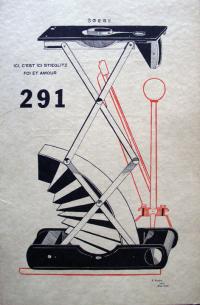
291 no.5/6 July/August 1915. "Ici, c'est ici Stieglitz foi et amour" by Picabia.


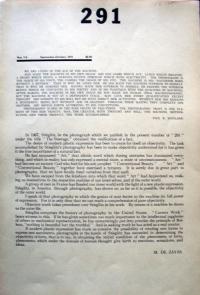
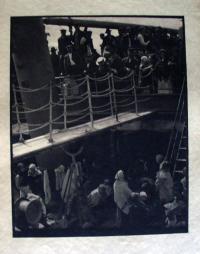
291 no.7/8 September/October 1915. "The Steerage" by Stieglitz. Comments on "The Steerage" by Paul B. Haviland and De Zayas.

Celebrities Who Will Not Fade

| 2 Comments

Galerie contemporaine, littéraire, artistique (Paris: L. Baschet, 1876-1880). Graphic Arts Collection (GAX) Oversize 2007-0414Q

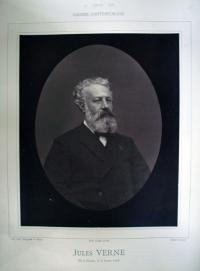
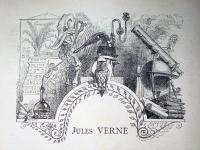
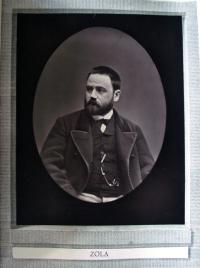
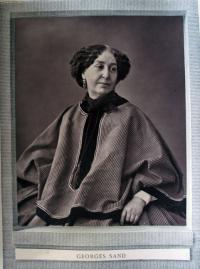
Galerie contemporaine, littéraire, artistique was published weekly in its first series from 1876 to 1880, and in a less regular second series from 1881 to 1884 (not in the Princeton library). The general public were persuaded to subscribe, and did in large numbers, by the captivating woodburytype portraits contained in each issue. These portraits were of contemporary celebrities from literature, music, science, politics, or the arts; each photographed by some of the great photographers of the day. Shown here are portraits of Jules Verne (1828-1905) and Émile Zola (1840-1902) made by Étienne Carjat (1828-1906); and George Sand (1804-1876) made by Nadar (pseudonym of Gaspard-Félix Tournachon 1820-1910).


The woodburytype (called photoglyptie in France) is not considered a true photograph because the image is not created from light-sensitive material. Instead we call it a photomechanical print. To make a woodburytype, a tough gelatin relief is created from a glass negative, which is then pressed into a sheet of soft lead creating a mold of the image—thick and thin as the image is dark and light. The mold is filled with a pigmented gelatin (usually purplish-brown) and covered with a piece of paper. When run through a printing press the gelatin is transferred onto the paper making an extremely detailed image but one that will not fade because no light-sensitive chemistry was involved. Such permanent prints were especially useful for commercial periodicals, such as Galerie contemporaine.

To explore the properties of woodburytypes and many other photographic processes, try the digital sample book created by Ryan Boatright and James Reilly at the Image Permanence Institute: http://www.digitalsamplebook.com/home.htm

Photographic Pleasures

| No Comments

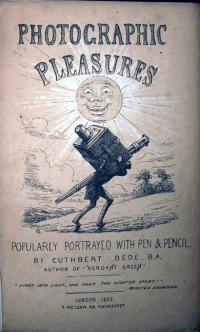
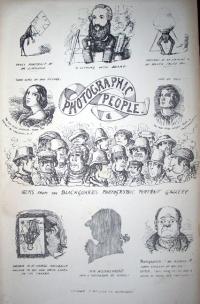
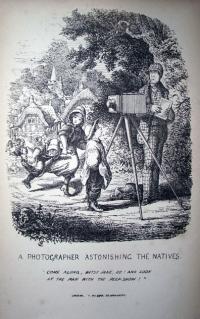
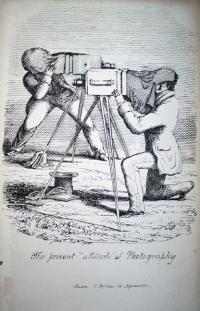
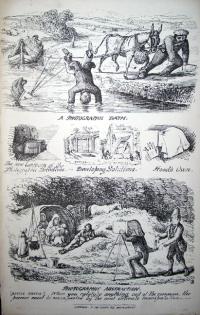
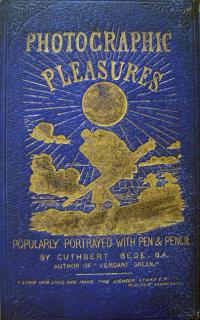
Cuthbert Bede (pseudonym of Edward Bradley, 1827-1889), Photographic Pleasures: Popularly Portrayed with Pen and Pencil (London: J. C. Hotten, 1859). 24 lithographed cartoons and humorous stories about the new art of photography. Graphic Arts Collection (GAX) 2006-3219N


Pathé Baby

| 9 Comments

By the early 1920s, the Société Pathé Frères had built the largest film equipment and production company in the world. To increase their 1922 Christmas sales, they released the first projector meant for home use: the Pathé Baby. Kodak quickly released its own brand of home equipment and film, which found greater popularity and by 1935 Pathé was forced into bankruptcy.

The 9.5 mm Pathé Baby films come in small cassettes holding approximately 30 feet of film that plays for around 60 seconds. What makes it unique is that it has sprocket holes down the center rather than on the sides. The film also has an ingenious little notch cut into each title frame that triggers the projector to stop for a few seconds, even though the operator continues to crank the film, allowing viewers time to read the text.

Princeton's collection of optical devices, and optical prints and photographs, is basically a pre-cinema collection. However, thanks to the help of Professor Rubén Gallo, we recently acquired a 1920s Pathé Baby projector along with approximately 1,000 Pathé films, including natural history, animation, biography, current events, and multi-reel comedies and dramas.

Here is a sample (black & white, no sound):


You need JavaScript turned on and the Flash Player installed to see this video.

There is a group of enthusiasts based in the United Kingdom who still use 9.5 mm film. Their website is www.Pathescope.freeserve.co.uk/Pathe95.htm

Tree and Serpent Worship

| No Comments

James Fergusson (1808-1886), Tree and Serpent Worship, or, Illustrations of Mythology and Art in India in the First and Fourth Centuries after Christ (London: India Museum … , 1868). Graphic Arts Collection (GAX) Oversize 2004-0934Q

Tree and Serpent Worship was compiled by the self-taught historian James Fergusson (1808-1886), who made his fortune at a young age in Calcutta and then devoted the rest of his life to his passion for Indian architecture. Fergusson befriended a number of the British officers who spent their time in India practicing the new art of wet-plate photography, such as Major Robert Gill (1804-1879) whose albumen prints were used to illustrate Fergusson’s 1864 edition of The Rock-Cut Temples of India (Graphic Arts Collection (GAX), 2007-2590N).

Another of Fergusson’s associates was James S. Waterhouse (1842-1922), who never used a camera before arriving in Calcutta. He became so accomplished that he was ultimately named surveyor-general to the monumental Survey of India. Under the sponsorship of the Indian government, Waterhouse spent eleven years—from 1864 to 1875—documenting the ethnic diversity of the people of India; work later replicated by Edward Curtis and others who joined the international mania for mammoth ethnographic studies.

During that same period, Waterhouse provided Fergusson with a group of images depicting the ancient Buddhist monuments in Sanchi, a small village in the state of Madhya Pradesh. The frontispiece of Tree and Serpent Worship shows Waterhouse’s image of the Northern gateway to the Great Stupa at Sanchi. This is the oldest of the religious stupas, or mounds, constructed in the third century BCE to hold the remains of the Buddha.

Along with 20 photographs by Waterhouse are 36 by W. H. Griggs (1832-1911), depicting Amravati sculptural fragments from the collection we now know as the Victoria & Albert Museum.

Early History of Photography

| No Comments
William Henry Fox Talbot (1800-1877), Some Account of the Art of Photogenic Drawing (London: Printed by R. and J.E. Taylor, 1839) Graphic Arts Collection (GA) Oversize TR144 .T34 1839q


In January of 1838, news reached William Henry Fox Talbot (1800-1877) in London that Louis-Jacques-Mandé Daguerre (1787-1851) had announced his direct positive process to the Academy of Sciences in Paris. Talbot rush to present and publish his own findings and on January 31, Talbot read a brief paper before the Royal Society in London. Several weeks later, he spoke again at length about the process that he called photogenic drawing.

Unfortunately, the Society declined to publish his research on photography in their Transactions and it was not until the following year that the paper found its way into print (shown here). This brochure constitutes the first separate publication on photography.

Inside the copy held at Princeton University is a letter from Sir Edward Brewster (Principal of St Andrew’s University and Chancellor of Edinburgh) who was an amateur photographer and writes about the calotype process.

William Henry Fox Talbot (1800-1877), The Process of Calotype Photogenic Drawing: communicated to the Royal Society, June 10th, 1841 ([London]: Printed by J.L. Cox & Sons, [ca. 1841]) Graphic Arts Collection (GA) TR395 .T34

It was not until 1841 that Talbot finally introduced the calotype process. Talbot again spoke to the Royal Society and the document pictured here is the publication of this “memoir” or talk presented on the creation of photography.

Princeton University holds many seminal publications on the history of photography from around the world. Also pictured here is the 1851 paper published by Louis Désiré Blanquart-Evrard (1802-1872), introducing his variation on the calotype entitled Traité de photographie sur papier.

Wilson's Photographic Magazine

| 1 Comment


Wilson’s Photographic Magazine (New York: E.L. Wilson, 1889-1914). Graphic Arts Collection (GAX) 2007-0005M

In 1957, Princeton received a wonderful donation of photography books from David H. McAlpin, class of 1920. These included many reference books and serials from the Camera Club of New York’s library (sold in 1955); in particular a set of Wilson’s Photographic Magazine.

When Dr. Edward L. Wilson (1838-1903) began the publication The Philadelphia Photographer in 1864, it was the only photographic magazine in the United States. In 1885, the magazine’s name was changed to Wilson’s Photographic Magazine and its central offices removed to New York City. As Wilson’s Photographic, the magazine was published semimonthly from 1889 to 1892. Issues published on the first Saturday of the month included an original albumen print and those published on the third Saturday held a photogravure, photo-engraving, or photolithograph. Beginning January 1893, the magazine became a monthly and each issue included at least one original print.

The following is a brief section of Wilson’s obituary printed in The American Amateur Photographer:

“[Wilson’s] first service was to secure a modification of the copyright law of 1831 so as to include photographs. In 1865 he organized and led the opposition of the fraternity to the so- called Bromide Patent. This fight continued over several years and eventually resulted in the upsetting of the patent, by which decision photographers were freed from a grievous tax. The stamp law was modified in 1866 and completely removed in 1868. In this year Mr. Wilson was foremost among those who organized the National Photographic Association, of which the present Photographer’s Association of America is the successor. In 1873 the National Association held at Buffalo, N. Y. what was probably the most successful photographic gathering ever held in America. A special number of The Philadelphia Photographer, comprising some 224 pages, reported this convention in detail, being published within two weeks after the close of the Convention—a remarkable journalistic feat at that time.”

1 2 3 4 5 6

Recent Comments

  • Elizabeth Van Riper: Thank you for sharing this wonderful tribute to Ulli Steltzer. read more
  • Jonathan Greene: I am trying to reach any member of Eric Sackheim's read more
  • eric adler: I am interested in the issue #2 31 Aug 1919. read more
  • Luffy: Quelle chance d'être tombé sur ce rare album ! Puis-je read more
  • Sigrun Siladji: I have got a set of these Wellington Picture Medals read more
  • Melvin Franklin: Thank You !!! I'm one the kids that Ulli helped. read more
  • Shortshanks: Of course this print was actually a direct copy of read more
  • pamela wesson: Thanks for this. Joe was an important figure to me read more
  • Sarah: Thank you for posting these - I've never seen grotesquerie read more
  • Wendy Hodgden: I have two signed etchings By Brouet that I inherited read more