Once There Was a Man with a Goat, Cabbage, and Wolf and They Had to Cross a River…

Lewis Carroll gave his pupils puzzles to make logic and mathematics instruction more interesting.   He might have sprung on them the well-known river crossing problem which goes something like this… There was a man who had to get a goat, cabbage, and wolf across the river in a boat too small to hold all four of them. What was he to do? The goat was sure to eat the cabbage if left alone with it and the wolf the goat if given a chance.  With a little quick thinking, the task can be successfully completed.

People have been solving this problem at least since the 12th century, when an illumination featuring a wolf, a sheep, and a vegetable that looks like kale appears in the Ormesby Psalter.  Since the 12th century, many variations on the river crossing problem have been noted in at different times, places, and sources.

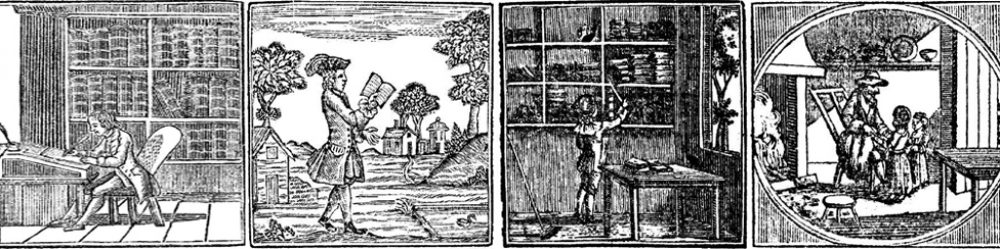
The Schoolmasters Assistant. London: Richard and Henry Causton, (1773). (Cotsen 33112)

Between 1705 and 1801, there were seventeen occurrences with a fox, a goose, and a bag of oats, five for a fox, a goose, and a bag of wheat, and three for the more familiar goat, cabbage, and wolf.  The majority appeared either in Jacques Ozanam’s famous Recreations for Gentlemen and Ladies or well-established school books like Thomas Dilworth’s Schoolmaster’s Assistant, under the heading “pleasant and diverting questions.”

Jeux Nouveaux Réunis. Paris: JJF, [1904]. (Cotsen)

For some time it seems that the goat, cabbage and wolf puzzler had been simultaneously associated with instruction and amusement.  Yesterday I discovered more evidence for that in an unlikely place, a recent acquisition, Jeux nouveaux reunis dating from around 1904.  Four or five Parisian companies involved in making pastimes seem to have partnered to produce a big wooden chest shown below stuffed with 64 entertaining pastimes individually boxed. Le souci du batelier: question du vieux tempts [The boatman’s problem] is the only logic puzzler to be found among all the dexterity and disentanglement puzzles.   The box contains a printed slip with the solution and figures of the goat, cabbage, and wolf on little wire stands and the boatman.

Players who couldn’t work it out in their heads could experiment with the figures plotting a sequence of trips across the river  that  would  preserve  cabbage  and  goat.It’s been speculated that the Jeux nouveaux reunis was a salesman’s sample.  Jerry  Slocum, the great historian and collector of puzzles shows in Puzzles Old and New that dexterity and disentanglement puzzles became an increasingly popular family entertainment in  early twentieth century.  He photographs the box of his copy of  Puzzle Parties (1911) sold by a Connecticut firm which contains many of the same French puzzles in the box Cotsen acquired.  Perhaps boxes were sold in France for puzzle parties as well as for sale overseas. 

Answers to the Puzzle Picture Challenge

The day of reckoning is here… Luckily your future isn’t riding on it!

PICTURE NUMBER ONE

A is Aladdin the poor widow’s son; / With his Wonderful Lamp a fair princess he won./

B’s for Blue Beard, without pity the least;/ And also for Beauty, who saved the poor Beast.

C’s Cinderella, who fled from the ball,/ When the Prince found her pretty glass slipper so small.

D is Dick Whittington; Bow Bells rang out–/ “Thrice Lord Mayor of London,:” and ended his doubt.
 PICTURE NUMBER TWO

E’s for the Elves, little mischievous wights,/ That dance with the Fairies on fine moonlight nights.

F is the famous Forty Thieves: in a tree/ Ali Baba’s concealed, and their doings can see.

G’s Goody Two-Shoes, a kind little maid,/ Who gave poor dumb creatures protection and aid.

H House that Jack built. Or, take which best suits,/ Here is Hop o’ My Thumb with his Seven-League Boots.

PICTURE NUMBER THREE

I is the Ice-Maiden, haughty and cold,/ And J is for Jack, who slew Giants of Old.

K is King Arthur: with him will be found/ The twelve gallent Knights of the famed Table Round.

L is for Little Bo-Peep.  Sad mishap! She lost all her sheep while just taking a nap.

M, Mother Goose, you may easily spy,/ On the back of her Gander she mounts to the sky!

PICTURE NUMBER FOUR

N’s Number Nip, a wee Gnome full of tricks; / He made a man ride on a bundle of sticks!

O is for Old Mother Hubbard–see how/ “The Dame made a curtsey, the Dog made a bow!”

P’s Puss in Boots, with his bag full of game,/ Whose Master the Princess’s husband became.

Q Queen of Hearts is; the Knave stole her tarts,/ But the King caught him at it, and so the Knave smarts!

Our challenge was extracted from Routledge’s Coloured ABC Book, which would have been marketed as a “picture book.”    In  mid-nineteenth century children’s book publishing, this meant  a collection of four to six previously published toy books bound up in a fancy pictorial cloth binding.  It was a way for enterprising publishers to repackage content attractively.

Routledge’s Coloured A B C Book: Containing Alphabet of Fairy Tales. Farm-yard Alphabet. Alphabet of Flowers. Tom Thumb’s Alphabet. With twenty-four pages of illustrations by Kronheim and others. London: George Routledge and Sons, ca 1868. (Cotsen 9761)

Alphabet of Fairy Tales, the first toy book listed on the table of contents on the picture book’s title page, was the source of the puzzle pictures and the accompanying doggerel.  Unfortunately, the identify of the author and illustrator remain a secret, because all the Routledge toy books printed up by Kronheim never identified the personnel responsible for them.  Another puzzle for some eager researcher looking for a different kind of challenge.