Recently in Prints, Drawings, Paintings Category

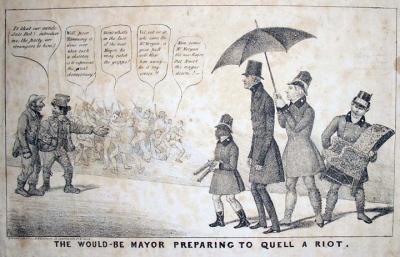
The Would-Be Mayor Preparing to Quell a Riot

| No Comments

Henry R. Robinson (active 1833-1851), The Would-Be Mayor Preparing to Quell a Riot, [1837]. Lithograph. Graphic Arts GA 2010. -in process

New York City mayoral candidate John Jordan Morgan (1770-1849) is seen on the right with members of his Tammany Democratic party shortly before the municipal election April 1837. He is approached from the left by two members of the Loco Foco (the Equal Rights party), a subdivision of the Democrats. A riot occurs in the left background between Irishmen and Germans.

The dialogue reads, “Is that our candidate Bob? introduce me; the party are strangers to him.” Others say, “Well, poor Tammany is done over when such a skeleton is to represent the great democracy!” and “Do’nt whistle in the face of the new Mayor, he may catch the grippe!” and “Vel vot of it, who cares for Mr. Morgan, a good puff will blow him away …”

Morgan, a member of the 23rd Congress under Andrew Jackson, lost the New York election prompting a second print from Robinson. Entitled The Death of Old Tammany and His Wife Loco Foco, the second print satirized the heavy losses suffered by both the Loco Foco and Tammany party. An American Indian represents Tammany, his breast pierced by an arrow, and his wife, the Loco Foco, is shown as a crude Irish woman. Both are crushed under the ballot box.

Joachim von Sandrart's "Teutsche Academie"

| No Comments

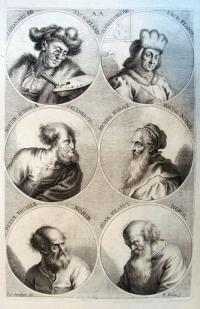
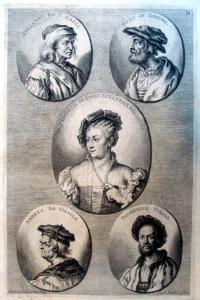
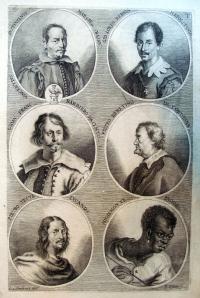
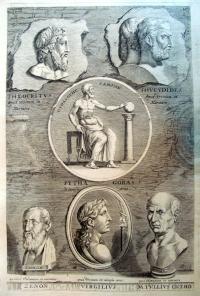
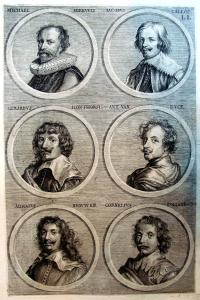
Recently, we found an unbound group of etchings by Joachim von Sandrart. We now know they are plates from Christianus Rhodius (fl. 1680), Joachimi de Sandrart … Academia nobilissimæ artis pictoriæ. Sive Dē veris & genuinis hujusdem proprietatibus, theorematibus, secretis atque requisitis aliis … instructio fundamentalis (Noribergæ: Literis Christiani Sigismundi Frobergii, 1683).


The artist and art historian Joachim von Sandrart (1606-1688) trained under Sebastian Stoskopff in Frankfurt, learned printmaking under Aegidius Sadeler in Prague, and worked in Gerrit van Honthorst’s studio in Utrecht. Initially, Sandrart planned to be an engraver but found success as a painter. During his career, he associated with Claude Lorrain and Nicolas Poussin; did drawings with Andrea Sacchi and Pietro Testa; and in 1653, was ennobled and made a member of the Palatinate-Neuburg Council.


From the mid 1660s, Sandrart was increasingly devoted to academia. He helped to establish the academy of art in Nuremberg (1662) and in Augsburg (1670). Sandrart became director of the Nuremberg academy.

In 1668, Sandrart began to write the Teutsche Academie der edlen Bau- Bild- und Mahlerey Künste, the first encyclopedic art history in German, with editorial help from the poet Sigmund von Birken. The work, published in three volumes between 1675 and 1680, was dedicated to the artists and art collectors of his day. The first two volumes include essays on architecture and sculpture, the theory of painting, biographies of ancient and modern artists, and descriptions of various art collections. Volume three added a translation of Ovid’s Metamorphoses and Cartari’s mythographic handbook. For a more complete description and searchable full-text, see http://www.sandrart.net/


In 1683, Christianus Rhodius translated part of Teutsche Academie and publish it along with a group of plates. This is the group now in graphic arts: approximately 66 etching with engraving, designed by Sandrart and printed by Philipp Kilian (1628-1693) and others.

Marquand Library has a first edition: L’Academia todesca della architectura, scultura & pittura: oder Teutsche Academie der edlen Bau- Bild- und Mahlerey Künste… (Nürnberg: J. von Sandrart; Frankfurt: M. Meriam, 1675-79). SAX Rare Books Oversize N7420 .S2f

Note, center left, Sandrart includes the image of an African European artist called Higiemonde. No biography is given.

Negen Houtsneden by Jan Cockx

| 1 Comment

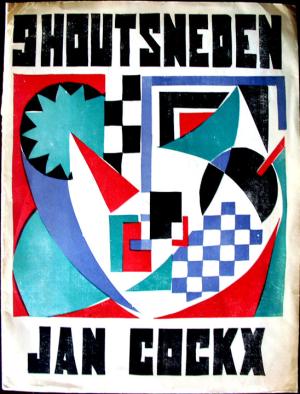
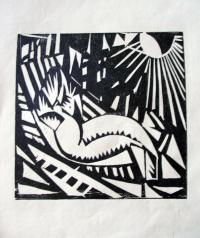
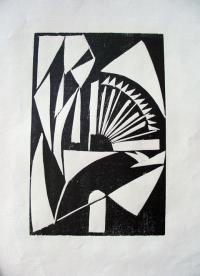
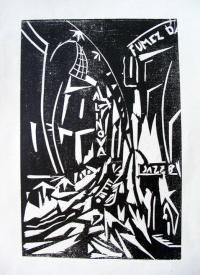
Jan Cockx (1891-1976), Negen Houtsneden [Nine Woodcuts] ([Antwerp : s.n., 1921]. Copy 57 of 100. Graphic Arts GAX 2010- in process

Following World War I, young artists throughout Europe were attempting to reinvent art and culture. In Antwerp, a small group of writers, poets, and social activists came together to publish a monthly journal called Ça ira, Revue mensuelle d’Art et de Critique. From April 1920 to January 1923, twenty issues were released with poems by Paul Colin, Theo van Doesburg, and Paul Éluard. Rough black and white woodcuts and linocuts filled the issues created by Floris Jespers, Paul Joostens, Frans Masereel, and Jan Cockx. Ça ira broke with its German and French colleagues in 1922 when Clément Pansaers published his “assassination of Dada” in a special number entitled ‘Dada, Its Birth, Life and Death.”

The Belgian artist and poet Jan Cockx (1891-1976) had his first exhibition in Paris at the age of twenty-nine, the same year he began publishing in Ça ira. In 1921, Cockx found the financial backing to publish a small portfolio of nine woodcuts with a striking color linocut on the wrapper. Graphic Arts’s copy is from the collection of Maurice van Essche, the editor of Ça ira.

An interesting note: the only other copy listed on OCLC is at the Library of Congress. Their edition note is quoted in French, our portfolio’s text is in Dutch. There must have been either two editions, or two distributors of this portfolio.

For more information, see Rik Sauwen, L’esprit Dada en Belgique (Leuven: Katholieke Universiteit, [1969]). Marquand Library (SA), PQ307.D3 S28 1969

Seventh Ward Beggars

| No Comments

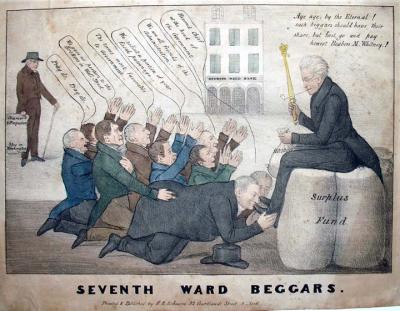
Henry R. Robinson (active 1833-1851), Seventh Ward Beggars, ca. 1836. Lithograph with hand coloring. Graphic Arts GA 2010- in process

This print shows Andrew Jackson (1767-1845), the seventh president of the United States, sitting on the government’s surplus funds, holding a bag of $100,000. Jackson had succeeded in destroying the Bank of the United States in 1832. He and his “kitchen” cabinet established a series of pet banks—state institutions used by the federal government as depositories for public funds. One such pet bank was the Seventh Ward Bank, seen in the back center, which was established in 1833.

Jackson had the power to distribute bank funds and in this print we see nine bankers begging for money, two are literally kissing his feet. Jackson tells them to first pay honest Rueben M. Whitney, a former director of the Bank of United States, now working for Jackson. In the back left stands a Courier Enquirer reporter who later opened an investigation into the bonus fund money used to pay off Whitney.

The beggars say, “Revered Chief at the head of the Government - We are all friends of the Administration - We solicit a portion of your fiscal patronage - The terms most favorable to Government - We gave no portion to the Brokers in Wall Street - Pray do, Pray do.”

In 1928, a portrait of Grover Cleveland was removed from the twenty dollar bill and replaced with a portrait of Andrew Jackson. According to the U.S. Treasury, “Treasury Department records do not reveal the reason that portraits of these particular statesmen were chosen in preference to those of other persons of equal importance and prominence.”

See also: John M. McFaul and Frank Otto Gatell, “The Outcast Insider: Reuben M. Whitney and the Bank War,” The Pennsylvania Magazine of History and Biography 91, no. 2 (April 1967): 115-44.

Auguste Roubille, 1872-1955

| 1 Comment

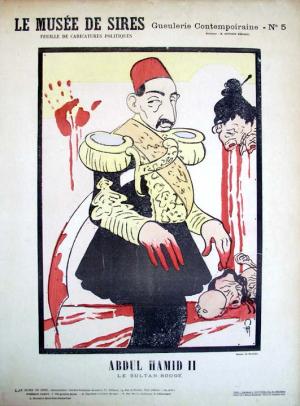
Auguste Roubille (1872-1955), Abdul Hamid II, ca. 1900. Lithograph. GC103 French Political Caricatures Collection. Abdul Hamid II, Le sultan rouge = His Imperial Majesty, Sultan Abdülhamid II, Emperor of the Ottomans, Caliph of the Faithful (1842-1918) was the 34th sultan of the Ottoman Empire, ruling from 1876 to 1909.

There is little information in the art history books about Auguste Jean-Baptiste Roubille (1872-1955). He was an engraver and a painter (he did café murals), a book illustrator, and a designer of posters and dioramas. Thanks to Stanley Appelbaum’s French Satirical Drawings from ‘L’Assiette Au Beurre’ for this little bit of biography. Beginning in 1897, Roubille worked for many of the Paris humor magazines, such as Le Courrier Français, Le Rire, Le Sourire, Le Cri de Paris, Cocorico, and others. L’Assiette claimed his services for its very first issue in April 4, 1901 and frequently in the years that followed.

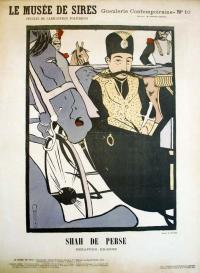
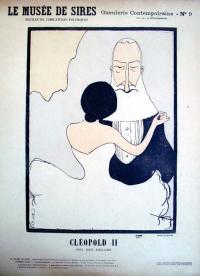
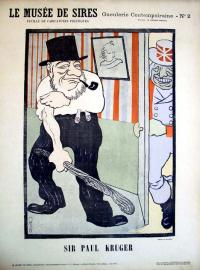
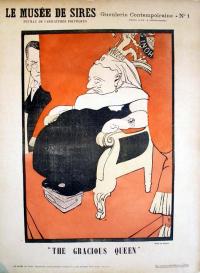
Around 1900, he completed a series of 13 lithographic posters for the writer/publisher Antonin Reschal at Librairie Parisienne Arnaud et Cie. They titled the set Le musée de sires, feuille de Caricatures Politiques (Museum of Lords or Rulers, sheets of political caricatures). My colleague Eduardo Tenenbaum offers a reading of the pun they make with the series title Gueulerie contempoiriane (after the series Galerie contemporaine): “gueule” (f.) in French is the muzzle or face of an animal, but in slang it means a person’s face or mouth, and is often used derogatorily. When used as a verb, “gueuler” can mean “to yell” or “to scream.” The phrase “gueulerie contemporaine” suggests to me humans braying like a bunch of animals, or in this case, politicians.

The rulers in this museum are surprisingly international in scope. Here are a few more:

Auguste Roubille (1872-1955), Shah de Perse, ca. 1900. Lithograph. GC103 French Political Caricatures Collection. Shah de Perse, Mozaffer Ed-Dine = Mozaffar ad-Din Shah Qajar (1853-1907) was the fifth Qajarid Shah of Persia, ruling from 1896 to 1907.

Auguste Roubille (1872-1955), Cleopold II, ca. 1900. Lithograph. GC103 French Political Caricatures Collection. Cléopold II. Roi des Belges = Leopold II (1835-1909) was King of Belgium, ruling from 1865 to 1909.


Auguste Roubille (1872-1955), Sir Paul Kruger, ca. 1900. Lithograph. GC103 French Political Caricatures Collection. Sir Paul Kruger = Paul Kruger (1825-1904) was President of the Transvaal Republic (South Africa), ruling from 1883 to 1900.

Auguste Roubille (1872-1955), The Gracious Queen, ca. 1900. Lithograph. GC103 French Political Caricatures Collection. “The Gracious Queen” = Queen Victoria (1819-1901), the longest-ruling monarch of the United Kingdom of Great Britain and Ireland, ruling from 1837 to 1901.

Louis Lozowick's "Steel Valley"

| No Comments
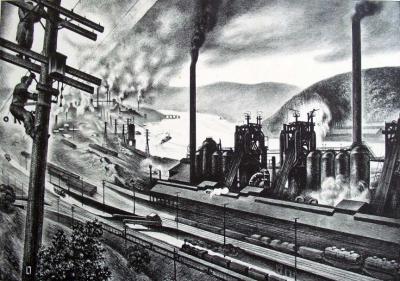
Louis Lozowick (1892-1973), Steel Valley, 1936. Lithograph. Edition of 15. Graphic Arts GA2007.01716

At the age of fourteen, Lozowick left his family in the Ukraine to join a brother living in New Jersey. He quickly learned English and studied painting and printmaking at the National Academy of Design in New York. Lozowick’s work has been labeled Precisionist (an American form of constructivism) and although he travelled extensively, it is the scenes of the new industrial age in the United States for which he is best remembered. Lithography was his medium of choice.

Lozowick moved to Berlin in the early 1920s where he was a member of the artists’ circle that included László Moholy-Nagy and El Lissitzky. He had his first solo show in Berlin at K. E. Twardy Book Shop, which led to a number of commissions as a graphic artist and illustrator.

By the time the depression hit, Lozowick was back in the United States. He joined the Graphic Arts Division of the Works Progress Administration where he was employed until 1940. He also taught lithography at the John Reed Club School of Art and was a founder of the New Masses (and eventually its art editor).

Lozowick was a good friend of Elmer Adler, the first curator of graphic arts at Princeton University, and Adler collected a small group of his lithographs, including this one, for the library. Several are signed and dedicated directly from Lozowick to Adler.

Brothers Ballantyne

| No Comments

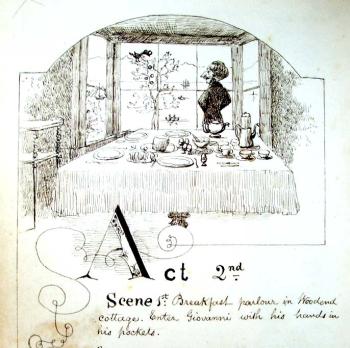
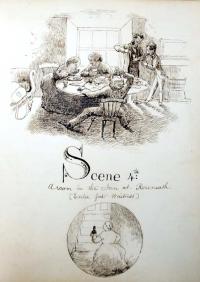
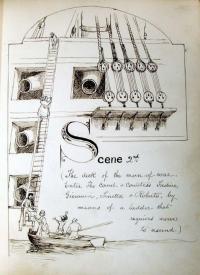
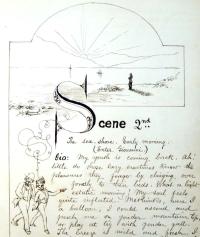
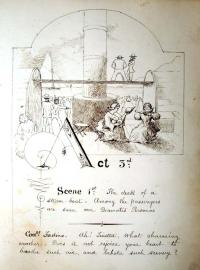
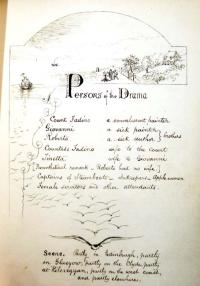
Robert Michael Ballantyne (1825-1894), The Invalids. A Tragedy (Edinburgh, 1859). Graphic Arts (GAX) 2010- in process.

These vignettes, historiated initials, and ink illustrations are for an unfinished entertainment by Robert Ballantyne, dedicated to Jane Macdonald, the wife of the Scottish painter John Faed (1819-1902). The Invalids was begun just three years after Ballantyne’s first published book (he went on to complete over eighty volumes) and is his only known attempt at drama or illustration.

The main characters are Count Fadino, a convalescent painter; Giovanni, a sick painter; and Roberto, a sick author. Roberto and Giovanni are the Ballantyne brothers, Robert and John. Fadino represents John Faed.

Robert’s brother John Ballantyne (1815-1897) was a portrait painter who played a significant role in Edinburgh’s art world. He was a founder and president of the Smashers, a sketching club, and preceptor of life classes at the Royal Scottish Academy. He completed at least seventeen portraits of London artists at work in their studios, including William Holman Hunt, John Millais, and David Roberts. Despite his success, John was primarily supported by Robert’s publishing income and the two worked closely on projects throughout their lives.

Victorian Grave Decoration

| No Comments

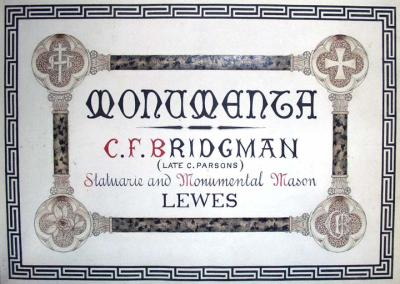
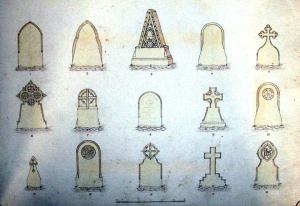
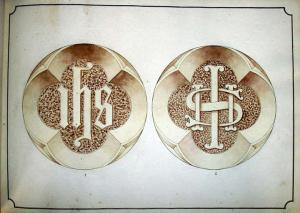
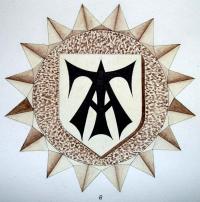
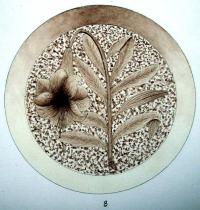
C.F. Bridgman, Monumenta (Lewes, ca. 1880). Red and black ink and watercolor wash. Graphic Arts GA2010- in process

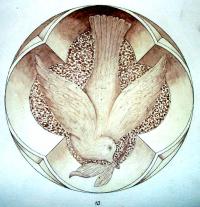
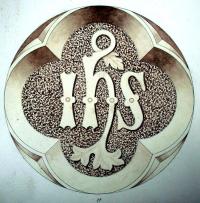
This pattern book for Victorian grave stone designs and stone roundels for grave ornaments contains eighty miniture designs with twelve large relief roundels. According to the antiquarian dealer Charles Wood, C.F. Bridgman was a well-known firm. Mr. Wood found this entry for them: http://www.rootschat.com/history/hastings/content/view/78/29/

The records of C.F.Bridgman, a firm of Stonemasons (formerly Parsons) based in Lewes from the early 18th century, were deposited in the East Sussex Records Office in 1965 by Hillman Sons, Vinall and Carter, Solicitors of Lewes, and consists of some 98 volumes of Ledgers, Day Books, Letter Books, Wage and Cash Books together with Classified Accounts which cover the period 1834-1959…

Hypochondriacs

| No Comments

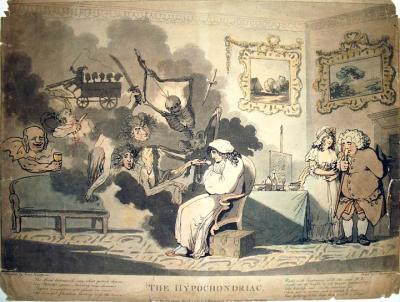
Princeton University’s science historian and an editor at Cabinet magazine, Professor D. Graham Burnett will be part of a panel entitled “The Art of Hypochondria” along with Brian Dillon and Marina van Zuylen on Tuesday, 9 February 2010, from 7:00 to 9:00 p.m. at The Kitchen, 512 West 19th Street, New York City. In honor of their talk, here are a few of our own hypochondriacs:

Thomas Rowlandson (1756-1827), The Hypochondriac, 1788. Etching. Graphic arts, GC112, Rowlandson Collection. Gift of Dickson Q. Brown, class of 1895. Inscribed: ‘The mind disemper’d - say, what potent charm, // Can Fancy’s spectre-brooding rage disarm? // Physics prescriptive, art assails in vain, // The dreadful phantoms floating cross the brain! - Until with Esculapian skill, the sage M.D. // Finds out at length by self-taught palmistry, // The hopeless case - in the reluctant fee, // Then, not in torture such a wretch to keep // One pitying bolus lays him sound asleep.’


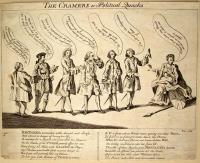
Anonymous, The Cramers or Political Quacks, ca. 1762. Etching. Graphic arts, GC021 British Cartoons and Caricatures Collection. Gift of Dickson Q. Brown, class of 1895. “Britannia tormented with discord and Strife … For Poison lurks their and deconstruction ensues”.


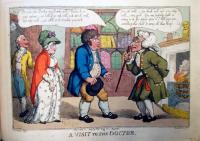
Thomas Rowlandson (1756-1827), after a design by George Moutard Woodward (ca. 1760-1809), A Visit to the Doctor, no date. Etching. Graphic arts, GC112 Thomas Rowlandson Collection. Gift of Dickson Q. Brown, class of 1895.


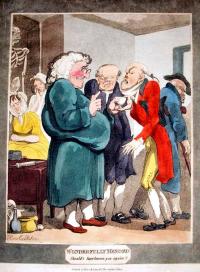
Thomas Rowlandson (1756-1827), Wonderfully Mended. Should’t Have Known You Again!!, 1808. Etching. Graphic arts, GC112 Thomas Rowlandson Collection. Gift of Dickson Q. Brown, class of 1895.


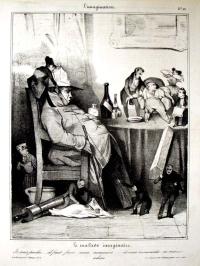
Charles Ramelet (1805-1851) after a design by Honoré Daumier (1808-1879), Le malade imaginaire. Je suis perdu…. il faut faire mon testament……. ils vont m’ensevelir… m’enterrer…. adieu!, 1833. Lithograph. Graphic arts, GA 2009.00086. Gift of William H. Helfand. From the series L’Imagination, no. 10 published in Le carivari May 21, 1833.


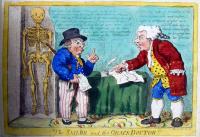
Isaac Cruikshank (1764-1811), after a design by George Moutard Woodward (ca. 1760-1809), The Sailor and the Quack Doctor, 1807. Etching. Bound with Caricature magazine, v. 1. Graphic arts, Rowlandson R 1807.51F. Gift of Dickson Q. Brown, class of 1895.


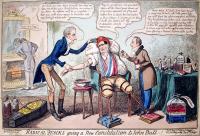
George Cruikshank (1792-1878), Radical Quacks Giving a New Constitution to John Bull, 1821. Etching. Graphic arts, GC022 Cruikshank Collection. Gift of Richard W. Meirs, class of 1888. “Designed by an Amateur. May 25, 1820.”
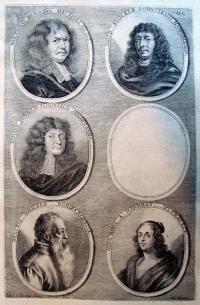
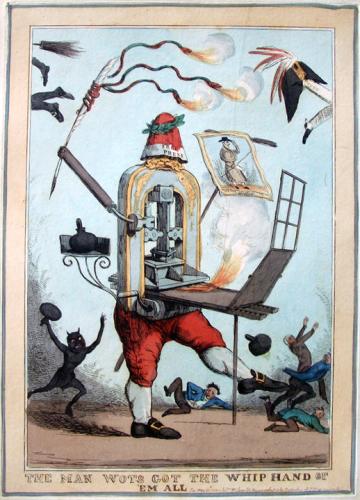
William Heath (1795-1840), The Man Wots Got the Whip Hand of ‘Em All, 1829. Hand-colored etching. Graphic Arts British Caricature.

This amazing etching was designed by William Heath (not to be confused with Henry Heath), one of the most underappreciated of the British caricaturists. According to the DNB, from 1825 to 1826, “Heath was in Scotland, writing and illustrating the first magazine in the world to be given over, predominantly, to caricatures: The Glasgow Looking Glass, later the Northern Looking Glass….” (Ex Oversize Item 3584659q)

When Heath returned to London in 1827, he began signing his prints with a drawing of the actor Liston in the role of Paul Pry from John Poole’s 1825 comedy. However the signature (and his engaging designs) attracted so many plagiarists that Heath was forced to abandon it in 1829.

Among the prints that attracted so much attention in the spring of 1829 were a series of satires on the question of Catholic emancipation featuring King George IV, Prime Minister Wellington, and Lords Eldon and Brougham. Titles included The Slap-Up Swell Wot Drives When Ever He Likes, The Guard Wot Looks After the Sovereign, The Man Wot Drives the Opposition, The Cad Wots Been Appointed Rat-Catcher to the Sovereign, and The Man Wot’s Been Made Foreman to the British, among others.

This print, The Man Wots Got the Whip Hand of ‘Em All, depicts a Stanhope Press with the legs of King George. It wears a cap of Liberty inscribed Free Press and holds a giant pen with fire-spitting serpents. Prime Minister Wellington’s departing legs and hat are seen at the top right, while the legs and buckled shoes of Lord Eldon are seen at the left. A print titled The Man Wot Drives the Sovereign (another by Heath) is about to be burned by the flames of the ‘free press.’ Note the printer’s devil with an ink ball bottom lower left.

The Graphic Arts division several dozen prints by Heath, along with his illustrated books. Here are a few others.

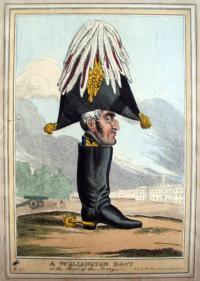
A Wellington Boot or the Head of the Army, 1827. Hand-colored etching. Graphic Arts British Caricature

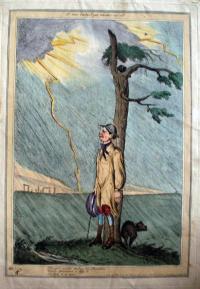
I Was Lucky I Got Shelter At All, 1825-1830. Hand-colored etching. Graphic Arts British Caricature

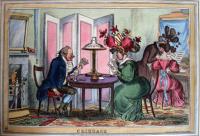
Cribbage, 1825-1830. Hand-colored etching. Graphic Arts British Caricature

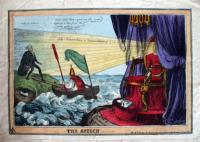
The Speech, 1828-1830. Hand-colored etching. Graphic Arts British Caricature

Wilson's Triple Wall of Privilege

| No Comments
Fred G. Cooper (1883-1962), Untitled [Woodrow Wilson], 1913. Pen, ink wash, and gouache drawing. Graphic Arts GA2009.00463

Cooper designed this political cartoon in response to Woodrow Wilson (1856-1924) and his 1913 “triple wall of privilege,” which sought to reorganize the tariffs, the banks, and the trusts in the United States. During the first year of his presidency, Wilson proposed the Underwood Tariff Bill to help lower the general rate from about 40% to 26%. This led to the first American income tax, based on a graduated scale that started on incomes over $3000. Wilson also put into place the Federal Reserve Act, with a Federal Reserve Bank in each of twelve regions. Finally, he focused on the reorganization of trusts and after much convincing, the Clayton Anti-Trust Act of 1914 was passed banning price discrimination.

Fred G. Cooper was born in Oregon and educated at the Mark Hopkins Art Institute in San Francisco, before moving to New York City in 1904 to find work as a freelance artist. He created designs for New York Edison (or ConEd), Westinghouse, and the U.S. War Department, among many others. This cartoon was probably for Life magazine, where he contributed drawings from 1904 to the 1930’s, although I have not yet found the issue.

(btw: The year after this cartoon was published, Cooper was one of fourteen graphic artists to form the American Institute of Graphic Arts (AIGA), along with Frederic W. Goudy, Hal Marchbanks, and William Edwin Rudge. The only membership requirement, besides $25 dues, was that each member had to buy his own Windsor chair.)

Candlelight Compositions

| No Comments

William Pether (ca. 1738-1821), after a painting by Joseph Wright of Derby (1734-1797), The Philosopher Reading a Lecture on the Orrery, 1768. Mezzotint. Graphic Arts GA 2005.01523

British painter Joseph Wright of Derby is best known for two oil paintings, A Philosopher Giving a Lecture on the Orrery in which a Lamp is put in Place of the Sun (ca. 1764-1766) and Experiment on a Bird in the Air Pump (1768). Each employs a strong, realistic light source to produce a dramatic scene with heightened areas of light and shadow; the age of enlightenment made visible. These scenes of bright whites and rich blacks were nicknamed candlelight compositions and their popularity was amplified when large-scale mezzotint reproductions were printed and sold.

We call the artist Wright of Derby to distinguish him from artists Richard Wright (1735-ca. 1775) and Joseph Wright (1756-1793), also exhibiting around the same period. Wright of Derby’s Philosopher (Art Gallery at Derby, Derbyshire, England) presents a lecture on the movement of the planets around the sun, using a mechanical model called an orrery. The figures may represent the collector who bought the painting, Washington Shirley, 5th Earl Ferrers, along with his friends and family. The lecturer is reminiscent of Isaac Newton, whose theories on the movement of the planets and universal gravitation were published in 1687. There is a portrait of Newton by Godfrey Kneller that may have been the inspiration for this figure (http://www.newton.ac.uk/art/portrait.html).

Graphic Arts’ impression of this print, along with an orrery, will be on view in the Milberg Gallery beginning February 7 in the exhibition: Envisioning the World.

For more information, see Elizabeth E. Barker, “New Light on The Orrery: Joseph Wright and the Representation of Astronomy in 18th-century Britain,” British Art Journal 1, no. 2 (Spring 2000): 29-37.

Washington at Princeton

| 1 Comment
Nathaniel Currier (1813-1888), Washington at Princeton January 3d 1777, 1846. Color lithograph. Gift of Edward L. Howe. Graphic Arts Portraits of George Washington Collection.

Inscribed: “At this important crisis, the soul of Washington rose superior to danger, seizing a standard he advanced uncovered before the columns and reigning his steed towards the emeny with his sword flashing in the rays of the rising sun, he waved on the troops behind him to the charge. Inspirited by his example the Militia sprang forward and delivered an effective fire which stopped the progress of the enemy.”

See also: Currier & Ives: a Catalogue Raisonne (Detroit: Galer Research, 1983). No. 5420. Graphic Arts Oversize GA NE2312.C8 A4 1983q

Audubon's pastels

| No Comments
John James Audubon (1785-1851), Red-Shouldered Falcon (Red-Shouldered Hawk), 1809. Pastel and pencil. Graphic Arts GC154. Gift of Edwin N. Benson, Jr., Class of 1899 and Mrs. Benson in memory of their son, Peter Benson, Class of 1938.

This pastel represents one of Audubon’s early attempts at drawing the various species of the birds of America. He began by using pastels, moved to watercolors, and the final published albums contain hand-colored aquatints. A later watercolor version (in the New York Historical Society) was used for the engraving by Robert Havell that became plate 56 of the Birds of America. The descriptive text for this plate reads: “Red-shouldered Hawk, Falco Lineatus, Gmel., Male, 1. Female, 2.; issued in 1829” as listed in Ornithological Biography, I, 296-99.

Inscribed “Falls of the Ohio, 29th November, 1809,” Princeton’s drawing was eliminated from the final selection by 1824, the year when Audubon sold it and others to his newly discovered friend Edward Harris (1799-1863). Harris not only paid Audubon $30 for the drawings but gave the artist an extra $100, saying “such men ought not to want for money.”

For an extended essay about this pastel, see The Princeton University Library Chronicle 15, no. 4 (Summer 1954): 169-78. http://libweb5.princeton.edu/visualmaterials/pulc/pulcv15n_4.pdf

An Insane American

| No Comments
George Cruikshank (1792-1878), after a sketch by George Arnald (1763-1841), William [James] Norris: an Insane American. Rivetted Alive in Iron, & for Many Years Confined, in that State, by Chains 12 Inches Long to an Upright Massive Bar in a Cell in Bethlem. Published by William Hone, London, July 1815. Etching with aquatint. Gift of Richard W. Meirs, class of 1888. Graphic Arts GC022 Cruikshank Collection.
Founded in 1247, Bethlem was a priory for the sisters and brothers of the Order of the Star of Bethlehem. It was first used as a hospital in 1330 and first housed patients recorded as “lunatics” in 1403. During the 18th century, the asylum, now nicknamed Bedlam, was opened to public visitors, a penny each and free on the first Tuesday of the month. 96,000 visitors were recorded in 1814.

One such visitor that year was the philanthropist, Edward Wakefield (1774-1854). He was shocked to see James (reported as William) Norris (17??-1814), once an American seaman, now chained to his bed. Norris had been admitted in 1800 and so terrorized the small staff that in June 1804 he was permanently confined in an iron harness. Ten years later when Wakefield visited, Norris was still in the same spot.

Norris’s isolation and constraints were described at the time:

A stout iron ring was riveted round his neck, from which a short chain passed through a ring made to slide upwards and downwards on an upright massive iron bar, more than six feet high, inserted into the wall. Round his body a strong iron bar about 12 inches wide was riveted; on each side of the bar was a ring; which was fashioned to and enclosed each of his arms, pinioned them close to his sides.

Wakefield was joined by William Hone (1774-1854) and James Bevans (1780-1842) to campaign for change in the conditions for patients, not only in Bedlam but throughout England. Their work led to the formation of the Committee on Madhouses in April 1815. Cruikshank was hired to etch Norris’s portrait, including the inscription: Sketch from the Life in Bethlem, 7th June 1814, by G. Arnald, Esq., A.R.A. Etched by G. Cruikshank from the Original Drawing Exhibited to the Select Committee of the House of Commons on Madhouses, 1815.

Although Norris was removed from his shackles, he died within a few months. Bedlam was closed and the facility moved to a new home in Lambeth (today the home to the Imperial War Museum). For more on the history of the Bethlam hospital, see: http://www.rcplondon.ac.uk/history-heritage/exhibitions/Past-exhibitions/inside-bedlam/Pages/Overview.aspx

The Repeal, or The Funeral Procession of Miss Americ-Stamp

| No Comments

After Benjamin Wilson (1721-1788), The Repeal, or the Funeral of Miss Americ-Stamp, 1766. BM 4140 copy B. Engraving with etching and contemporary hand coloring. Graphic Arts GA 2010. in process.

The Stamp Act of 1765 generated intense opposition with the American colonists, who called for a boycott of British imports. Needing the revenue from American trade, the British Parliament voted to repeal the Stamp Act in 1766.

The Marques of Rockingham, only recently named Prime Minister, had the difficult job of convincing Parliament of the benefits of this repeal. To help sway public opinion, he commissioned the artist Benjamin Wilson (1721-1788) to draw two satirical prints. The first, published in February 1766, was titled The Tombstone and showed leading “hard liners” dancing on the tomb of the Duke of Cumberland. The second, seen here, was published on March 18, the day Parliament voted the repeal.

The main focus of the print is a funeral procession of Stamp Act supporters carrying a child’s coffin (the Act was only four months old). At the lead is William Scott or Anti-Sejanus, who reads from a sermon. Scott is followed by Solicitor-General Wedderburn and Attorney General Fletcher Norton, carrying flags that display the vote against the repeal; then George Grenville, Lord Bute, Lord Temple, Lord Halifax, and Lord Sandwich. They walk along a harbor that represents the Rockingham ministry with three ships labeled “Conway,” “Rockingham,” and “Grafton.”

Benjamin Franklin was a friend of Wilson and when he received a copy of the print, Franklin wrote, “I think he was wrong to put in Lord Bute, who had nothing to do with the Stamp Act. But it is the Fashion to abuse that Nobleman, as the Author of all Mischief.”

The Repeal quickly became “the most popular satirical print ever issued” according to R.T. Haines Halsey, “Impolitical Prints,” Bulletin of the New York Public Library 43, no.11 (Nov. 1939). Within three days the publisher issued an advertisement requesting patience because he could not keep up with all the orders he had received. Within the week other print sellers were issuing their own versions of Wilson’s scene.

According to the Dictionary of National Biography’s entry on Wilson, the print was titled “The Repeal; or, the Funeral of Miss Ame-Stamp. It was sold for one shilling and brought Wilson 100 pounds in four days. On the fifth day it was pirated, and two inferior versions produced at six-pence.” The British Museum’s catalogue identifies the original etching and six variant editions, A-F.

Graphic Arts recently acquired an excellent impression of copy B, a reduced, chiefly engraved version of Wilson’s print. Processional figures are reproduced on the same scale as the original but the background buildings and ships are altered to fit on a smaller sheet. A descriptive text, once sold separately, is here engraved below the image along with a slightly altered title, now “Americ-Stamp”.

See a copy of [An act for granting and applying certain stamp duties] (London: Printed by Mark Baskett, 1765). Rare Books, William H. Scheide Library (WHS) 16.5.9

E.P. Richardson, “Stamp Act Cartoons in the Colonies,” The Pennsylvania Magazine of History and Biography 96, no. 3 (July 1972).

Tableau des papiers monnoies

| No Comments
François Bonneville (active 1787-1810), Tableau des papiers monnoies qui ont eut cours depuis l’époque de la Révolution Française, Published Paris: François Bonneville, 1797. Hand-colored engraving. Graphic Arts GA 2009.01180

On February 19, 1796, a bonfire of money was built and then burned on Paris’s Place des Piques. The bills were assignat, the state bond used as the national currency since 1789. According to Richard Taws, the ritual incineration of the assignats “signaled a rupture … intended to register a self-conscious break with the past.” In the months following, a number of trompe l’oeil engravings of crumbled, old assignats began to circulate throughout Paris. The example shown here, both engraved and published by François Bonneville, shows a group of scattered bills, perhaps tossed in a gesture of despair at their worthlessness during that period of hyperinflation.

For more, see Richard Taws, “Trompe-l’Oeil and Trauma: Money and Memory after the Terror,” Oxford Art Journal 30, no. 3 (2007)

The Brazen Image of Pitt

| No Comments

Charles Williams (1797-1830), The Brazen Image Erected on a Pedestal Wrought by Himself, 1802. Hand-colored etching. Published by S W Fores, London. Graphic Arts (GAX) Rowlandson Collection. Gift of Dickson Q. Brown, Class of 1895.

This caricature shows a statue of William Pitt, the Younger (1759-1806), a British politician who, at the age of twenty-four, became the youngest Prime Minister of England. The yellow Pitt stands on a pedestal whose base reads: Increase of National debt 250-000-000. The stone under the statue says: Sic itur ad astra (thus you shall go to the stars), Income Tax. Smaller blocks are inscribed: Horse Duty, Tax on Beer, Tax on Malt, Additional House Tax, Additional Window Tax, Hat Duty, and so on. Pitt holds papers in his right hand marked ‘Budget” and at his left is a rudder decorated with a dolphin.

To the left of the statue stands Charles James Fox (1749-1806), a prominent British Whig statesman and the arch-rival of Pitt. With him is the playwright Richard Brinsley Sheridan (1751-1816) who was also a Member of Parliament aligned with the British Whig Party. Fox says: “That Brass countenance of his never shone with more conspicuous confidence, one would think he was in the very [?] of proposing a new Tax.” Sheridan says: “There’s a Monument of Integrity, his Works not only follow, but support him, Nebuchadnazzars Brazen Image was nothing to it, Nor his people half so Idolatrous.”

The opposite pair is John Bull (the personification of England) and his wife Hibernia. He says: “Odzooks there’s the dear Image - , the promoter of our Union, and I suppose that there Writing there, is the account of all his wonderfull Works”. She says: “Why Mr Bull I thought he was the greatest Man we ever had, but its all Bodder, why by St Patrick, Mr OBrien (the Irish Giant) [i.e. Patrick Cotter] would make Six of him.”

The Assault, or Fencing Match

| No Comments
Victor Marie Picot (1744-1805), after a painting by Charles Jean Robineau (active by 1780, died ca. 1787), The Assaut, or Fencing Match, which took place at Carton House on the 9th of April, 1787, [1789]. Stipple engraving with aquatint. Graphic Arts Rowlandson collection. Gift of Dickson Q. Brown, Class of 1895.

A 1787 fencing match between a man and a woman in the elegant rooms of Carlton House, London, before the Prince of Wales might seem like an unusual scene in itself but this is only the beginning of the intrigue.

The Prince had arranged this fencing demonstration between Mademoiselle d’Eon, seen on the right, and Monsieur de Saint George, on the left. It hardly mattered who won (and records vary as to the facts) since it was to spectacle of the two individuals that brought the audience to the match that day.

The figure on the right is Charles Geneviève Louis Auguste André Timothée d’Éon de Beaumont (1728-1810), commonly known as the Chevalier d’Eon, who lived the first half of his life as a man and the second half as a woman. He served as a spy to Louis XV, travelled extensively, and seemed to encourage the speculation that he was a woman in men’s clothing. By 1770, while living in London, d’Eon negotiated his return to France by happily agreeing to dress only as a woman.

The fencer on the left is Joseph de Bologne de Saint-Georges or the Chevalier de Saint-Georges (1745-1799), who was the son of a wealthy plantation owner in the French West Indies colony of Guadeloupe and one of his African slaves named Anne. Joseph was raised as a French African and lived under the barriers of people of color at that time in France. He studied and became a champion fencer as well as a composer and conductor. He was also one of the first Black Masons in France and founded the Société des amis des noirs (Society of the Friends of Black People).

By 1787, d’Eon had returned to London and made a meager living giving fencing demonstrations, such as this one with the visiting Saint-Georges, who was nicknamed “The God of Arms.” D’Eon was fifty-nine and Saint-Georges was forty-eight.

The French artist Charles Jean Robineau captured the match in an oil painting, which is today owned by Her Majesty Queen Elizabeth II and held in the Royal Collection, RCIN 400636. http://www.royalcollection.org.uk/egallery/object.asp?maker=12234&object=400636&row=3

The French printmaker Picot reproduced and published Robineau’s painting as an engraving. A superb copy of this print was given to Princeton University by Dickson Q. Brown, Class of 1895, who was a collector of British caricature and believed it had been made by James Gillray.

For more information, see Gary Kates, Monsieur D’Eon is a Woman: a Tale of Political Intrigue and Sexual Masquerade (New York: Basic Books, 1995). Firestone Library (F):, DC135.E6 K37 1995

Pierre Bardin, Joseph, sieur de Saint-George: le chevalier noir ([Paris]: Guénégaud, [2006]) Firestone Library (F), DC137.5.S35 B37 2006.

Also of interest is d’Eon’s autobiography, written under the pseudonym M. de La Fortelle (1735?-1799), La vie militaire, politique et privee de demoiselle Charles-Genevieve-Louise-Auguste-Andree-Timothee Eon ou d’Eon de Beaumond … (Paris, 1779). Rare Books (Ex), 1509.171.327.55

The British Bee Hive

| No Comments

One of the last copper plate etchings George Cruikshank completed was this taxonomy of British society in the form of a beehive. Originally drawn in 1840, Cruikshank did not etch the design until February 1867, self-publishing the print in March of the same year. Graphic arts holds not only the original copper plate but also one of Cruikshank’s first pencil sketches for the print.

According to George Reid, the print “represents English society as it exists, and the folly of interfering with such a noble structure by means of Parliamentary Reform. The section displays fifty-four ‘cells,’ with each class and trade represented, from the royal family to the omnibus conductor, and having for a foundation the army, the navy, and the volunteers; surmounted by the crown, with the royal standard on one side, and the union jack on the other.” If you look closely, you will find book sellers in the middle left section.

Cohn notes that the print was sold by William Tweedie for one pound, uncolored. It was subsequently issued printed on a double sheet of letterpress, entitled A Penny Political Picture for the People.


George Cruikshank (1792-1878), The British Bee Hive [Preliminary sketch], 1840. Cohn 957. Pencil on paper. Graphic Arts, Cruikshank collection.

George Cruikshank (1792-1878), The British Bee Hive [copper plate], 1867. Cohn 957. Signed and dated in plate, l.r.: ‘Designed in the // year 1840 by // George Cruikshank // and altered & etched by him // in Febr. 1867 - & pubd. In March/67.’ Graphic Arts GA 2009.01179

1 2 3 4 5 6 7 8 9 10 11 12 13 14 15 16 17 18 19

Recent Comments

  • Isabel Ribeiro: Thank you for your reply. I would indeed love to read more
  • Isabel Ribeiro: Gorgeous! Is there any way to access the rest of read more
  • S. Scudder: Mary Stilwell is my ggg-grandmother ... thank you for posting read more
  • V.E.G.: James Franklin, Benjamin Franklin's half-brother is a direct descendant of read more
  • Bob Fleck: Nice comments and well worth it. read more
  • N. Sutherland: Do you have any further biographical material on this Thomas read more
  • john W: Have the complete collection of EA Seguy papillons including front read more
  • Vermathio: algarabia, charabia et Picabia. Le premier désigne la langue read more
  • Matt SCOVILL: I have the complete "bookplates in Japan" box. I am read more
  • Daniel Joseph Bobroff: April 30, 2013 To Princeton University: This is a Plaintiff read more