Recently in Illustrated books Category

Julia Margaret Cameron and Alfred Lord Tennyson

| 2 Comments

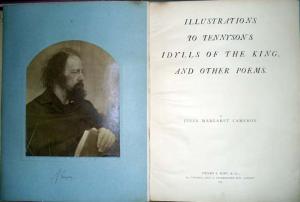
Julia Margaret Cameron (1815-1879), Illustrations to Tennyson’s Idylls of the King, and other poems (London: Henry S. King, 1875). volume 1, 12 albumen silver prints. Graphic Arts Collection (GAX) Oversize 2007-0055F. Purchased with David H. McAlpin Fund of the Art Museum, Friends of the Library Fund, and the Elmer Adler Memorial Fund. 1974.


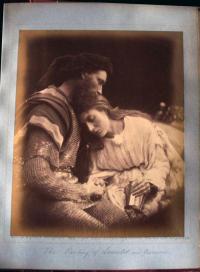
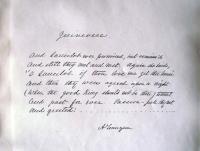
“The Parting of Sir Lancelot and Queen Guinevere,” 1874. Albumen silver print. Idylls of the King and Other Poems


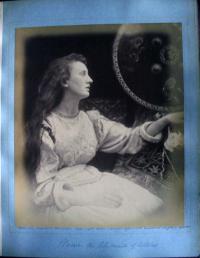
“Elaine, the Lily Maid of Astolat,” 1874. Albumen silver print. Idylls of the King and Other Poems

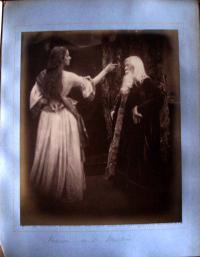
“Vivien and Merlin,” 1874. Albumen silver print. Idylls of the King and Other Poems

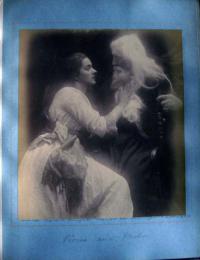
“Vivien and Merlin,” 1874. Albumen silver print. Idylls of the King and Other Poems

In the summer of 1874, Julia Margaret Cameron (1815-1879) was living next door to Alfred Lord Tennyson (1809-1892) at Farringford, Freshwater, on the Isle of Wight. Tennyson had taken “Morte D’Arthur” published in 1842 and expanded it into “Idylls of the King” in 1859. He asked Cameron to make illustrations for a new publication of these poems and she produced over 200 prints from wet-plate collodion-on-glass negatives. Unfortunately, the publisher chose only two to be reformatted as wood-engravings and even those did not reproduce well in the final book.

At Tennyson’s encouragement, Cameron went on to produce a book of her own with albumen silver prints interspersed with texts by Tennyson lithographed from Cameron’s hand-writing. The first volume appeared in January 1875 and the second in May, selling for six guineas. The frontispiece for each volume was a portrait of Tennyson dressed as “The Dirty Monk,” dated 1869.

Cameron wrote, “My aspirations are to ennoble Photography and to secure for it the character and uses of High Art by combining the real and ideal sacrificing nothing of Truth by all possible devotion to Poetry and beauty.”

Alfred Lord Tennyson (1809-1892), Idylls of the King (London: E. Moxon, 1859). Contents: Enid. - Vivien. - Elaine. - Guinevere. PUL nine copies available

Imatgeria Religiosa

| No Comments


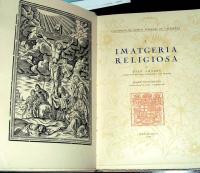
Joan Amades and Josep Colomines, Imatgeria Religiosa (Barcelona: Gregori, 1947). Series: Col’leccio de Boixos Populars de Catalunya, I. Religious iconography of Spanish works held in Catalan collections. Graphic Arts (GAX) 2009- in process

Printed Illumination

| No Comments

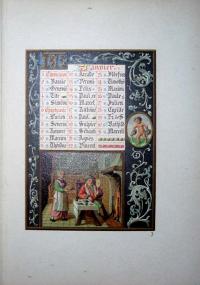
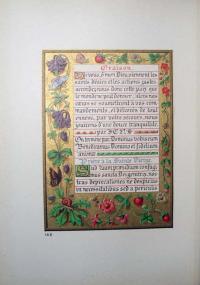
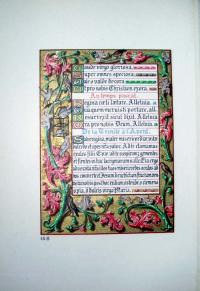
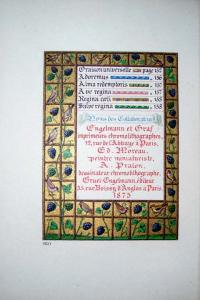
Livre d’heures [Book of hours] (Paris: Engelmann et Graf, 1875). Graphic Arts (GAX) 2009- in process

The nineteenth-century French artist Godefroy Engelmann I (1788-1839) studied painting at the Académie des Beaux-Arts but turned his talent to printmaking when he was introduced to the new medium of lithography in 1813. On a trip to Munich, Engelmann purchased a press, stones, and all the equipment needed to set up a studio, which he did in Mulhouse, France, followed by presses in Paris and in London.

Engelmann excelled at color lithography which reproduced the look of chalk drawings and oil paintings for fine art prints. In his twenty years of production, he was responsible for most of the major technical developments of the medium, publishing two important treatises, Manuel du dessinateur lithographe (1822) and Traité théorique et pratique de lithographie (1835-40).

Engelmann’s son Godefroy II (1814-1897) joined the firm in 1837, and merged the business with the publisher Graf to form ‘Engelmann et Graf’. The firm quickly established itself as the leading company in France for the printing of facsimiles of illuminated manuscripts, such as this chromolithographic book of hours.

Parabaik of Myanmar

| 2 Comments


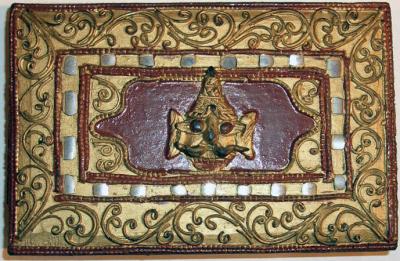
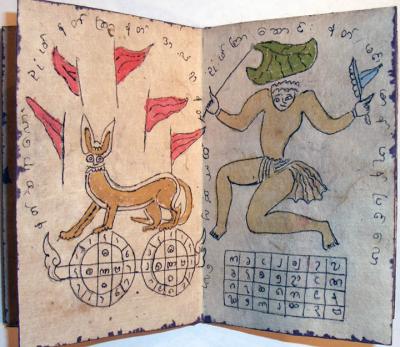
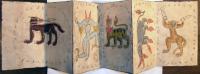
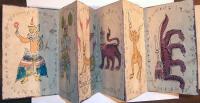
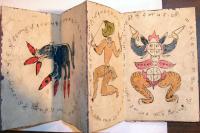
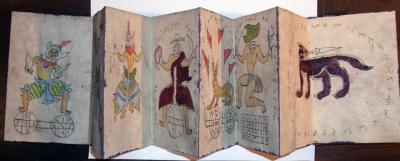
This tiny folded-paper book or parabaik (also spelled parabeik) came to the department with no attribution or provenance. It is untitled and constructed in the traditional Burmese/Myanmar manner, with the heavy paper cut and pasted into one long strip, then folded accordion style and attached to wood boards. The binding has an identical relief decoration on either side, ornamented with glass facets.

The hand-painted text, written in a round Burmese hand, forms circles around animal figures, astrological symbols, and runes. Although we do not have an expert on campus who has been able to translate this lovely volume, the characters do not appear to form complete sentences, but are perhaps the sounds or syllables that form magical chants or charms.

Untitled book of charms [parabaik], 20th century. Gift of Alfred L. Bush. Graphic Arts (GAX) 2009- in process

Mizraïm

| No Comments
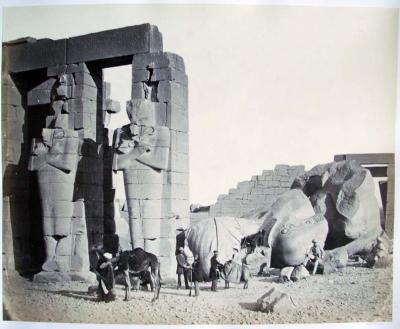
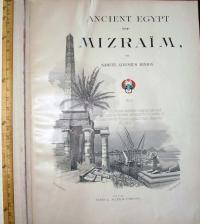
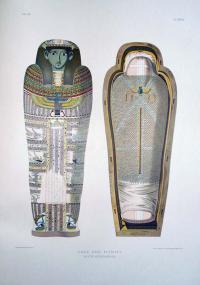
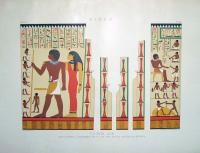
Samuel Augustus Binion (1853-1914), Ancient Egypt or Mizraïm (New York: H.G. Allen, c1887). Copy no. 2 of 800. Graphic Arts Collection (GAX) Oversize Rm 2-15-G, cabinet 32(F16)

“Henry G. Allen and Co., 156 Fifth Avenue, New York, have just published Ancient Egypt or Mizraïm, a work begun seven years ago by Samuel Augustus Binion. It is profusely illustrated with colored plates and rich engravings and the edition de luxe is limited to 800 copies. The purpose of the book is to present the history of Egypt and Egyptian art, which will illustrate and describe the wonders of Egyptian architecture in the most thorough manner, and in size sufficiently large to enable the artist to give faithful restorations of the architecture, ornamentations, hieroglyphics, and decorations in their original colors and in form convenient for the private as well as the public library.” Publisher’s Weekly July 25, 1896.

What is Mizraim?
miz’-ra-im (mitsrayim): (1) A son of Ham, and ancestor of various peoples, Ludim, Anamim, etc. (Gen 10:6,13; 1 Ch 1:8,11). (2) The name of Egypt. The land of Ham.—cham, was another name for the land of Egypt. It occurs only in Ps 105:23,17; 106:22; Ps 78:51 probably refers to the land of Ham, though it may refer to the children of Ham. -James Orr, “Definition for MIZRAIM,” International Standard Bible Encyclopedia

The Well-Equipped Printing Shop

| No Comments

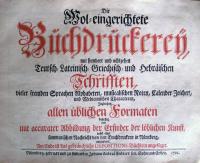
Johann Heinrich Gottfried Ernesti (1664-1723), Die wol-eingerichtete Buchdruckerey: mit hundert und achtzehen teutsch-, lateinisch-, griechisch-, und hebräischen Schrifften, vieler fremden Sprachen Alphabeten, musicalischen Noten, Calender-Zeichen, und medicinischen Characteren, ingleichen allen üblichen Formaten bestellet… (Nürnberg: Gedruckt und zu finden bey Johann Andreä Endters seel. Sohn und Erben, 1721). Graphic Arts Collection (GAX) Oversize 2006-0269Q

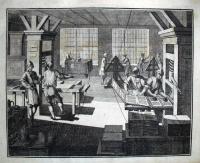
This German printers’ manual describes an early 18th-century printing office. The shop, first owned by Michael Endter (fl. 1653-1662) and his family, was purchased by Johann Ernesti in 1717. As seen in the engraved frontispiece, Ernesti had two working presses. One is engraved with the dated 1440, for the beginning of printing, and the other 1730, to signify the printing of this issue of the manual. Nine men are working inside the shop setting the type, proofreading the copy, and printing the pages.

The manual begins with thirteen biographies and engraved portraits of early printers, including Laurens Janszoon Koster (ca. 1370-ca. 1440), Johannes Gutenberg (ca. 1398-1468), Johann Fust (ca. 1400-1466), Aldus Manutius (1449/1450-1515), Christophe Plantin (ca. 1520-1589), among others.

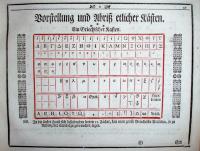
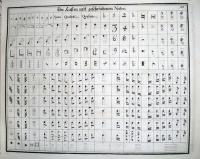
Over one hundred type specimens are introduced, including 47 Black Letter, 21 Roman, 14 Italic types, as well as Slavic, Greek, and Hebrew fonts. In addition, there are special calendar symbols, astrological signs, and engraved music fonts.

How to Reform a Country

| No Comments

Jonathan Swift (1667-1745), Voyages de Gulliver dans des contrées lointaines; édition illustrée par J.J.Grandville (1803-1847) (Paris: H. Fournier ainé, 1838). Graphic Arts Collection (GAX), 2005-2172N

A Voyage To Laputa, Chapter 6. The Author proposes some Improvements which are honorably received.

I told him… the Bulk of the People consisted wholly of Discoverers, Witnesses, Informers, Accusers, Prosecutors, Evidences, Swearers…. The Plots in that Kingdom are usually the Workmanship of those Persons who desire to raise their own Characters of profound Politicians…to fill their Coffers with Forfeitures; and raise or sink the Opinion of public Credit.

It is first agreed and settled among them, what suspected Persons shall be accused of a Plot: Then, effectual Care is taken to secure all their Letters and other Papers, and put the Owners in Chains. These Papers are delivered to a Set of Artists, very dexterous in finding out the mysterious Meanings of Words, Syllables and Letters.

For Instance, they can decipher a Close-stool to signify a Privy-Council; a Flock of Geese, a Senate; a lame Dog, an Invader; the Plague, a standing Army; a Buzzard, a Minister; the Gout, a High Priest; a Gibbet, a Secretary of State; a Chamber pot, a Committee of Grandees; a Sieve, a Court Lady; a Broom, a Revolution; a Mouse-trap, an Employment; a bottomless Pit, the Treasury; a Sink, a C—-t; a Cap and Bells, a Favorite; a broken Reed, a Court of Justice; an empty Tun, a General; a running Sore, the Administration.

Full text in English: http://www.jaffebros.com/lee/gulliver/contents.html

Rules and Examples of Perspective Proper

| No Comments

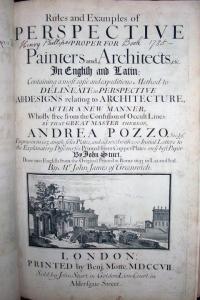
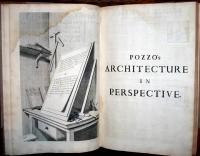
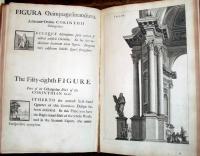
Andrea Pozzo (1642-1709), Rules and Examples of Perspective Proper for Painters and Architects, etc. in English and Latin: Continuing a Most Easy and Expeditious Method to Delineate in Perspective all Designs Relating to Architecture, After a New Manner Wholly Free from the Confusion of Occult Lines… (London: Printed by Benj. Motte: Sold by John Sturt …, 1707). Graphic Arts Collection (GAX) Oversize 2007-0007F

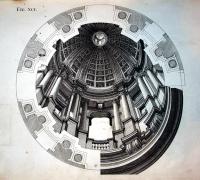
Andrea Pozzo was a remarkable Italian painter and architect of the Baroque period. Known for his frescoes using illusionist perspective, Pozzo’s most dramatic work can be found in Rome in the painting of the dome, apse, and ceiling of the Church of S. Ignazio (1685-1694). As this project was being completed, Pozzo wrote down instructions for his particular technique of perspective in a manual entitled Perspectiva pictorum et architectorum, published in 1693.

As one of the earliest manuals on perspective for artists and architects, the book went through many editions and translations, from the original Latin and Italian into French, German, English, and, Chinese. The text was noted for the clarity and the precision of its explanations of perspective, making it accessible to architects and artists alike. A cherished volume in any library, Pozzo’s book has been called “the most elaborate and expensive architectural book ever produced ….”


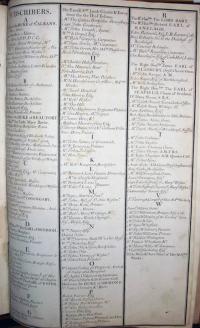
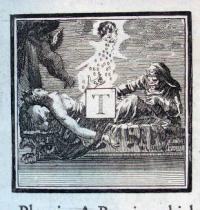
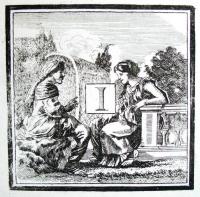
The first English edition came in 1707 under the title Rules and Examples of Perspective Proper…, translated by the architect John James (ca. 1672-1746) and published by Benjamin Motte Sr. (died 1710). This edition has over one hundred folio engravings along with 208 historiated initials John Sturt (1658-1730). 161 subscribers are listed on an engraved plate bound into the final book, including many prominent artists, architects, printers, businessmen, and politicians.

Paul Landacre

| 2 Comments

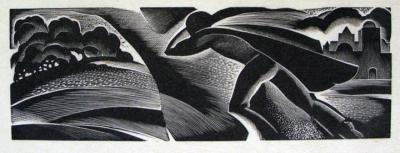
Jake Zeitlin (1902-198) moved to Los Angeles in 1925 and in only two years, was operating one of the most popular bookstores in the city. Nicknamed At the Sign of the Grasshopper because of the symbol on the front, the shop became a local hangout for writers and artists, who browsed the shelves and enjoyed works of visual art in the shop’s small gallery.

One of the local artists Zeitlin introduced to the neighborhood was Paul Landacre (1893-1963) whose first one-man show was held at the bookstore in 1930 and received a favorable reviewed by Arthur Millier in Prints magazine. The Zeitlin’s and the Landacre’s became good friends and Paul’s wife Margaret even worked as a secretary for the bookshop.

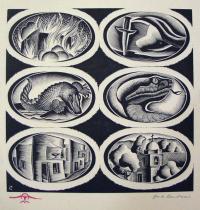
When Zeitlin established his own publishing imprint, Primavera Press, Landacre was asked to illustrate many of the books. The first in 1933 was Marguerite Wilbur’s translation of Alexandre Dumas’ gold rush novel A Gil Blas in California. Pictured at the left is a recently acquired sheet of proofs for chapter headings in this book.

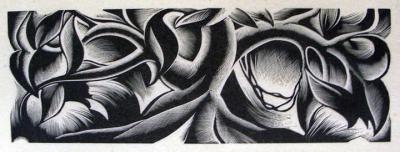
1933 was a busy year for Landacre, who submitted designs for the proposed Limited Editions publication of W.H. Hudson’s Green Mansions. Although some proof pages were printed by Grant Dahlstrom, the design was not selected and these chapter headings (top and bottom) were never published. Note, as Jake Wien below reminds us, that Landacre went on to illustrate three future editions for the Club.

For a bibliography of Primavera Press, see A Garland for Jake Zeitlin, on the occasion of his 65th birthday & the anniversary of his 40th year in the book trade (Los Angeles: Grant Dahlstrom & Saul Marks, 1967) Firestone Library (F) 0334.993.37

New Technology of 1607

| No Comments

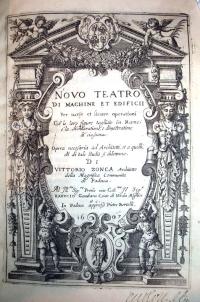
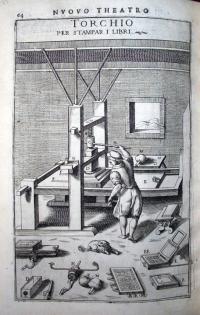
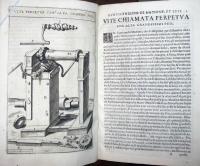
Vittorio Zonca (1568-1602), Nouo teatro di machine et edificij per varie et sicure operationi: co[n] le loro figure tagliate in rame é la dichiaratione, e dimostratione di ciascuna … (Padoua: Appresso Pietro Bertelli, 1607). Graphic Arts Collection (GAX), Oversize 2004-1029Q

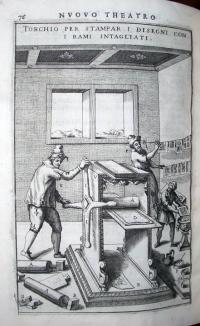
Today, new models of hardware are obsolute in a matter of years. It wasn’t until five years after his death that the first edition of Vittorio Zonca’s book on new machines was printed and published by Pietro Bertelli. Fourteen years later Bertelli’s son Francesco published a second edition using the same 42 copperplate engravings.

Three plates are signed: FV (i.e. monogram Francesco Valesio, born ca. 1560); Ben W sc (i.e. Benjamin Wright); and AH (or AHI or AI; monogram). The source for Zonca’s designs is believed to be a manuscript by the Sienese painter Francesco di Giorgio Martini (1439-1501), which includes illustrations of various fifteenth-century machines.

A good article about such books: Alexander Keller, “Novo Teatro di Machine et Edificii,” Technology and Culture (1988), p. 285-87. Firestone Library (F) 9030.898.

Other volumes in Princeton libraries of the “Theater of Machines” genre:

Jacques Besson, Theatrum instrumentorum et machinarum Iacobi Bessoni Delphinatis, mathematici ingeniosissimi (Lugduni: Apud. Barth. Vincent. …, 1582). 60 engravings by Jacques Androuet du Cerceau (fl. 1549-1584) and others. Rare Books (Ex) Oversize 9008.175f

Gaspard Grollier de Servière (1677-1745), Recueil d’ouvrages curieux de mathematique et de mecanique, ou, Description du cabinet de Monsieur Grollier de Serviere (Lyon: Chez David Forey …, 1719). Engravings Étienne Joseph Daudet (1672-1730). Graphic Arts Collection (GA), 2007-3659N

Jacob Leupold (1674-1727), Theatrum machinarum… (Leipzig: Druckts Christoph Zunkel, 1724-1788). MICROFILM 03959

Agostino Ramelli (1531-ca. 1600), The Various and Ingenious Machines of Agostino Ramelli, translated from the Italian and French … by Martha Teach Gnudi (Baltimore: Johns Hopkins University Press, 1976). Rare Books (Ex) Oversize Oversize TJ144 .R313q

Johann Vogel (17th/18th century), Die moderne Baukunst (Hamburg: B. Schiller, 1708). Marquand Library (SAX): Oversize TH144 .W63 1708q

New Year's Resolutions

| 2 Comments
Broadside advertisement

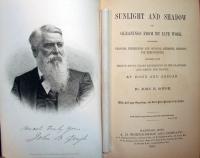
John Bartholomew Gough (1817-1886), Sunlight and Shadow (Hartford, Conn.: Worthington and Company, 1881). Graphic Arts Collection (GAX) Hamilton 686
As a poor young man, John Gough was an alcoholic. When he “signed the pledge” and stopped drinking, he began a career as a temperance lecturer and reformer. Gough became an internationally acclaimed inspirational speaker and writer. He published his first autobiography in 1845, with reprints or new editions nearly every year until it was completely rewritten in 1869. Other books, based on his life experience, had minor plots as an excuse to publish more of his personal message, such as Sunlight and Shadow; or, Gleanings from My Life Work. Comprising Personal Experiences and Opinions, Anecdotes, Incidents, and Reminiscences, Gathered from Thirty-Seven Years’ Experience on the Platform and among the People, at Home and Abroad.


Here is a short excerpt from one of his speeches:

I had fallen, O, how low ! In the very depths of my desolation, wife and children had been torn from my side. In the midst of thousands I was lonely, and, abandoning hope, the only refuge which seemed open for me was the grave. …Despair was my companion, and perpetual degradation appeared to me my allotted doom. I was intensely wretched ; and this dreadful state of things was of my own bringing about. I had no one but myself to blame for the sufferings that I endured ; …Such was my pitiable state at this period—a state apparently beyond the hope of redemption. But a change was about to take place—a circumstance which eventually turned the whole current of my life into a new and unhoped for channel.

Gough also wrote in support of others, such as his introduction to Ann Eliza Young (born 1844), Wife No. 19, or the Story of a Life in Bondage: Being a Complete Exposé of Mormonism, and Revealing the Sorrows, Sacrifices and Sufferings of Women in Polygamy (1876). Princeton owns no less than five copies of this book, including one you can check out: Firestone 1226.987

Gough died on stage in Pennsylvania in 1886.

One of the longest poems in European literature

| No Comments

Le donne, i cavallier, l’arme, gli amori, / le cortesie, l’audaci imprese io canto.
Of wives and ladies, knights and arms, I sing, / of courtesies and many a daring feat.


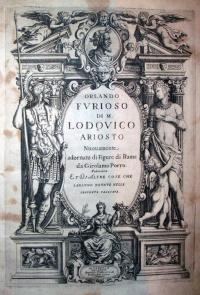
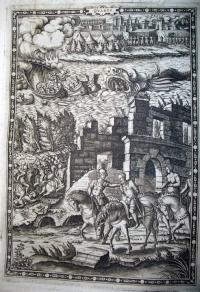
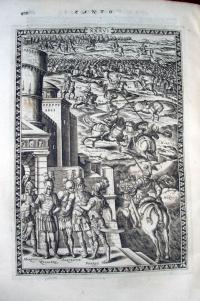
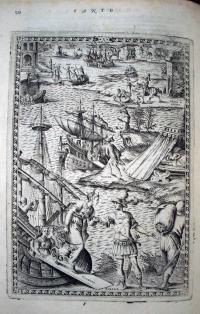
Lodovico Ariosto (1474-1533), Orlando furioso; nuouamente adornato di figure di rame da Girolamo Porro padouano ([Venice]: Appresso Francesco de Franceschi senese e compagni, 1584). Graphic Arts Collection (GAX), Oversize 2004-1179Q

Ariosto began work on his epic poem Orlando Furioso (Mad Orlando) at the age of 32. He continued to expand and polish it over 16 years before it was finally published in 1532, a year before his death.

The plot revolves around the conflict of the Christian versus the Moor, the war between the Holy Roman Emperor, the King of North Africa, and the King of Spain. It is a continuation of Matteo Maria Boiardo’s romance Orlando Innamorato (Orlando in Love), although it can be read on its own.

The poem is divided into forty-six cantos, each containing a variable number of eight-line stanzas. The complete work is 38,736 lines long, making it one of the longest poems in European literature. It was also one of the most celebrated narrative poems of the Italian high Renaissance.

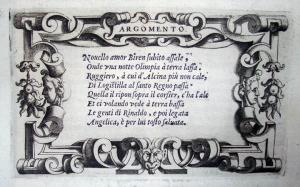
Princeton owns sixteen illustrated editions of Orlando Furioso. One of the most elaborate is this 1584 edition with 64 full-page engravings by the Venetian artist Girolamo Porro (1520-1604). In addition, the argomento or theme that introduces each poem is set inside a classical cartouche.

Also recommended is the 1879 French edition, Roland furieux: poème héroïque, illustrated by Gustave Doré (1832-1883). Rare Books (Ex), Oversize 2004-0064F.

Currently most requested item

| No Comments

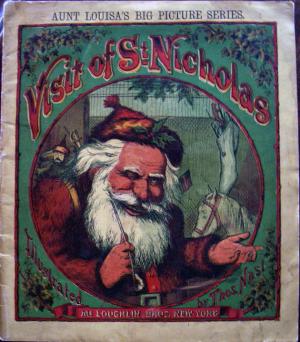
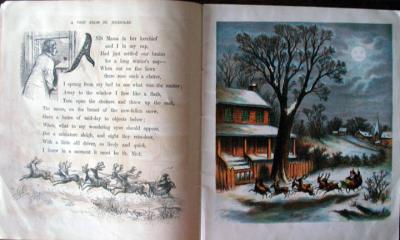
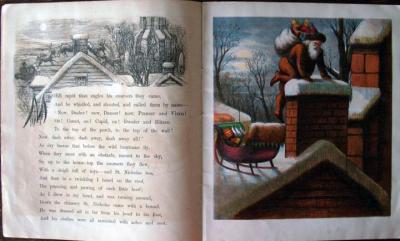
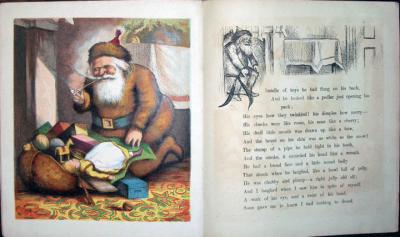
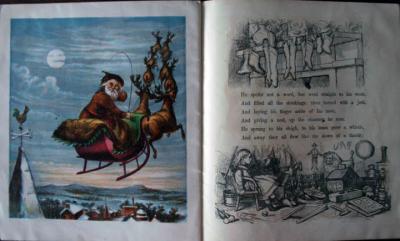
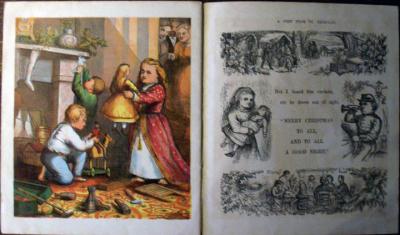
Clement Clarke Moore (1779-1863), Visit of St. Nicholas; illustrated by Thos. Nast (1840-1902) (New York: McLoughlin Bros., [1869]). Part of: Aunt Louisa’s big picture series. Graphic Arts Collection (GAX), Oversize Hamilton 1142q

Juan Pascoe and Taller Martín Pescador

| 3 Comments

Princeton University library is the fortunate new owner of 84 books, 54 broadsides, and several hundred pieces of printing ephemera handset, hand-printed, and mostly hand-bound by the Mexican master printer Juan Pascoe at the Taller Martín Pescador.
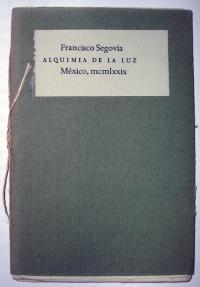


Francisco Segovia, Alquimia de la luz, 1979.
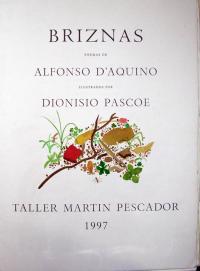
Alfonso D’Aquino, Briznas: poemas;
ilustrados por Dionisio Pascoe, 1997.
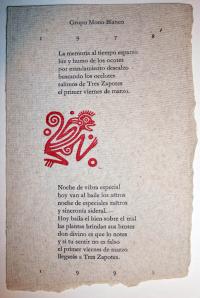

Tarjeta para el 20 aniversario del Grupo Mono Blanco (White Monkey, Pascoe’s musical ensemble), 1998.

Born in Chicago in 1946, Pascoe was educated in the United States, while spending vacations at his father’s home in Mixcoac, outside Mexico City. He learned the art of letterpress printing at the age of 25 as an apprentice to Harry Duncan at the Cummington Press in West Branch, Iowa. When Pascoe moved full-time to Mexico in 1973, he set-up a print shop with a renovated nineteenth-century R. Hoe Washington handpress and sets of Spectrum and Garamond type, with Castellar for titling and initials. In 1975, Pascoe established his own imprint, named the Taller Martín Pescador (Kingfisher Workshop) at the suggestion of the writer Roberto Bolaño.
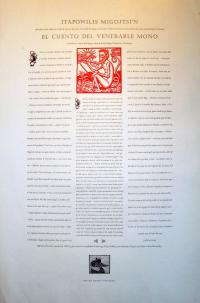
Cartel de El Cuento del Venerable Mono, 2003.
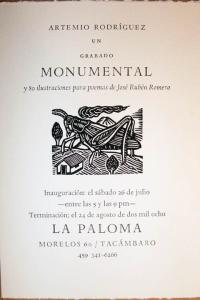
Artemio Rodriguez exhibition poster

From the beginning, Pascoe set all the type by hand, inked and printed each page, and personally sewed each quire into their unpretentious paper covers. As his reputation grew, the projects became more elaborate but the technology remained the same. Authors published at the press include some of the major name in Latin American literature such as Octavio Paz, Gabriel Garciá Márquez, Efraín Huerta, Juan José Arreola, Roberto Bolaño, José Luis Rivas, and Francisco Segovia.
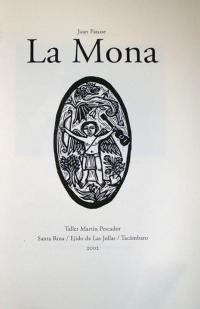
Juan Pascoe, La Mona, 2002
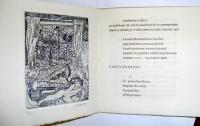
Poemas de Raul Renan: catulinarias & saficas, grabado de Dionisio Pascoe, 1979

Since 1981, Pascoe has worked in a shop outside Tacámbaro, Michoacán. After years researching and published texts on the history of Mexican typography and printing, Taller Martín Pescador has become the foremost source for traditional Mexican graphic arts as well as innovative Latin American literature and poetry.

Cartel de Los signos del zodiaco: doce textos/ escritos por Francisco Hernandez, 1997
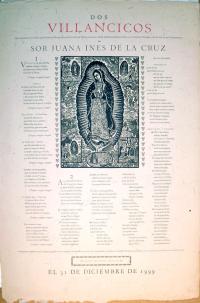
Cartel de Dos Villancicos de Sor Juana Ines de la Cruz, 1999


For more information, continue below.
First Japanese Book Printed from Movable Type

| No Comments

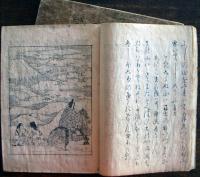
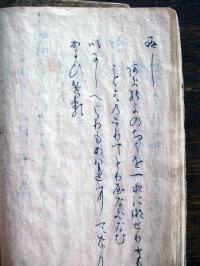
Ariwara Narihira (825-880), 伊勢物語 (Ise monogatari or Tales of Ise) [S.l. : s.n., 慶長戊申 i.e. 1608?]. Second edition. Graphic Arts (GAX) 2008- in process.

“In 1593, in the wake of the Japanese invasion of Korea, a printing press with movable type was sent from Korea as a present for Emperor Go-Yōzei. …The printing press may have been offered to the emperor more as a curiosity than as a practical invention, but that same year he commanded that it be used to print an edition of the Confucian Kobun Kokyo (Classic of Filial Piety). Four years later, in 1597, a Japanese version of the Korean printing press was built with wooden instead of metal type, probably because of the difficulties of casting; and in 1599 this press was used to print the first part of the Nihon Shoki (Chronicles of Japan).

By this time printing was developing into the hobby of the rich … and many editions began to appear. These editions, associated with Emperors Go-Yōzei and Go-Mizunoo and with such figures as Toyotomi Hideyoshi and Tokugawa Ieyasu, were intended for presentation and not for sale. The finest printed books of the time were designed by the artist Hon’ami Kōetsu (1558-1637)… [and] the masterpiece of this press was the illustrated edition of Ise Monogatari (Tales of Ise) published in 1608.”

from Donald Keene, World Within Walls: Japanese Literature of the Pre-Modern Era, 1600-1867 (New York: Holt, Rinehart and Winston, c1976) East Asian Library (Gest): Western, PL726.35.K4

Complete digital book: http://digitalgallery.nypl.org/

Complete text, see: http://etext.lib.virginia.edu/japanese/

Dürer's marginalia

| No Comments

Albrecht Dürer (1471-1528), Oratio dominica polyglotta singularm linguarum characteribus expressa et delineationibus Albert Dueri (Munich: Stuntz, [1820]). Graphic Arts (GAX) 2008- in process

In 1515, Albrecht Dürer created a series of designs on the margins of a Prayer Book in the Royal Library at Munich, formerly belonging to the Emperor Maximilian I. The book became known as Dürer’s Christlich-Mythologische Handzeichnungen. In 1808, one of the first lithographed publication to use multi-colored inks was a reproduction of Dürer’s border designs by Johann Nepomuk Strixner (1782-1855) published at Aretin-Senefelder Verlag. When Rudolf Ackermann (1764-1834) started his Lithographic Press in London in 1817, a facsimile of the 1808 German edition was its first important production.

The 1820 Munich edition shown here fills the borders with the Lord’s prayer in 43 different languages lithographed in colors by Strixner, published under the new title of Oratio Dominica Polyglotta.

Also available: Albrecht Dürer (1471-1528), Albrecht Dürers christlich-mythologische Handzeichnungen ([Munich: A. Senefelder, 1808]). Graphic Arts Collection (GAX), Oversize 2007-0749Q

Die Nibelungen, an ancient tale of knightly honor

| 2 Comments

Die Nibelungen. Interpreted by Franz Keim (1840-1918) and illustrated by Carl Otto Czeschka (1878-1960) (Wien; Leipzig: Verlag Gerlach u. Wiedling, [1909?]). Graphic Arts Collection (GAX), PT1580 .K44 1909

This unassuming little book gives the reader no indication of the riches it holds inside. The design of the text and eight double page illustrations are the work of Carl Otto Czeschka, a leading member of the Vienna Secession. Czeschka studied at the Vienna School of Arts and Crafts and worked as a designer for the Wiener Werkstätte from 1905 until 1908 when he left for a teaching post at Hamburgs’ Kunstgewerbeschule. Czeschka went on to design for a variety of media including jewelry, metalwork, textiles, furniture and book design.

This copy of Die Nibelungen will be included in an exhibition at the Princeton University Art Museum from March 21 to June 7, 2009. The show, entitled “Myth and Modernity: Ernst Barlach’s Images of The Nibelungen and Faust” will offer the first American showing of the Nibelungen drawing cycle by Barlach.

Divine Books

| 1 Comment
Dante Alighieri (1265-1321), The Divine Comedy; translated by Robert & Jean Hollander; illustrated by Monika Beisner (Verona: Valdonega, 2007). Copy 238 of 500. Graphic Arts Collection (GAX) Oversize 2008-0109Q

Midway in the journey of our life
I came to myself in a dark wood,
for the straight way was lost.
Ah, how hard it is to tell
the nature of that wood, savage, dense and harsh —
the very thought of it renews my fear!


Dante Alighieri (1265-1321), Dante’s Inferno: translations by twenty contemporary poets; frontispiece by Francesco Clemente ([Hopewell, NJ]: Ecco Press, 1993). Copy 21 of 125. Graphic Arts Collection (GAX) Oversize PQ4315.2 .H28 1993q


above:

Dante Alighieri (1265-1321), The Divine Comedy of Dante Alighieri. Inferno / a verse translation by Tom Phillips with images and commentary ([London]: Talfourd Press, 1983). Copy 33 of 185. Graphic Arts Collection (GAX) Oversize 2008-0003E

below:
Dante Alighieri (1265-1321), The Ante-Purgatorio; Cantos I-IX of the Purgatorio, English translations by Henry Wadsworth Longfellow. Original etchings by Jack Zajac (New York: Racolin Press, 1964). Edition of 215 copies. Graphic Arts Collection (GAX) Oversize 2006-0046E
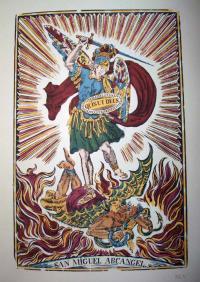

It is so bitter death is hardly more so.
But to set forth the good I found
I will recount the other things I saw.
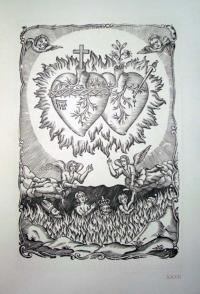
How I came there I cannot really tell,
I was so full of sleep
when I forsook the one true way.
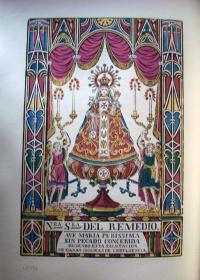
Dante Alighieri (1265-1321), The Divine Comedy of Dante Alighieri / the prose translation by Charles Eliot Norton ; with illustrations from designs by Botticelli (New York: Bruce Rogers & the Press of A. Colish, 1955). Copy 171 of 300. Graphic Arts Collection (GAX) Oversize 2007-0376Q
The Princeton Dante Project: http://etcweb.princeton.edu/dante/index.html

Documents d'Atelier

| No Comments

Victor Champier (1851-1929), Documents d’atelier: art décoratif moderne (Paris: Libraire de la Revue des arts décoratifs, 1898). Graphic Arts Collection (GAX) Oversize 2004-0581Q

Victor Champier founded the Revue des Arts Décoratifs (1887-1902) and established a school of industrial arts in Roubaix. He compiled these plates, printed through the pochoir or hand-stencilling process, to include 60 designs for decorations of textiles, wallpaper, ceramics, furniture, architecture, metalwork, sculpture, and jewelry. The book offers examples of work by Alphonse Mucha, A. Sandier, Francis Jourdain, A. Lalique, L. Bonnier, A. Tourette, C. Boignard, and other artists of the period.

The End of the Stock-Market World

| No Comments

Last December 2007, I posted an entry on Het Groote Tafereel der Dwaasheid or The Great Mirror of Folly. Each edition has a slightly different group of prints: Harvard’s copy has 71, Princeton’s 73, and each includes several not in the other volume.

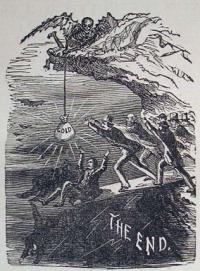
This page, originally engraved by Monogrammist C L, later altered by an anonymous 18th-century Dutch engraver after Pieter Quast (1606-1647) and entitled De Actiewerld op Haar Ende (The End of the Stock-Market World), is included in Harvard’s copy but not Princeton’s. However, we recently acquired an impression to help complete our collection of the prints for in this anonymous 1720 project.

The central figure in this caricature is the philosopher Diogenes (ca. 412-323 BCE). Considered the founder of Cynicism, he eschewed worldly pleasures, wore coarse clothing, and pursued practical good. He is often shown carrying a lantern, searching for an honest person, but in this print his lantern has been given away (presumably having given up finding an honest man). He has lost everything in the stock-market bubble of 1720 from investing in the South Seas Company. As the text beneath the image concludes,

How easily can such a flier be upset by a South Sea blast or a Quinquempoix* bubble! So whoever gives his name and honor for the money, and adores it like an idol, deserves to be scorned in this fashion.

*Quinquempoix was the name of the street where the Parisian money market was located.

This print was first engraved around 1670 by the Monogrammist C L to satirize the tulip mania in the Netherlands. The plate was then altered to satirize the stock-market speculation of 1720.


1 2 3 4 5 6 7 8 9 10 11 12 13 14

Recent Comments

  • Isabel Ribeiro: Thank you for your reply. I would indeed love to read more
  • Isabel Ribeiro: Gorgeous! Is there any way to access the rest of read more
  • S. Scudder: Mary Stilwell is my ggg-grandmother ... thank you for posting read more
  • V.E.G.: James Franklin, Benjamin Franklin's half-brother is a direct descendant of read more
  • Bob Fleck: Nice comments and well worth it. read more
  • N. Sutherland: Do you have any further biographical material on this Thomas read more
  • john W: Have the complete collection of EA Seguy papillons including front read more
  • Vermathio: algarabia, charabia et Picabia. Le premier désigne la langue read more
  • Matt SCOVILL: I have the complete "bookplates in Japan" box. I am read more
  • Daniel Joseph Bobroff: April 30, 2013 To Princeton University: This is a Plaintiff read more