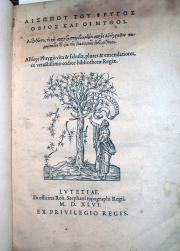
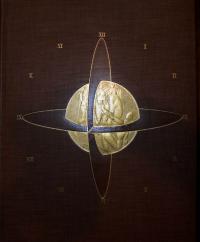
Aisōpou tou Phrygos ho bios kai hoi mythoi: auxēthentes te kai pro sapēkribōmenoi pros antigraphon palaiota ton to ek tēs basilikēs bibliothēkēs = Æsopi Phrygis vita & fabulæ : plures & emendatiores, ex vetustissimo codice bibliothecæ Regiæ (Lutetiæ [Paris]: Ex officina Rob. Stephani typographi Regii, M. D. XLVI. [1546]). Greek title and Greek subtitle in Greek characters; text in Greek. Graphic Arts Collection (GAX) 2004-3189N
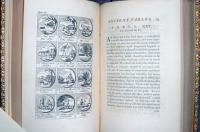
Robert Dodsley (1703-1764), Select Fables of Esop and Other Fabulists …(Birmingham [Eng.]: printed by John Baskerville, for R. and J. Dodsley, 1761). Graphic Arts Collection (GAX) Baskerville 1761b
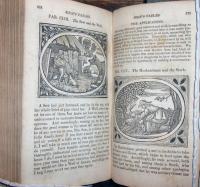
Fables of Aesop and Others, translated into English with instructive applications, and a print before each fable by Samuel Croxall (Philadelphia: S. Probasco, 1831). engravings by James Poupard. Graphic Arts Collection (GAX) 2003-0490N
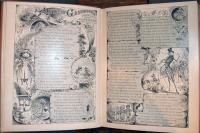
Selections from Aesop’s Fables, versified by Clara Doty Bates; accompanied by the standard translations from the original Greek; illustrated by E.H. Garrett … [et al.] (Boston: D. Lothrop, c1884). Graphic Arts Collection (GAX) 2003-0369N
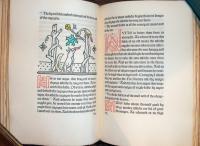
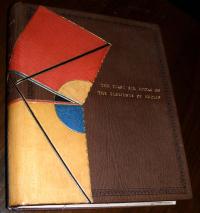
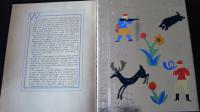
The Subtyl Historyes and Fables of Esope, Translated out of Frensshe in to Englysshe by William Caxton at Westmynstre in the yere of oure Lorde. mcccc.lxxxiij ([San Francisco]: The Grabhorn Press at San Francisco, 1930) “Two hundred copies… Initialed and decorations by Valenti Angelo …” Graphic Arts Collection (GAX) 2004-3609N
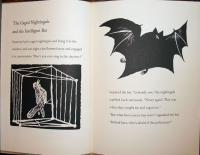
12 Fables of Aesop (New York: Museum of Modern Art, c1954) “Linoleum blocks by Antonio Frasconi to illustrate Twelve fables of Aesop newly narrated by Glenway Wescott, Adapted from a limited edition designed by Joseph Blumenthal.” Graphic Arts Collection (GAX) Z232.B654 A37 1954
Recently in Illustrated books Category
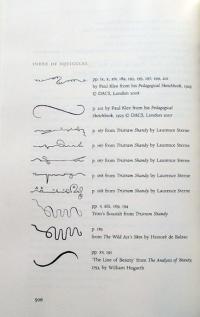
The first book of literary criticism I’ve ever read with an index to squiggles just arrived: Adam Thirwell (born 1978), The Delighted States: a Book of Novels, Romances, & their Unknown Translators, Containing Ten Languages, Set on Four Continents, & Accompanied by Maps, Portraits, Squiggles, Illustrations, & a Variety of Helpful Indexes (New York: Farrar, Straus and Giroux, c2007). Firestone Library (F) PN3491 .T55 2007
It’s about time.
Professor Michael Wood’s review:
http://www.bookforum.com/
inprint/015_02/2467
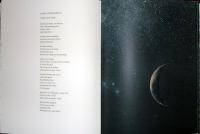
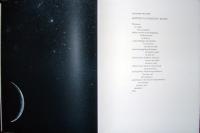
The Inconstant Moon: Poems to the Moon by Mark Jarman … [et al.]; with a Homeric hymn translated by Apostolos N. Athanassakis; lithographs by Enid Mark. (Philadelphia: ELM Press, 2007) Limited edition of 45 signed copies, 8 poets’ copies numbered I-VIII, and 10 artist’s proofs. (GAX) Oversize 2007-0662Q
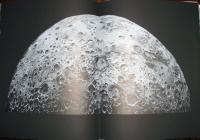
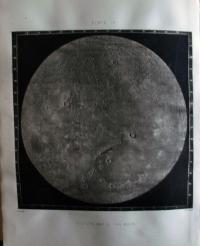
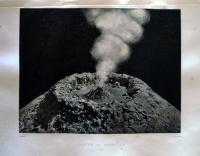
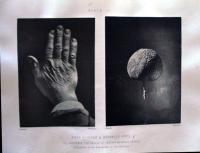
James Nasmyth (1808-1890) and James Carpenter (1840-1899), The Moon, Considered as a Planet, a World, and a Satellite. 2d edition. (London: J. Murray, 1874). Illustrated with woodburytypes and wood engravings. Graphic Arts Collection (GAX) Oversize 2003-0202Q
Nasmyth photographed his own hand to demonstrate the similarity between the shrinking of the molten surface of the moon and the wrinkling of his own skin.
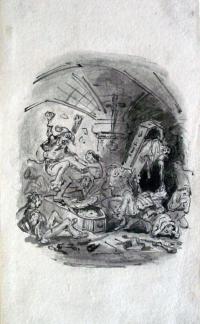
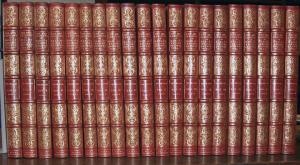
Newly acquired by the graphic arts division is this unique twenty-volume extra-illustrated copy of Life and Labours of Hablôt Knight Browne. Browne was the 19th-century illustrator best known for his steel-plate etchings and wood engravings for ten books by Charles Dickens.
Dickens was already a popular author when his illustrator Robert Seymour committed suicide. The practically unknown Browne was selected to complete The Pickwick Papers and went on to collaborate with Dickens until 1859. Browne took the nickname “Phiz” to complement Dickens’ penname “Boz.”
As it was originally published in 1884, Thomson’s single volume biography contained an engraved portrait and 130 illustrations (GA Rowlandson 946). Princeton’s unique copy has been vastly expanded to 20 volumes, extra-illustrated with the insertion of more than 1250 plates, including 11 watercolours, 81 pencil and ink drawings (a few with a touch of colour or double-sided), and 11 autograph manuscript items signed by Browne.
Among the manuscripts are a group of charming illustrated letters to Frederick William Cosens, an avid collector of Dickens. Cosens commissioned Browne to furnish him with watercolor drawings of every image he had created for a Dickens novels (more than 400 in all). It has been speculated that this 20 volume set is the work or commission of Cosens, although the provenance is not certain.
These volumes present to researchers not only a wonderful collection of art by one of the great illustrators of the 19th century, but also a number of variant states of the final plates. The sketches and letters provide documentary information about Browne that cannot be obtained elsewhere.
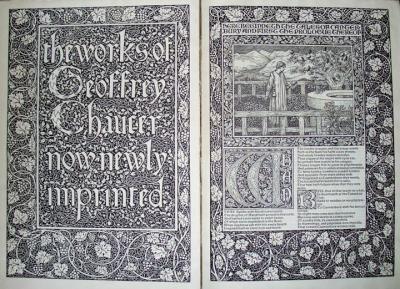
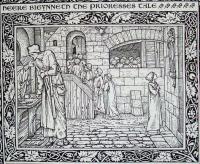
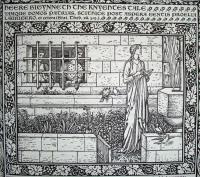
William Morris (1834-1896) wrote, “Have nothing in your houses which you do not know to be useful or believe to be beautiful.” [Hopes and Fears for Art, Rare Books (EX) 3867.4.345] One of the objects Morris would not have objected to was his own Works of Geoffrey Chaucer, also known as the Kelmscott Chaucer after the press where it was printed.
In 1891, Morris set up three presses in his home, where he could design and print fine press editions. Over 50 books were completed. The Kelmscott Chaucer was one of the last and certainly one of the most successful.
The book was the product of many talented men besides Morris. The text was edited by Frederick Startridge Ellis (1830-1901), ornamented with 87 pictures designed by Edward Burne-Jones (1833-1898), and engraved on wood by William Harcourt Hooper (1834-1912). It is interesting to noted that Burne-Jones’s drawings were photographed and the photographic images printed onto the woodblocks to ensure the fidelity of the engraving. The full-page woodcut title, fourteen large borders, eighteen borders or frames for the pictures, and twenty-six large initial words, along with the ornamental initial letters large and small were designed by Morris. For more on this, see The Life of William Morris by J. W. Mackail, v. 2, p. 326, Graphic Arts collection (GAX) PR5083.M25.
425 copies of the book were completed by a total of 11 master printers. Thanks to Morris’s expert salesmanship and personal magnetism, the entire edition was sold out before the books were finished on May 8 and issued on June 26, 1896.
Princeton University library owns four copies of the Kelmscott Chaucer. One is bound in full white pigskin and signed by T. J. Cobden-Sanderson (1840-1922) at Doves Bindery in 1903. For more about Morris and his circle, the William Morris Society has a new blog at http://morrissociety.blogspot.com/
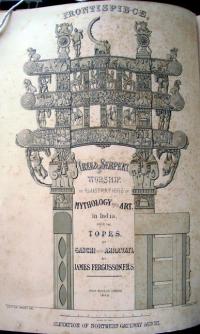
James Fergusson (1808-1886), Tree and Serpent Worship, or, Illustrations of Mythology and Art in India in the First and Fourth Centuries after Christ (London: India Museum … , 1868). Graphic Arts Collection (GAX) Oversize 2004-0934Q
Tree and Serpent Worship was compiled by the self-taught historian James Fergusson (1808-1886), who made his fortune at a young age in Calcutta and then devoted the rest of his life to his passion for Indian architecture. Fergusson befriended a number of the British officers who spent their time in India practicing the new art of wet-plate photography, such as Major Robert Gill (1804-1879) whose albumen prints were used to illustrate Fergusson’s 1864 edition of The Rock-Cut Temples of India (Graphic Arts Collection (GAX), 2007-2590N).
Another of Fergusson’s associates was James S. Waterhouse (1842-1922), who never used a camera before arriving in Calcutta. He became so accomplished that he was ultimately named surveyor-general to the monumental Survey of India. Under the sponsorship of the Indian government, Waterhouse spent eleven years—from 1864 to 1875—documenting the ethnic diversity of the people of India; work later replicated by Edward Curtis and others who joined the international mania for mammoth ethnographic studies.
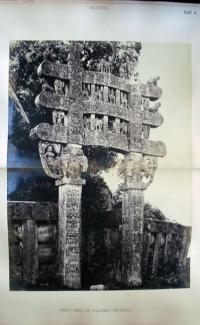
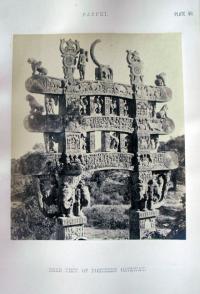
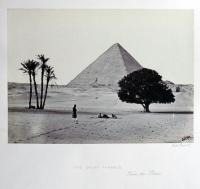
During that same period, Waterhouse provided Fergusson with a group of images depicting the ancient Buddhist monuments in Sanchi, a small village in the state of Madhya Pradesh. The frontispiece of Tree and Serpent Worship shows Waterhouse’s image of the Northern gateway to the Great Stupa at Sanchi. This is the oldest of the religious stupas, or mounds, constructed in the third century BCE to hold the remains of the Buddha.
Along with 20 photographs by Waterhouse are 36 by W. H. Griggs (1832-1911), depicting Amravati sculptural fragments from the collection we now know as the Victoria & Albert Museum.
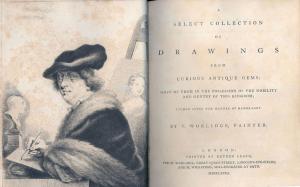
Around 1740, painter and printermaker Thomas Worlidge settled in the Covent Garden section of London. He found success painting portrait miniatures and later, as an etcher working “after the manner of Rembrandt”. This refers to his drypoint technique of drawing with a sharp needle directly into the surface of the copper plate. It also alludes to Worlidge’s admiration for Rembrandt the man, such as in this frontispiece self-portrait, which is a clear imitation of a Rembrandt self-portrait.
When Worlidge died in 1766, he was in the middle of a massive project etching a series of 182 drypoint portraits. Princeton owns several variant editions of the collection. The following is a description of the project taken from the Dictionary of National Biography, vol. 21:
The series was published in parts, some of which seem to have been issued as early as 1754 but Worlidge died before the work was completed. It was finished by his pupils William Grimaldi and George Powle, and was published by his widow in 1768 at the price of eighteen guineas a copy. In its original shape the volume bore the title, A select Collection of Drawings from curious antique Gems … printed by Dryden Leach for M. Worlidge … and M. Wicksteed, Seal-engraver at Bath.
The frontispiece, dated in 1764, shows Worlidge drawing the Pomfret bust of Cicero; behind on an easel is a portrait of his second wife, Mary. No letterpress was included originally in the volume, but between 1768 and 1780 a few copies were issued with letterpress. After 1780 a new edition in quarto, deceptively bearing the original date of 1768, appeared with letterpress in two volumes at five guineas each. The title-page omits mention of M. Wicksteed’s name, but is otherwise a replica of the first.
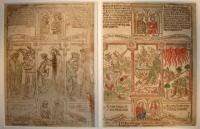
blank verso of leaf 40 and leaf 38 “s” Hell
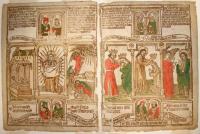
Princeton’s historical leaf collection holds three leaves from an edition of the Biblia pauperum, one of the best-known of the fifteenth-century blockbooks. According to Nigel Palmer’s article in the current Journal of the Printing Historical Society (no. 11, 2008, Firestone Z119 .P95613), the Biblia pauperum was “an ensemble of texts and images which narrated the history of man’s redemption from the Annunciation through to the Last Judgement and the coronation of the blessed soul in heaven” represented in 40 plates. During the 1460s, the 40 woodblocks for this volume were recut three times, along with seven intermediate issues in which just some of the blocks were replaced.
Mr. Palmer examined the sheets in Princeton’s collection and wrote that he believed they belong to the edition X, “almost certainly printed in Germany”. Of the known copies of this edition, Palmer identified one in Blackburn, England, originally from Gotha, which lacks these numbers and might be a match for our leaves.
The three leaves shown here are anopisthographic (printed on one side). Two of the sheets have been pasted together to form recto and verso of one sheet. Because there are so few Biblia pauperum surviving in their original structures, it is difficult to be certain about their construction but several editions were sewn into single-quire volumes in chancery folio (approximately 310-20 x 440-50 mm., only slightly larger than Princeton’s sheets).
Blockbooks were made from about 1450 to the 1470s, and Palmer cautions us to regard them as intertwined with all experimentation in printing technology of the period, included single-leaf woodcuts, single-leaf metalcuts, single-leaf engravings, books and single leaves with text printed with moveable type, and books with typographic text and woodcut illustrations.
For a complete reading of the iconography in each plate (in English), see Avril Henry’s Biblia Pauperum Marquand Library Oversize Z241.B6B52 1986Q
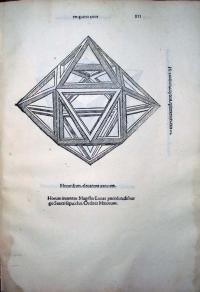
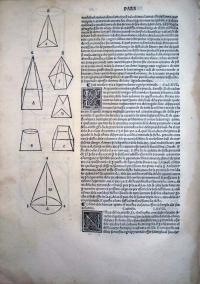
Luca Pacioli, known as Brother Luca, was a Franciscan monk and a mathematician. In 1497, he was invited to the court of Lodovico Sforza in Milan, where Leonardo de Vinci (1452-1519) was also in residence. The two became friends and spoke at length about mathematical theory as it applied to the application of proportion in artistic composition. It was at this time that Luca began his book De divina proportione. Leonardo provided some of the illustrations and the book was dedicated to Lodovico. In 1499, Luca and Leonardo were forced out of Milan and it was not until 1509 that their three volume work was published in Venice (volume three is an Italian translation of Piero della Francesca’s Latin writings On [the] Five Regular Solids). For more information, read Ruth Mortimer’s Harvard College Library Department of Printing and Graphic Arts, catalogue of books and manuscripts, (1964, v.2, part 2, p. 499-502. GA Z881 .H346)
Divine Proportion, or the golden ratio, is the ratio a : b = b : (a + b).
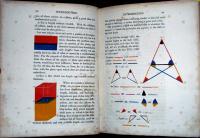
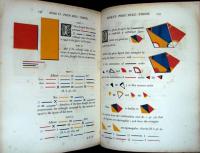
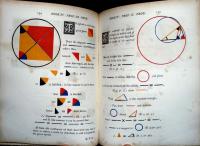
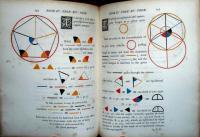
One of the many remarkable things about this edition of Euclid is the expert printing. Each of the colors were printed from separate plates that had to be expertly registered; that is, positioned so that the geometric angles of the didactics matched exactly.
The printing was done by Charles Whittingham (1795-1876), nephew to Charles Whittingham, founder of the Chiswick Press where elaborately illustrated editions were published. Whittingham the younger joined his uncle’s business and quickly perfected the specialty of overlaying the printed image from several blocks.
The book was exhibited in London at the Great Exhibition of 1851 and both Euclid and Oliver Byrne, an otherwise unknown mathematician, took a backseat. Praise was researved for the beauty of the composition and the artistry of the printing. The book was sold by William Pickering for the extravagant price of 25 shillings, placing it out of reach of the simple educators who were suppose to have benefited from this new system for learning geometry.
Soon after Thomas Maitland Cleland left school, at the age of 16, he taught himself to set type, bought a small Gally Universal, and began making books in his basement. In 1900, he moved to Boston and published under the imprint Cornhill Press, named after the street where he lived. D. B. Updike of Merrymount Press was an early mentor, who provided commissions and endless criticism, leaving Cleland chronically unsatisfied with anything less than perfection.
Cleland went on to work as art designer for McClure’s Magazine, the Locomobile Company of America, the Westvaco Corporation, the Cadillac Motor Car Company, and Fortune Magazine, although he wrote “I am not, and never have been, particularly interested in advertising and have done much of my work for it only because it was, or seemed to be, necessary in order to make a living.”
In the 1930s, he made a series of calendar illustrations for the Harris, Seybold, Potter Company of Cleveland Ohio, which manufactured high-quality sheet-fed offset lithographic printing presses. The company tried to convince the printing world that sheet fed-offset presses could produce quality 4-color process work and Cleland’s prints were meant to provide the proof. “God Bless America,” seen below, is one of these prints.
In between commercial work, Cleland illustrated fine press editions, often using a series of stencils. Writing to Merle Armitage about his process, Cleland explained “It is made entirely with stencils which I cut myself by hand in thin metal (thirteen of them in all) and which I then printed successively by brushing through them with pure water colours. … so far as I know, no one has attempted before to make a complete picture with them as a medium, and I hope no one will try it again. It was an insane amount of work for such a trifling result, and took about four months work to make a hundred of them—fifty for the special edition of Adler’s book of my work, and fifty for sale.” (GAX Oversize NE539.C57 A3 1929q)
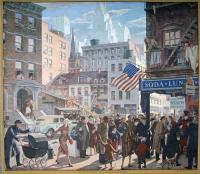
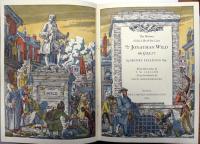
One of his most complex projects was Jonathan Wild, seen above, printed under Cleland’s supervision by the Marchbanks Press and published by the Limited Editions Club. In a letter to editor George Macy in 1942, Cleland wrote, “I am anxious to have this large line drawing photographed for the plate so … I should have proofs of the plate on which I can paint in the color for each stencil … so that they will have only the actual coloring of the edition to do after the book is off the press.” The coloring was accomplished by Charlize Brakely, who charged $10 per thousand pages. The book has 30 pages with color in an edition of 1,500, so that means a total of 45,000 pages to color.
2008 is John Milton’s quatercentenary. As one of many events celebrating the author this year, Professor Nigel Smith spoke Thursday at Labyrinth Books on his new book, Is Milton Better than Shakespeare? Professor Smith pointed, in particular, to Milton’s ability to merge poetry with conversation and urged audience members who were not convinced to simply read Paradise Lost.
Firestone Library holds 610 editions of works by Milton including four copies of the first edition of Paradise Lost from 1667. Rare Books and Special Collections boasts 62 illustrated editions of Milton, beginning with the first illustrated Paradise Lost, published in 1688 with engravings by M. Burghers and Peter Paul Bouche after designs John Baptist Medina and Bernard Lens. Rare Books (Ex) Oversize 3859.369.142q
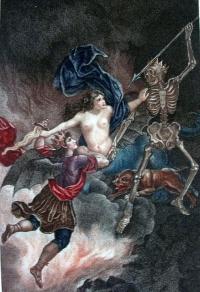
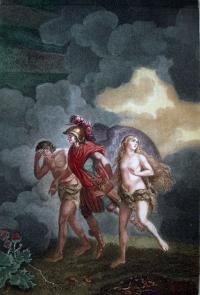
Pictured here is the first edition illustrated in color: Le Paradis perdu (Paris: Chez Defer de Maisonneuve, 1792). Graphic Arts division (GAX) Oversize PR3561.F5 D8 1792q. For this edition, Frédéric-Jean Schall (1752-1825) created a series of paintings specifically to be used as designs for engraved illustrations to this bilingual edition. Twelve stipple engravings were printed à la poupée, that is, with hand-painted application of colored inks to sections of the copper plate before printing. Each sheet had to be inked and printed separately, significantly limiting the edition’s print run, but adding enormous beauty and charm to the volume.
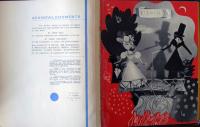
In the early years of the 20th century, the publishing house known as Tolmer et Cie or Maison Tolmer was located at 15, quai Bourbon in Paris. The editor in chief was Alfred Tolmer, who took over after his father, whose name does not seem to have been recorded. Alfred’s son Claude Tolmer (1922-1991) was also with the firm and Bernard Tolmer is also mentioned. These three generations of Tolmers produced literally hundreds of beautiful volumes with exceptional design, often illustrated with original pochoir or lithographic prints. See Papillons in a previous blog post.
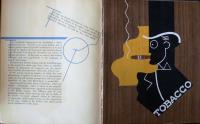
In 1930, Alfred began to write his definitive treatise on graphic design, entitled Mise en Page: the Theory and Practice of Layout, which continues to be consulted, if only for the inspirational layout of this book alone. The volume deals with photography, typography, and illustration, using unusual techniques of collage, pochoir, and coated papers. He published a French language edition himself and an English language edition with The Studio magazine, which was printed in London and includes the French text at the back.
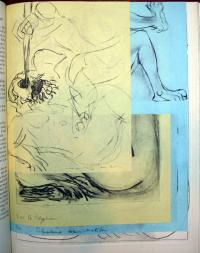
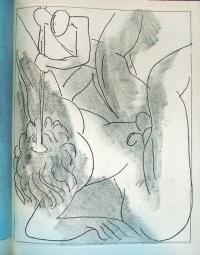
Ever since George Macy, founder and editor of the Limited Editions Club, published an English language edition of Ulysses in 1935, pairing James Joyce’s text with prints by Henri Matisse, there has been a controversy as to whether Matisse ignored Joyce by submitting images based on Homer’s Odyssey. There is no question that the six original soft-ground etchings— “Calypso,” “Aeolus,” “Cyclops,” “Nausicaa,” “Circe,” and “Ithaca”—have a relationship to Homer. The question is whether this was a conscious choice, sanctioned by Joyce, to relate the story and structure of the one book to the other.
In James A. Knapp’s article “Joyce and Matisse Bound” http://muse.jhu.edu/journals/elh/v067/67.4hnapp.html the question is answered yes, with documentation offered from letters between Macy and the artists, and comments from their colleagues, such as Alfred Barr who wrote “Matisse remarked that he had observed how Joyce’s Ulysses was divided into episodes based on Homer’s Odyssey … Macy accepted the suggestion and Matisse went to work.” (Matisse: His Art and His Public, 1951).
Either way, the work of two masters comes together in a powerful way. Macy designed the sequence, including reproductions of the drawings Matisse also sent, which led up to the final etchings. These are bound on top of the final prints in an overlapping fashion that echoes the overlapping stories of the text. Princeton’s copy is one of the 250 (out of the total edition of 1500) signed by Joyce, which originally sold for $15.
The coming of the seventeenth-century brought a proliferation of drawing manuals, beginning with Henry Peacham (1576?-1643?), The Art of Dravving vvith the Pen and Limning in Water Colours (London: Printed by Richard Braddock, 1606) [available online as an electronic text]. These books were written for an aristocratic audience of men and women who had the time to train their eyes and improve their mind.
The manuals provided instruction with an emphasis on art as an intellectual endeavor. Drawing is always the essential practice, with the arts of printing and painting coming later. Linear or contour models of the body parts are offered for copying, teaching the popular practice of limning.
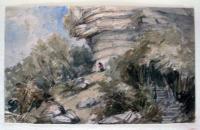
The Excellency of the Pen and Pencil was published anonymously, printed by Thomas Ratcliff and Thomas Daniel, and sold by them at the Chyrurgeons Arms and at the Golden Lyon. The text is based in part on the writings of Albrecht Dürer and Hans Holbein. The title page introduces it as “A Work very useful for all Gentlemen, and other Ingenious Spirits, either Artificers or others.” A second edition was published in 1688 with the significant edition of a section on the mezzotint, a process that came into use just after the first edition had been released.
Other seventeenth-century drawing manuals available at Princeton include: Sir William Sanderson (1586?-1676), Graphice. The Use of the Pen and Pensil. Or, The Most Excellent Art of Painting (London: Printed for R. Crofts, 1658). Marquand Library (SA) NE910.G7 F17 1658
John Evelyn (1620-1706), Sculptura, or, The History, and Art of Chalcography and Engraving in Copper (London: Printed by J.C., 1662) Graphic Arts Collection (GAX), NE1760 .E94
William Salmon (1644-1713), Polygraphice: or the Arts of Drawing, Engraving, Etching, Limning, Painting, Washing, Varnishing, Gilding, Colouring, Dying, Beautifying and Perfuming (London: Printed by A. Clark, for John Crumpe, 1675). 3rd ed. Marquand Library (SAX): Rare Books, NE910.G7 S45 1675x
In 1806, Reverend James Beresford (1764-1840) published a series of humorous dialogues entitled, The Miseries of Human Life (Graphic Arts, Rowlandson 1806.3). The book proved so popular that three editions sold out in a matter of weeks.
Several imitations appeared the following year, including Robert Heron’s Comforts of Human Life (Graphic Arts, Rowlandson 1807.4) but the most successful by far was The Pleasures of Human Life published under the name of Hilaris Benevolus and Company, Fellows of the “London Literary Society of Lusorists.” In fact, the book was written by John Britton, a young man whose only other books to date were historical and topographical essays on England.
Britton followed Beresford’s use of dialogues and his use of hand-colored etchings by Thomas Rowlandson (1756-1827), commissioning five prints only loosely connected to the text. The frontispiece literally turns Beresford’s book topsy-turvy, complimented by an illustrated title page, drawn by another popular artist of the time, R. William Satchwell (1732-1811) and engraved by William Bond.
Britton wrote that members of the Society of Lusorists, including Benevolus, Simon Specific, David Demurrer, and others, held meetings to “examine, canvass, and discuss the most noted and popular acts, deeds, and things done, performed, and committed in the British metropolis.” The pleasures are separated between male, female, and neuter, “interspersed with various anecdotes, and expounded by numerous annotations.”
Britton went on to become an celebrated advocate of historic preservation and in 1845, a Britton Club was formed in his honor.
The British actor, director and artist Edward Gordon Craig (1872-1966) was the son of actress Ellen Terry and designer Edwin Godwin. He began his professional career as an actor with Henry Irving’s company at his Lyceum Theatre in London. Craig played Hamlet in 1894 and again in 1896, but gave up acting soon after. His interest in art and design became more important to him and ultimately, occupied all his time and energies.
It was in Uxbridge around 1893 that Craig met the artists James Ferrier Pryde and William Nicholson, from whom he learned to make prints and in particular, fell in love with the woodcut. In 1898, Craig started a magazine, The Page, which he edited, illustrated, and published as an outlet for his own work. In less than two years, he had completed nearly 200 woodblocks and published Gordon Craig’s Book of Penny Toys.
Craig moved to Germany in 1904, where he wrote and published On the Art of the Theatre. A few years later, Constantin Stanislavski invited him to direct Hamlet with the Moscow Arts Theatre. Craig also designed the sets, using a series of neutral, movable screens. He later presented a set to William Butler Yeats for use at the Abbey Theatre in Dublin, Ireland.
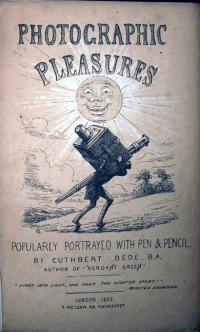
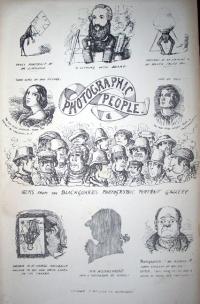
While most publishers content themselves with one form of illustration in any individual book, a few select titles include a variety of illustrative techniques. This account of surgical pratices during the American Civil War includes etchings, wood engravings, lithographs, chromolithographs, albumen photographs, heliotypes, and woodburytypes. In short, almost every reproductive process available at the time can be found somewhere within these six bound volumes. Here are a few samples.
Eugène Grasset merges decoration and illustration in the designs for his late nineteenth-century books and posters. His borders spill inward, overlapping with the text and vying for the reader’s attention. It took the artist over two years to design 250 unique pages for this Art Nouveau version of the chansons de geste of Charlemagne and the book remains a signifiant moment in the history of the French illustrated book. Other examples of Grasset’s designs can be seen in:
Eugène Grasset. La plante et ses applications ornementales. Paris: Librairie Centrale des Beaux-Arts, [1896?]. Graphic Arts Collection (GAX) oversize 2004-0004E and oversize 2004-0003E
Anatole France. Le procurateur de Judée. Paris: Édouard Pelletan, 1902. Rare Books (Ex) 3253.3.372
Eugène Grasset. Méthode de composition ornementale. Paris, Librairie centrale des beaux-arts [1905] NK1510 .G7q
Mathurin Méheut. Études d’animaux. Paris: Librarie centrale des beaux-arts, c1911. Graphic Arts Collection (GAX) Oversize 2006-0085F
Recent Comments