Recently in Illustrated books Category

Picasso Block

| 3 Comments

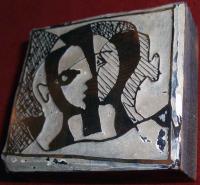
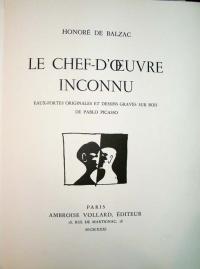
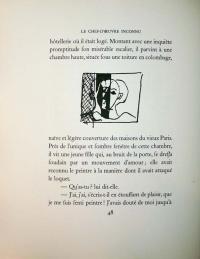
Honoré de Balzac (1799-1850), Le chef-d’oeuvre inconnu (The Unknown Masterpiece) (Paris: Vollard, 1931). 13 etchings and 67 woodcuts by Pablo Picasso (1881-1973). Copy no. 154 of 340, with an additional suite of 13 etchings. Book is a gift of Monroe Wheeler. Graphic Arts collection GAX oversize PQ2163.C4 1931q. Block is a gift of Elizabeth Roth in honor of Karl Kup.

Le chef-d’oeuvre inconnu is a short story by Honoré de Balzac, which was originally called “Maître Frenhofer” or “Master Frenhofer” when it was published in 1831. The character of Frenhofer is a painter who has been working on the same painting for ten years. Over that time, he develops a complex relationship with his model who is also his mistress. The story ends sadly, with the artist burning his canvas before he dies.
In 1927, the French art dealer and publisher Ambroise Vollard commissioned Picasso to illustrate a deluxe edition of Balzac’s text, intended for fine art print collectors. Picasso connected with the story on a very deep level, to the point that he moved his studio to the street where the hero of the story had lived. On the centenary of the story, the Picasso/Balzac edition was released.

Along with this masterpiece in 20th-century book design, the collection of graphic arts holds a woodblock designed by Picasso for Le chef-d’oeuvre inconnu that was never included in the published edition.

Amadou Bamba Day in Harlem

| 2 Comments


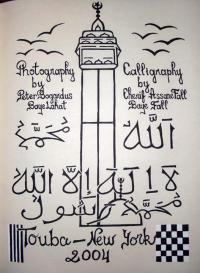
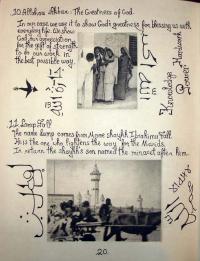
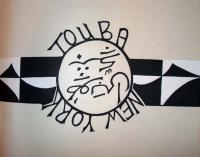
Touba / New York (New York: Khelcom Press, 2004). Edition: 45; printed on Kumohadamashi paper. Graphic Arts GAX 2008- in process.

Touba / New York is an examination of the Murid Brotherhood, a Sufi Muslim movement dedicated to the promotion of peace. The word Mouride in Arabic means “one who desires,” and the Mourides are one of the fastest growing religious movement in West Africa.

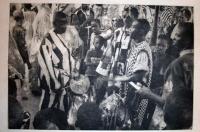
Once a year, Sheik Mourtada Mbaké, the youngest son of Amadou Bamba and the spiritual leader of the Mourides, travels to Harlem. The growing community of Senegalese expatriates gather around a red-brick building named the House of Islam on 137th Street and Edgecombe Avenue. They come to pay homage to the Sheik and receive his blessing. The week-long celebration begins on July 21 and ends on July 28, Amadou Bamba Day, with a huge parade down 116th street, through Little Senegal. The overwhelming majority of the men and women in this parade were originally from Touba (pronounced ta-wa-ba), the second largest city in Senegal and the location of Bamba’s sacred burial place.

This book grew out of the artist Peter Bogardus’ encounters and travels with descendants of Sheik Bamba and his foremost student, Ibra Fall. Text is printed from woodcuts cut by Peter Bogardus after calligraphy by Sherif Fall and Shaykh Ndiguel Fall. Illustrations include 35 photogravures by Bogardus.

Printed Paintings and Engraved Drawings

| 1 Comment

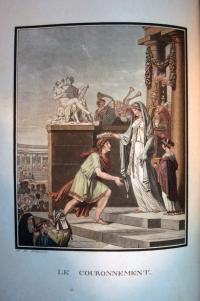
Le Couronnement
(The Crowning)

Antoine Gautier de Montdorge (1701-1768), L’art d’imprimer les tableaux (Paris: Le Mercier, 1756). Graphic Arts Collection (GAX) 2004-3391N. Gift of Elmer Adler.

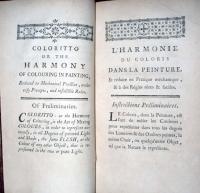
In 1725, the German artist Jakob Christoffel Le Blon (1667-1741) published Scheme of Colours in Coloritto, outlining his discovery of a multi-color intaglio printing technique, which he used to print reproductions of chalk and pastel drawings. For the first time, full-color prints could be created from just three colors: blue, yellow, red (and later black) printed in that order, one on top of the other. Many eighteenth-century French printmakers learned and practiced this technique, which became known as chalk manner engraving. Variations were developed to also reproduce gouache and watercolor paintings.

Philibert-Louis Debucourt (1755-1832) was particularly able at wash manner printing and a good example of his work is “Le Couronnement” or “The Crowning” [at the left] from Héro et Léandre, translated by Le Chevalier de Quérelles (Paris: Pierre Didot l’ainé, 1801). Graphic Arts Collection (GAX) Oversize PQ2384.Q45 H4 1801q. This particular print required six different plates with six different inks: blue, green, yellow, red, brown, and black, in that order.

In the nineteenth century, these time-consuming and expensive printing techniques were replaced with stencil and hand coloring, which was usually done by low-paid female workers.

Princeton owns a later publication by Antoine Gautier de Montdorge with Le Blon’s text in English and French, along with a complete explanation of the technique. For additional information on chalk manner printing, see the exhibition catalogue: Margaret Morgan Grasselli, Colorful Impressions: the Printmaking Revolution in Eighteenth-Century France ([Washington, D.C.]: National Gallery of Art, 2003). Graphic Arts Collection (GA) Oversize 2005-0445Q

For more on color, see the new rare books acquisition announced at http://blogs.princeton.edu/rarebooks/2008/04/
recentlyacquiredwiener_farbe.html

Polychromatic Decoration

| No Comments

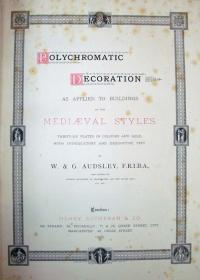
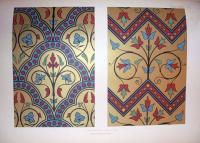
W. & G. Audsley, Polychromatic Decoration as Applied to Buildings in the Mediaeval Styles (London: H. Sotheran & Co., 1882). GA Oversize NK2180.A8F

The Audsley brothers, William James (born 1833) and George Ashdown (1838-1925), were Scottish architects who practiced in Liverpool from 1856 to 1880, in London during the 1880s, and in New York City beginning in 1892.

Throughout their career, the brothers wrote, lectured, and published their designs and their beliefs, including the beautiful color-plate book Polychromatic Decoration. Intended as a pattern book and practical guide to the painted decoration of medieval-style buildings, the volume was an instant success. The brillient chromolithographs were printed by Firmin-Didot, who also published a French edition. Although the two editions were meant to be released simultaneously, La peinture murale décorative, dans le style du moyen age (Marquand Library (SA) Oversize NK2140 .A7f) actually came out weeks earlier, at the end of 1881 and so, has an earlier date. Each contains 36 chromolithographed plates, offering 166 designs.

In 1895, George Audsley presented a talk at the Architectural League of New York on “The Polychromatic Decoration of Churches,” which was reprinted in Architecture and Building. This may have led directly to the commission to design the painted ornamentation for Our Lady of Grace Roman Catholic Church of Hoboken, New Jersey. For Princetonians who want to see the Audsleys’ work in situ, this remains the closest example.

To see more digital images, go to: http://digitalgallery.nypl.org/nypldigital/
dgkeysearchresult.cfm?word=Audsley%2C%20W.%20%20(William)&s=3&notword=&f=4

Pro-Slavery Demonstrators Destroy Pennsylvania Hall

| No Comments

Pennsylvania Hall Association, History of Pennsylvania Hall, which was destroyed by a mob, on the 17th of May, 1838 (Philadelphia: Printed by Merrihew and Gunn, 1838). Graphic Arts Collection (GAX) Hamilton 1295

“It is with reluctance we come before the public with the story of our wrongs,” begins the final chapter of History of Pennsylvania Hall. “Were we to consult our own feelings, we should draw a veil over the disgraceful transactions we are about to disclose.”

Pennsylvania Hall opened its doors on Monday, May 14, 1838. The building was constructed to provide a safe place for organizations to meet and discuss the abolition of slavery. By Thursday evening, the building was demolished.

The first group to meet in the Hall was the Female Anti-Slavery Society and the next morning, a group of pro-slavery demonstrators began posting placards around Philadelphia, urging citizens to interfere, forcibly if they must, with further meetings. When the Society met again on Wednesday, demonstrators yelled and threw bricks through the windows.

On Thursday, the Society sent a letter to the mayor of Philadelphia, asking for his protection. A series of letters went back and forth all day and around sunset the mayor addressed 15,000 demonstrators who had gathered outside the Hall. He told them he would not stop them, in fact he said, “I look upon you as my police, and I trust you will abide by the laws, and keep order.” With that, the mob attacked the building and set it on fire.

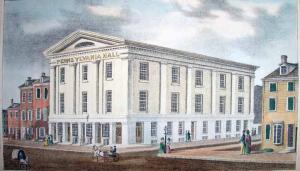
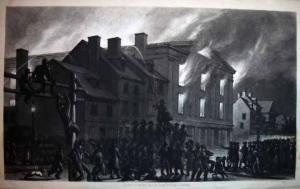
The History is illustrated with three views of the Hall: a color lithograph frontispiece before the fire (top); a mezzotint by John Sartain depicting the fire (bottom); and a wood engraving of the ruins, drawn by John Archibald Woodside, Jr. and engraved by Reuben S. Gilbert (not shown here).

Eggs, Nests, and Beaks

| 2 Comments

Illustrations of the Nests and Eggs of Birds of Ohio. Texts by Howard Jones and illustrations by Virginia Jones. (Circleville, Ohio, 1886). GAX 2008- in process.

“Nest and Eggs” is a beautiful color-plate book that began in 1877 as the project of Genevieve Jones and Eliza Shulze, two young women in Circleville, Ohio. Jones’ father offered to finance the publication and to collect the birds’ nests for the girls to illustrate. None of them had any previous experience but it was their hope to produce a scientific work in twenty parts, illustrated with hand-colored lithographs, which would sell for $5.00/part.

According to the research of Ernest Wessen, published in The Papers of the Bibliographical Society of America 47, no. 3 (1953), some of the production and most of the credit for the publication was taken over by Genevieve’s younger brother, Howard. Even their mother, Virginia, who help out after 1879, received more credit than her daughter.

Regardless, the production of the book was exceptional. Adolph Krebs, a professional lithographer, shuttled 65 pound stones back and forth between Circleville and his studio in Cincinnati. Josephine Klippart, a professional colorist, was paid $3/print. Robert Clarke, a Cincinnati publisher, printed the text and wrappers.

The first part was released in July of 1879 and the final part in December of 1886. In the end, the biggest loser might have been Dr. Jones, who put up $13,181 for the edition of 90 copies (23 parts, 60 plates). Records indicate sales over ten years returning just $2,000. The Smithsonian has digitized all the plates at www.sil.si.edu/ondisplay/nestsandeggs/

Alexander Wilson (1766-1813), American ornithology; or, The natural history of the birds of the United States (Philadelphia: Bradford and Inskeep, 1808-25). Rare Books (Ex) Oversize 8880.975q

At the other end of the spectrum, is Alexander Wilson’s color-plate book American Ornithology, published from 1808 to 1825. Under the instructions of his neighbor, the naturalist William Bartram, Wilson began painting birds of the area. Engraver Alexander Lawson was employed to translate the designs to engravings. Either dissatisfaction or lack of funds led Wilson to fire the colorists and he did most of the hand-coloring himself.

In a recent exhibition at the Library Company of Philadelphia, curators presented the discovery that Wilson also used some color printing to supplement the hand work. If this is the case, Wilson’s Ornithology is the first American book with plates printed in more than one color.

To see more on Wilson and his coloring, go to www.librarycompany.org/
color/section4.htm

Brody Neuenschwander, Calligrapher

| 1 Comment

Princeton University alumnus Brody Neuenschwander, class of 1981, has a new book, Textasy (Ghent: Toohcsmi, 2007), which is reviewed in the most recent issue of baseline magazine (Paul Shaw, “The Work of Brody Neuenschwander,” baseline 53 (autumn 2007) Firestone Oversize Z250 .B37q). The book is in process and will be housed in Marquand Library.

Born in Houston 1958, Neuenschwander was appointed University Scholar while at Princeton, a position that allowed him to devote almost all his time (when he wasn’t rowing) to art history. He graduated in 1981 with high honors for his thesis on the techniques of medieval manuscript illumination. His graduate work was completed at the Courtauld Institute in London, writing on the methodology of German art history.

More importantly, while in London, Neuenschwander began studying calligraphy at the Roedhampton Institute. It was as a calligrapher, rather than an art historian, that he made a career for himself.

Over the last two decades, Neuenschwander collaborated on numerous projects—films, operas, and installations—with the English film director Peter Greenaway, including “Prospero’s Books”, “Pillow Book”, “Flying over Water”, “Bologna Towers 2000”, “Columbus”, and “Writing to Vermeer.” Greenaway contributed one of the essays in Textasy, noting that the artist stretches the boundaries of calligraphy, “exploring the possibilities of text in motion, and of writing as a filmed performance.”

Miró/Eluard Exhibition Now Open

| No Comments

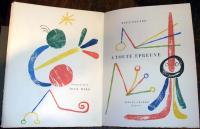
This spring, we are celebrating the fiftieth anniversary of À toute épreuve, one of the most beautiful books of the twentieth century, created by the French poet Paul Éluard and the Catalan artist Joan Miró. The entire unbound volume is on exhibit in the Milberg Gallery for the Graphic Arts, Firestone Library, through June 29, 2008.

The exhibition opening will be celebrated on Sunday, March 9, 2008, with Elza Adamowicz, Professor of French and Visual Culture, School of Modern Languages, Queen Mary, University of London, presenting the talk “The Surrealist Artist’s Book: Beyond the Page” in the Betts Auditorium, School of Architecture, at 3:00. A reception will follow at 4:00, in the Leonard L. Milberg Gallery for the Graphic Arts on the second floor of Firestone Library.

Paul Éluard (1895-1952). À toute
épreuve. Gravures sur bois de
Joan Miró
. Première édition
illustrée. Geneva: Gérald Cramer, [1958]. 79 woodcuts by Joan Miró, printed in Paris at Atelier
Lacourière; text printed by Marthe Fequet and Pierre Baudier. Image: © 2008 Successió Miró / Artists Rights Society (ARS), New York / ADAGP, Paris

From its humble beginnings in 1930 as a plain paper miniature, this simple collection of poems was transformed into an extraordinary deluxe edition folio. The cries of loneliness expressed in Éluard’s verse, “Je suis seul je suis seul tout seul” (I am alone I am alone all alone), are answered on each page with the buoyant companionship of vibrantly colored prints, resulting in a new sense of wholeness and optimism. The title of the work, roughly translatable as “ready for anything” or “foolproof,” conveys a sense of durability and perseverance. Éluard’s poems represent strength in the face of emotional turmoil just as the book survived production challenges and setbacks to become a monument to the art of bookmaking and the possibilities of collaboration.

The project began in 1947, when the Swiss publisher Gérald Cramer approached Éluard with the idea of publishing an illustrated edition of his poetry. For the art, Éluard suggested his friend Miró, with whom he had already collaborated. It took Miró eleven years to create the 233 blocks needed to print 79 woodcuts. He used planks of wood collaged with plastic, wire, old engravings and bark paper to achieve images that practically dance across the page. “I am completely absorbed by the damn book,” wrote Miró to his publisher, Gerald Cramer, “I hope to create something sensational… .” The final volume has a brilliance of invention and a vitality of form and color, rarely found inside the cover of a book.

Special thanks go to Ainsley Brown, Ph.D. candidate, Department of French and Italian, for her work on all aspects of this exhibition and its keepsake. In the gallery, we will offer English language translations of the poetry, some by Ms. Brown and some by the Irish writer Samuel Beckett, who was a great admirer of Eluard’s work. Here is a sample:

L’univers-Solitude
2
Villages de la lassitude
Où les filles ont les bras nus
Comme des jets d’eau
La jeunesse grandit en elles
Et rit sur la pointe des pieds.

Villages de la lassitude
Où tous les êtres sont pareils.

Paul Eluard
Universe-Solitude
2
Villages of weariness
Where the arms of girls are bare
As jets of water
Where their youth increasing in them
Laughs and laughs and laughs on tiptoe.

Villages of weariness
Where everybody is the same

Translation by Samuel Beckett

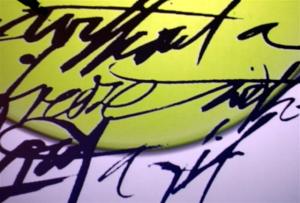
A New Translation of Jayadeva's "Gita-Govinda"

| No Comments

The Gita Govinda or Song of Krishna is considered by many experts to be among the finest examples of Sanskrit poetry. It was written in the 12th century by the great poet, Jayadeva, and describes the relationship between the Krishna and his lover, Radha. The poetry is organized into 12 cantos or chapters, each sub-divided into 24 divisions called Prabandhas, containing couplets grouped into 8, called Ashtapadis.

Kamini. A Cycle of Poems from Jayadeva’s Gita-Govinda. Translated by Andrew Schelling. Designed and printed by Ken Botnick (St. Louis: emdash, 2007). Edition: 65. GAX 2008

The first English translation of Jayadeva’s 1000-year-old songs was by Sir William Jones in 1792. This new translation was completed by the contemporary poet, Andrew Schelling, who selected 29 poems from the 12 cantos to create a suite of poetic images of desire and longing, embracing both introspection and eroticism.

Schelling lives in Boulder, Colorado, where he teaches poetry, Sanskrit, and wilderness writing at Naropa University. He was the 1992 recipient of the Academy of American Poets award for translation and received a Witter Bynner Foundation for Poetry grant in 1996 and 2001. For more of his translations, see: Amaru, Erotic love poems from India. A translation of the Amarushataka by Andrew Schelling (Boston; London: Shambhala, 2004). Indo-European Philology Coll. (Indo). Firestone, PK3791.A43 A812 2004

Printed at emdash Press, Kamini employs 20 colors to capture the various blue manifestations of Krishna. The text is printed in English and Sanskrit, hand-set in Dante type on Bugra paper. The images, photographed by Ken Botnick last spring during a trip to India on a Fulbright grant, were transfered to photo-polymer plates and printed with the letterpress text.

Botnick is professor of visual communications and director of the Nancy Spirtas Kranzberg Studio for the Illustrated Book, at Washington University in St. Louis. He is also the director, designer, and master printer of emdash Press. His career began at the University of Wisconsin, where his classmate Steve Miller had just launched Red Ozier Press. In the fall of 1979, Miller and Botnick received an NEH grant and moved the press New York City, where it ran successfully until 1988. Miller went to the University of Alabama as director of book arts, while Botnick joined Yale University Press as head of art book design and production. In 1997, he moved to St. Louis and Washington University.

Graphic Arts holds a number of Red Ozier editions and two other recent emdash books: Kavya (2003), a series of classical Sanskrit poems collected by Octavio Paz; and In Defense of the Book (2001) by William Gass. These wonderful books are available, without appointment, in the Department of Rare Books and Special Collection reading room.

Flowers for the Faculty

| No Comments

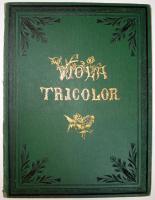
Count Franz Pocci (1807-1876), Viola tricolor: in picture and rhyme (New York: Stroefer & Kirchner, [1876]). Chromolithographs. Graphic Arts Collection (GAX) Oversize 2006-0315Q

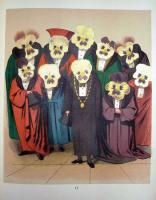
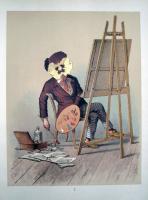
Franz Pocci, a high official in the Court of King Ludwig I, was also a musician, artist, and writer. He collaborated with “Papa Schimid”, founder of the Munich marionette theater, designing and painting the sets, curtains, and props, as well as writing a number of the stories. Pocci went on to publish many illustrated children’s books, which can be found in the Cotsen Library and the Graphic Arts division here at Princeton. In Viola tricolor, printed in astonishing chromolithography, Pocci replaces all the faces with flowers. He is responsible for both the art and the verse.


Faculty Professors
Here stand the University chaps,
In their grand official gowns and caps;
And thinks full sure, each learned elf:
“The cleverest here? - ‘tis I myself!”


The Painter at His Easel
Thus many a painter once gay and glad,
Sits before his picture, and says full sad:
“Oh had I but turn’d this work in to cash!”
“But nobody buys since the last great smash!”

La Orquesta

| No Comments


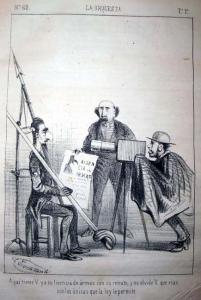
GAX Oversize 2007-0582Q

La Orquesta: Periódico Omniscio, de Buen Humor y con Cariaturas, often referred to as the Mexican Punch, was a satirical journal published out of Mexico City between 1861 and 1877. Graphic Arts holds 106 consecutive issues, each consisting of four pages of text and a full-page lithographic caricature.

Most of these caricatures were drawn by painter and social satirist Constantino Escalante (1836-1868), who was also one of the journal’s editors. Orquesta’s constant criticism of the Mexican government led to Escalante being arrested and jailed on more than one occasion.

For more information on Escalante, see Salvador Pruneda, La caricatura como arma política; caricaturas anónimas y de los artistas: J. G. Z., Constantino Escalante [et al.] (México, 1958). Firestone Library, NC1320 .P944

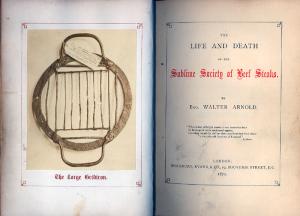
Walter Arnold, The Life and Death of the Sublime Society of Beef Steaks (London: Bradbury, Evans, & Co., 1871). 7 plates (incl. 6 mounted albumen silver prints). Graphic Arts division GAX 2008 in process.

“Like Briton’s island lies our steak,
A sea of gravy bounds it;
Shalots, confus’dly scattered, make
The rockwork that surrounds it.
Your isle’s best emblem these behold,
Remember ancient story:
Be, like your grandsires, first and bold,
And live and die with glory.”

I am posting this Saturday at 5:00 p.m., in honor of the weekly meeting of the Sublime Society of Beef Steaks. From 1735 to 1869, the 24 members of this London dining club, along with their 24 guests, met to eat a beefsteak dinner, drink plenty of wine and sing. Needless-to-say, it was for men only.

Their visual identity was the gridiron and as the location of their dinners changed over 134 years, the original gridiron of the society moved along with them. In each venue, it was ceremonially hung in the centre of the ceiling, over the presidents chair. An albumen photograph of the gridiron is seen above, tipped into Arnold’s book as its frontispiece.

Some of the best known members of the Sublime Society include David Garrick, William Hogarth, The Prince of Wales (soon to be King George IV), and Samuel Johnson. More about the group can be found at: http://sublimesocietyofbeefsteaks.org/SublimeSociety.org
/TheSublimeSociety.html
and in John Timbs (1801-1875), Clubs and Club Life in London. With anecdotes of its famous coffee houses, hostelries, and taverns, from the seventeenth century to the present time (London: Chatto and Windus [1872]). Firestone Library (F) 1465.906.11

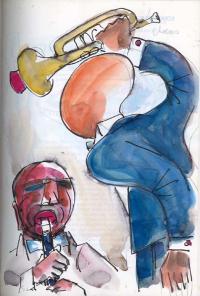
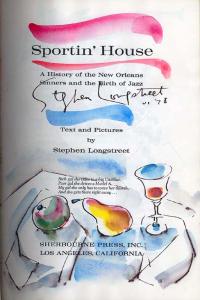
Stephen Longstreet (1907-2002), Sportin’ House: New Orleans and the Jazz Story, A History of New Orleans Sinners and the Birth of Jazz. (Los Angeles: Sherbourne Press, [1965]). Extra illustrated with watercolors by the author dated 1978. GAX ML 3561.J3 L63.


Stephen Longstreet wrote more than 100 books, collaborated on a dozen screenplays, and created an uncounted number of painting, drawings and watercolors. Over half of his books are available on Firestone’s shelves http://catalog.princeton.edu; 68 of his colorful watercolors, primarily portraits, can be found in the Graphic Arts division http://libweb.princeton.edu/libraries
/firestone/rbsc/aids/gc088.html
; and perhaps, most interesting of all, is this copy of Sportin’ House. Princeton’s copy is extra illustrated with watercolors drawn by the author directly onto the pages of the book, including the title page which he signed and dated.

Born in New York City and raised in New Brunswick, New Jersey, Longstreet moved to Paris in the 1920s to study painting. It was there he began creating watercolor portraits of such luminaries as Gertrude Stein and James Joyce. His evenings were spent at the Paris jazz clubs where he got to know the music and the musicians. Today, some of his best known books include Storyville to Harlem: Fifty Years in the Jazz Scene (1986) Oversize Rare Books: Western Americana collection ML87 .L66 1986q and Jazz From A to Z: A Graphic Dictionary (1989) Graphic Arts division Oversize ML102.J3 L66q.

His semi-autobiographical novel, The Sisters Liked Them Handsome, became a Broadway musical entitled High Button Shoes, starring Nanette Fabray and Phil Silvers. A complete list of his films can be found at: http://www.imdb.com/name
/nm0519487/

The Potential of Paper and Ink

| No Comments

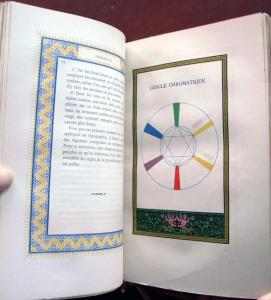
Albert de Rochas, Le livre de demain (Paris: Raoul Marchand, 1884). 432 pages, complete in 44 fascicles. Full morocco binding by Wendling. One of 250 copies signed by De Rochas and the publisher.

What were the options for book publishers and printers in the late nineteenth century? This ‘Book of Tomorrow’ answers that question by offering the reader an amazing mixture of paper, ink, color, graphic arts and typography spread throughout 44 meticulously printed sections. Divided by physical elements (color, paper, ink, etc.), each section offers examples of French poetry or short prose printed on a variety of paper colors, weights, and textures, using a multitude of fonts and inks, with diverse illustrative formats such as photolithography, collotype, etching, and collage. Not a single ornamental border is repeated in the same colors or patterns throughout the 432 pages, and many decorative elements are heightened with gold or silver. The last principal fascicle contains 10 paper samples from papyrus to Chinese and Japanese papers.

Next time you find yourself in a graphic rut, check out Le livre de demain, Graphic Arts division, GAX 2008 in process.

The Natural History of the Lion

| 1 Comment

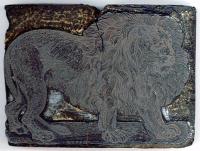
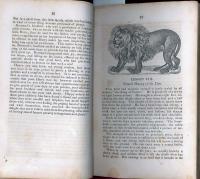
Wood-engraved block by John S. Horton, for John J. Harrod, The Introduction to the Academical Reader (Baltimore: Harrod, 1830). Hamilton 1742. Woodblock is a gift of David B. Long in honor of Gillett Griffin.

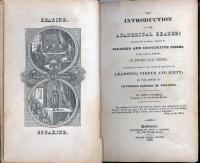
This engraved wood block is signed in the block ‘Horton’. It was produced by the New England wood-engraver John S. Horton to head the chapter “The Natural History of the Lion” in publisher John J. Harrod’s 1830 The Introduction to the Academical Reader. A history of the lion is just one essay in this compilation of “pleasing and instructive pieces … intended to induce and promote the love of learning, virtue, and piety in the minds of juvenile classes of readers.”

The title page offers the inspirational text: “By reading we learn not only the actions and sentiments of different nations and ages, but we transfer to ourselves the knowledge and improvements of the wisest and best of mankind.” Credited to Watts on the Mind, the actual source is The Improvement of the Mind: Containing a Variety of Remarks and Rules for the Attainment and Communication of Useful Knowledge, in Religion, the Sciences, and in Common Life, by Isaac Watts (1674-1748)

Harrod’s book is one of several thousand American imprints illustrated with wood-engravings, identified in the Sinclair Hamilton collection within the graphic arts division. The collection is searchable online as well as in the published catalogue: Early American Book Illustrators and Wood Engravers, 1670-1870 (GA Z1023 .P9 1968).

The process of wood engraving involves the cutting of an image in relief on a hard, end-grain block of wood. The engraver cuts away the parts of the block that are to remain white in the finished image. The hardness of the wood allows the engraver to cut multiple thin lines, creating a more complex image than was possible with the soft matrix used for woodcuts. Wood engraving was the technique of choice for book illustration in the early nineteenth century.

The Great Mirror of Folly

| No Comments

Het groote tafereel der dwaasheid, vertoonende de opkomst, voortgang en ondergang der actie, bubbel en windnegotie, in Vrankryk, Engeland, en de Nederlanden, gepleegt in den jaare MDCCXX. Zynde een verzameling van alle de conditien en projecten van de opgeregte compagnien van assurantie, navigatie, commercie, &c. in Nederland, zo wel die in gebruik zyn gebragt, als die door de h. staten van eenige provintien zyn verworpen: als meede konst-plaaten, comedien en gedigten, door verscheide liefhebbers uytgegeeven tot beschimpinge deezer verfoeijelyke en bedrieglyke handel, waar door in dit jaar, verscheide familien en persoonen van hooge en lage stand zyn geruineerd, en in haar middelen verdorven, en de opregte negotie gestremt, zo in Vrankryk, Engeland als Nederland…
(The Great Mirror of Folly, showing the rise, progress, and downfall of the bubble in stocks and windy speculation, especially in France, England and the Netherlands in the year 1720, being a collection of all the terms and proposals of the incorporated companies for insurance, navigation, trade, &c. in the Netherlands, both those of which have gone into actual operation and those which have been rejected by the legislatures in various provinces. With prints, comedies, and poems, published by various amateurs, scoffing at this terrible and deceitful trade, by which various families and persons of high and low condition were ruined in this year, and possessions lost, and honest trade stopped, not only in France and England but in the Netherlands…).
[Amsterdam?] 1720. 131 p. in various pagings: 73 plates (part fold., incl. ports., maps, plans) 40 cm. Various pieces in prose and verse on the financial transactions of John Law and others, brought together under a general title-page. Graphic Arts Collection (GAX) Oversize 2006-0014F

Here are only 3 of the 73 engraved plates from The Great Mirror of Folly, offering satirical scenes in the rise, progress, and downfall of stocks in France, England and the Netherlands during 1720. The volume is also informally known as The Great Bubble Book after the speculator’s bubbles that burst, causing the first great stock market crash in September of that year. This is an unusual book for many reasons. It was issued without an author or publisher or even city of origin identified. Each individual volume appears to be a unique compilation of prints and texts, holding between 49 and 74 images from up to 56 different engravers.

To see more, Harvard University’s South Sea Bubble site, has a complete index, including digital images of their edition: http://www.library.hbs.edu/hc/ssb/recreationandarts/tafereel.html

Paul Éluard (1895-1952). À toute
épreuve. Gravures sur bois de
Joan Miró
. Première édition
illustrée. Geneva: Gérald Cramer,
[1958]. 79 woodcuts by Joan Miró,
printed in Paris at Atelier
Lacourière; text printed by Marthe Fequet and Pierre Baudier. Image copyright Artists Rights Society (ARS)
The Princeton University Library is pleased to announce the acquisition of one of the most beautiful books created in the twentieth-century, À toute épreuve, with text by the French poet Paul Éluard and 79 original woodcuts by the Catalan artist Joan Miró.
The entire volume can be seen in the upcoming exhibition entitled, Notre Livre: À toute épreuve. A Collaboration between Joan Miró and Paul Éluard, in the Milberg Gallery for the Graphic Arts, Firestone Library, from February 22 to June 29, 2008.

To create this book, Miró cut over 233 woodblocks working over the better part of eleven years. He used planks of wood collaged with plastic, wire, old engravings and bark paper to achieve images that practically dance across the page. "I am completely absorbed by the damn book," wrote Miró to his publisher, Gerald Cramer, "I hope to create something sensational. . . ." The final volume has a brilliance of invention and a vitality of form and color, rarely found inside the cover of a book.

The exhibition opening will be celebrated on Sunday, March 9, 2008, with Elza Adamowicz, Professor of French and Visual Culture, School of Modern Languages, Queen Mary, University of London, presenting the talk "The Surrealist Artist's Book: Beyond the Page" in the Betts Auditorium, School of Architecture, at 3:00. A reception will follow at 4:00, in the Leonard L. Milberg Gallery for the Graphic Arts on the second floor of Firestone Library.

In the gallery, we will offer English language translations of the poetry, some by the Irish writer Samuel Beckett, who was a great admirer of Eluard's work. Here is a sample:

L'univers-Solitude
2
Villages de la lassitude
Où les filles ont les bras nus
Comme des jets d'eau
La jeunesse grandit en elles
Et rit sur la pointe des pieds.

Villages de la lassitude
Où tous les êtres sont pareils.

Paul Eluard
Universe-Solitude
2
Villages of weariness
Where the arms of girls are bare
As jets of water
Where their youth increasing in them
Laughs and laughs and laughs on tiptoe.

Villages of weariness
Where everybody is the same

Translation by Samuel Beckett

Illustrated with Original Photographs

| 1 Comment

During the nineteenth century, when photography was still a new art form, book publishers would cut and paste individual, original photographs into their books as illustrations. It was an expensive, time-consuming process and so, you might think it was only very limited-edition publications that were illustrated in this way. This is not the case. One reason we know this is is by looking at the Princeton University Library, where there are hundreds of examples of books—novels, textbooks, government documents—that include original, now historic, photographs.

H. Beaumont Small (1832-1919). The Canadian Handbook and Tourist’s Guide; Giving a Description of Canadian Lake and River Scenery and Places of Historical Interest with the Best Spots for Fishing and Shooting. Montreal, M. Longmoore & Co., 1867. Frontispiece by William Notman (1826-1891). Graphic Arts Collection (GAX) 2004-1110N

We are now adding a special subject heading to books with original photographs in them to make them searchable in the main online catalogue. If you would like to try this search, go to http://catalog.princeton.edu and type: Photographs, Original—Illustrations in books into the search box. If you find books with photographs that has not yet been noted, please sent me the information and we will add the heading.

If you would like to browse a list of the titles we have been able to locate so far, continue with this posting below:

Boredom and how to avoid it in 1753

| No Comments

Unsigned engraving after Davide Antonio Fossati (1708-1780) in Giovanni Battista Passeri (1694-1780). Della Seccatura Discorsi cinque di L’Antisiccio Prisco. Dedicati a Nettuno. Venice: Pietro Valvasense, 1753.

This unsigned engraving, attributed as after the Swiss artist Davide Antonio Fossati, shows four boys playing a game of leap-frog; presumably the earliest illustration of this sport. It is one of six plates in Passeri’s discourse on the drying up of wit and entertainment at the time, which he dedicated to Neptune. If anyone has a theory on why Neptune, I’d love to hear about it.

Passeri, the Abbate of Pesaro, was an antiquarian, a philologist, and an archeologist. Each of the five discourses or sections describe a different form of boredom and are illustrated with a beautiful engraving suggesting a way to combat this fatigue. The book was written as a carnival satire, and partly presented to the academy of Pesara.

Besides publishing Della Seccatura Discorsi, Passeri has the distinction of having published the greatest catalogue of fake Roman terracotta lamps ever produced. The Marquand Art and Archaeology Library at Princeton University holds several of Passeri’s studies on Etruscan vaces:

Passeri, Giovanni Battista, 1694-1780, Lucernae fictiles Musei Passerii, 1739, Location: Marquand Library (SAX): Rare Books, Call Number: NK3835 .P26f

Passeri, Giovanni Battista, 1694-1780, Mvsevm etrvscvm, exhibens insignia vetervm Etrvscorvm monvmenta aereis tabvlis cc. nvnc primvm, 1737 Location: Marquand Library (SAX): Rare Books, Call Number: N5740 .G67q

Passeri, Giovanni Battista, 1694-1780, Serie di vasi tratta da vari musei d’Italia … rãpresentanti le pitture degli Etruschi, 1787, Location: Marquand Library (SA), Call Number: NK3845 .P26f

Passeri, Giovanni Battista, 1694-1780, Thesavrvs gemmarvm antiqvarvm astriferavm quae e complvribvs dactyliothecis selectae aereis tabvlis cc. inscvlptae observationibvs inlvstrantvr adiect, 1750, Location: Marquand Library (SAX): Rare Books, Call Number: NB1268 .G67q

All the World Going to See the Great Exhibition of 1851

| No Comments

George Cruikshank, 1792-1878. All the World Going to See the Great Exhibition of 1851. Etching, 1851. Signed at the center of globe.

This image first appeared in Henry Mayhew’s 1851 or The Adventures of Mr. and Mrs. Sandboys and Family, Who Came Up to London to ‘Enjoy Themselves,’ and to See the Great Exhibition (London: David Bogue, [1851]). The work includes ten etchings by George Cruikshank and a woodcut title page reproducing the design on the wrappers of the parts. Cruikshank is making fun of the approximately 25,000 people who attended the exhibition, which was conceived to demonstrate Britain’s status as an industrial power.

According to Cruikshank’s catalogue raisonne by Albert Cohn, Mayhew’s text was originally issued in eight parts in green wrappers, February-September 1851, and on completion in light blue stamped cloth, with a gilt design upon the spin. In the early issues there is an error in the pagination at p. 63, where in subsequent issues a leaf of advertisements is inserted to make good the omission on the numbering of the pages. The set was sold in parts for ten pounds and in blue cloth for four pounds.

1 2 3 4 5 6 7 8 9 10 11 12 13 14

Recent Comments

  • V.E.G.: James Franklin, Benjamin Franklin's half-brother is a direct descendant of read more
  • Bob Fleck: Nice comments and well worth it. read more
  • N. Sutherland: Do you have any further biographical material on this Thomas read more
  • john W: Have the complete collection of EA Seguy papillons including front read more
  • Vermathio: algarabia, charabia et Picabia. Le premier désigne la langue read more
  • Matt SCOVILL: I have the complete "bookplates in Japan" box. I am read more
  • Daniel Joseph Bobroff: April 30, 2013 To Princeton University: This is a Plaintiff read more
  • Ana Paula: Nice! I wish I could be there to enjoy it! read more
  • Nora Lin: What a shame! Those rooms were inspirational, not only on read more
  • pepesel: Why did they have to close it? That seems shortsighted. read more