Recently in Acquisitions Category

Prague through the Eyes of Kafka

| No Comments
prague3.jpg
prague2.jpg

prague1.jpg
prague4.jpg

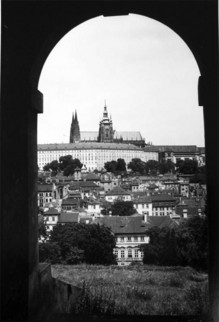
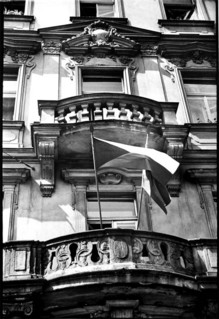
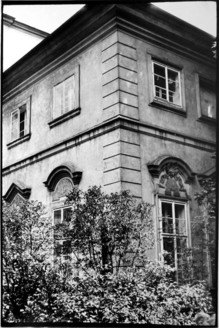
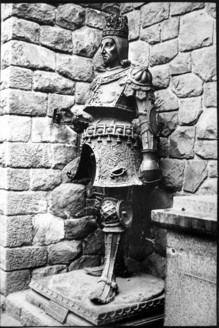
Franz Kafka (1883-1924) first met Milena Jesenská (1896-1944) when she worked as the Czech translator of his early short prose work. In April 1920, he began a correspondence from a pension in Meran, which extended through March 1924, three months before his death. In one of the early letters, he describes his fears as a young boy of six walking across Prague to the elementary school.

Letters to Milena was published in New York and Frankfurt in 1953, edited by Willi Haas. The photographic essay, Prague Through Kafka’s Eyes, was shot by Ruth Ivor (1912-2008) while on assignment for Life magazine in 1965 and left on deposit at Princeton University Library in 1980.

With sincere thanks to the Ruth Ivor Foundation, a complete set of Ms. Ivor’s Prague photographs is now a permanent part of our Graphic Arts Collection. These are a few examples.


Franz Kafka (1883-1924), Letters to Milena. Edited by Willi Haas; translated by Tania and James Stern (New York: Schocken Books [c1953]) Firestone Library (F) PT2621.A26 Z5513 1953.

Margarete Buber-Neumann (1901-1989), Mistress to Kafka: the Life and Death of Milena; introduction by Arthur Koestler (London: Secker & Warburg, 1966). Firestone Library (F) PT2621.A26 Z6463 1966

Julio Cortázar by Julio Silva

| No Comments
Julio Silva of Julio Cortazr.jpg

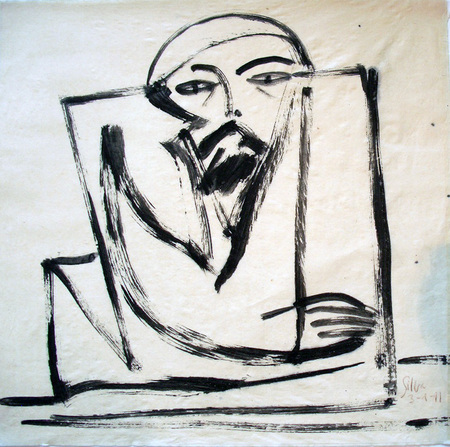
This portrait of Argentine novelist and short story writer Julio Cortázar (1914-1984) was created from memory by his Argentine friend and frequent collaborator Julio Silva (born 1930).

They met in Paris, where Cortázar moved in 1951 and Silva shortly after in 1955. Their first published collaboration came in 1966 when Silva provided lithographs to complement Cortázar’s Les discours du Pince-Gueule. They worked closely on the collage books, La Vuelta al Día en Ochenta Mundos (1967) and Último Round (1969) and then Territorios (1978). In 1976, Cortázar dedicated Silvalandia to the artist, who provided the illustrations.

Jorge Luis Borges wrote, “No one can retell the plot of a Cortázar story; each one consists of determined words in a determined order. If we try to summarize them, we realize that something precious has been lost.”

Julio Cortázar (1914-1984), Ultimo Round (México: Siglo Veintiuno Editores, 1969) Rare Books (Ex) Item 4913202

Julio Cortázar and Julio Silva, Les discours du pince-gueule. Nouv. éd. (Saint-Clément-de-Rivière: Fata Morgana, 2002). Graphic Arts RCPXG-7055109

Julio Cortázar (1914-1984), La vuelta al día en ochenta mundos. 5. ed. ([Mexico] Siglo Veintiuno Editores [1969]) Firestone Library (F) PQ7797.C7145 V845 1969

Julio Silva (born 1930), Julio Cortázar, 1991. Ink and brush drawing. Graphic Arts Collection GAX 2012- in process

Chaldaean Account of the Deluge

| No Comments
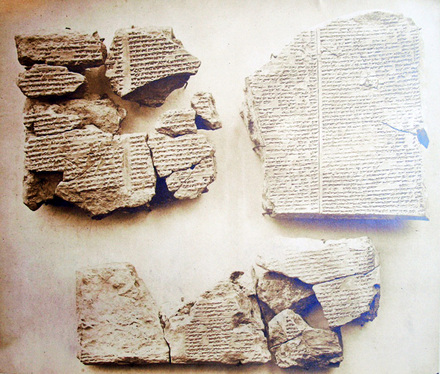
chaldaean 1.jpg

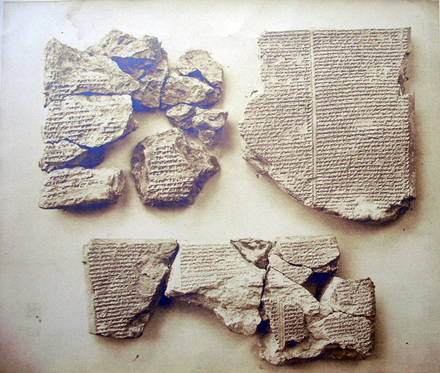
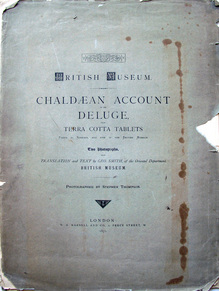
Stephen Thompson (1831-1892) and George Smith (1840-1876), Chaldaean Account of the Deluge from Terra Cotta Tablets Found at Nineveh, and Now in the British Museum (London: W.A. Mansell, 1872). Graphic Arts Collection GAX 2012- in process.

chaldaean3.jpg

Brothers Stephen and Thurston Thompson, along with Roger Fenton, were hired by the British Museum to photograph and document the Museum’s collection. During the 1850s and 1860s, they worked their way through the vaults, taking the objects outside (when the weather allowed) to get the best light. In 1872, Stephen took on the terra cotta tablets in the department of oriental antiquities. Two of his albumen silver prints were published in the Museum’s series, Album photographique, along with a translation and commentary by George Smith (1840-1876).

Smith had been hired to piece together the fragments of tablets from Ninevah and in 1871, published “The Phonetic Values of the Cuneiform Characters,” to assist in the transcription and translation of Assyrian documents. The following year, he found what he believed to be evidence of the biblical flood as accounted in the book of Genesis.

Read Smith’s paper “The Chaldean Account of the Deluge,” published in Transactions of the Society of Biblical Archaeology 2 [1873] 213-34 online here: http://www.sacred-texts.com/ane/chad/chad.htm

chaldaean 2.jpg

National Types and Costumes

| No Comments
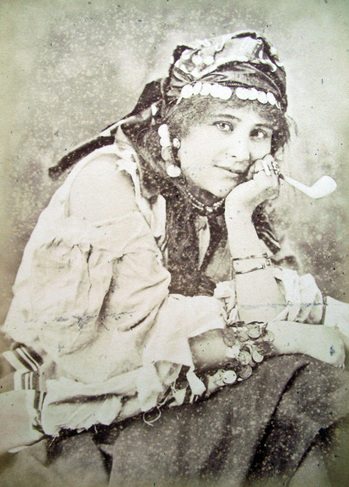
national types6.jpgBohemia
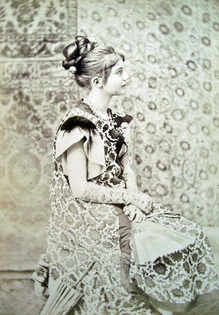
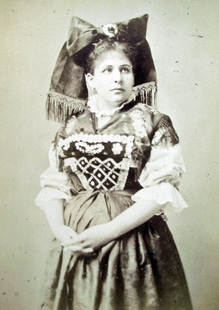
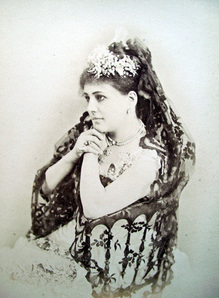
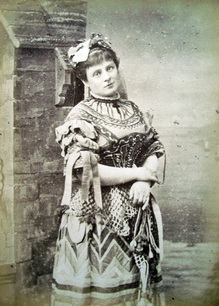
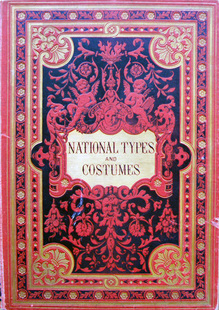
National Types and Costumes, with explanatory text (London: Frederick Bruckmann, ca.1885) including 15 mounted albumen photographs. Graphic Arts Collection GAX 2012- in process. Gift of Bruce C. Willsie, Class of 1986.

national types5.jpgChina
national types2.jpgAlsace

national types4.jpgSpain
national types3.jpgRussia
national types1.jpg

In 1858, Freidrich (or Frederick) Bruckmann (1814-1898) founded one of the most important German publishing houses of the 19th century. The firm settled in Munich and around 1863, Bruckmann added both a photographic and a lithographic studio to his printing operation. This allowed him to control not only the text and binding of his books but also the illustrations. He was a pioneer in modern fine art publishing and branches of the firm opened in Vienna, Berlin, Paris, London, and New York.

An influential early project was a portfolio illustrating all of Goethe’s female characters. The volume featured albumen silver prints by Josef Albert, although Bruckmann was also a working photographer. They tried similar projects with the characters of William Shakespeare, Friedrich Schiller, and others. Soon Bruckmann Verlag developed a specialization in illustrated collections; groups of women, groups of painting, groups of decorative arts, etc.

Thanks to Bruce Willsie, Class of 1986, we recently acquired a charming example entitled National Types and Costumes. There is no information inside the volume to confirm this but it was published around the same time Bruckmann won a Silver Medal at an international competition and there is reason to believe the photographs are by Bruckmann himself.

Die Kunst für Alle. (München: F. Bruckmann, 1885-1944). Marquand Library (SA) Oversize N3 .K9q

Gustav Friedrich Waagen (1794-1868), Die Gemäldesammlungen in der Kaiserlichen Ermitage zu St. Petersburg (München: F. Bruckmann, 1864). Marquand Library (SAX) ND40.L52 W32

Wilhelm von Kaulbach (1804-1874), Goethe’s frauengestalten (München: F. Bruckmann, [1864?]) Rare Books Off-Site Storage Oversize 3445.753.11f

A Lottery Dream Book

| No Comments
indovino fortunato3.jpg
indovino fortunato5.jpg

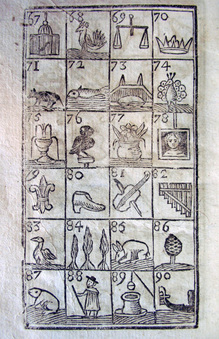
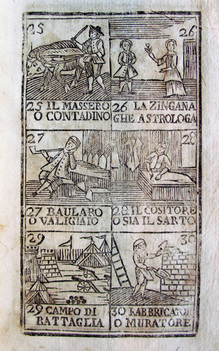
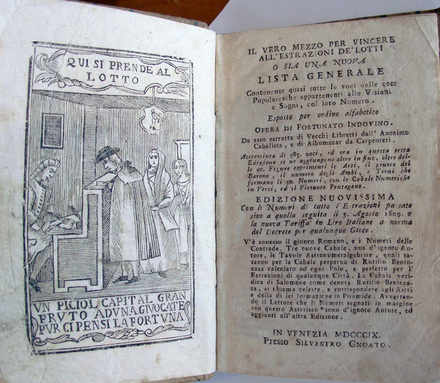
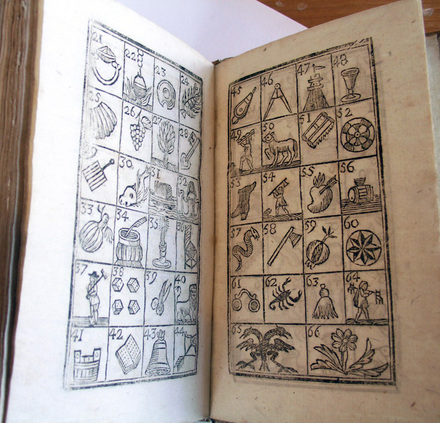
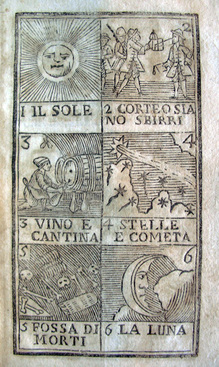
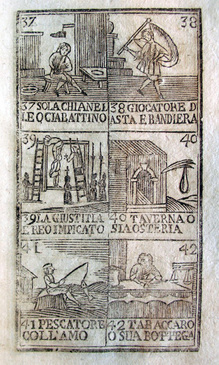
Fortunato Indovino, Il vero mezzo per vincere all’estrazione de’ lotti, o sia una nuova lista generale contenente quesi tutte le voci delle cose popolaresche appartenenti alle visioni e sogni, col loro numero. Esposte per ordine Alfabetico [The Surest Means to Win the Lottery Drawing, or a New General List Containing Entries for All the Everyday Things Found Inside Visions and Dreams, With Their Numbers. In alphabetical order] (Venice: Sylvester Gnoato, 1809). Frontispiece and 19 plates of woodcuts, with an additional full-page woodcut dated 7 February 1754.

indovino fortunato7.jpg

Lottery dream books or guidebooks were popular in the eighteenth and nineteenth century but few have survived. An astrologer using the pseudonym Fortunato Indovino, or Lucky Guesser, wrote one in 1754 that was reissued many times over more than eighty years. This Venetian edition is small and light, easy to carry with you throughout the day.

indovino fortunato1.jpg
indovino fortunato8.jpg

According to historian Susan Nicassio:
“Fortunato gave reassuringly complicated rules for ‘knowing the right, and precise, number not only for ambos and ternos, which make up the numbers that will be played, but please God, of all 90 numbers on the list’. The method for choosing numbers has been described as cabalistic and it is a good word. One technique was to select a number, then multiply it by its nearest inferior; then take half of the product of this multiplication, and that half gave the number you want for the ambo.”

indovino fortunato6.jpg
indovino fortunato4.jpg

“For example, you may decide (from a dream…) that the appropriate symbol for you this week is a dog. The number for a dog, in the Roman lottery, is 17. You multiply 17 by 16, its nearest inferior, and arrive at 272. Half of 272 is 136. So the number you want for the ambo is 136.”
“Dream books were in great demand for deciding the numerical meaning of dreams (a drowned man translated to 88). Events in everyday life had numbers. If a child in your family were ill with a fever, you would bet 18-28-48; if you had an unhappy or one-sided love affair, your number was 90.” — Susan Vandiver Nicassio, Imperial City: Rome, Romans, and Napoleon (Welwyn Garden City: Ravenhall, 2005). Firestone Library (F) DG812.7 .N53 2005

This book can be read in any order

| No Comments
sporta, composition1.jpg

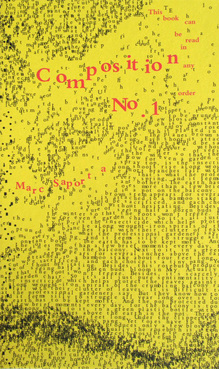
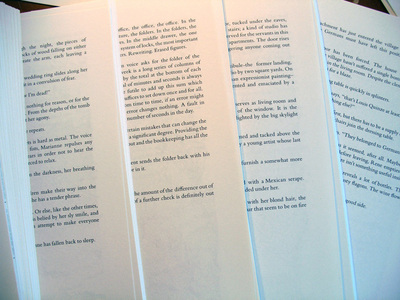
Graphic Arts’ newest acquisition began in 1962, when the French writer Marc Saporta (1923-2009) published a book in a box, entitled Composition n° 1: roman. The following year, Princeton University acquired a copy translated by Richard Howard. The publisher included instructions for the reader: “The pages of this book may be read in any order. The reader is requested to shuffle them like a deck of cards.”

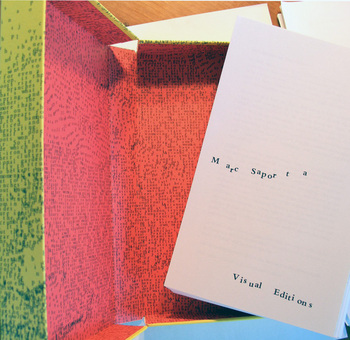
Around this time last year, the London publishing house Visual Editions decided to issue Saporta’s novel in a new edition. “We publish books that use visual writing,” the editors explained.

“There is a rich literary heritage for this kind of writing and this very much forms the basis for what we’re setting out to do. The way we think about visual writing is this: writing that uses visual elements as an integral part of the writing itself. Visual elements can come in all shapes and guises: they could be crossed out words, or photographs, or die-cuts, or blank pages, or better yet something we haven’t seen. The main thing is that the visuals aren’t gimmicky, decorative or extraneous, they are key to the story they are telling. And without them, that story would be something altogether different.”

saporta, composition2.jpg
saporta, composition3.jpg

The new edition includes 150 pages: 150 first pages and/or 150 last pages. On November 25, 2011, the Victoria & Albert Museum invited 150 people to be Read Outlouders, each one reading a different page spread throughout the Museum. Here’s a look at the event:

">

Marc Saporta (1923-2009), Composition No. 1, a Novel (New York: Simon and Schuster, 1963). Rare Books (Ex) 3290.49.326.7

Marc Saporta (1923-2009), Composition No. 1. Introduction by Tom Uglow, illustrated page entitled “The Anatomy of Your Favourite Novel” by Salvador Plascencia (London: Visual Editions, designed by Universal Everything, 2011). Graphic Arts Collection (GAX) 2012- in process

Shunga

| No Comments
utagawa toyokuni 5.jpg

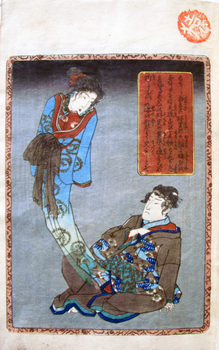
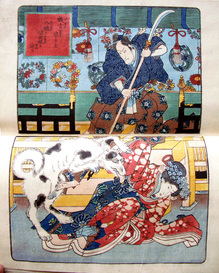
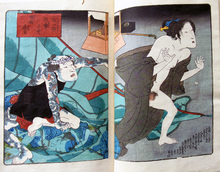
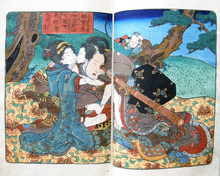
Utagawa Toyokuni III (Utagawa Kunisada 1786-1865), Koi No Yatsu Fuji (Edo, ca. 1870). Graphic Arts Collection 2012- in process


utagawa toyokuni 4.jpg
utagawa toyokuni 1.jpg


utagawa toyokuni 3.jpg
utagawa toyokuni 2.jpg

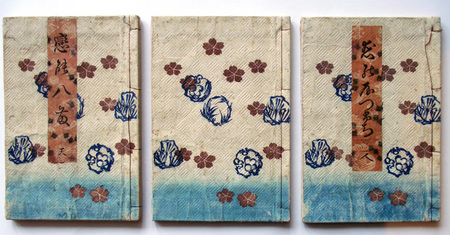
Koi no Yatsu Fuji, published at the New Year in 1837, is a shunga version of Satomi Hakken-den, the most representative work of Kyokutei Bakin (also known as Kyokutei Shujin), originally published in 1814-42. Both its text and illustrations are clever parodies of the original work. The author’s name is given as Kyokudori Shujin, a perversion of and is the pseudonym of the gesaku writer Hanagasa Bunkyō. The illustrations are by Bukiyo Matahei, otherwise known as Kunisada. The title is a version of the ‘eight tufts of hair-amulets (yatsu-busa)’ of the dogs in the original work, which appear as such in the main text; but for some reason the term is Yatsu Fuji in the title. The inside title reads Nansō Satomi Hakken-den.” -Yoshikazu Hayashi, Kunisada’s Koi no Yatsu Fuji Shunga Book (1996)

Utagawa Kunisada (later Utagawa Toyokuni III, 1786-1864) was the Andy Warhol of his day. He was the most popular, most copied, and most financially successful artist of that period. As a young man, he apprenticed with Toyokuni, later having the honor of taking that master printer’s name. Experts estimate Kunisada’s total work to be over 20,000 prints.

Many of the Shunga (erotic) prints and books in this country are in the backrooms of art museums and library, carefully housed and controlled by shy librarians. This is only the second such volume to enter Princeton University Library but an important example of a significant genre. The date of this edition is only a guess, there is no date inside the volume.

Grete Stern

| No Comments
grete stern of juan ramon jimenez.jpg

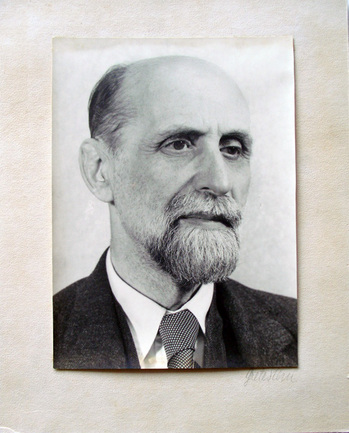
[above] Grete Stern (1904-1999), Juan Ramón Jiménez, 1949. Gelatin silver print. Graphic Arts Collection GA2012- in process. Purchased with fund provided by the Program in Latin American Studies.
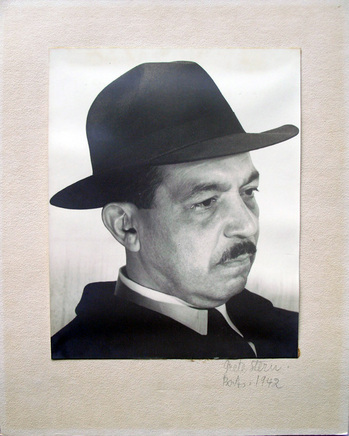
[below] Grete Stern (1904-1999), Pedro Henríquez Ureña, 1942. Gelatin silver print. Graphic Arts Collection GA2012- in process. Purchased with funds provided by the Program in Latin American Studies

grete stern of pedro henriquez urena.jpg

In the 1930s, the German photographer Grete Stern (1904-1999) married the Argentine photographer Horacio Coppola (1906-2012) and settled in Buenos Aires. They brought with them the ideology of the Bauhaus workshop in Dessau where they met and were important agents in the spread of European modernist theory to South America.

Already a prize-winning artist and manager of an acclaimed Berlin photography studio (together with Ellen Auerbach), Stern opened a second studio in Buenos Aires, offering graphic design, advertising, and commercial portraiture.

“In 1940 the couple moved to a Modernist house built in the outskirts of the city, designed by architect Wladimiro Acosta …The house became a meeting place for young artists and writers … both Argentine and exiled foreigners. They met to show their work and discuss cultural matters. For example, in 1945 the Madi arts group (Movimiento de Arte Concreto Invención) exhibited for the first time at her house. Stern used the gatherings in her home as an opportunity to photograph her visitors. Among her subjects were exponents of the avant-garde in the arts and letters, including Jorge Luis Borges, Clément Moreau, Renate Schottelius and others.” (Jewish Women’s Archive)

Princeton is fortunate to have acquired two of Stern’s portraits. The first is a 1942 image of Pedro Henríquez Ureña (1884-1946) a Dominican intellectual, philosopher, and literary critic, known for his essay “La utopía de América” (1925), among many others. The second, taken in 1949, is a portrait of the Spanish poet Juan Ramón Jiménez (1881-1958), who received the Nobel Prize in Literature in 1956.

Below is a short video of Stern and her husband with a clip from Coppola’s film Ringl and Pit, in which Stern plays the part of the maid.


See also: Grete Stern (Valencià: IVAM Centre Julio González: Generalitat Valenciana, 1995). (SAPH): Photography TR680 .S914 1995
Sueños: Fotomontajes de Grete Stern: Serie Completa (Buenos Aires: Fundación CEPPA, Centro de Estudios para Políticas Públicas Aplicadas, [2003]). (F) TR647 .S789 2003

Apollinaire's Calligrammes

| No Comments
apollianaire calligrammes6.jpg
apollianaire calligrammes4.jpg
apollianaire calligrammes2.jpg
apollianaire calligrammes3.jpg
apollianaire calligrammes7.jpg

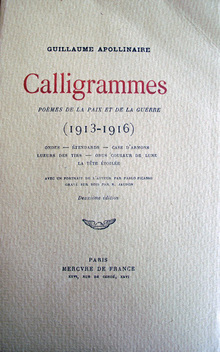
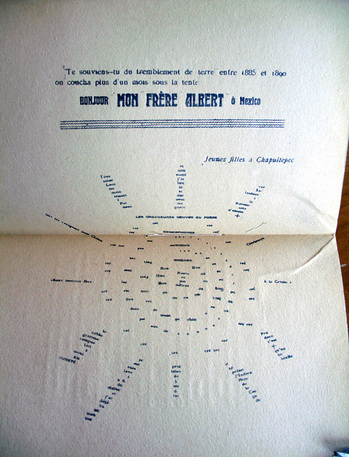
Banker, soldier, magazine publisher, art reviewer, and cultural provocateur Guillaume Apollinaire (1880-1918) published his first collection of poetry, L’enchanteur pourissant in 1909. He followed this with Alcools (aka Alcohols) four years later.

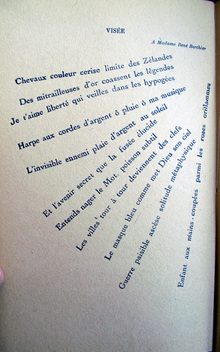
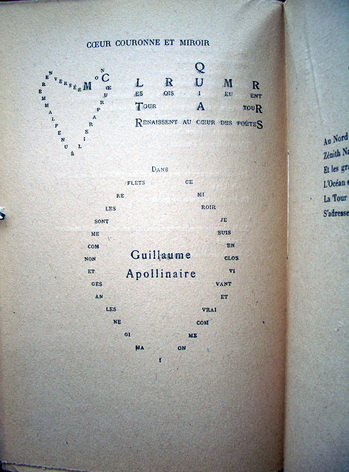
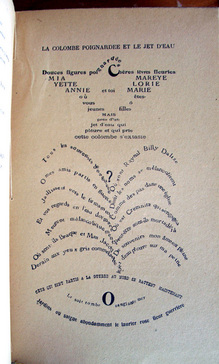
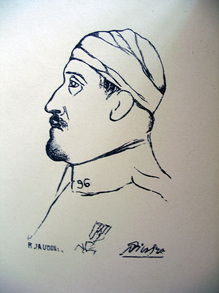
During the First World War, Apollinaire composed the word pictures that would form his third volume, entitled Calligrammes, poèmes de la paix et de la guerre 1913-1916 (Calligrams: Poems of War and Peace 1913-1916). Like his friend Pablo Picasso (who drew his frontispiece portrait), Apollinaire painted his view of the world in a non-linear way, using language and letters as his paint and brushes. Published the year of his death, Calligrammes remains one of the most influential books of the twentieth century.

This important work will be on view at the Princeton University Art Museum in the spring of 2013, as they celebration this generation of avant-garde artists and writers with an exhibition and symposium organized by Professor Efthymia Rentzou.

apollianaire calligrammes1.jpg

Listen to a 1913 recording of Apollinaire reading his poetry:

Total Destruction of the Democratic Platform

| No Comments
total destruction of the democratic.jpg
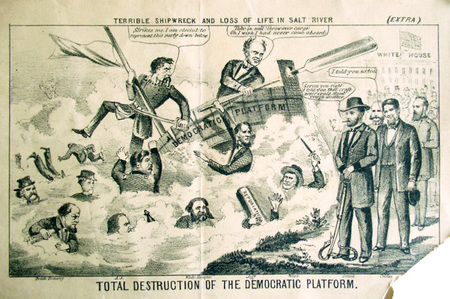
Unidentified artist, Total Destruction of the Democratic Platform. Terrible Shipwreck and Loss of Life in Salt River, 1868. Lithograph. Graphic Arts Collection GA2012- in process.

If a political party was in trouble in the 19th century, they were said to be “up the Salt River.” This was the case for the Democrats in the presidential election of 1868. Their ticket of Horatio Seymour (1810-1886) and Francis Blair (1821-1875) ran against the Republican Party’s nominees Ulysses S. Grant (1822-1885) and Schuyler Colfax (1823-1885).

An unsigned political cartoon shows the Democrats on a sinking platform, along with their shipmates Jefferson Davis, Andrew Johnson, Wade Hampton, Henry Wise, and newspaper publisher Marcus Mills “Brick” Pomeroy. Blair says he wishes he “had never come aboard.”

Meanwhile, Grant and Colfax watch calmly from the shore, not far from the White House. An important aspect of the Republican platform that year was their endorsement of the Fifteenth Amendment to the Constitution, which allowed African Americans to vote. Thanks to a provision that kept many ex-confederates (and Democrats) from voting, Grant won the election by 52.7 % of the popular vote and became the 18th President of the United States.

"Night Lunch for a Blank Generation" and other stories

| No Comments
search destroy5.jpg
search destroy2.jpg
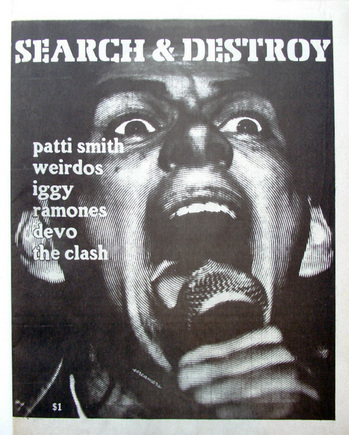
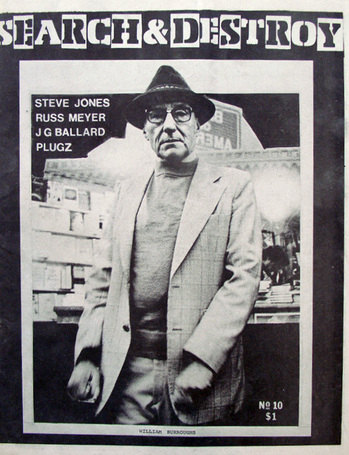
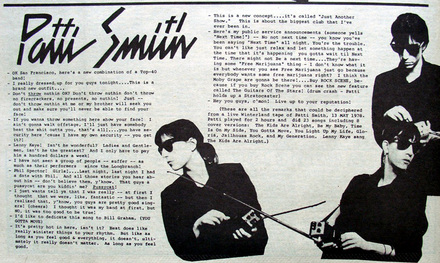
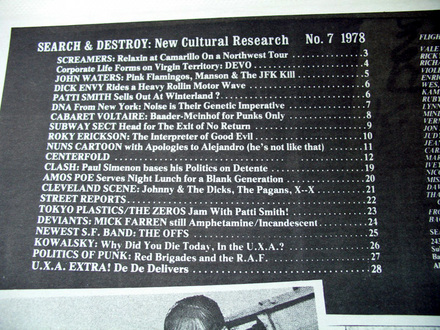
Search & Destroy (San Francisco, CA: [s.n.], v. 1, no. 1, 1977-v. 2, no. 11, 1979). “New wave cultural research.” Graphic Arts Collection GAX 2012- in process

search destroy4.jpg
search destroy1.jpg

“Though small, San Francisco-based RE/Search is credited with beginning a fringe publishing phenom[enon],” writes Susan Carpenter (LATimes Aug. 13, 2002). [V. Vale] … had no career aspiration other than working as a clerk at City Lights Books when he started Search & Destroy. Vale put together the magazine with an IBM Selectric II correcting typewriter he used after hours at the bookstore. Using money he solicited from legendary beatnik Allen Ginsberg and City Lights founder Lawrence Ferlinghetti, Vale was able to print his first issue but had to rely on the money he made through benefit concerts to keep the venture going.”

Although the zine only lasted eleven issues, it was quite influential and remains a key source for interviews in late 1970s popular culture including music, art, literature, and film. Writers featured include William Burroughs, J.G. Ballard, Patti Smith, Octavio Paz, and Bob Flanagan among others.


search destroy3.jpg

Destruction of the Royal Exchange by Fire

| No Comments
royal exchange.jpg
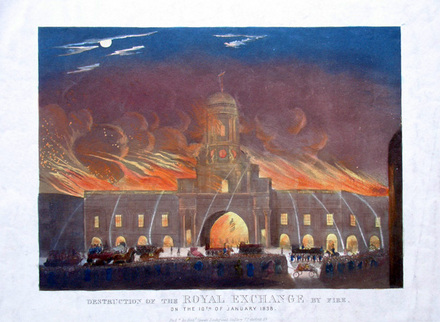
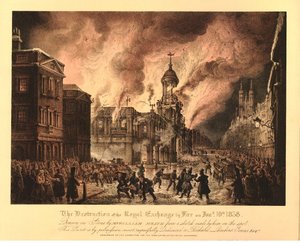
Attributed to William Heath (1795-1840), Destruction of the Royal Exchange by Fire, on the 10th of January, [1838]. Etching with hand coloring. Published by Robert Havell’s Zoological Gallery, London. Graphic Arts Collection GA2012 in process

On the night of January 10, 1838, the Royal Exchange, at the corner of Threadneedle and Cornhill Streets in the City of London, burned to the ground. It was one of the most spectacular fires of the 19th century and many artists got out of bed to sketch the scene, including William Heath. At least two prints are derived from Heath’s drawings, an etching published by Robert Havell at his Zoological Gallery [above] and a lithograph published by Rudolph Ackermann at his Eclipse Sporting Gallery [below].

destruction.jpg

The Destruction of the Royal Exchange by Fire on Jany 10th 1838
British Museum

See also: Effingham Wilson (1783-1868), Wilson’s Description of the New Royal Exchange, including an Historical Notice of the Former Edifices … (London: E. Wilson, 1844). DA687.R69 W557 1844.

James Nasmyth and the Durable Image

| No Comments
nasmyth the moon15.jpg
First edition, heliotype with thumb right

nasmyth the moon1.jpg
Second edition, woodburytype with thumb left

In 1874, the Scottish engineer James Nasmyth and London publisher John Murray prepared and released two simultaneous editions of Nasmyth’s study of the moon. Although the text and pagination is the same, the illustrations are not. Why?

Nasmyth was an amateur astronomer who built his own 20-inch reflecting telescope and made detailed observations of the moon. He was also an amateur photographer and experimented with various ways of making images of the moon. He drew, creating the plaster models, and photographed both the moon itself and his own reproductions.

nasmyth the moon4.jpg1st ed., heliotype dated 1865
nasmyth the moon5.jpg2nd ed., woodburytype dated 1864

It was a time when many men and women were attempting to find the perfect form of reproduction: the durable photograph. One that would not fade or change over time AND could be printed in ink (independent of the action of light), so it could be made on cloudy days.

Heliotypes, autotypes, and woodburytypes were only a few of the non-silver prints made from photographic negatives. Each had their own drawbacks, especially the beautiful woodburytype, which was the most time-consuming. Some publishers preferred the heliotype, which did not have the glossy surface of the woodburytype or the albumen photograph. The autotype was the quickest but didn’t have the detail of the others.

nasmyth the moon12.jpg
nasmyth the moon11.jpg
Both woodburytypes, one with pigment?

Is it possible that Nasmyth and Murray were experimenting with book illustration, to see which edition would remain true longer? If so, the woodburytype won because the third edition of this book, published in 1885, is listed as having only woodburytypes (not held at Princeton).

nasmyth the moon9.jpg1st ed., single heliotype
nasmyth the moon10.jpg2nd ed., two woodburytypes
nasmyth the moon8.jpg

1st ed., front cover

James Nasmyth (1808-1890) and James Carpenter (1840-1899), The Moon: Considered as a Planet, a World, and a Satellite. 1st edition (London: John Murray 1874). Graphic Arts Collection GAX 2012- in process. With 23 plates, including 6 photogravures, 4 heliotypes, 2 lithographs and 1 chromolithograph after drawings or photographs by Nasmyth, 12 mounted photographs on 11 leaves (10 autotypes by Brooks, Day & Son and 2 woodburytypes), and various wood engravings with text.

James Nasmyth (1808-1890) and James Carpenter (1840-1899), The Moon: Considered as a Planet, a World, and a Satellite. 2nd edition (London: John Murray 1874). Graphic Arts Collection GAX Oversize 2003-0202Q. Note, frontispiece and plates XII, XIII XVI, and XX are photogravures in the first edition, woodburytypes in second edition; plates II, XIX, XXI, XXIII in first edition are heliotypes, woodburytypes in second edition; plate XIX in first edition has one illustration (glass globe cracked) and two illustrations in second edition (add the full moon); plate III is woodburytype in both editions, but larger in first edition; plate XIV is woodburytype in both editions, but smaller in first edition.


Engraved on steel

| No Comments
heath views of london1.jpg
Views of London. 45 plates engraved by Charles Heath (1785-1848) (London: Hurst, Robinson & Co., & R. Jennings Year: 1825). Each plate accompanied by a leaf with descriptive letterpress. Graphic Arts Collection GAX 2012- in process

Charles Heath made his first etching when he was six years old and in 1840, was responsible for engraving on steel the world’s first postage stamps. It is his skill engraving on steel rather than copper, for which he is best remembered today.

“Heath was also a pioneer in new printmaking techniques… . In 1820, for an edition of Thomas Campbell’s poem Pleasures of Hope, he engraved the first plates on mild steel rather than copper, giving much longer production runs from each plate. In larger commercial plates he was less successful. By contrast his View from Richmond Hill and his Gentlemen of the Time of Charles I, together with his Christ Healing the Sick, were masterpieces of their kind.

In 1821 and again in 1826, Charles Heath got into financial difficulties, but quickly recovered following an energetic diversion into the new fashion for illustrated annuals and giftbooks… . From 1825 onwards he was almost entirely occupied first in engraving for The Amulet, Literary Souvenir, and Landscape Annual, and then in promoting his own productions, notably The Keepsake, Picturesque Annual, the Book of Beauty, and similar publications such as J. M. W. Turner’s Picturesque Views in England and Wales.” Dictionary of National Biography

heath views of london2.jpg
heath views of london3.jpg
heath views of london4.jpg
heath views of london5.jpg

Advertising The Sunday World

| No Comments
sunday world group 3.jpg
sunday world group 2.jpg
sunday world group 1.jpg

F. Gilbert Edge (active 1890s), Advertising posters for The Sunday World, [1896]. Color printed letterpress posters. Graphic Arts Collection GAX 2012- in process

We recently acquired nine color letterpress advertisements for Joseph Pulitzer’s Sunday World, the heavily illustrated Sunday edition of his daily newspaper The New York World. Pulitzer increased his advertising in 1895, when William Randolph Hearst established a rival paper The New York Journal and the two vied for subscribers.

Note in particular the announcement of an article by Garrett Putnam Serviss (1851-1929) describing “Monsters That Live on the Planet Jupiter.” Serviss was a trained astronomer with degrees from Cornell and Columbia, who wrote early science fiction. He published an unauthorized sequel to War of the Worlds by H. G. Wells, called Edison’s Invasion of Mars. This was followed by a second book about life on Venus and a third about the Moon. His story about Jupiter never made it beyond the pages of The Sunday World.

Fanny Palmer

| No Comments
palmer new york drawing4.jpg
Frances Flora Bond (Fanny) Palmer (1812-1876), The New York Drawing Book: Containing a Series of Original Designs and Sketches of American Scenery, No. 1 (New York: William H. Graham, 1847). Lithographs. Graphic Arts GAX 2012- in process

palmer new york drawing3.jpg

Fanny Palmer created over 200 lithographs for the Currier & Ives publishing company and is regarded as one of the leading commercial illustrators of her time. Born in Leicester, England, she married Edmund Seymour Palmer at the age of twenty and immigrated to United States a few years later.

In the 1840s, Mr. and Mrs. Palmer set up a lithographic printing business called “F&S Palmer,” with Fanny drawing and Edmund printing the stones. The company was not successful and this drawing book was one attempt to begin a commercial series that would save the business. Priced at 25 cents, it did not sell well and the series ended with No. 1.

After going bankrupt, Fanny joined Nathaniel Currier as one of his leading staff artists. Palmer’s work was well received until 1857, when James Ives became Currier’s partner and began to redraw the figures in her pictures. She stuck it out, retiring in 1868 at the age of sixty-six.

palmer new york drawing2.jpg

See also: http://libweb2.princeton.edu/rbsc2/ga/unseenhands/printers/palmer.html

Fuse 1-20, with antimatter

| No Comments
fuse magazine8.jpg

Neville Brody, Adrian Shaughnessy, and Jon Wozencroft, FUSE 1-20: From Invention to Antimatter: Twenty Years of FUSE (Köln: Taschen, 2012). 1 book (411 p.), 10 posters, 1 keycard. Graphic Arts GA2012- in process

fuse magazine3.jpg
fuse magazine2.jpg

Adrian Shaughnessy writes, “Under Brody’s art direction, early Fuse stuck pins in the eyes of typo traditionalists and gleefully invited the displeasure of graphic design’s self-appointed ruling elite by simultaneously showing how typography, thanks to the computer, had become open to all comers and showing how it had been freed of its traditional purpose of conveying linguistic meaning.”

Launched by Neville Brody and Jon Wozencroft in 1991, FUSE was a forum for digital and experimental typography. Produced with FontShop International in Berlin and FontWorks in London, each quarterly issue was delivered in a cardboard box with a disk of new digital fonts, a couple large posters, and a colorful magazine (or booklet). Issues were constructed around a theme, through which the editors hoped would explore “the unmapped potential of the new digital technology.”


fuse magazine1.jpg

Twenty years after that original launch, the out-of-print issues have now been reissued in this new limited edition. The box comes with a little credit card providing access to a computer database of fonts, which we are welcome to download and use as much as we want. There are ten poster from issues 19 and 20, and a 400 page glossy text of both old and new material, sure to shock the typographic community all over again.

fuse magazine7.jpg


Reflex camera

| 1 Comment
reflexcamera3.jpg
Reflex camera, ca. 1905. Made by the Reflex Camera Company,
Newark, New Jersey. Adjustable lens by Voigtländer & Sohn, Braunschweig, Germany. Gift of anonymous donor.
reflexcamera2.jpg


reflexcamera1.jpg

On December 4, 1942, The New York Times posted an obituary for Louis Borsum (1856-1942), who “developed the Reflex Camera and Metal Polish.” Borsum died at the age of 88, a retired inventor living in East Orange, New Jersey. Originally from Germany, Borsum was a pioneer in the development of photography equipment. His first patent was filed in 1891 and a later variation on the Reflex camera, shown here, was patented in 1895. Unfortunately, the business did not last long and the development of a single reflex camera was left to others.

Not much information on Borsum has been recorded. A small notice was published in a 1906 Photo-Era magazine and then, picked up in Camera: a Practical Magazine for Photographers, stating “A new aspirant for honors, in the convention this year, was the Borsum Camera Co., Jersey City, N. J., manufacturers of the Reflex Camera. The new Reflex has been much improved; it is lighter and simpler than ever before, and the sale promises to be large, as was demonstrated at the convention, where Messrs. Borsum and Fiedler made many friends.”

See where this camera stands within a timeline of photographic equipment, as shown in: Douglas B. Tubbs, The Illustrated History of the Camera from 1839 to the Present (New York Graphic Society, 1975). Marquand Library (SA) Oversize TR250 .T82 1975q

reflexcamera history page.jpg

Où diable l'amour va-t-il se nicher!

| No Comments
ou diable lamour.jpg
Photographer unknown, after a painting by Édouard de Beaumont (1821-1888) after a photograph by Charles Nègre (1820-1880), Où diable l’amour va-t-il se nicher! 1873. Albumen silver print. Graphic Arts GA2012- in process

376px-Henri_Le_Secq_near_a_Gargoyle.jpgCharles Nègre (1820-1880) The Vampire, 1853 (c) Musée d’Orsay
1940.889.jpgCharles Meryon (1821-1868), Le Stryge, 1853. (c) Cleveland Museum of Art
318-02c45db35d.jpg Joseph Pennell, Le Stryge, 1893.
(c) Art Institute of Chicago
354-191145a9d0.jpgEdward Frascino, “Come on Harve. Do your Quasimodo for us!” 15 July 1972. (c) The New Yorker

In 1844, Édouard de Beaumont (1821-1888) was one of several artists asked to illustrate a new edition of the novel Notre-Dame de Paris by Victor Hugo (1802-1885). First published in 1831, the book was an enormous success and the 1844 edition was to be a sumptuous new printing with two dozen new engravings.

The popularity of Hugo’s book not only resulted in multiple editions in many languages but also in the restoration of the Cathedral of Notre Dame itself. Beginning in 1845 and lasting for twenty-five years, the controversial rebuilding included the addition of the gargoyles on the Galerie des Chimères.

Many visual artists were inspired to create images of the structure, using in particular the gargoyles as romantic icons. Charles Nègre (1820-1880) and Henri Le Secq (1818-1882) playfully photographed each other on the north tower in 1853 and Nègre’s image remains a favorite in museum collections around the world. Views of “The Vampire” looking out over the city of Paris turned up everywhere, including an etching by Charles Meryon and later, a painting by Winslow Homer.

Twenty years after Nègre made his photograph, Beaumont was inspired to revisit the theme in a painting he called “Où diable l’amour va-t-il se nicher!” Historians have translated this enigmatic title several ways, offering “Where the devil will love nest,” “Where will Devil Love nest,” or “Where the hell is love going to nest!” among other variations. Rather than drag his easel up all those stairs, Beaumont simply copied the major portion of the photograph exactly, substituting only the portrait Le Secq for a couple in love (the woman in a startlingly green dress).

Beaumont’s painting was not only accepted into the Salon of 1873 but won second prize. An engraving of the painting was made by Léon Gaucherel and the French firm Goupil et Cie. had both an albumen photograph and a woodburytype created. They first sold them as part of their series Galerie photographique and then, published the woodburytype in their sumptuous journal Galerie contemporaine littéraire, artistique (v. 8, 1884) along with a portrait of the artist and several other paintings.

For more variations on the Vampire theme, see the wonderful study by Michael Camille, Gargoyles of Notre Dame: Medievalism and the Monsters of Modernity (Chicago: University of Chicago Press, 2009). Marquand SA NA3549.P2 C36 2009


Jean-Martin Charcot's Visual Psychology

| No Comments
iconographie14.jpg
Désiré Magloire Bourneville (1840-1909) and Paul Regnard (1850-1927), Iconographie photographique de la Salpêtrière. Service de M. Charcot (Paris: Adrien Delahaye & Co., 1876-1877, 1878). Graphic Arts Collection GAX 2012- in process

iconographie1.jpg
iconographie11.jpg

As a young professional Jean-Martin Charcot (1825-1893) served his internship at Salpêtrière, a women’s hospital in Paris used as more of “a warehouse for female outcasts: women who were mad, violent, crippled, chronically ill, mentally retarded, unmarried and pregnant, or simply old and poor.” Charcot called it “that grand asylum of human misery.” [Medical Muses, 2011]

In 1862, Charcot returned to Salpêtrière as chief physician of medical services and transformed it. During his tenure, the hospital grew to house more than 5,000 patients in 100 buildings; the largest institution of its kind in Europe. It had its own farm, bakery, and by 1878, a well-equipped photography studio. (Bellevue Hospital in New York City also had a full photography department.)


iconographie2.jpg
iconographie10.jpg
iconographie7.jpg

Asti Hustvedt writes, “Charcot … brought hysteria, hitherto marginal, into the mainstream. He legitimized the disease by defining it as an inherited neurological disorder, not madness or malingering.” Martin Kemp noted that the doctor’s work was “an unrivaled attempt to create what may be called ‘visual psychology’ —in which imagery and environments played a central role in diagnosis, recording, clinical suggestion, treatment and the design of the patients’ surroundings.”

Charcot was deeply influenced by his predecessor at Salpêtrière, Guillaume-Benjamin Duchenne de Boulogne who published his treatise Mécanisme de la physionomie humaine in 1862. Six years earlier, Duchenne had begun photographing his patients, thanks to the help of Adrien Tournachon (Nadar’s brother), as a form of “orthography of the physiognomy in motion.” Charcot began to do the same.

iconographie3.jpg

In 1875, he selected as an intern a young psychiatry student named Désiré-Magloire Bourneville, who was also a journalist. Bourneville wrote extensively for medical journals and eventually, published two of his own. Under Charcot, he learned to keep extensive medical histories on the patients, many of which were later published in Iconographie. It is thanks to Bourneville that Charcot’s many accomplishments became known both in his own time and today.

iconographie8.jpg
iconographie4.jpg

Another intern, Paul Regnard, was hired, in part, for his ability to make photographs. Charcot hoped these would provide visual evidence to support his conviction that hysteria was a real organic disease with particular symptoms. In 1882, photographer Albert Londe (1858-1917) was hired as a chemistry assistant and before long, took over the running of the photography laboratory. Londe published his own study in 1893 entitled La photographie médicale: application aux sciences médicales et physiologiques, dedicated to Charcot.

iconographie9.jpg

“The photographs in the Iconographie haunt its pages,” writes Hustvedt, “[they are] the ghosts of women who refuse to be reduced to medical illustrations.”


See also:
Asti Hustvedt, Medical Muses: Hysteria in Nineteenth-Century Paris (New York: W.W. Norton & Co., 2011). Firestone RC339.52.C453 H87 2011

Ann Thomas, Beauty of Another Order: Photography in Science (New Haven, CT: Yale University Press in association with the National Gallery of Canada, Ottawa, 1997). Marquand Library (SAPH): TR692 .T466 1997

Recent Comments

  • Linda Felcone: I had the pleasure of taking The Art of the read more
  • John Fleming: I saw Dale Roylance only infrequently since his retirement, but read more
  • Isabel Ribeiro: Thank you for your reply. I would indeed love to read more
  • Isabel Ribeiro: Gorgeous! Is there any way to access the rest of read more
  • S. Scudder: Mary Stilwell is my ggg-grandmother ... thank you for posting read more
  • V.E.G.: James Franklin, Benjamin Franklin's half-brother is a direct descendant of read more
  • Bob Fleck: Nice comments and well worth it. read more
  • N. Sutherland: Do you have any further biographical material on this Thomas read more
  • john W: Have the complete collection of EA Seguy papillons including front read more
  • Vermathio: algarabia, charabia et Picabia. Le premier désigne la langue read more