Recently in Acquisitions Category

Pierre Bonnard's personal copy of Parallèlement

| No Comments
bonnard13.jpg

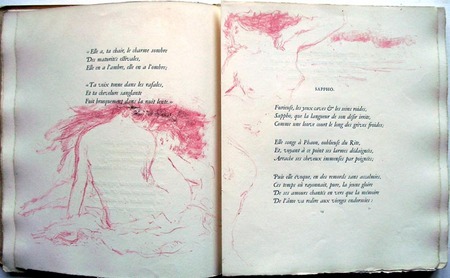
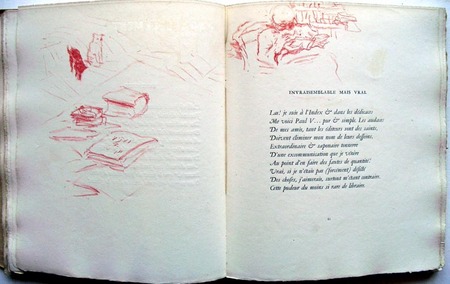
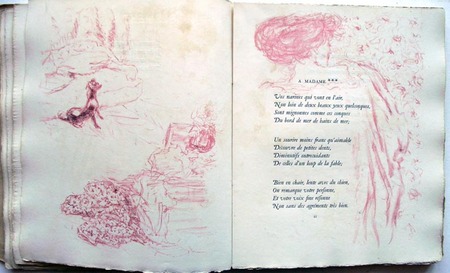
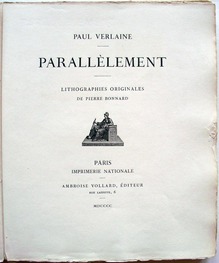
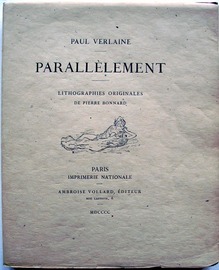
Pierre Bonnard (1867-1947) and Paul Verlaine (1844-1896), Parallèlement (Paris: Ambroise Vollard, 1900). Color lithograph. Illustrated with a lithographic frontispiece, wood engraved title-vignette (repeated on front wrapper), 108 lithographs, and 8 wood engravings cut by Tony Beltrand after Bonnard designs. Preserved in rose colored morocco box. Graphic Arts GAX 2011- in process

bonnard12.jpg

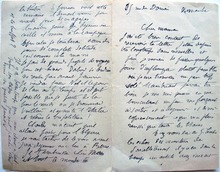
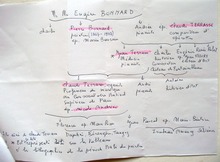
Graphic Arts recently acquired Pierre Bonnard’s personal copy of Parallèlement, his first and greatest livre de peintre. It comes with a four-page hand-written letter from Bonnard to his mother that includes a significant reference to the famous objection, and later rejection, by the French Government of the original wrappers. Also included is a letter from Madame Terrasse confirming that this copy passed down through the family from the painter to her husband, musician Claude Terrasse (1867-1923).

bonnard10.jpg

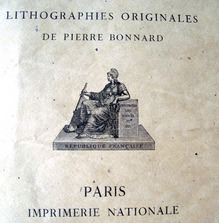
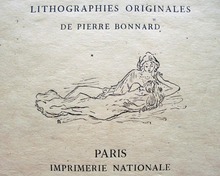
Verlaine’s poems Les Amies [The Girlfriends], the first section of Parallèlement, were published under a pseudonym in 1867 and then, immediately banned because they described lesbian sex. Ambroise Vollard (1866-1939), a Parisian art dealer, wrote that he was inspired to publish the poems as soon as he read them, probably in the second, 1899 edition (Ex PQ2463 .xP3 1899). Vollard sent the text to be printed at the Imprimerie Nationale, whose authorities had only the title of the book, Parallèlement, in their records and thought they were printing a geometry textbook.

When it became known that it was, in fact, poetry of a lesbian love affair, the book was immediately recalled. Vollard was forced to have the title-page and wrappers reprinted with the official “Republique Française” symbol removed. Our copy includes both sets of wrappers, plus a copy of the original printer’s prospectus.

bonnard2.jpg
bonnard5.jpg
bonnard6.jpg
bonnard4.jpg

Vollard continued undaunted. After Lucien Pissarro (1863-1944) turned down the project, the dealer commissioned lithographs from Pierre Bonnard (1867-1947) even though he had never worked in the medium. Bonnard sketched directly on top of the pages of Garamond type and then, recreated 108 of these drawings on lithographic stones in the studio of Auguste Clot, who pulled the edition.

bonnard9.jpg
bonnard7.jpg


Parallèlement is the first great livre de peintre of the twentieth century, a Vollard creation that set the standard for innovative fusion of text and illustration. Bonnard’s seductive rose-coloured lithographs drape across the pages of text, making Parallèlement a full collaboration of writer, artist, publisher, and printer. Use of color such as this was not attempted again for many years.” The Arts of the French Book, 1900-1965 by Eleanor M. Garvey and Peter A. Wick (GA Oversize 2006-0065Q).

Fragments of Light 5

| No Comments
Like stars
The rays of the sun leave the walls.
Every wall becomes black and dark
As the sunlight returns to its post.
What stunned you at faces of beauty,
Was the sunlight through three-colored glasses.
Colorful glass shows the light
Thus in many colors to us.
When the glasses of many colors are gone
Thereupon the colorless light will stun you.
Begin to witness now the light without glass
So as when glass breaks, there is no blindness.
Contented with your bookish knowledge
Staring at the stranger’s light?
Watch Him steal the light, as you learn
You are a borrower, not a giver of light.

rumi3.jpg

Maulana Jalāl al-Dīn Rūmī (1207-1273), Fragments of Light 5. Translation by Zahra Partovi. Sculpture by Linda Schrank (New York, NY: Vincent FitzGerald & Company, 2010). Copy 12 of 35. Graphic Arts 2011- in process


A book of verse by the thirteenth-century Sufi philosopher and poet, Maulana Jalāl al-Dīn Rūmī. The volume has been designed in the style of the Chinese slatbook, a format that is 3,000 years old. It contains thirty-two slats (or clear acrylic tiles) for the text in English and Persian, along with ten tiles for the title page and colophon.

The tiles are bound or sewed with blue and saffron fishing line, then fastened at end with small plastic disc so that ladder of tiles can be unfolded from an acrylic rectangular base. The English text is laser etched in Alcuin type on one side and the Persian script similarly printed on the other. The entire book is housed in a black suede foldover box by Hands On Bookbinding, lined with silver industrial Mylar.

rumi1.jpg
rumi2.jpg

The translator, Zahra Partovi, teaches at The New School for Social Research and is a leading interpreter of Rumi’s poetry for English-speaking readers. She has collaborated with Vincent FitzGerald on eleven previous limited-editions of Rumi’s work. This project paired her translation with the visual design of Linda Schrank, a New York artist and instructor at Pratt Institute.

rumi5.jpg

Partovi wrote, “This masterful poet combines philosophy, mysticism, and psychology in a language so piercing as to enter the realm of music. It is this element more than any other which has made Rumi’s poetry so irresistible to readers for over seven hundred years, even through the fire of translation.”


See also: Maulana Jalāl al-Dīn Rūmī (1207-1273), Ruminations: quotations from the writings of Jalaluddin Mohammad Rumi, translated from the Persian by Zahra Partovi (New York: Vincent FitzGerald & Co., 1998). Graphic Arts Collection (GAX) Z232.F524 J34

Tendor Friendships

| No Comments
pochoirbook1.jpg

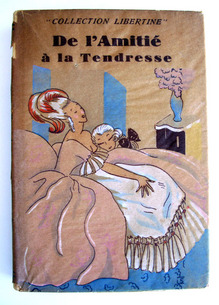
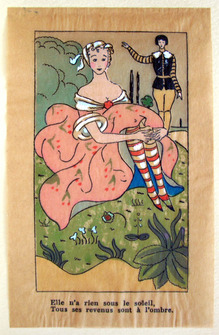
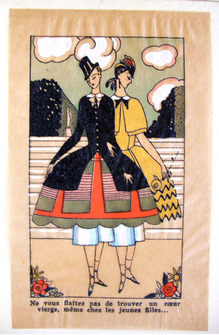
De l’Amitié à la Tendresse [Tender Friendships] (Paris: Editions Nilsson, “Collection Libertine,” [ca. 1920s]). Gift of Robert J. Milevski. Graphic Arts GAX 2011- in process.

A charming compilation of quotes and short passages on love by such authors as Balzac, Baudelaire, Byron, Casanova, Gautier, Hugo, de Musset, Nietzsche, Rousseau, and Sand, among others. The cover and four pochoir plates can be attributed to Robert Polack, who created pochoir plates for several other Nilsson editions in the 1920s.

pochoirbook2.jpg
pochoirbook3.jpg

Re d acted by Daniel Heyman and Nick Flynn

| No Comments
daniel8.jpg

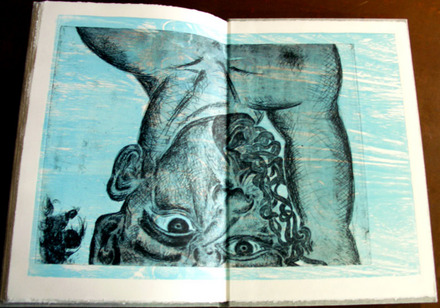
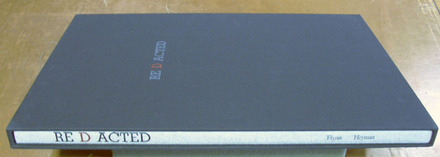
Daniel Heyman and Nick Flynn, Re d acted ([Philadelphia: Heyman, 2011]). Copy 1 of 8, signed and numbered by the artist and the writer. Graphic Arts GAX 2011- in process

daniel10.jpg
daniel9.jpg

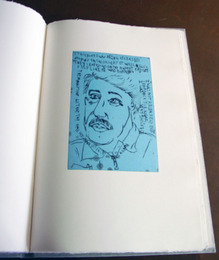
Over the past four years, Daniel Heyman, Princeton University Lecturer in Visual Arts, has been making images about the war in Iraq, specifically the abuse and torture of innocent Iraqis at Abu Ghraib and other prisons. For this work, Heyman traveled to Jordan and Turkey where he has talked face to face with over forty-five former detainees. As they spoke, Mr. Heyman created drypoint portraits, surrounded with the words of their testimonies. The resulting Amman Portfolio was acquired by the Princeton University Art Museum, among many others.

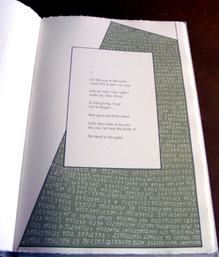
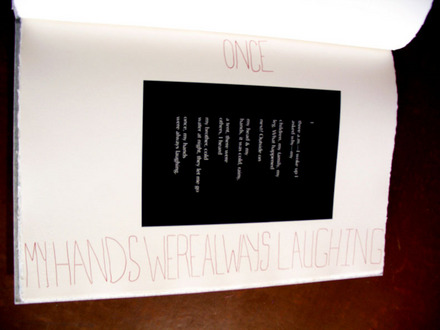
More recently, Heyman has been collaborating with another Guggenheim Fellow, New York City writer Nick Flynn, who was also in Istanbul for 2007 testimonies. The result (finished a few days ago) is an oversize livre d’artiste entitled Re d acted, containing nine hand printed portraits of Iraqi torture victims and seven poems by Flynn. The Graphic Arts collection is proud to own copy no. 1 of 8.

daniel6.jpg
daniel7.jpg

Heyman’s chine-collé images were drawn on copper plates while in Istanbul, during the interviews with former detainees of Abu Ghraib and other American run Iraqi prisons. Heyman shared the texts from these and other portraits with Flynn, who used them as inspiration for the suite of seven poems, Re d acted.

The chine-collé prints were editioned by Cindi Ettinger at CR Ettinger Studio (Philadelphia, PA). Flynn’s poems were designed by Daniel Heyman and Marisha Simons, and editioned by Brian Garner at Litho Shop, Inc (Baltimore, MD). The book was hand bound at Hope Bindery and Box Company (Providence, RI).

5
On the way to the toilet
count five & pee, —no one

told me why. One night I
woke up, they chose

& start giving, I had
five to forget—

they gave me three more.

Forty days later & he was
the one, he took the body of

the dead to the gates


For more about Heyman:
http://www.danielheyman.com/
For more about Flynn
http://www.nickflynn.org/
You might also want to read The Ticking is the Bomb, Flynn’s 2010 memoir, in which he talks about his experiences in Istanbul. (Firestone PS3556.L894 Z468 2010).

The Land of Enthusiasm and the Empire of Love

| No Comments
maps4.jpg

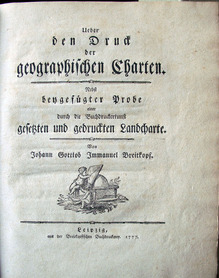
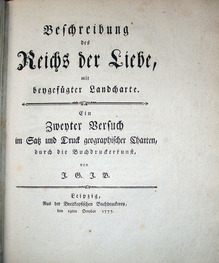
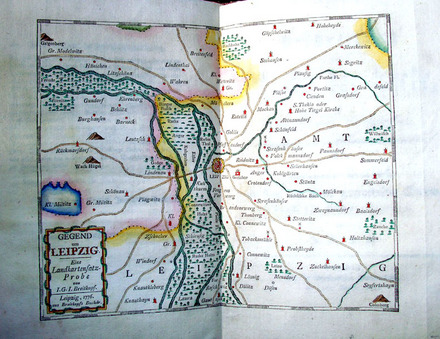
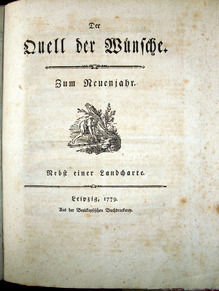
Three times, between 1777 and 1779, the German music publisher Johann Gottlieb Immanuel Breitkopf (1719-1794) set and printed a map with moveable type. It’s hard to imagine the time and trouble such type-setting would take. Breitkopf thought he had developed a method to speed map production but in the end, it took much longer and was discontinued. Princeton has just acquired a new volume with all three Breitkopf maps bound together.

maps7.jpg
maps5.jpg

According to Bigmore & Wyman’s Bibliography of Printing, “Breitkopf claimed to have been the inventor of map-printing by the use of types, or what is known as ‘typometry’. William Haas, a type-founder of Basle, appears to have previously published a method somewhat similar, but Breitkopf had been experimenting on the matter for some twelve years previously, and it was only his dissatisfaction with the result obtained that induced him to keep his achievements to himself.”

maps6.jpg

In the first book, Breitkopf gives an overview of the use of woodcuts and copperplate engravings for map printing. Then, he describes his own letterpress process, which is illustrated with a map of Leipzig and its surroundings.

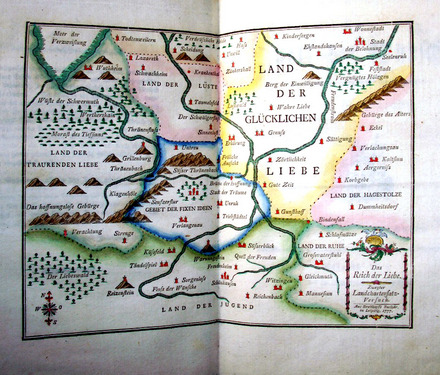
In the second book is a map of the Empire of Love “written, drawn, composed, and printed within three days, on the occasion of a wedding.”

maps2.jpg
maps1.jpg


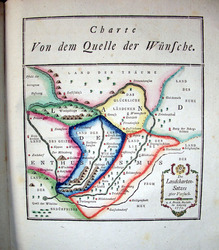
The third volume and its map illustrate the origin of desires, from enthusiasms to money, happiness to peace & quiet.

See also Edward Clements Bigmore (1838?-1899) and Charles William Henry Wyman (1832-1909), A Bibliography of Printing. 3rd ed. (New Castle, Del.: Oak Knoll Press, 2001). Graphic Arts: Reference Collection (GARF) Z117 .B59 2001


Johann Gottlob Immanuel Breitkopf (1719-1794), Ueber den Druck der geographischen Charten. Nebst beygefügter Probe einer durch die Buchdruckerkunst gesetzten und gedruckten Landcharte. Leipzig: Breitkopf, 1777.
bound with:
Beschreibung des Reichs der Liebe, mit beygefügter Landcharte. Ein Zweyter Versuch im Satz und Druck geographischer Charten durch die Buchdruckerkunst. Mit doppelblattgroßer kolorierter gestochener Karte. Leipzig: Breitkopf, 1777.
bound with:
Der Quell der Wünsche. Zum Neuenjahr. Nebst einer Landcharte. Mit kolorierter gestochener Karte. Leipzig, Breitkopf, 1779. Graphic Arts GAX 2011- in process

Brothers Dalziel

| No Comments
dalziel9.jpg

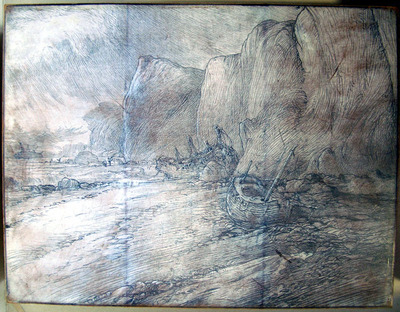
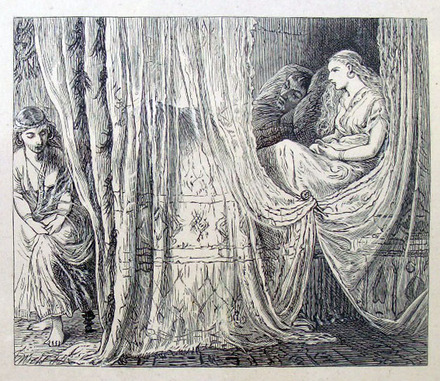
Graphic Arts is the fortunate new owner of proof prints, blocks, and drawings by the Brothers Dalziel (pronounced De el, rhymes with Real), previously owned by the bookseller Nigel Williams (1962-2010). The collection includes eighty-five proof wood engravings for the Bible, ca. 1860s; forty-three proofs of illustrations of children; and an uncut pencil drawing pasted to a woodblock, depicting wrecked ships below a cliff face and titled “Coast scene by Thomas Dalziel 1872-3” on the label pasted underneath.

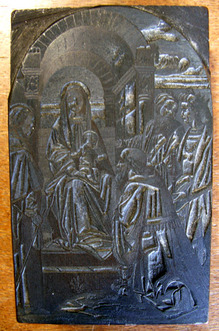
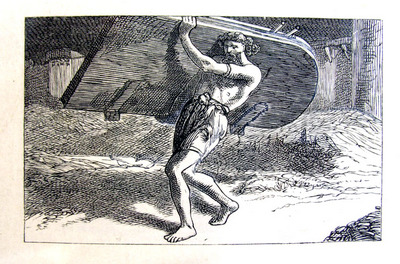
The collection also has an engraved woodblock depicting the Adoration of the Magi in a fitted case with two proofs of the image and an early reproduction of the drawing for “Sampson carrying the Gates” by Frederick, Lord Leighton, reproduced as a wood-engraving in the Dalziel Bible Gallery, framed and glazed.

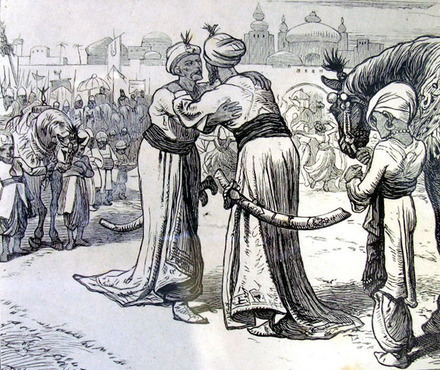
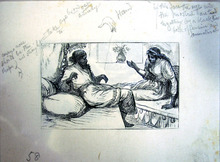
One hundred forty-six proofs illustrate The Arabian Nights, prepared from drawings by Thomas Dalziel and first published in 1877. Many include the aritst’s annotations for reworking (we are lacking only no. 8, 24, and 65 from the series numbered 1-148 and tailpiece).

Finally, twenty-nine wood-engraved proofs are by William Harvey to illustrate The History of Ancient and Modern Wines by Alexander Henderson (1824), one of the first books illustrated by Harvey. The proofs were formerly to property of Thomas Dalziel

dalziel2.jpg

This block gives us direct proof of the wood engraving process used by the Brothers Dalziel and others. A linear sketch was delivered by one of the artists, the drawing was pasted to a woodblock of the same size, and the engraver cut directly through the paper into the block, cutting away the white areas and leaving the black lines standing in relief.

Although this print was never cut and so, never published, the first long poem by Meg Blane in Robert Buchanan’s North Coast and Other Poems (1868) is set in a similar landscape. It’s possible that the drawing was designed for that publication.

dalziel5.jpg
dalziel4.jpg

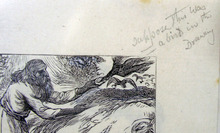
Many of the proofs include handwritten comments indicating changes or correction still needed. Above on the right, there is a question about the intention of the artist. The man’s hand might be holding a torch or it might be handing food to a bird. Hopefully, the engraver clarified the image for the publication.

dalziel3.jpg

The Brothers Dalziel were a highly productive firm of Victorian engravers, founded in 1839 by George Dalziel (1815-1902) and his brother Edward Dalziel (1817-1905). There were eight Dalziel brothers altogether and two others, John and Thomas, joined the firm later.

The Dalziel brothers worked with many important Victorian artists, producing illustrations for books and magazines of the period. Among the artists they worked with were Arthur Boyd Houghton, Richard Doyle, John Gilbert, William Holman Hunt, and John Everett Millais.

dalziel7.jpg
dalziel8.jpg

See also, Dalziel’s Illustrated Arabian Nights’ Entertainments (1865). EX 2263.2864
and
Dalziels’ Bible Gallery (1881). Graphic Arts GAX 203-0010F

Salazar and the Secretariado da Propaganda Nacional

| No Comments
portugal1.jpg

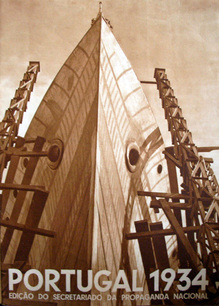
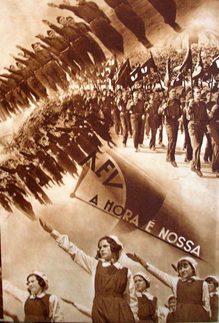
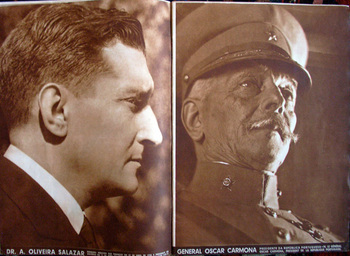
In 1933, António de Oliveira Salazar (1889-1970) led a coup d’état and established the Estado Novo (New State) or the Second Republic in Portugal. Salazar’s authoritarian regime had remarkable longevity, lasting until 1968. One of his first undertakings was to establish the powerful Secretariado da Propaganda Nacional (SPN) to present a dynamic image of his country to the rest of the world. Within a year, Portugal 1934 was published.

portugal5.jpg
portugal4.jpg

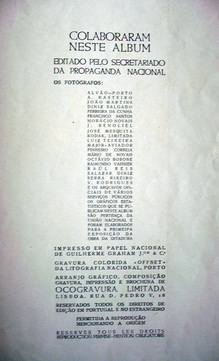
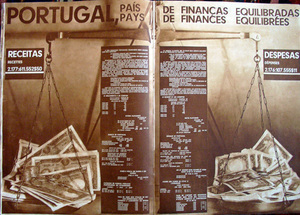
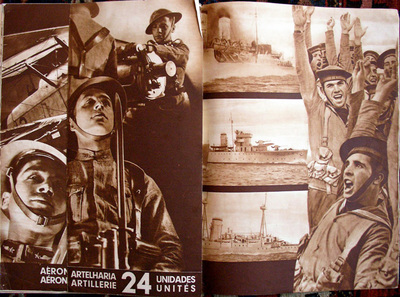
This striking, oversize paperback is filled with high-quality graphics including photomontage, full-page bleeds, and multiple fold-outs, under the direction of Antonio Ferro, chief of propaganda and communication. To his credit, Ferro hired the best photographers and graphic artists of the time, including Alvão-Porto, A. Rasteiro, João Martins, Diniz Salgado, Ferreira da Cunha, Francisco Santos, Horácio Novais, Joshua Benoliel, and others.

There were at least three variations. Princeton’s copy has an orange cover, while others have black and green covers. There may have been more.

portugal8.jpg
portugal6.jpg

Portugal 1934 (Lisbon: SPN [Secretariado da Propaganda Nacional], 1934). Graphic Arts 2011-

portugal2.jpg
portugal3.jpg
portugal7.jpg

The Game of Hazard

| No Comments
hazard.jpg

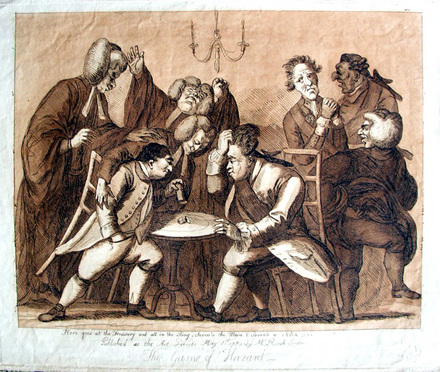
Attributed to Francesco Bartolozzi (1728-1815) after Loraine Smith (1751-1835), The Game of Hazard, 1782. Etching with aquatint. Published by M. Rack, London. Graphic Arts GAX 2011-

In Smith’s design, we see (on the left) the Whig politician Charles James Fox (1749-1806) who was, at the time, the foreign secretary in Rockingham’s short-lived government, and (right) Frederick North, 2nd Earl of Guilford (1732-1792), who had recently left office as Chancellor of the Exchequer and leader of the House of Commons.

They are busy playing the popular dice game called Hazard. The print is inscribed, “Here goes at the Treasury and all in the Ring, Seven’s the Main & Seven’s a Nick.” 1 May 1782

Born in Florence, the superb engraver Francesco Bartolozzi moved to London in 1764 and helped to establish the Royal Academy of Arts. While there, Bartolozzi did a number of commercial projects including the aquatinting of this print, working from in his large home in the North End, Fulham.

Painted without hands in 1844

| No Comments
biffin2.jpg

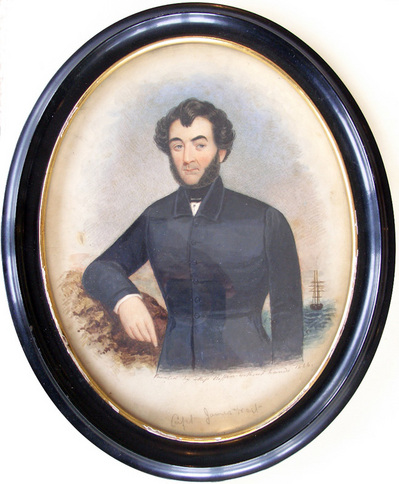
Thanks to the generous donation of W. Allen Scheuch II, Class of 1976, given in honor of Meg Whitman, Class of 1977, graphic arts is the proud owner of a watercolor portrait by the British artist Sarah Biffin (1784-1850). Born with no arms or hands or legs or feet, Biffin taught herself to perform a variety of everyday tasks using her mouth and shoulders. She developed a talent for drawing and painting; became an expert seamstress; and performed these abilities before a crowd of spectators.

biffin.jpg
Sarah Biffin (1784-1850), Portrait of Captain James West (1808-1884), 1844. Watercolor on paper. Graphic Arts. 2011- in process. Gift of W. Allen Scheuch II, Class of 1976, given in honor of Meg Whitman, Class of 1977.


Biffin’s family contracted with Emmanuel Dukes, a traveling showman, to make her one of his sideshow attractions. She traveled from town to town, painting or writing for the public’s entertainment. Dukes publicized her as “The Eighth Wonder!” and pocketed all the proceeds from the sale of her watercolors.

Thanks to the patronage from George Douglas, the sixteenth Earl of Morton (1761-1827), Biffin was finally released from her contract and established a studio in the Strand, London, where she painted miniature portraits.

A brief and unfortunate marriage left Biffin destitute. Her later years were spent in poverty, living in Liverpool, surviving thanks to the support from a public appeal led by Richard Rathbone. Biffin continued to paint and in 1844, completed this portrait of James West (1808-1884), captain of the U.S. Mail Steamship “Atlantic,” which sailed between New York and Liverpool.

For more details, see the entry on Biffin in: Stephen Lloyd and Kim Sloan, The Intimate Portrait ([Edinburgh]: National Galleries of Scotland; [London]: The British Museum, 2008. Marquand Library and Graphic Arts ND1314.4 .L56 2008.

Chiyogami Papers

| No Comments
birdandbull.jpg
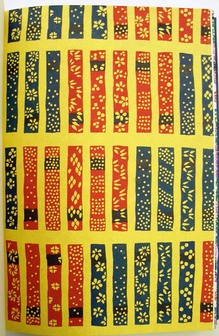
D. Sidney Berger, Chiyogami Papers (Newtown, Penn.: Bird & Bull Press, 2011). Copy 99 of 120. Composed in Ehrhardt types by Michael & Winifred Bixler & bound by Campbell-Logan bindery. The Japanese lettering is by master calligrapher Shozo Sato. Graphic Arts GAX 2011- in process

birdandbull7.jpg
birdandbull6.jpg

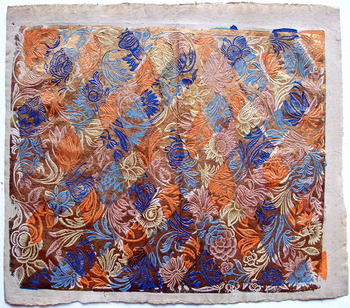
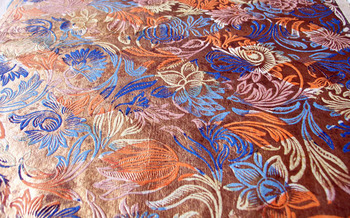
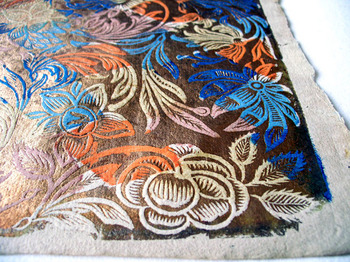
Chiyogami designs were originally developed in the Edo period as woodblock prints. The decorative papers were made into colorful paper dolls or pasted on tea tins or small paper boxes. In the twentieth century, these patterns began to be applied using silkscreens and this continues today.

As the preface notes, “Not much has been written in English about these lovely papers. Only one book, Ann Herring’s The World of Chiyogami, published in 1987, looks at the subject, but, while it has much information, it leaves out a great deal about chiyogami’s history, manufacture, papers, makers, pigments, woodblocks, stencils, uses, and patterns, among other things.”


birdandbull2.jpg
birdandbull5.jpg

Henry Morris founded Bird & Bull Press in 1958, where he has published numerous studies on paper marbling. This is his seventh and most beautiful. The volumes are especially useful because of the striking samples of hand-marbled papers tipped into each copy.

Sidney Berger is The Ann C. Pingree Director of the Phillips Library at the Peabody Essex Museum and adjunct Professor at Simmons College and at the University of Illinois, Champaign/Urbana. He and his wife, Michele Cloonan, are the proprietors of the Doe Press, and they have a large collection of decorated papers.

Old, New, and Post Testament

| No Comments
xubing1.jpg

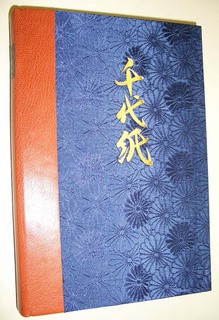
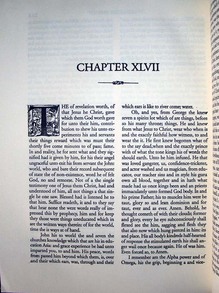
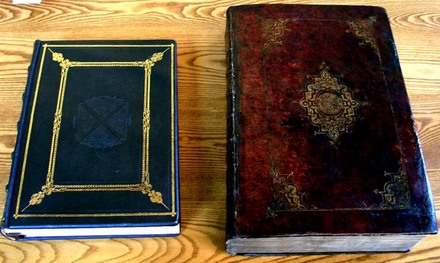
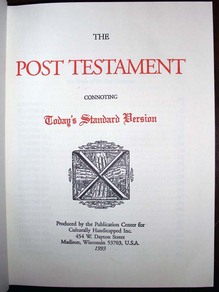
In honor of the Quatercentenary of the King James Bible, we are posting a modern version created by the Chinese American artist Xu Bing. Just as his 1987-89 project A Book from the Sky was a reaction to the history of writing, calligraphy, and book culture in China, his Post Testament offers a similar response to one of the seminal text of the Western World, the King James bible.

Xu Bing created “three hundred specially printed and bound volumes that in appearance look like weighty tomes of literary significance. The content of the books, however, presents quite a different story: a strange, hybrid text which the artist created by combining the King James Version of the New Testament with that of a trashy contemporary novel, through alternating each word of the texts. As a result, the only way to read the complete text taken from either book is to skip every other word.”

xubing3.jpg
xubing2.jpg

Xu Bing, The Post Testament: Connoting Today’s Standard Version (Madison, WI.: Piblication Center for Culturally Handicapped, Inc., 1993). Artist’s proof copy. Edition: 300. Graphic Arts GAX 2011- in process

The artist’s statement continues, “…regardless of which narrative the reader is focused on, the visual presence of the other narrative cannot be avoided, creating a visual imprint on the reader’s mind. The hybrid text thus generates a new and abnormal reading pattern. At the same time and on another level of cognition, it creates a kind of third narrative that limns the border between avant-garde literature and visual art. Post Testament also allows readers to engage with highly loaded texts that are removed from their usual connotations.”

kingjames2.jpg
kingjames.jpg
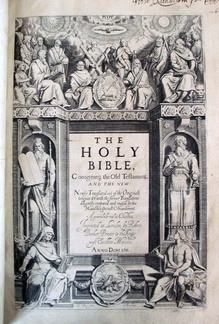
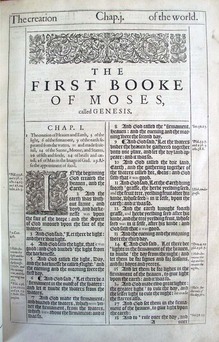
The Holy Bible, Conteyning the Old Testament and the New: Newly Translated Out of the Originall Tongues and With the Former Translations Diligently Compared … (Imprinted at London: R. Barker, 1611). RHT copy in contemporary paneled red goatskin. Robert H. Taylor Collection (RHT) Oversize 17th-706


For more information: Britta Erickson, The Art of Xu Bing: Words Without Meaning, Meaning Without Words (Washington, DC: Arthur M. Sackler Gallery, 2001). Marquand Library N7349.X8 E742 2001

stereocards8.jpg
stereocards5.jpg
French tabletop stereo viewer, ca. 1890. Graphic Arts (GA) 2011- in process
stereocards2.jpg

This Visionneuse (viewer) was discovered by Madame Nicole Canet and included in her 2009 exhibition Maison Closes (Brothels) at the Galerie Au Bonheur du Jour, Paris. The tabletop stereo viewer originally sat in the waiting room of a Paris brothel. Gentlemen would drop coins through the top slot and then, turn the right hand knob to view a series of paper stereo cards depicting the pensionnaires travaillant dans la maison (boarders working in the house). Our box holds two dozen cards on a wire frame linked together in a continuous loop. Each coin must have allowed for one sequence through the cards.

In her exhibition catalogue, Canet writes that she attempted “to re-open the doors to these secret houses and hotels, the bordellos and brothels of Paris, which for many years have remained stubbornly closed. The maisons closes are an integral part of the history of Paris from the Belle Époque to the first decades of the twentieth century.”

stereocards6.jpg
stereocards7.jpg

She continues “I opened Au Bonheur du Jour on 13 April 1999, exactly fifty-three years after the law was passed that meant the destruction of the national register of prostitutes and the closure of some 1,400 establishments, 180 of which were in Paris. Coincidentally, the gallery, at number 11 rue Chabanais, is situated just opposite a house, at number 12, where for many years one of the legendary bordellos of Paris operated: Le Chabanais.”

stereocards.jpg
stereocards3.jpg

Our unlabeled viewer, with its simple revolving wire chain, is a late nineteenth-century variation of the Alexander Beckers tabletop viewer. A trained Daguerreian, Beckers worked as a photographer in New York City for many years before he was sidetracked with his inventions. On April 7, 1857, he patented a revolving stereoscope with a metal belt that held up to 144 glass or 288 printed views. Since then, the many variations of his device are often referred to generically as “Beckers.”

Special thanks go to Rubén Gallo, Professor of Spanish and Portuguese Languages and Cultures; and Director, Program in Latin American Studies, for his patient assistance in the acquisition of this historic optical device.

Winslow Homer buried in advertising

| No Comments
homerill2.jpg
homerill3.jpg

At the same time that Winslow Homer (1836-1910) was drawing his most famous illustration for Harper’s Weekly, “A Sharp-Shooter on Picket Duty” (1862), he was also illustrating children’s books, including Bessie Grant’s Treasure (GAX Hamilton 1726) and Fred Freeland or The Chain of Circumstances.

Original wood engravings created after his designs for the stories were reprinted in numerous advertisements for these books. Boston publishers Walker, Wise & Co. ran sixteen pages of advertising in the back of Susan Lander’s Spectacles for Little Eyes (1862) (Graphic Arts GAX 2011- in process). Three Homer prints can be found in these back pages.

Thanks to donor Tom Lange for discovering these prints and delivering them to graphic arts where they take their place alongside the wood engravings of the Sinclair Hamilton collection.


homerill5.jpg

1559 Frontispiece Woodblock

| No Comments
colomboblock.jpg

Realdo Colombo (ca. 1510-1559), Original woodblock for the frontispiece of Colombo’s De re anatomica libri XV (Venice: Vincenzo Valgrisi for Nicolai Bevilacqua, 1559). Pearwood block (291 x 205 mm), with cartouche cut-out at top for the title type inset. Purchased with funds donated by Ronald A. Brown, Class of 1972; G. Scott Clemons, Class of 1990; Dr. Eugene S. Flamm, Class of 1958; Professor Joshua T. Katz; Professor James H. Marrow; Vsevolod A. Onyshkevych, Class of 1983; Dr. Robert J. Ruben, Class of 1955; Mark S. Samuels Lasner; Terry I. Seymour, Class of 1966; W. Allen Scheuch II, Class of 1976; Bruce C. Willsie, Class of 1986; an anonymous donor; the 75th Anniversary Fund of the Friends of the Princeton University Library; and funds from the Princeton University Library. Graphic Arts GAX 2011- in process


woodblock4.jpg
woodblock8.jpg

We have acquired the original woodblock for one of the most famous frontispieces in renaissance medical literature and Colombo’s only published work. In 1543, Colombo assumed the position held by Andreas Vesalius (1514-1564), as professor of medicine at the University of Padua and the imagery for Colombo’s frontispiece is a direct reference to the frontispiece of Vesalius’s De humani corporis fabrica libri septem (1543). The scene also has much in common with Donatello (ca. 1386-1466), The Heart of the Miser, in the arrangement of the students and the dangling arm of the cadaver: http://www.shafe.co.uk/crystal/images/lshafe/Donatello_ Miracle_of_ the_ Misers_ Heart_1450.jpg

Ruth Mortimer writes, “The names of Titian and [Giuseppe Porta] Salviati have been mentioned in connection with this cut. Titian, as a friend of Colombo’s. Salviati, by comparison with the title block that he designed on a similar scale for Marcolini’s Sorti in 1540. Salviati was further associated with Marcolini in 1552 and possibly 1556, and Bevilacqua was successor to Marcolini’s press.”

The suggestion that Titian (ca. 1488-1576) may have designed this frontispiece is not surprising, as the artist had many links with the world of Venetian publishing and was known to collaborate with block cutters in the production of prints, such as his vast multiblock Submersion of Pharaoh’s Army and his dynamic Saint Jerome in the Wilderness. In fact, it was one of his students, Jan Steven van Calcar (ca. 1499-ca. 1546), who designed the woodcuts for Vesalius’s anatomy book.

woodblock7.jpg
woodblock.jpg


However, the artist, whoever he was, would have known that he was second choice, since the book was meant to have been a collaboration between Michelangelo Buonarroti (1475-1564) and Realdo Colombo.

In 1548 Colombo moved to Rome and wrote to Duke Cosimo I de’ Medici to explain that he wanted to “pursue my dissections and supervise the painters.” He also mentioned his collaboration with the “greatest painter in the world” on a proposed book of anatomy. The work alluded to would be the De re anatomica libri XV, and the painter was Michelangelo, who planned to design the illustrations. Sadly, Michelangelo never completed the designs and Colombo died during the printing of his only book.

According to Andrea Carlino (“The Book, the Body, the Scalpel: Six Engraved Title Pages…,” RES, Anthropology and Aesthetics [1988]), the extant frontispiece offers several references to the intended collaboration. The doctor performing the dissection is unquestionably Colombo, and the man to the right (left in the block), taking the hand of the putto, bears a resemblance to numerous portraits of Michelangelo. The man with the book might be Vesalius with his Fabrica, which Colombo is trying to correct with this volume. The young artist on the floor might refer to whoever took over after Michelangelo.

Richard Lan writes, “For aesthetic as well as commercial motives, frontispieces in sixteenth-century books were objects of considerable importance, and significant effort and expense were lavished on them on the part of publishers: their two-fold purpose was to summarize the contents of the book in a graphically striking way, often with an allegorical element or a ‘concetto’ in the manner of an emblem book, and to ‘sell’ the book. In sum, illustrated title-pages frequently represent the summit of the graphic arts in the printed book, and have been so acknowledged in several exhibitions and anthologies.”

Little Topsy's Song

| No Comments

topsy.jpg

In the October 21, 1852, issue of Eliza Cook’s Journal, there is an extended article about Harriet Beecher Stowe’s new book Uncle Tom’s Cabin. “Wherever you go,” Cook wrote, “there is Uncle Tom’s Cabin for sale. … Mrs. Harriet Beecher Stowe, an American lady … has now become a household word. It is nearly as superfluous also to say anything about the story with which the people are so familiar…”

“It is said that the characters are exaggerated. … But it must be remembered that Mrs. Stowe, throughout her work, asserts that the Black race are peculiarly distinguished by active and tender emotions,

which render them more than ordinarily faithful and affectionate,—by great patience, which makes them long-suffering,— and by a sense of, and love for, the ludicrous, which keeps them light-hearted in the midst of suffering. We confess that we are disposed to agree with Mrs. Stowe in these opinions.”

The following year, sheet music for “Little Topsy’s Song” was published with words by Eliza Cook (1818-1896) and music by Asa B. Hutichinson (1823-1884). This edition of the broadside was issued in New York City around 1860.

Eliza Cook (1818-1896) , Little Topsy’s Song ([New York]: H. De Marsan, ca. 1860). Graphic Arts GA 2011- in process

Coming: Uncle Tom's Cabin

| 1 Comment
uncle tom.jpg
Coming: Uncle Tom’s Cabin [Broadside] ([United States]: Ora Martin, Inc., [ca. 1925]). Graphic Arts GA 2011- in process

On June 20, 1900, both the New York Times and the Chicago Tribune reported on a panic that occurred during a performance of Uncle Tom’s Cabin in Atlantic Highlands, New Jersey. A tent had been erected to hold an audience of 400 people but the play was so popular that an additional 200 people crowded into the temporary wooden seats.

Just as Little Eva was ready to do her big scene, a section of seating collapsed and forty people fell to the ground. Men pulled out their knives and cut holes in the tent to escape the panicking crowd. Dozens of women fainted and had to be carried out.

The actors attempted to continue the performance but the Captain of Police refused to allow it. Once quiet was restored, members of the audience were offered a refund but most preferred to receive tickets for the next evening’s performance.

That was a travelling company under the management of Orcott and Roberts. Uncle Tom’s Cabin continued to tour well into the 1920s, when this poster announced yet another performance under the management of Ora Martin, Inc.

Seeds on Hard Ground

| No Comments
waits3.jpg

There are 146 chapbooks noted online in Princeton’s Rare Books and Special Collections. Certainly there are many more without any special genre heading. Our newest addition is a chapbook by the musician Tom Waits entitled Seeds on Hard Ground (2011).

waits.jpg
waits2.jpg

Ours is a second edition. The first printing of 1,000 copies sold-out in a matter of minutes. The publishers state, “This will be the final printing and the last chance to purchase this limited edition chap book. The second printing will be limited
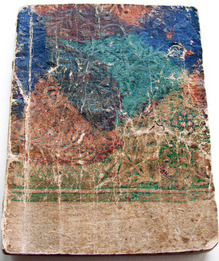
to 1000 copies in North America. The street date will be February 28th.” Ours came yesterday.

Tom Waits is releasing Seeds On Hard Ground in collaboration with his label Anti records to raise funds for homeless services in his region and to bring attention to a growing problem in today’s hard times. A book of photographs by Michael O’Brien and poetry by Waits entitled Hard Ground is scheduled for release later this year.
Tom Waits, Seeds on Hard Ground (San Francisco: X-Ray Book Co., 2011). Graphic Arts GAX 2011- in process

The Loss of the Whaling Brig William and Joseph

| No Comments
whaling2.jpg

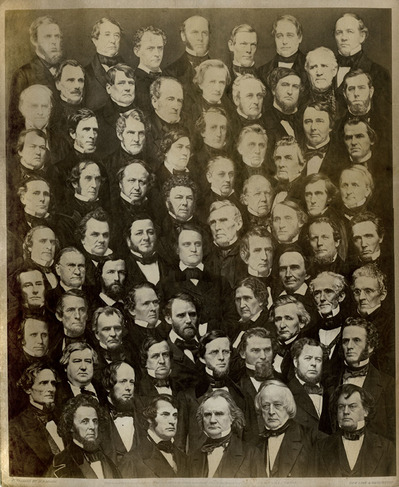
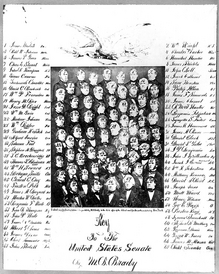
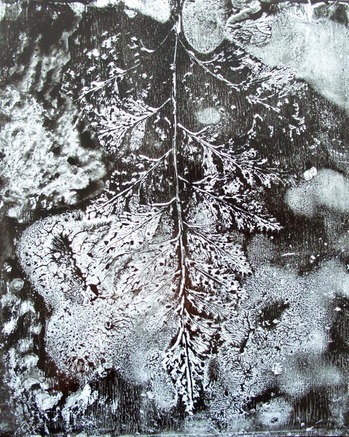
Elisha Dexter, Narrative of the Loss of Whaling Brig William and Joseph, of Martha’s Vineyard, and the Sufferings of Her Crew for Seven Days, a Part of the Time on a Raft in the Atlantic Ocean: with an appendix, containing some remarks on the whaling business, and descriptions of the mode of killing and taking care of whales: with plates descriptive of some of the principal scenes. 2nd ed. (Boston: Charles C. Mead, 1848). Graphic Arts GAX 2011- in process
whaling4.jpg

According to Dexter, the whaling brig William and Joseph departed Holmes’ Hole on August 2, 1840 in search of sperm whales. They stopped briefly at the Azores and Capre Verde islands before sailing to the West Indies, where they stopped to restock the ship.
In September 1841, the William and Joseph set sail for Boston with 200 barrels of oil. A month later, they were caught in a storm and the ship first capsized and, ten minutes later, righted itself but with significant damage. Over the next week two sailors died and the cargo was lost.


Elisha Dexter had a financial interest in the ship and published this narrative to recoup his losses. OCLC notes only one institutional copy of Dexter’s first edition and ten of the second, enlarged and improved edition. This acquisition will make it eleven.
whaling1.jpg
whaling3.jpg

Sea Monster Spotted 1795

| No Comments
seamonster2.jpg
seamonster.jpg
seamonster3.jpg

Wahre Beschreibung des Seewunders oder Wassermanns, der im letzten Herbst im Venetianischen Meerbusen auf der dalmatischen Küste sich gezeigt hat, und zur Verwunderung und fast Ensetzen von vielen tausend Meschen gesehen worden (Nachrichten aus Italien, 1796). Graphic Arts GAX 2011- in process

This news pamphlet, illustrated with a large woodcut of a merman, gives an account of a sea monster, who supposedly appeared off the coast of Dalmatia near the city of Ragusa, present day Dubrovnik, in October 1795. He was a giant with long flowing hair who walked out of the water and spent time roaming the coast, all the while screaming and gesticulating. He was said to have eaten several young boys.

See also The Merman’s Diversion [harlequinade manuscript] (England. ca. 1776]). Cotsen Children’s Library (CTSN) Manuscripts 23903

Stenography

| No Comments
shorthand2.jpg
“This curious Art will teach you to take down,
The great Affairs of Government and Crown.”

shorthand5.jpg
James Weston (1688-1751), Stenography Compleated, or The Art of Short-Hand Brought to Perfection; Being the Most Easy, Exact, Lineal, Speedy, and Legible Method Extant … (London: Printed for the author, 1727).

shorthand6.jpg
shorthand3.jpg

James Weston (1688-1751) was a London teacher and practitioner of stenography. He published four books, here together in one volume, presenting his own geometrical system of short-hand.

Weston assures the reader that with his system words “can be joined in every sentence, at least two, three, four, five, six, seven, or more words together in one without taking off ye pen, in ye twinkling of an eye, and that by the signs of the English moods, tenses, persons, particles, &c., never before invented.”

He goes on to say, “By this new method any, who can but tolerably write their names in roundhand, may with ease (by this book alone without any teacher) take down from ye speaker’s mouth, any sermon, speech, trial, play, &c, word by word, though they know nothing of Latin. And may likewise read one another’s writing distinctly be it ever so long after it is written. To perform these by any other short-hand method extant is utterly impossible as is evident from ye books themselves.”

Recent Comments

  • V.E.G.: James Franklin, Benjamin Franklin's half-brother is a direct descendant of read more
  • Bob Fleck: Nice comments and well worth it. read more
  • N. Sutherland: Do you have any further biographical material on this Thomas read more
  • john W: Have the complete collection of EA Seguy papillons including front read more
  • Vermathio: algarabia, charabia et Picabia. Le premier désigne la langue read more
  • Matt SCOVILL: I have the complete "bookplates in Japan" box. I am read more
  • Daniel Joseph Bobroff: April 30, 2013 To Princeton University: This is a Plaintiff read more
  • Ana Paula: Nice! I wish I could be there to enjoy it! read more
  • Nora Lin: What a shame! Those rooms were inspirational, not only on read more
  • pepesel: Why did they have to close it? That seems shortsighted. read more